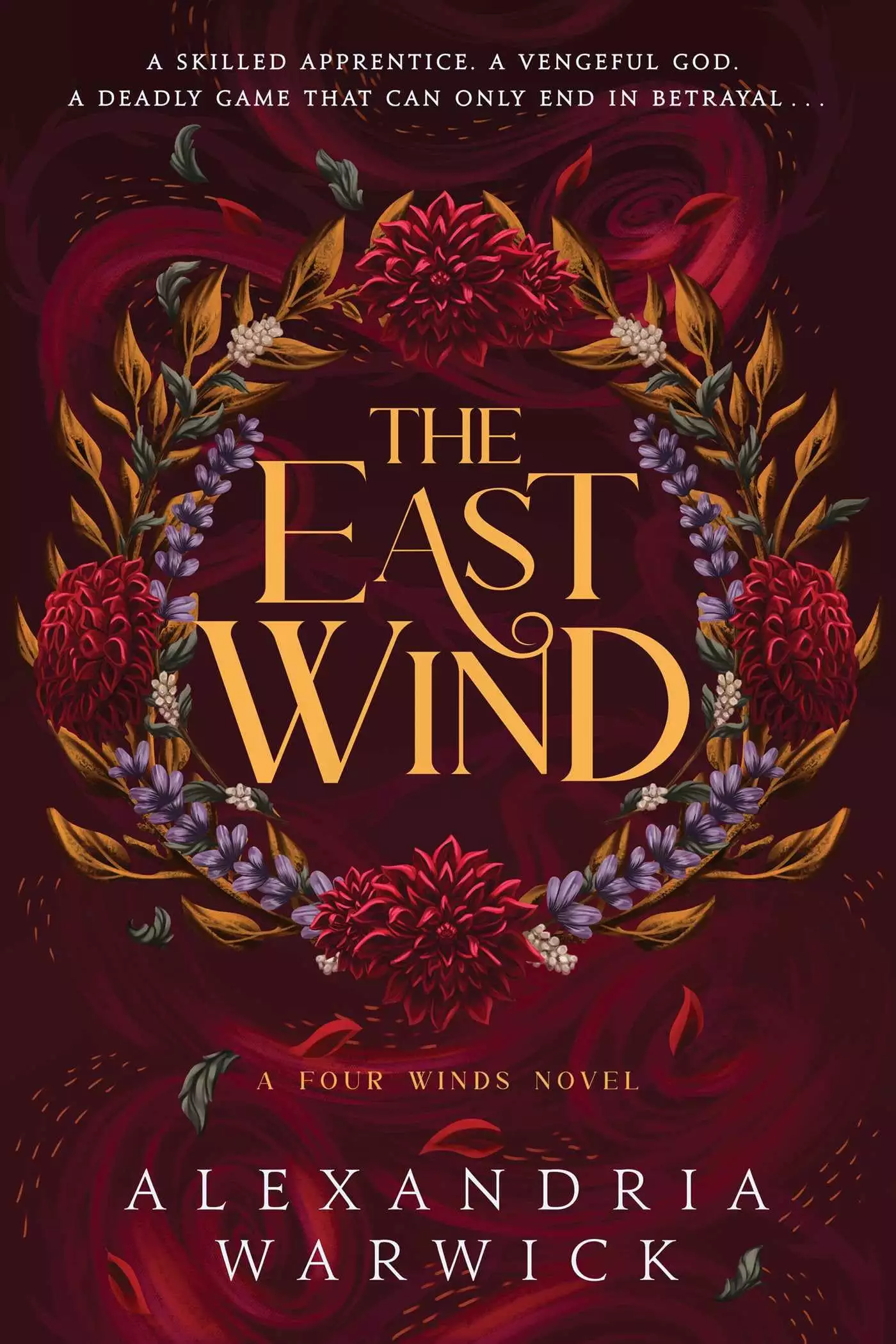
Rapunzel meets the myth of Psyche and Cupid in a stand-alone fantasy romance tale of love, survival and healing, as a mortal woman and a god unite to overcome deadly trials—and their own tortured pasts—in the climactic final installment of the Four Winds series.
Min of Marles is a skilled apprentice, assisting the town's apothecarist in brewing potions, tonics, and deadly poisons. High in the estate tower where she works, a powerful immortal is kept chained, tortured daily for information. His screams haunt her waking and dreaming hours. A god, she learns. The East Wind, Eurus, who commands the sea-born storms.
A hasty attempt to free him leads to Min’s own capture and forced employment to the East Wind as an aide to his grand plans for revenge. In the City of Gods, a tournament is held every thousand years, in which the winner may ask a favor from the esteemed Council of Gods. If Eurus wins, the council must reverse his banishment, the sentence that exiled him and his brothers to the mortal realms. But he requires a deadly poison to ensure that, once the favor is granted, the council will pay for his centuries long exile.
To earn her freedom, Min reluctantly assists in Eurus’s plans. As they work together to defeat the deadly trials, she realizes her relationship to the East Wind isn’t purely transactional. But if she ever wishes to return home, she must betray the god she loves.
For more stories from the world of the Four Winds, check out The North Wind, The West Wind, and The South Wind.
Release date:
January 13, 2026
Publisher:
S&S/Saga Press
Print pages:
352
* BingeBooks earns revenue from qualifying purchases as an Amazon Associate as well as from other retail partners.
I pause amidst chopping herbs. The spacious, stone-walled workshop at the rear of the estate coaxes forth the crumbling sound. Moments later, a second cry follows, a hoarse shriek of harrowing pain.
A thread of unease slinks through me, and I glance toward the narrow staircase where Lady Clarisse vanished hours before. The screams should not trouble me. They are frequent, expected, wrenched from all manner of prisoner my employer has confined in the cells below the estate. But these particular sounds arise from the northern tower. And the northern tower is seldom used.
I glance down at my unfinished work as the distant chapel bell tolls the eleventh hour. Today’s delivery must be made before noon. According to the bell, I am already behind.
Lover’s Dream, one of the apothecary’s most popular teas, begins with four parts golden ash to one part larkspore, followed by a sprinkling of sleeping grass. After combining the ingredients into the small pot of liquid boiling atop the stove, I set it aside to cool before shifting my attention to Bones of Stone: two parts oleander, one part white clay, two parts griffin saliva.
Recent illness sapped the village mason of his strength. He now requires something potent enough to grant him the ability to lift entire homes by himself. I work as quickly as I’m able to without slicing off my finger. The only thing Lady Clarisse loathes more than tardiness is incompetence.
The slap of footsteps reaches me, and I stiffen. From the corner of my eye, I watch my employer emerge from the stairwell and march gleefully toward a large metal basin tucked in the far corner. Her blood-spattered dress swings about her slender calves as she proceeds to wash the crimson from her hands.
“I assume, Min,” Lady Clarisse drawls without looking at me, “that the lack of chopping indicates your work is complete?” Water gushes from the metal pump, smacks against the brick floor surrounding the basin. Blood smears the hardened clay in red.
I resume slicing the oleander stems. A sticky white substance wells from the incision. Alone, it is toxic to mortals, but when mixed with griffin saliva, it is able to restore eyesight, grant incredible strength, and enhance healing, amongst other things.
“Lover’s Dream is ready for the final ingredient,” I say.
Lady Clarisse huffs with irritation, yet dries her hands and moves toward the locked cupboard, which I’m forbidden from accessing due to the prized nature of the contents held inside. After unlocking the door, she pulls a glass bottle and pipette from the shelf before squeezing two pearly drops into the cooling liquid. Lover’s Dream: a draught promising everlasting love. One part larkspore, four parts golden ash, a sprinkling of sleeping grass—and sea-nymph tears, procured between the hours of midnight and dawn.
Lady Clarisse is neither god nor saint, but she certainly acts like one. Lady Clarisse’s Apothecary supplies the villagers of St. Laurent with miracles daily. But to do so, she must twist an elixir’s elements until it becomes something else entirely, a form of dried, pressed, or distilled power that once belonged to those immortal beings.
For that is who occupies the cells belowground: immortals. She snags their hearts, peels the hard-as-diamond nails from their fingers, squirts the juices from their eyes. She steals their hair, flaxen and ebony and flame, makes brews from their blood, bottles their voices—whispers and confessions and pleas.
From these components, her ladyship crafts the most remarkable teas. She promises undying love, miraculous healings, impossible swiftness of the feet. But the brightest jewels are her timeless beauty teas, which repair all manner of damage to the face, including natural aging. Lady Clarisse appears just shy of her third decade, though only I know that she is well into her fifth.
As the steam clears from Lover’s Dream, her ladyship narrows her eyes. “What is this?”
My attention shifts to the cooling liquid. According to The Practice of Herbal Remedies, the brew should be a bright shade of violet, but the color is more akin to lavender.
I wipe my palms on the front of my apron. Breathe, Min. “We w-were out of sleeping grass,” I explain. “I substituted it f-for charred fennel—”
“What have I told you about substitutions?” she snarls.
Two, three, four heartbeats pass before I’m able to speak. “That you n-never w-w-want to see them in y-your presence.”
“So why have you ruined my tea with them?”
Generally, one may substitute sleeping grass with charred fennel without issue. “The Practice of Herbal Remedies s-states…”
Her ladyship’s milk-white skin curdles into a mottled shade of red. She snatches the frayed, self-bound manual from where it rests on the counter. “This?” she hisses. “This is what you are referring to?” She shakes it so hard a page tears free, and I inhale sharply, worried Nan’s old book will fall to pieces. Along with a cookbook and a religious tome depicting the deities of Jinsan, this is one of the few things Nan left to me.
“Let me remind you that you work for me now. So whatever that old woman taught you, banish it from your thoughts.” Lady Clarisse tosses the manual onto the worktable where I have set various herbs out to dry. I hurriedly shove it into my apron pocket. “The next time I see that stupid book,” she seethes, “I will throw it into the fire.”
I drop my gaze. “Y-yes, my lady.”
She shunts me aside to mix additional ingredients into Lover’s Dream, likely to fix my error. Briefly, she stirs a pot simmering on the back burner, an unidentifiable tea she has been nurturing for weeks now. “Fetch me breath-of-a-saint. And make haste.”
I stumble through the back door, down the sagging steps, to the garden at the rear of the estate. A chill wind bites at my stockings, and a whiff of salt-soaked air cuts through the bright crispness of autumn. The estate clings to the cliffside like a barnacle. Eastward lies the sea, though I avoid peering in that direction if I can help it. To the west, the beech trees bordering the property have begun to rust.
The garden is all snarling bramble and climbing weeds. A short, rotting fence surrounds the plots of vegetables and herbs. I bang at the gate until the latch unsticks. Nan would be horrified to see this level of neglect. Always, the land must be tended to, otherwise the Mother of Earth will not provide. Then again, Nan is long gone, only my memories a reminder of our time together. What I wouldn’t give to feel my grandmother’s embrace again.
I make a note to replace the gate latch before returning to the workshop with the requested cutting. Her ladyship is busy pouring dried herbs into a small woven bag stamped with the words: Lady Clarisse’s Apothecary.
“I will be heading into town shortly,” she says, her back to me. “I expect your work to be complete by the time I return.”
Not that it’s any of my business, but Lady Clarisse rarely ventures into town so late in the week. “Are there additional supplies you need? I’m happy to go in your stead.”
“This has nothing to do with inventory.” She snatches the breath-of-a-saint from my hand, tossing it into the pot. The tea’s lavender shade deepens to violet. “I’m meeting with someone about selling the estate.”
A low, incessant drone begins to flood my eardrums, not unlike a swarm of bees. “You’re s-selling the estate?”
“Yes.” She sounds positively charmed. Giddy, almost. “I’m tired of this dump. It’s too far from town, too expensive to maintain, and business suffers as a result. It’s time for something new.” Grabbing a small flask, she fills it with Lover’s Dream, then stoppers it. “Imagine: a shop on Market Street. No, two shops, a whole slew of them!” Her soft, girlish laugh tinkles the air. “I deserve this.”
Color bleeds hot across my pale cheeks. It feels as though her ladyship has taken a pitchfork and rammed it straight through my chest. What is left? A heart full of holes.
I love the estate dearly. How can I not? I’ve lived the last sixteen years of my life amongst its wild grounds. Nan took me in—a young girl of six—when my mother failed to care for me. I’ve lived here ever since.
“I don’t understand,” I croak. “How will y-y-you—”
“What have I told you about your incoherency? Speak clearly, or do not speak at all.”
I swallow down all the mangled bits and fractured words. “How—” I pause. “How w-will you find enough land to grow everything required for the business? Moving into town means higher property taxes, l-less space, and—”
My employer whirls around, regarding me with familiar disdain. “When I want your opinion, Min, I will ask for it.”
I fall mute. Lady Clarisse’s name may be marked upon the deed to the estate, but she does not love this place as I do. To her, the narrow stairs are a nuisance. The kitchen is cramped, outdated. She despises the wallpaper, yet has never made an effort to replace it.
The estate is not perfect, but it is home. It is here I first learned to create teas, a child standing only as tall as Nan’s hip. My grandmother loved the land, loved the character of the warped floorboards and creaking beams, though both the landscape and architecture of St. Laurent differed greatly from her homeland. Following Nan’s passing, Lady Clarisse was kind enough to allow me to stay on as an employee, after having bought the estate in a private sale. If it is sold, I will lose Nan’s crushed ginger fragrance, which still lingers in certain rooms. I will lose, too, those memories of belonging, of Nan. “My lady—”
“Come here, Min.”
My pulse scatters, a wild-eyed beat bruising my sternum. Head bowed, I shuffle across the room, skirting the small woodfire stove.
Selecting a flower stalk from a nearby vase, she holds it up for my perusal. “Identify.”
How can she expect me to focus after informing me I will lose my home? I try to concentrate on the flower, its spherical head. “Handmaiden’s basket.”
She dips her chin in satisfaction. “Uses?”
“It is a natural blood thinner. When picked after the frost, the petals may be used as a temporary stimulant.”
“And?”
Was there a third use? Not that I can recall. I have scoured The Practice of Herbal Remedies and committed its instructions to memory. There is no third use, which means this is a test.
“There is none,” I state firmly. Only when she returns the bloom to the vase do my lungs loosen.
“Adequate,” she says, though the curtness with which she speaks suggests otherwise. “But tell me, what do you get when you combine handmaiden’s basket with three wings from the sand dusk moth?”
A decade I have worked for her ladyship, yet I am still no more than a lowly apprentice despite my twenty-two years of age. She does not trust me to handle the immortal-born ingredients, secured always under lock and key. She believes me incompetent. At this rate, I will never become a full-fledged bane weaver. “I don’t know,” I whisper.
“Of course you don’t.” Pityingly, she smiles. “I see this is too complex for you, but I suppose I should not be surprised. Some of us are destined for greatness. Others, unfortunately, are only fit for chopping herbs.”
My tongue falls slack behind my teeth. She is correct. Someone needs to chop herbs—and I am adequate at the job.
Lady Clarisse shifts her focus elsewhere, much to my relief. “I’ll need you to bring the prisoner in the northern tower his meal while I’m out,” she states, snagging her sweater from the wall hook and shrugging it on. “Can I trust you to do this properly?”
I straighten in surprise. Each day, I bring meals to the prisoners in the cells below. Never this one. Never the northern tower. “Yes, my lady.”
Satisfied, her ladyship brushes past me. She has nearly reached the front door when my foolhardy tongue decides to expose itself. “Are y-you sure this is the best w-way to go about things?”
She halts in place, spine rigid. “Excuse me?” Slowly, she turns to face me, strands of her black tresses pulling free of the low tail hanging down her back.
My fingers clamp the rough cotton of my apron. I force them to loosen, though I cannot mask their trembling. “The prisoner.” I lick my lips. “It’s b-b-been three months since he w-was captured. If you have b-been unable to glean whatever information you n-need from h-him, might it be possible that he doesn’t kn-kn-know anything?”
The vacuity of her expression is one I know well. I have irked her, or made a nuisance of myself, or both. “And what makes you think you have the authority to question my work?”
I drop my eyes. “I apologize, m-my lady. I did not mean to imply th-that I have authority over anything.” All of it, every hoarsened word, uttered in a breathless rush. “I am only concerned that th-th-these attempts will lead to d-disappointment, and I would not want your efforts to go to w-waste.”
Breath held, I peer upward through my eyelashes. With pursed lips, her ladyship wanders nearer, considering what I have said.
Luckily, she is lenient this morning. “Worry not. The faster you can make what I require, the quicker I obtain what I need from the prisoner.” She pats my arm with all the compassion of a venomous snake. “I know it might be difficult for you, Min, but surely even the least intelligent people can manage to harvest a sprig of mint.” She shoves me toward the table, where the dented metal tray used for serving meals rests. “Now make haste. Oh, and mix two spoonfuls of Nightmare’s Blood into the soup before serving it to him. The potion is finally ready.”
I stare at my employer with thinly veiled shock. Nightmare’s Blood?
“Is there a problem?” she demands.
“N-no, my lady.” My gaze lowers to the floorboards beneath my scuffed loafers. The floor is safe, always safe. I stare until her footsteps recede, and I am alone.
Nightmare’s Blood. What a vicious brew. In essence, it bleeds one’s mind of clarity, casts a veil across their senses so that the line between waking and dreaming is blurred. Such vulnerability will allow her ladyship to wring whatever information she seeks from the prisoner. Three months she has tortured this man. But he has yet to break.
The thought of administering this poison chills my blood, but the power to decide does not belong to me. I cannot change what is. I must eat, sleep, make a living. I must carve out a life, same as all the rest. The last thing I want is to attract Lady Clarisse’s wrath. She favors the lash, amongst other cruelties. But I see myself in this man, as I do in all the prisoners. It would be a comfort to receive kindness, however reluctantly given.
After gathering the prisoner’s soup—potatoes in bone broth—I squeeze two drops of Nightmare’s Blood into the meal, as instructed. The scent of crushed cherries unfurls as the liquid blackens. Two heartbeats later, it lightens to its normal hue.
Six hundred and forty-four stairs carry me up the long, spiraling throat to the northern tower. When the solid steel door at last flickers into view beneath the lone torch set into the wall bracket, I slow, halting a few steps below the landing.
The cells buried in the belly of the estate are barred in iron, with narrow holes cut into the upper walls, which allow the glow of sun and moon to pierce the gloom. The northern tower is different. It is singular, its isolated chamber offering neither window nor light. As such, the prisoner has spent three months in darkness. If he was separated from the rest, he must be powerful indeed.
Warily, I step onto the landing, whose window offers a view of the realm beyond: the sea, the cliffs, over which the tower juts. My fingers tighten around the tray of food pressed against my belly. A sound, heavily muted, comes from behind the steel door. As I strain my ears, it comes again. Metal. It sounds like a heavy chain being dragged across the stone floor.
The knots within me tangle further. My task is simple: push the tray through the slot located at the bottom of the door.
“Walk away,” I whisper. Easy, to do what is expected of me.
Instead, I slip my hand into the pocket of my apron.
Only one universal antidote exists: Winter’s Sunrise. It requires no less than six weeks of steeping, the water continually refilled as its three components—pumpkin seeds, sweet mint, and the hair of a demon—break down into a paste. As a precaution, I always carry a small vial with me, for exposure to poisons carries significant risk.
I am moving before my mind has the opportunity to deter me. Pulling free the stopper, I pour three drops of the antidote into the man’s soup, watching as it disperses. Then I shove the tray through the slot in the door and flee down the stairs as though death itself is in pursuit.
We hope you are enjoying the book so far. To continue reading...

 Please log in to recommend or discuss...
