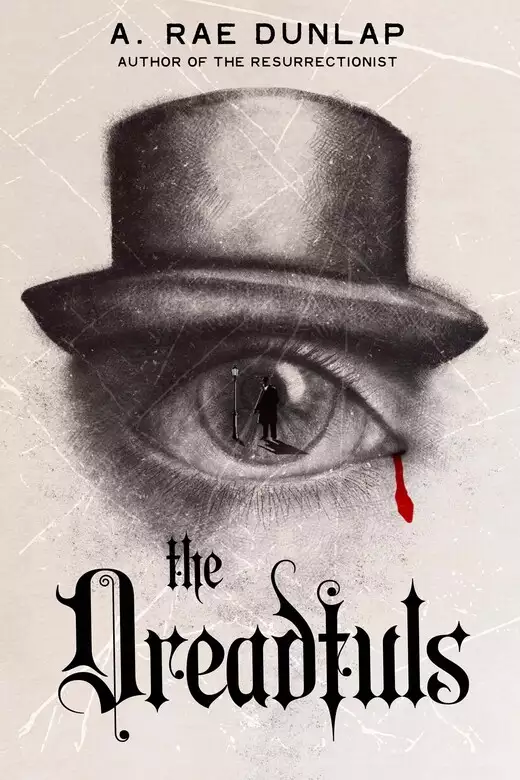
The darkly atmospheric and gruesome tale of Jack the Ripper unfolds against the backdrop of a Victorian London reform school, as a young inmate sets out to find the identity of the elusive serial killer in a riveting new book perfect for fans of The Square of Sevens and Enola Holmes.
London, 1888. Committed to the Whitechapel Hall Reform School for “incurable delinquency” Adelaide “Dell” Morton is a precocious, defiant misfit. She’s also a voracious reader of true crime and detective fiction, including the sordid, sensationally popular Penny dreadful stories. In an unlikely stroke of luck, she’s found a kindred spirit in her poised, perfectionist roommate, Pippa. Their obsession is only further fueled by the Jack the Ripper murders blazing a trail of terror throughout London’s seediest streets . . . right outside Whitechapel Hall’s front door.
Desperate for adventure, they embark on their own investigation—and discover an ally in Noah, son of the local butcher. But Noah’s motives are not mere fascination: His father is the prime suspect. Noah is desperate to clear his name, and Dell and Pippa are only too eager to help.
Their budding spywork soon yields shocking results: they witness straightlaced Whitechapel teacher Miss Kaye escaping the school the night of the latest crime. Could Jack the Ripper be a she? Delving into Miss Kaye’s background, Dell is both horrified and thrilled to find that within Miss Kaye’s past lies a chapter dark enough to rival any Penny dreadful . . .
Dell’s fixation with Miss Kaye reaches dangerous heights while a series of suspicious events leave Miss Kaye in sole command of Whitechapel Hall. Trapped in their teacher’s ever-tightening web of control, the three devious detectives devise a risky plan to track her. But what ensues may only propel them ever deeper into secrets, lies, ruthless acts, and betrayals that go back decades—and a confrontation that will irrevocably change the fates of all involved . . . if they survive.
Release date:
March 31, 2026
Publisher:
Kensington Books
Print pages:
352
* BingeBooks earns revenue from qualifying purchases as an Amazon Associate as well as from other retail partners.
If the world had the decency to display any sense of romanticism, the Whitechapel Hall Reformatory School ought to have been the most dismal place into which I ever stepped foot. The solemn tones of the grand clock perched above the imposing structure would announce my arrival, piercing the misty air. And once I crossed the threshold of the heralded institution, a hailstorm should burst over the city, pelting the windows of the Hall with remarkable intensity. The ferocity of the storm would be punctuated with wild flashes of flame-blue lightning, illuminating every colour with terrible distinctness, turning the hearts of the Hall’s inhabitants icy with creeping dread. Claps of thunder reverberating down the dark and gloomy corridors would echo through abandoned vaults and hidden passageways, conjuring the souls of the dead long forgotten, and somewhere deep below (in an ancient dungeon, perhaps?), the rattle of chains would rise up in a ghostly chorus.
But because the world has no such romantic notions, the weather remained belligerently pleasant as my aunt and I were escorted from the grand entryway of the Hall immediately upon our arrival. My heart sank as we were bustled through bright, pristine corridors, the air within them devoid of mildew and decay, instead laced with a heavy undertone of carbolic soap. Beams of brilliant sunlight poured through the polished windows, and it was with an air of utter despair that I discovered the headmaster’s office was no better: like the rest of the school, it was scrubbed spotless and flooded with light, giving the room a distinct air of cheerfulness that I detested with every fibre of my soul.
At least our initial sojourn into the Whitechapel district had been appropriately dismal. The streets were filthy, lined with urchins and beggars, and (much to my delight) we’d been forced to step over the corpse of a disembowelled rat lying upon the staircase of the very institution to which I’d been committed. My aunt’s already-pale face had visibly blanched, and for a moment, I was filled with hope that my most macabre delights might manifest at last.
Sadly, it was not to be. For apparently within the walls of the Whitechapel Hall Reformatory School, no credence was given to gothic fancy, and instead the place appeared to be governed with the ruthless fist of modern propriety.
It was utterly hateful.
We awaited the headmaster’s arrival in stony silence, and I hazarded a glance at my aunt’s face, seeking any semblance of comfort there. Seated beside me in serene stoicism, her expression was, as always, unreadable. Even after four years of living as her ward, it was still unfathomable to me that she was my mother’s twin. My sunny, boisterous mother, with her shock of auburn hair and honey-hued skin, whose whole persona radiated the glowing warmth of her childhood in far-off Australia, whose voice still carried the singsong accent of her homeland; who’d always seemed so out of place on the dour grey moors of Somerset (where I’d passed my own childhood in her loving care) that she’d seemed a creature from another world entirely.
How was it possible that hers was the same blood as my aunt, who had so completely conformed to contemporary London standards that her well-coiffed hair, ash-pale skin, and tack-sharp accent would never betray a hint of her wild girlhood abroad? And how could it be that my mother’s heart, so bursting with love and affection, had stilled, while my aunt’s, which appeared to be fuelled purely out of hardened spite, resolutely soldiered on?
Emotion rose in my chest at the thought. I suppressed it and averted my eyes from my aunt’s profile before I could allow myself to continue down a treacherous path of maudlin self-pity at my loss.
Not a moment too soon, the office door swung open and two imposing figures strode into the room, each clad head-to-toe in black. My aunt sprang to her feet and nearly upset her own chair in her haste to turn and offer them a curtsy. I bit back a laugh at her tiresome decorum as I slowly rose to offer my new wardens a considerably more reluctant greeting, scarcely bending at the knee.
“Mrs. Atkins, I assume?” The elder and taller of the two men offered a generous bow and friendly smile in my aunt’s direction, the corners of his eyes wrinkling in what I could only assume was manufactured fondness. After all, what reason would this old man have to display graciousness to the family of his prisoner? His genteel demeanour was greatly disappointing, as I’d been expecting a considerably more villainous captor against which to test my wits.
“I’m Headmaster Graves, the director of this fine institution, and this is my esteemed associate, Reverend Barnett.” The balding man in vicar’s attire with a humourously voluptuous beard extended a bow of his own, but to my relief, he did not smile, and his eyes remained cold. Perhaps a worthy adversary.
“A pleasure to meet you, gentlemen.”
Graves turned his trite hospitality towards me. “And this must be Miss Adelaide Morton! We’ve heard so much about you, my dear.” He diplomatically neglected to mention that any advance knowledge he had was extracted from a police report, and the old version of me would have been quick to point this out. But careless obstinance had gotten me into this mess, and I was determined to suppress any outbursts that might alert my captors to the danger of my true nature. It was imperative to my plan.
“The pleasure is mine, sir.” I ignored the suspicious look on my aunt’s face at my uncharacteristic display of civility.
“Please, ladies, do have a seat.” With a wave, he ushered us into our chairs, and he and the vicar took their places at the opposite side of the ornate desk dominating the room.
“Now, Miss Morton, it’s my understanding that we will be graced with the pleasure of your company for the next nine months.” Headmaster Graves gazed down at me with a neutral expression upon his face.
So says the judge, I internally retorted but managed to curtail my response to an unobjectionable nod.
“Do tell me, young lady,” he continued with an infuriating air of faux familiarity, as though we were making conversation over afternoon tea. “What brings you here?”
“A court order, sir.” As if there were any other reason I would subject myself to this drudgery.
He nodded, a falsified expression of concern overtaking his visage. “For what offence?”
“Stealing.”
“Stealing what, dear?”
“Please, Headmaster, she—” my aunt attempted to interject, but she was immediately silenced by a wave of Graves’s hand.
“Mrs. Atkins, it is important to us that our pupils take responsibility for their actions; it is the first step towards moral repair. So, tell me, Miss Morton: What brings you here?”
I took a deep breath and let the words flow freely. After all, I had nothing of which to be ashamed. “My uncle burned all my books and wouldn’t give me money for new ones, so I went out and stole some.”
Graves raised an eyebrow. “And why did your uncle burn your books?”
I blinked back at him. Because he resents the fact that my parents died and left me as his legal ward and takes every opportunity to remind me that my presence is unwelcome. But I couldn’t say such words aloud to be mistaken for a prized pupil eager for reform.
“Because he … didn’t like them.”
“Please, Headmaster, that is hardly the whole of it,” my aunt rudely interjected. “In the last four years, my niece has gone from obstinate to uncontrollable. She answers to no one but herself and seeks nothing but indulgence and self-gratification. She scared off no fewer than three governesses with her macabre fascinations, and when we enrolled her at boarding school, she escaped six times in as many months, resulting in her expulsion. She’s brought dishonour upon our household more times than I can count, and it’s only by the grace of my husband’s connections that her latest foray was kept from the papers! We’ve done everything we can, but nothing helps. We’re at our wits’ end.”
Graves held up a hand, stilling my aunt’s airing of grievances at once. “I understand, of course. Her story is not so unlike that of many of our other pupils. Did this all begin with the death of her parents?”
My aunt shook her head vigorously. “Hardly, Headmaster. I regret that the seeds of her moral depravity were planted by none other than her own father and recklessly indulged by my sister. Throughout her childhood, they exposed her to terrible things in the books she read, even as they poisoned her mind. And instead of stopping her, her parents outright encouraged her in these endeavours!”
Graves furrowed his brow. “What sorts of things was she reading?”
My aunt sighed deeply, as if admitting to some cardinal sin. “She began with the penny books they sell on the street—full of filth and delinquency. From there, it was crime broadsides, news of robbery, murder, vice, and perversion, the depths of which I shudder to imagine. When she became our ward, we tried to keep her away from them, but it was like a disease! She cannot help herself, Headmaster, for her constitution has been so affected by prolonged exposure that she can no longer tell right from wrong. It is a moral failing.”
“My dear lady, say no more.” It was the first time Reverend Barnett had spoken, and his voice was cold, deep, and commanding. “Your niece is not the first to fall victim to the depravity of this literature, and I can assure you, we are all too familiar with her affliction.”
My aunt looked flabbergasted. “You are?”
“Of course.” The Reverend narrowed his eyes at me, as if he could appraise my condition by the countenance of my face. “An eager perusal of these penny packets of poison destroys all sense of virtue. The habit of receiving pleasures without any exertion of thought, by the mere excitement of curiosity and sensibility, may be justly ranked among the worst effects of habitual novel reading. It tends to inflame the passions, pollute the imagination, and corrupt the heart.”
My aunt nodded eagerly, apparently enthralled by her kindred spirit. “Precisely, Reverend!”
“Why, just last year two young boys murdered their own parents under the influence of these penny books!”
My aunt clasped her chest and uttered a gasp of despair. (Meanwhile, I made a mental note to attempt to find more details on this crime, as it sounded frankly enthralling. Had they used poison? Or even an axe, perhaps? How positively wicked!)
The Reverend continued his diatribe, whipping himself into such a frenzy of over-dramatics that it was rather uncomfortable to behold. “Not that I’m implying your life is in danger, my dear woman. But you may rest assured that your niece has come to our institution just in the nick of time! For even if you had weaned her off her dependence, the individual always suffers cravings of former excitement. Within these walls, we can ensure that any such temptation is eradicated before she is returned to your diligent care.”
Graves nodded in enthusiastic consent. “Whitechapel Hall is unrivalled in our rate of rehabilitation, and you are fortunate the court has entrusted your niece to us. I can assure you she will be in safe hands.”
For a moment, my aunt hesitated. “Forgive me, gentlemen, but you must understand that despite my desperation, Whitechapel does not seem the place in which vices are eradicated. Why, just on our way here we were exposed to the vilest conditions imaginable! How do you endeavour to rehabilitate your wards in such surroundings?”
To my surprise, the Reverend broke into a wide grin. “Mrs. Atkins, your mind is of a most measured temperament, and we understand your concern. But Whitechapel Hall excels at moral rehabilitation because of its location, not despite it! Under my tutelage, we have developed a groundbreaking programme for Morality and Temperance Outreach. The pupils are exposed daily to the conditions of the neighbourhood as a warning of what will befall them should they stray from the path of righteousness. It is through this exposure that they learn to reject vice and embrace their position in society as ambassadors of virtue and good will!”
It took every ounce of restraint I possessed not to roll my eyes at the thought of being an ‘ambassador of virtue.’ I would rather end up dressed in rags begging in a gutter than capitulate to such nonsense. My aunt, however, looked much relieved at the prospect.
Before I could be tempted to object, there were three sharp raps at the office door, and it swung open to reveal a dour-looking woman with brassy-coloured pin-straight hair pulled into such a severe knot that it gave her face a distinctly taut, shrew-like form. Her dark eyes fell on me from beneath hooded lids, and her very gaze caused me to shiver in my seat.
“What perfect timing! Mrs. Atkins, Miss Morton, I’m delighted to introduce you to Miss Kaye, our venerable Religion and Morality teacher and house mother to our girls. She’ll be escorting Miss Morton about the school until she gets her bearings.”
The woman bobbed briefly in a stilted approximation of a curtsy, still staring at me with such intensity that I knew not how to react.
“A pleasure, Miss Kaye,” my aunt chirruped cheerfully from beside me.
“I assure you, madam, the pleasure will be all mine.” The tone of her words rattled me. Though innocuous in content, her delivery, spoken in a low, dangerous tone, hinted at much darker intent. She looked fully capable of enacting violent torture upon her wards or perhaps transfiguring into a rat to spy on them … At last, I thought. I have found my villain!
Miss Kaye wasted no time. Within moments, I was whisked from the headmaster’s office without the opportunity to bid my aunt adieu. Not that I minded; it was rather thrilling to have a proper adversary upon which to focus my attention, and Miss Kaye rose to the challenge brilliantly. She gruffly paraded me from one end of the school to the other, barking out points of interest in a sharp staccato timbre that made me speculate she was about to drag me by the ear like a spoiled child.
“Kitchen. Bakehouse. Laundry. Dining. Daily chapel that way.” I chased the hem of her skirt up a gleaming rounded staircase as she proceeded down the whitewashed hallway.
“These are the classrooms. You’ll be at the end there with the rest of the girls your age.” She gestured brusquely towards a closed oak door at the far end of the corridor. “Religion, needlework, and daily domesticity will be practised here in the afternoon. Mornings are devoted to work.”
I paused, falling behind her unrelenting pace. “And what about academics?”
She turned, her facial expression displaying a distinct air of chagrin. “Academics?”
I floundered. “You know … reading? Mathematics? … French?”
“Miss Morton, are you under the impression that you are attending an academic institution?”
Her words caught me off guard. “I … No, not exactly, but surely we are at least encouraged to read—”
“You will read the Bible and appropriate articles on our moral duties as Christian women. That is the policy of this school.”
I was gobsmacked. “But … Not even poetry?”
Miss Kaye narrowed her eyes, then turned on her heel and stalked haughtily down the hall before taking an abrupt left at yet another staircase, this one far narrower than the first, lecturing all the while.
“Miss Morton, this is a reformatory institution. The educators here are not your childhood governess. In the Hall, you will learn exemplary morals, the value of hard work, and the domestic skills with which you may obtain respectable employment following your sojourn here. That is all. Nothing more.”
It dawned on me for the first time that this was indeed my aunt’s plan all along: She and my uncle had no intention of supporting me into adulthood. I was to be abandoned to this institution and then left to fend for myself as a domestic servant, of all things!
But then I paused, a savage retort dying on my tongue. After all, wasn’t this the way of it? It was the sad fortune of every heroine in my beloved penny bloods to be up against such odds. Just as they did, it would be up to me and my wits to escape this terrible fate, make my way in the world through sheer will and courage, and of course, eventually claim my rightful inheritance, which surely had been hidden by my scheming relatives.
In that case, I reasoned, this setback was simply all part of the plot. I must simply remain calm, composed, and compliant.
Until such a time that I was not.
We reached the top of the staircase and passed through a large, open chamber lined with two long rows of wrought-iron beds, each neatly made in simple white linens.
“This is the Girls Dormitory, but sadly, we are at capacity. As such, the headmaster has instructed that you shall temporarily reside in the annex. This way.” I tore my gaze from the bleak lodgings to see Miss Kaye disappear around a bend at the far end of the hall. Hastening my gait, my heart leapt into my throat as I watched her ascend a twisted iron staircase so steep it was nearly a ladder.
Could it be that at last my romantic notions had come to fruition? Was I truly fortunate enough to be locked away in a dismal tower, isolated from my peers, left alone to scheme upon my escape in precious solitude? I was breathless and flushed with excitement (and frankly, the exertion of the climb) as I ascended into what appeared to be an ancient belfry, and to my deepest satisfaction, the space was gloriously gloomy.
The belfry had none of the fashionable modernity of the lower floors. In lieu of the polished tiles and gleaming marble below, the floor here consisted of dangerously rotting wood. The windows were small and opaque, the glass smoky with a layer of grime that cast a woeful vignette upon the drab view. The vaulted beams supported walls of crumbling brick that held up a decrepit roof thirty feet overhead, and I could distinctly make out a few patches of sunlight creeping through where the structure had given way to the elements. In the mild weather of the day the space was merely devoid of charm, but I imagined as soon as we were blessed with rain the tableau would be wonderfully bleak and draughty indeed.
It was perfect.
No sooner had the thought crossed my mind than a voice from over my shoulder startled me nearly out of my wits.
“Miss Kaye?”
Miss Kaye turned, and I followed her eyes to a figure emerging from the deep shadows at the far end of the tower. For an instant, the juxtaposition of light and dark was too strong for me to find shape to the form, but everything changed the moment it stepped into a strong beam of sunshine projecting from a crack in the rafters far above, and in that instant, I was struck breathless.
It had never occurred to me until that moment that the distressed damsels exalted in the pages of my penny books might be reflections of true persons, for they were simply too beautiful, too innocent, too pure to exist in a world as mundane as ours. Yet here before me stood a girl so dazzling in her perfection that my vision swam in the angelic glow emanating from her radiant visage.
She resembled a fragile flower, her white-blonde hair a halo crowning a face that would have formed a study for the rarest sculptor that ever Providence gave genius to. Long, silken lashes cast pallid shadows upon her impeccable cheeks as eyes of celestial blue laced with inquisitiveness peered at me, an intruder in her sanctuary. She would make an exquisite victim for the dastardly vampire that stalked the pages of my serials.
“Ah, Miss Fitzroy, there you are. I present to you Miss Morton, our newest boarder. Miss Adelaide Morton, this is Miss Philippa Fitzroy. You two will be sharing the annex until such a time that beds become available in the dormitory. Miss Morton, the staff will be assembling a bed and delivering your belongings after supper. Miss Fitzroy, I shall entrust you with Miss Morton’s timeliness until she becomes familiar with our schedule.”
“Yes, Miss Kaye.” She curtsied with the grace of an angel, and I recoiled at her meek disposition. Was she not incensed to have her private sanctum invaded by a total stranger? I would have been irate at such an imposition were I in her place.
“Very well. Miss Morton, Miss Fitzroy is an exemplary pupil. With her guidance, I have no doubt that you will thrive here at Whitechapel Hall.” And with that, she turned and receded down the stair.
A ringing silence ensued. Miss Fitzroy blinked at me, apparently taking stock of her new charge.
I glared back. It would seem I was not fated to be the solitary heroine locked in the tower, as this tower was already occupied by an infinitely more sympathetic character, one whose beauty and manner eclipsed the whole of my own in every conceivable way. I couldn’t believe my misfortune; how dare this lump of saccharine piety usurp my narrative?
Miss Fitzroy offered me a smile that was perhaps intended to be welcoming, but her placid willingness to accept my presence unchallenged irritated me deeply. “You can call me Pippa for short,” she offered in her sweet singsong voice.
I narrowed my eyes. “Dell.”
“Oh, lovely! But your full name, Adelaide—is that like the place in Australia? I read a book about it once. It was fascinating: gold mines and cowboys and kangaroos!”
“Yes.”
Her prim hand rose to her lips with excitement. “Really? Is that where you’re from?”
“No. My mother was born there. But her family came to London when she was a young woman.” It struck me then for the first time that I was now the same age my mother had been when she came to England. In my childhood, her adventure had always seemed that of a mature woman, whereas I currently felt adulthood to be a world away from my trappings.
“Oh.” To my satisfaction, Pippa looked visibly disappointed, but sadly this affliction was short-lived. “Well, at least you must know some wonderful stories about it!” Her assumption that I would be willing to share these stories only irked me further. Was she truly so delusional as to think we’d become bosom friends?
“Not really.”
“Oh.”
At least that shut her up. Another silence stretched out between us, and I revelled in it. After all, the more I could make her dislike me, the more urgently she would aspire to vacate the annex and leave me alone to do my plotting.
An idea came to me at once. “Have you heard of Blue Cap?”
A delicate crease appeared between Pippa’s eyebrows. “Why, no! Who is he?”
I bit back a smile, recalling a recent edition of Blue Cap the Bushranger. “Oh, just one of my favourite Australian heroes. He ran the most fearsome gang in all of New South Wales, robbing hotels and taverns and the like, and having shootouts with police.”
“He sounds fearsome.”
I shrugged. “As highwaymen go, he was the worst of them. Rumour has it I’m related to him.” Her eyes widened ever so slightly at this improvised flight of fancy. “Sadly, he was chased down by the law and died stranded in the outback, mummified by the blazing sun, eyes plucked out by vultures and guts devoured by dingoes.”
Pippa recoiled. “That’s disgusting.”
“It’s my greatest aspiration to one day return and find his body, give my dear old granduncle a proper burial …” I gazed wistfully into the distance, as if transfixed by the thought. Pippa opened and closed her mouth a few times, but to my supreme satisfaction, I had struck her speechless.
Just then, a shrill clang emanated from the floor below, and we both jumped.
“Well.” Pippa averted her gaze and smoothed the nonexistent wrinkles from the front of her frock. “That’ll be the bell for supper. Follow me.” She marched to the stair and descended into the hall below. It would seem my story had repelled her enough to scorn any notions of a burgeoning friendship between us, much to my relief.
Pippa was an unfortunate obstacle to be overcome, for without her, my placement in the annex would be an incredible stroke of luck. If I could evict her from the space, I would have hours of unsupervised freedom with which to plan my getaway. For my mission at Whitechapel Hall was hardly simple: I would not, as I had at boarding school, give in to flights of fancy and make hasty, ill-advised attempts at escape.
This time would be different: I was a child no longer, and nothing in my new circumstances would allow for the hare-brained half-measures I’d employed before, leaping out of unlocked windows or recklessly bolting towards every open door. This time, I would follow in the footsteps of my penny blood heroines: I would of course apply courage and cunning, but above all, I would apply patience. I would earn the absolute trust of those around me, until I’d had time to perfect my scheme. My willing compliance was to be my great disguise.
I would escape Whitechapel Hall by a method and means yet to be determined. Once outside, I would stow away aboard a train bound for Portsmouth. There, I would use my wits and wiles to gain passage to Australia, where I would join the police force as their first-ever lady detective, using all I had learned in my so-called penny packets of poison to solve the most heinous crimes in the territory. Acclaim, fame, and fortune all awaited me, and I could hardly wait to get started!
But wait I must. I would be clever. Cautious. And above all, patient.
With an air of grim determination, I dutifully followed Pippa down the stairs.
We arrived to find the dining hall already near capacity, with six long tables arranged in the shape of a horseshoe around a lectern. The hall was oddly silent, devoid of the chatter I’d expect from the clusters of girls diligently taking their place in accordance with some invisible seating chart to which I was not privy. It was with a twinge of resentment that I found myself anchored at Pippa’s heels, chasing her ice-pale plait through the throngs of identical black frocks and lace collars until we came to two vacant chairs at the far end of the table closest to the lectern. Pippa came to stand stiffly behind one, and with a curt nod of her head, I took my place beside her.
The hu. . .
We hope you are enjoying the book so far. To continue reading...

 Please log in to recommend or discuss...
