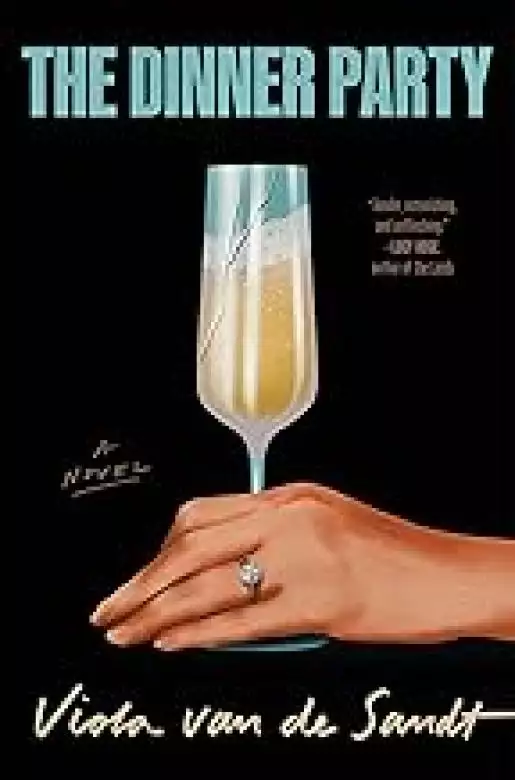
For fans of Cleopatra and Frankenstein and Assembly, an intimate and darkly propulsive story told over the course of a dinner party, from its careful preparation through its explosive, irrevocable finish, about the tensions of love and autonomy, grief and female rage, and the surprising moments when they come crashing to the surface.
Franca left the Netherlands behind to start her new life in England with Andrew. Andrew, whose parents lived in South Kensington but had a flat their son could “borrow” nearby. Andrew, an old-fashioned British gentleman who encourages her not to work but to instead focus on her writing. Andrew who suggests a dinner party with his colleagues to celebrate their big upcoming launch.
A dinner party that Franca must plan and shop and cook and clean for. A dinner party during a heatwave when the fridge breaks, alcohol replaces water, and an unexpected guest joins their ranks, upending the careful balance between everything Franca once was and now is…
Expertly weaving the past and present with precision and delicious tension, The Dinner Party is a thoughtful and thought-provoking look at female rage, body autonomy, and all the concessions women make throughout their lives—big and small—until the surprising moment when they decide they can make them no longer.
Release date:
November 4, 2025
Publisher:
Little, Brown and Company
Print pages:
304
* BingeBooks earns revenue from qualifying purchases as an Amazon Associate as well as from other retail partners.
Stella says I should write a letter. It can be addressed to her, or to no one in particular, or perhaps to a friend. Someone I trust. Do I have anyone like that?
I don’t have to post it. I can write this letter to myself. It doesn’t have to be read. These words are mine, she says. She says it will help. Acknowledging what happened, describing it in as much detail as I can, trying to remember instead of pushing it all away. Stella thinks it will guide me in my recovery.
I say I have nothing to recover from. She disagrees, and lists the facts as she knows them, written down in the file she brings out every time we meet. Everything that happened that night, in black and white, read out dispassionately, things I remember and things I don’t. They’re not at all a reflection of how it felt, what went on before it, why I did what I did. Facts don’t come into it.
Her request takes me by surprise. I didn’t think she’d get into all this after just three weeks. She’d said we’d spend our first few sessions getting to know each other. I still hardly know anything about her.
I don’t know how to begin, I admit. She says begin at the beginning, but I tell her that’s stupid. There’s never any real beginning, unless I’m to go back to my birth, or better yet, the birth of my parents, their lives and families, their jobs and childhood injuries, but that’s just so boring. A biography that starts with the lives of the grandparents? Skip the first chapters. Besides, it’s facile, seeking explanations in family histories. I was an adult when it happened. My choices, like my words, are mine.
Begin at the climax then, Stella says. I cock an eyebrow. I didn’t come. She says that’s not what she meant. She means the culmination, the denouement, this thing I did that brought me here. That business with the knife. She says write it down, what happened, to yourself or to a friend. I don’t care where you begin.
So, Harry: here goes.
I drop the knife on the counter.
Or at least I think I do. I might drop it on the kitchen table. It’s cluttered with the remains of the dinner I made: a dirty knife doesn’t look out of place.
Or perhaps I drop it on the floor. Right in the center of the spreading puddle of stickiness that sticks to the knife’s blade, the handle, the palm of my left hand.
Alternatively, I wash the knife with Fairy Liquid, rinse the suds, dry it with the rosebud towel, put it back into the block. Like nothing happened. Like I’m destroying the evidence.
I can’t remember. It’s strange. It’s only been a few months. I’m young. Never did drugs. I’m not drinking as much as I did then. I’ve been talking to people, doctors, therapists: my head works. I’ve been reliving this moment constantly ever since; I’ve hardly thought of anything else. So I should remember everything.
But I don’t. Each time some detail changes, and then that changed detail changes again until I’m left with a hundred different endings for those final moments of that day. I drop the knife on the counter, on the table, on the floor. I wash it and I dry it and I put it back in the drawer. I don’t wash it: the knife isn’t dirty at all. My hand isn’t sticky. There’s no puddle on the floor.
But no, there is a puddle. I’m sure of it. I make a cake. The recipe says to mix the molten chocolate with the cream and spread it over the top, but the mixture I make is too thin. It pours from the cake onto the table and drips from the table to the floor. From the dining room comes a boozy roar and the crackle of glass and one of them lurches into the kitchen with his hand wrapped in a napkin and a shard of the liquor cabinet’s glass door in his palm. Can I have a plaster. And in another moment, earlier in the evening, I myself cut my finger so there’s blood on the floor, for sure, and chocolate, and my blood mixed with someone else’s—and none of these details I’m drowning in clears up anything. As soon as I touch them, the certainties crumble between my fingers, and time distorts them, and my body remembers different things with many different names.
It begins a week before. Friday night, the living room sofa. I’ve a notebook on my lap—one of those Moleskine ones, leather-bound—in which I’ve managed to put down a few half-hearted scribbles that are meant to outline the lackluster short story I’m supposed to be writing. Andrew has surrounded himself with his MacBook and his iPad and his iPhone and is working through his emails. Netflix is on in the background; I’m rewatching The Crown. Or, really, I’m gaping at Vanessa Kirby’s legs while I pour another glass from the bottle of Merlot.
Without taking his eyes off his computer, Andrew speaks.
“So we’re about to finish this thing.”
“Oh?” How many meals would I have to skip to be able to wear that kind of dress?
“Evan and I,” Andrew says absentmindedly. “We’ll be done with it.”
“When?” I haven’t found a job yet, so this could be my project. Sixteen hours every day: not eating.
“Next week. Friday’s the launch.”
“Oh.” Probably easier to just skip the booze—that’d go a long way. “Great.”
“I want to have a party,” Andrew goes on. “A dinner party, I mean. To celebrate.”
I look away from the TV. Andrew has sunk deep into the sofa, his head against the back, legs spread out on the coffee table. His beautiful face has got a faint blue sheen to it: just last week he bought this 65-inch OLED 4K monstrosity with something called four-sided Ambilight that he keeps gushing about. It casts the entire living room in the colors of whatever we’re watching, which in the case of The Crown is mostly a cool blue.
“A dinner party next Friday?”
“No.” He yawns, scratches his flat belly. “Friday’s the launch, I just said. There’s a reception after. Godawful drag—introductions, speeches, protestations of grandeur,” he mocks with a grin, then groans dramatically. “God, they’ll say we’re drawing on a level with the Americans.”
“Shock horror,” I say with a smile. Guilty secret: his mistaking arrogance for confidence is what first attracted me to him. “What could be worse?”
“Knowing they’re right.” For a moment, Andrew’s expression is bleak. Then he brightens. “I just want to make sure we celebrate properly. The day before, the Thursday. Just us.”
“You and Evan, you mean.”
“And Gerald,” he grumbles. “Can’t very well leave him out.” He glances back at his laptop. The cast of his mouth and the tension in his shoulders betray his irritation.
“Remind me,” I try tentatively, “Gerald’s the—”
“The fossil we hired to help with the selection—literature—though I can’t quite remember why Evan chose him. Royal pain in my arse.” He sits straighter and turns to me. “Tell me. If you were an expert in English literature and you’d been asked which of the world’s greatest works should be sent into space—no, no, more than that… If you’d been given the opportunity to make a new version of the Golden—”
“The Golden Record, yeah.”
“—would you just keep moaning about what an impossible task it is?”
“Does he?” I ask, careful not to answer the question.
“At every fucking opportunity. I mean, compare the guys we hired for paintings and sculptures. I spoke to them on the phone like, twice, and they all sent me their lists over email. But this guy—”
“Gerald.”
“Gerald,” Andrew scoffs like the name is testament to his character. “Keeps banging on about how ‘to open up the canon is to destroy the canon.’ And the annoying thing is Evan and I don’t give a shit whether the canon’s open or not. He insists on coming round every two days, ‘to go over the selections,’ and it takes us half an hour to…” Andrew pauses to stare at the TV as Prince Philip takes flying lessons, looking like an ignorant and pampered pillock.
“Well,” I say as the scene cuts, “you have to agree with him: it would be quite difficult.”
“What would?”
“Choosing ‘the best books ever written.’”
“Would it?”
“Who can even pick their favorite book?”
“Carl Sagan, Cosmos,” Andrew says promptly.
“Yes, because that’s the only one you’ve ever read.”
“Not true.”
“Oh yes, you also read the sequel.”
“Pale Blue Dot,” Andrew confirms.
A warm breeze drifts in through the open window nearby, but to me it feels cold, smelling of frost and wet forest.
“In any case, the dinosaur likes rabbit.”
“Sorry, what?”
“Gerald—the dinosaur—likes rabbit. Like, braised or something, whatever that means.”
“It’s fried and stewed.”
“What?”
I mute the television as someone in the scene is about to start another speech. “Braised rabbit. You fry it briefly and then you let it stew.”
“So you can make it,” Andrew concludes, turning back to his laptop now that the TV sound is off. I stare at him.
“Andrew,” I begin, “correct me if I’m wrong—”
“I love correcting you.” He grins at me over his screen.
“—but didn’t you and Evan, only three years ago, sell your own company?”
“What’s that got to do—”
“There are, literally, millions of pounds in your bank account—”
“Our bank account.”
“So call a bloody caterer.”
“I like it when you say ‘bloody.’ Makes you sound like a proper English lady. Oh, come on,” he cajoles when he catches sight of my expression, “calling in a caterer would lack the personal touch.”
“I’m a vegetarian.”
“You don’t have to eat it, do you? And you’ve got the time. It’s just a starter—make whatever you want—then the rabbit, then a chocolate cake: Evan’s favorite,” he explains. “I just want us to have a good time.”
“Matter of good booze, I’d say.”
“Well yes,” Andrew allows with a smile, “but if wine’s all we’re serving we’re sure to have rather a short evening.”
“Fine,” I sigh. “All right.”
“Really?”
“Yeah.”
“Cheers, darling.” He leans over to kiss me.
“What time d’you want to start?”
“Seven? We’ll come straight from the office.”
“Fine.”
“Great.”
Andrew turns back to his computer and starts some rapid-fire typing.
Up on the windowsill, where the open window brings the summer evening in, an undulating ball of fur unfurls. Nails extend and disappear again into the old pink blanket I’d placed there, and the sleeping cat wakes up. He’s an exhibitionist, I think, as he yawns extravagantly, shows off his teeth, stretches to curl his spine into a wave, makes his front paws seem twice as long as they usually are: a display. Of elasticity, of youth, of a body—his, slim and strong—and its contrast with mine: though neither fat nor soft, never slim or strong enough. He stares at me first thing, as if he knows what I’m thinking, then springs from the sill onto the sofa and approaches quietly, perfectly at ease.
I want to steal the cat’s ease, to claim the effortlessness with which he’s found tranquility in this house. He’s only been here for three weeks, while in the three years I’ve been living here I’ve searched in rooms he’s never been in and found only a growing sense of apprehension. He meows, and it’s a sweet sound but to me it feels like salt sprinkled into raw flesh, and yet Andrew gave me this cat and the cat is a living being so I sit still, don’t push him off like I long to when he climbs down my shoulder and across my chest to settle on my lap. To sleep. Imagine that. He nods off within a minute, and I force my body into inactivity, let muscles wither and joints lock, dwindle myself down into a thing, something warm and soft to sleep on. Andrew doesn’t look up. I watch him instead of the cat: Andrew, lounging in his shirtsleeves, top buttons open, a gorgeous man.
“Tell me,” he begins, and his voice dampens my irritation with the cat, “how many does this make it?”
“How many what?”
Andrew looks up, at me and then at the TV screen. “Times you’ve watched this?”
“Oh, don’t start again.”
“You’ve ribbed me about only ever reading books about space—”
“Out-of-date ones.”
“—but when I first met you, you read all the time, and now you only—”
“—watch The Crown,” I finish. “Or some such.”
“Or some such,” Andrew agrees. “Why?”
“Don’t ask tonight.” I sink a little deeper into the sofa. “Please. Another time.”
He looks at me while I look at the screen. He puts his arm around my shoulders and pulls me toward him, kisses the top of my head.
I never really fell in love with Andrew, I think. I didn’t realize this until recently. Back when I first met him, four years before the dinner party, I did fall head over heels, felt blushing warmth tingling through my entire body. It just wasn’t for Andrew himself. Instead, it was for his slacks, the fold down the length of his legs, his crisp shirt, sleeves rolled up against the elbows, that glimpse of throat and clavicle, hair that’s not quite curls but not quite straight, his preppy glasses. The first smile he gave me over the top of his computer screen at the library that day. I felt lonely and abandoned and very sorry for myself and he smiled at me like I was worth smiling at.
He was doing research, he said. After I’d smiled back and we’d both stolen glances, after he finished with his work at the same time I did and we packed our bags simultaneously and together began to walk out of the library. He had a posh voice that sounded a little distant in the beginning, though he told me later that was because he’d been so very nervous, talking to me.
“We’re setting up a company, me and a friend,” Andrew said when I asked him what he had been working on. “It’s going to change the way people work.”
“Oh?” I said with a smile, walking on the smooth marble floor like it was water, unable to see anything but the tall, beautiful man walking next to me. Mantovani played in my head, trite and saccharine but delicious in that moment, yes. “How will it do that?”
“We’re building this app. It’ll allow users to block certain websites or applications that are just designed to take up masses of your time and stop you from focusing on your work. Why are you smiling?”
I couldn’t help it. We’d stepped through the revolving doors and out into the street—watery sunlight and hundreds of bikes chained to the railing that skirted the canal—and despite the excitement of having a man like Andrew trying so hard to impress me, and my incredulity at what he’d just revealed about his work, here was a tiny pinprick in this bubble I was floating in: the thought of you, Harry, how we’d met in a place so very near here, on a day so very much like this one.
“You want people to use an app that would help them to stop using apps,” I teased. He looked surprised for a moment, embarrassed, but then he laughed out loud and said that yes, that was exactly what they were doing, and it did indeed sound ridiculous when you put it like that.
“Last year,” I said, “my mother called and told me she’d bought five books on minimalism. How to declutter your house.”
Andrew chuckled.
A clink, cut crystal, Mother’s red-rimmed eyes. We’re going out.
I took the lock from my bike. “Where’s yours?” I asked, looking around.
“Oh, I’m here on foot. I’m only in Utrecht for a month or two. We’re collaborating with a couple of programmers in the region—you guys make really cool things here.”
“Where do you live, then?” I asked as I began to walk toward the city center, bike in hand.
“I’m from the UK.” He fell into step beside me.
“Yeah, I figured that.”
“Ah, yes, the accent,” Andrew confirmed, digging his hands deep into the pockets of his neat navy coat. I wanted to touch it, touch him. Feel how warm he was underneath those layers. “My family lives in London. And Cambridge.”
“I have a friend who moved to Cambridge a few days ago,” I said, unable to stop myself. “Harry.” It hurt a little, saying your name.
“Oh, that’s a coincidence. How about you? Where are you from?”
“I’m from here. Well, from the south,” I amended.
“Is it far?”
“No, it just sounds that way. It’s only an hour’s drive.”
“Really?” He seemed surprised. “It’s that small a country?”
“Put it this way,” I said, “someone farts down in Maastricht they can smell it up in Groningen.”
Andrew guffawed, and I glowed with the pleasure of making him laugh.
“Is your family there?” he asked, still chortling a little. “In the south?”
“No. Not anymore. My dad… Well, my mother’s just…” We’re going out. “She’s just moved. Long story.”
“Oh, I’m sorry.”
“I’m a regular Disney princess,” I drawled, “waiting to be saved from a dark past and absentee parents.” Andrew laughed again, although it wasn’t all that funny, and said that he hoped to see me around sometime.
The next day, I made sure to be at the library early, secured a seat in the same place, kept an eye out and smiled when he came in, early as well, and sat down opposite me. We both pretended to work that day, but I spent more time studying the line of his jaw, and he seemed to like my hair and the shape of my lips. We went into town together at two in the afternoon and he took me to a place I’d never been with you, some tiny café in a basement with open windows. It was so close to the canal that you could smell the water and hear the boats glide through it, those on board faffing about with ice boxes filled with wine and beer. Andrew had rolled up his sleeves, and instead of watching the spectacle of the boats, which I normally loved to do, I sneaked glances at the fine light hairs on his forearms, the knobbly joints in his fingers, his clean fingernails and broad thumbs. He drank tea and so did I, and then cups of coffee, and when the afternoon had nearly ended he asked for a glass of Austrian Grüner Veltliner. The waitress asked if he’d rather like a bottle and Andrew looked at me questioningly, hopeful but not imposing, and I smiled and said okay.
The flutter in my belly, the rush of longing as I looked at him: I realized I was falling in love then. Again, not necessarily with him, or with his looks even, but with the kind of things he told me, the questions he asked, his way of speaking. He had that easy confidence that said circumstances had been good for him, life had worked out the way he wanted, he had a family who supported him. I felt envious, and thought that getting close to him, someone who had things going for him, would be the answer to everything. My mother leaving, you leaving, none of that would matter if I became part of this beautiful, privileged man’s life.
“I’m twenty-nine,” he told me when I asked. “You?”
“Twenty-three.”
“And studying comparative lit,” he nodded seriously. I looked to see if he was mocking me, but if anything, his expression carried his own quiet, washed-out brand of envy. “I wanted to study astrophysics.”
“Why didn’t you?”
“Hadn’t the balls.”
“I’m not an expert, but I think I can safely say you wouldn’t need them.”
“No,” he laughed. “I mean, I wanted to, but my parents told me it was too academic and that I’d be better off doing something practical. I didn’t dare go against them. They’d pay for all of it, had paid all my school fees in the past, so at the last minute I decided to do computer science instead. So you see,” he shrugged, “hadn’t the balls. Not like you.”
“I didn’t really need them,” I returned. “I don’t think my mother even knows what I’m doing here.”
“She doesn’t care about your education?”
“Not sure. When I got my first BA—”
“Oh? What did you—”
“English, as a second language,” I explained. “When I got my degree, my mother put ten thousand euros in my bank account, but didn’t show up for my graduation.” I took a sip of wine. “I didn’t have balls. I had money.”
“Oh, but so did I,” Andrew admitted. “Your parents are rich then?”
“My father was.”
“Not anymore?”
“He up and left.”
“What, divorce?”
“Even more pedestrian than that,” I murmured, picking up a blue Bavaria beer coaster from the table and ripping it apart. “He died.”
“Oh. Oh, I’m so sorry.” With that, the playful glow in which we’d basked evaporated, and Andrew looked tremendously uncomfortable.
“No matter,” I said with a small smile. “A new woman wouldn’t have surprised me. The cancer did.” When Andrew frowned at me, I went on: “My parents loved each other, but because of their busy jobs they barely spoke. I sometimes think my mother didn’t particularly like him. Either of us.”
“Why?”
“We used to go out together, my dad and I. Saturday mornings, we’d walk and read together, you know.”
“That’s nice.”
“When we got home, full of stories and theories and big ideas,” I said, smiling and rolling my eyes, “I remember the look on her face.” My smile faded. “Full of disapproval and… contempt, even.”
“Really?”
“She’d been working all morning and there we were, high on fairy tales and things of no consequence, no practical application.” I frowned. “That’s what it felt like to me, at least. Her silence, I mean. She’d hardly speak to us on Saturdays. She was cold and distant and…” I took a deep breath in. “Well, anyway, that’s what I remember. Maybe she has an entirely different take on things.”
“So on Saturday afternoons, evenings?”
“Oh, they’d both be hard at work. Sundays, too. Him in the study, she in the living room.”
“And you?”
“I had my stories.”
“You turned to writing?”
“Not writing, exactly. I pictured stories in my head. I’d lie in bed and have conversations with my characters. I imagined things.”
“What kinds of things?”
“Being left in a forest, at night, with my hands tied behind my back. That was one I spent a lot of hours on.”
“Right.” He scratched his ear, the side of his neck. “Jesus.”
“It wasn’t sinister or anything.”
“Wasn’t it?”
“I imagined growing cold and really, really tired. It’d help me fall asleep.”
“You couldn’t sleep?”
“I had some trouble for a while. When I was too tired to make up my own stories, I usually read. It became like a…” Eggshells cracked, and frozen grass beneath our feet. “There was this silence in the house, in my head, that my dad left behind when he died. Whenever I stopped reading, or imagining, it just followed me around. So I didn’t stop.”
The waitress—blonde and very, very tall—passed and smiled at Andrew. He didn’t smile back. Didn’t seem to notice. Sparks of excitement fired in my stomach.
“What age were you when you left home?” he asked.
“Twenty-one. When I came here.”
“Oh.”
“What?”
“I thought you might have left a bit sooner.”
“So did I, but then Paul arrived. He wasn’t planned,” I quickly went on, “I was still very young, but my mother…”
“Oh.” Andrew took a sudden breath, shifted his weight. “Oh right,” he said again. He clasped his hands together on the tabletop. “You’ve—you’ve got a—”
I couldn’t contain my smile any longer. “No, I’m messing with you,” I admitted, a. . .
We hope you are enjoying the book so far. To continue reading...

 Please log in to recommend or discuss...
