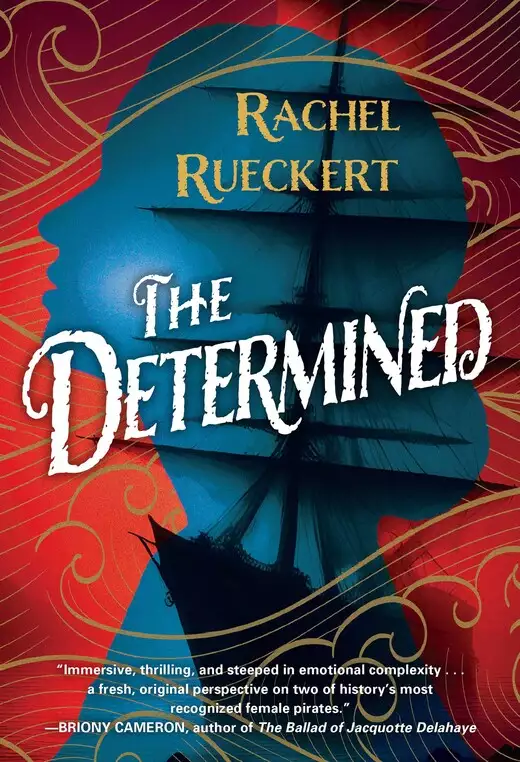
A groundbreaking novel of historical fiction based on the real experiences of two of the Golden Age of Pirates’ most infamous women, Anne Bonny and Mary Read, who dared to subvert the rules and gender roles of their time.
1721, Spanish Town, Jamaica. Captured, convicted, and pregnant, 23-year-old Anne Bonny faces the gallows. When writer Captain Charles Johnson enters the garrison, she strikes a deal: she’ll tell this opportunistic fool her story if he sends a doctor to her friend, Mary Read, who’s battling prison fever.
Prior to their arrest, life at sea had offered Anne and Mary freedom that few women knew. Anne, born into scandal in Ireland, seeks home and elusive safety in South Carolina. Discovering the opposite, she makes a bitter bargain for emergency passage to the Bahamas.
Across the Atlantic in England, Mary confronts her own limitations as an illegitimate daughter. She sneaks into a merchant crew, disguised as a cabin boy. But when war sends Mary into the cavalry, she meets a challenge even she might not rival.
When their paths collide in Nassau, a notorious “pirate den,” Anne and Mary find kinship aboard the Revenge—the fastest ship in the Caribbean. With the governor out for blood, every raid brings more risk. From the high seas to the depths of a Jamaican prison, Anne and Mary must navigate impossible choices, each determined to taste freedom again.
Release date:
February 24, 2026
Publisher:
Kensington Books
Print pages:
400
* BingeBooks earns revenue from qualifying purchases as an Amazon Associate as well as from other retail partners.
Spine pressed against the prison wall, Anne rested her hands on the swell of her stomach. The cloth of her breeches—the same ones from the night of their capture—clung to her damp skin as she sat on the unforgiving stone floor. She could still smell the grapeshot and gunpowder. She wore the same shirt too—his calico shirt. The bitter memory pierced her like a rapier.
Not even the child had energy to move. Nothing had energy to move in Jamaica’s heat.
Anne didn’t bother to glance up at the hush of men speaking outside her cell, the sound of their shuffling boots. Among them, she made out the voice of the burly guard who brought her daily water.
“I insist on supervising,” he said. “She has no shackles.”
“Are you suggesting I am unable to protect myself against an unarmed woman?” asked an unfamiliar voice.
The guard huffed. “She is no woman.”
“I can hold my own,” the stranger said. “I assure you.”
Anne stiffened, aware of her vulnerable position. But if this visitor dared to touch her, he wouldn’t be able to hold his own bowels when she was done with him.
She resolved to betray no nerves. A silence followed, heavy as the humid air in this godforsaken garrison.
“Do consider—”
“Surely, my good man, you have heard of my reputation?”
The guard relented. “I’ll be down the hall. Call if you need assistance.”
Not until after the squeal of her door opening, then closing with a decisive click, did Anne tuck a strand of red hair behind her ear. She lazily lifted her gaze up from the straw-covered ground.
“Good afternoon,” the gentleman said, clearing his throat and removing an ostrich-feathered tricorn. He wiped beads of sweat from his wrinkled forehead with a kerchief—clean as snow—before placing it inside the leather bag he carried. Anne watched without blinking as he scanned the dim room: the saggy cot, a three-legged stool, a rancid bucket, the streak of sun from the slash of barred window above.
Then, finally, at her.
“I am sorry that a young woman of twenty-three, in your condition, must bear these difficult circumstances.” He arched a brow, as if ready for a reaction—any reaction.
She looked away, hiding a stab of despair.
Sighing, he pulled the wooden stool from the corner and placed it in front of her. “May I?”
Anne balked. She couldn’t help it. She’d known a life of pleasantries and politeness once, and she could still see through them.
“I don’t have to ask who you are, since on that everyone is clear. Or are they?” He paused. “But you can call me Captain Charles Johnson. Yes, I know my way around a ship—circumnavigated the globe by my twenty-seventh birthday, if you can believe it.”
“What I believe is that you’re a rat spying for Governor Lawes.” The sound of her own voice, loud yet raw from eight weeks of solitary confinement, startled her.
“No, miss. I assure you, I come on my own business.”
At this, the baby kicked. Hard. Her hand flew to her side. Jesus, Mary, and Joseph. She still had two months of this feisty thing waging war in her womb.
The captain smiled, probably thinking he was making headway—the fool. He took a seat, then pulled out a small oak desk from his bag, along with a quill and some parchment. He rested a crystal inkwell on the floor.
No weapons. No objects of torture. Anne felt her muscles relax and eyed the writing materials with a surge of longing.
But still, this gowl—whoever he might be—deserved nothing.
“You have no reason to fear me,” he said.
“I don’t fear you,” Anne lied.
Johnson inhaled, nodding. She didn’t like the way his eyes lit when she spoke.
“I’m a writer as well as a captain,” the man said, inking his quill. “I traveled far to see you. And your friend.”
Mary’s face flashed before her.
“I am compiling a book. The world is eager to understand you, to learn how—”
“No,” Anne said. No, no.
No.
Anne placed a firm hand on the wall to pull herself up, to yank herself out of the upswell of desperation that flooded her chest and threatened to drag her under. She did not want to sit below him—to be pitied, judged, or exploited by this blunderbuss. She folded her arms over her belly and glared at the desk balanced on his knees. Her fingers twitched with yearning as she imagined wielding the quill herself.
“If you help me,” Captain Johnson said with practiced patience, “I might be able to help you.”
Of all the many lies she’d ever been told, it was the most beautiful one she’d ever heard.
“Says me!” Anne roared, her fingers swiping at the air. Blood rose to her cheeks, the fury Mam warned could cause more freckles.
“Dul go h-olc ort,” Anne swore. Bad luck to you.
The boy laughed at her curse. “You must make your máthair proud with that mouth. Obedient as a fiend, too—skipping your lessons again.”
Anne balled her fists. How dare he bring up Mam? Or her dreary lessons? Da’s efforts to teach Anne his trade, a last attempt to redeem her worth in the eyes of the granny and granddad she’d seen but once, were proving disastrous and dull.
Bloody hell, Anne hated dull.
And that miserable Seán O’Brien at the moment.
She swung again for the stick. It had been a double-edged sword in her mind a few minutes earlier as she and Queen Maeve battled Furbaide. If Anne still had the fallen branch, she would have used it to knock Seán into the River Bandon by now.
Anne threw all her force into his chest, toppling Seán into the soggy grass.
“Dirty papist,” he shot, scowling at the stains on his trousers.
She smirked and folded her lanky arms. “I’m not the one covered in mud, you filthy bastard.”
Of all the wonderful curses, this was Anne’s favorite. Perhaps because she knew of no insults for the Protestants. Or maybe because bastard was the worst word of all. Da had told her off for using it. He warned her never to utter it in his presence again and, most importantly, never to say it to anyone else. Should she have occasion to talk to anyone else—a habit he and Mam generally advised against. The less people knew about their affairs, with Da’s wife run off and Mam being a Catholic, the better.
But what did it matter? Everyone already knew the truth about her. And besides, Anne enjoyed winning her fights. Her friends never shunned rough play or swearing:
Go dtite tigh ort. May a house fall upon you.
Buinneach dhearg go dtigidh ort. May you have red diarrhea.
Then, of course, Anne’s second favorite curse: Go ndéana an diabhal dréimire de chnámh do dhroma ag piocadh úll i ngairdín Ifrinn. May the devil make a ladder out of your bones to pick apples in the garden of hell.
Anne lunged for the stick and Seán gave up the battle with a torrent of snide insults. She scanned the pink-orange sky and the waning sun before heaving a victorious sigh.
“Well, I know something you don’t,” Seán said, scrubbing at the stains on his sleeves. “Aoife’s dadaí is back from Cork—brought her back something you’d fancy to see.”
Anne’s heart leapt. “Go on.”
When he saw he had something over her again, he flashed a wicked smile. Anne exhaled, then reluctantly offered him a hand. He took it.
“A sap whistle.”
Anne gaped. Mam had gifted her a sap whistle for her eighth birthday last winter, but Da had taken it away after she’d shot peas at a passing carriage.
“Liam and Fionn will want to see it, too,” Anne said. She and Seán began the walk along the riverbank toward the quay, her stick now a powerful scepter—no, a druid’s magical staff—that she used to part the greenery as she journeyed. As they strolled, she plucked primrose, buttercups, and fuzzy purple sheep’s-bit to make a clumsy bouquet for Mam. The enormous rock wall of Charles Fort, her friends’ usual meeting spot, shrank behind them as they neared the heart of Kinsale.
Anne’s skirt snagged on a thistle.
“I liked you better when you wore trousers,” he said.
Anne yanked the linen hem free. “Not even the Devil cares what you think, Seán O’Brien.”
He laughed in reply. The moment word began to spread a few years ago that Anne was not a Cormac heir, especially given the dubious circumstances of her birth, Da had declared that the ruse was over. The dresses soon followed.
By the time Anne and Seán reached the city center, the merchant shops were closing for the day. Ships and smaller fishing boats lay at anchor in the crowded harbor, their mighty sails the color of clouds. The smell of sea bass and huss wafted from the docks as men and women haggled.
“Slán. See you tomorrow, same time and place,” Seán said, snatching the staff back before dashing away.
Anne stood and watched Seán go, his bare feet flying. She often wondered what would happen if she were to follow him to the poor side of town. Where did he live? What was his home life like? But she never pursued him. She wouldn’t want Seán—or Aoife, or the rest of them—knowing the same of her. Anne’s parents weren’t keen on company. Or friends. Or her, at times.
A pair of redcoats walked past, deep in conversation, causing Anne to snap her attention to the time. She had to beat Mam back to the house. Clean off her boots. Hide the evidence of her folly. Present the flowers. Anne never quite knew which Mam she might get: the frail but playful mother who was all games and trilling laughs and teasing, or the strong mother who guided their family like the brightest of stars, knowing just what to do and say and how everyone else should act, or—on rare but terrible occasions—the firebrand mother who could lance Anne straight through with a single, hateful look.
The bells of St. Multose Church bellowed as Anne sprang across the road for home.
Anne skidded to a halt when she saw the commotion outside her house. In the fading light, a crowd gathered below the lowest gable. Neighbors. Parishioners. She didn’t have to attend service with them to recognize the pinched faces. They muttered with pursed lips as they stood before the front window where Da kept his law office.
What was left of the front window.
Taking a step, Anne felt a crunch beneath her heel.
Glass.
She jerked her boot back. Her eyes darted from the road to the dozens of gawkers. Her breathing—already labored from the dash home—became shallower.
Mam.
Where was Mam?
“Mind yourself,” someone said when Mrs. Doyle arrived with a broom.
“I’ll mind what I please. These Penal Laws violate the laws of God and man both.”
“Hush!” a man retorted. “Do you want to be next? Branded a ‘West Brit’?”
“God?” a white-haired woman huffed. “They’ve no respect for the Good Lord. That hussy had it coming.”
Anne’s mouth went dry. Her heart hammered in her chest and she dropped the bouquet clenched in her fist.
Mr. O’Neill leaned forward on his cane to better inspect the damage. “Did anyone see who dealt the blow?”
Mam.
Find Mam.
Before anyone spotted her, Anne slipped through her secret slot in the blackthorn hedge near the carriage house and sprinted for the entrance to the servants’ quarters.
Flinging open the door, she froze on the front step, remembering her boots. The muck. No one used this entrance. No servant would work for such a “family” as hers. She’d leave a trace. Mam could spot a pinprick of dust.
Find her.
If she’s alive, she can flay me later.
Anne’s pulse sounded in her ears as her feet pounded up the stairs. She pushed through the last paneled door, spilling into the drawing room and searching for her parents. No candles. No smells of dinner in the making.
“And how are we supposed to survive if your law practice fails?” came a shout from upstairs. “If they kill you and drag me out onto the street? Or haul me back to jail?”
The hair on the back of Anne’s neck rose.
Firebrand Mother.
Mam was very much alive.
“I would never let that happen to us,” came Da’s calm but passionate rebuttal.
Anne sagged with relief. They were safe, and she was safely forgotten—again. If Anne could make it to her own bedroom, past Mam and Da’s argument, she’d hear everything in the morning without getting in the crossfire. She could clean the boot prints off the stairs before Mam noticed.
She removed her shoes at last, holding them by the laces, and tiptoed up the stairs.
“Stop acting the goat, William. They’ll bring torches next. We can’t go on like this. Me, living in the house. Our child will be the death of me—growing taller by the hour, wild as a feral dog. It’s bad enough she robbed me of my health, that my belly landed me in prison. You’ll never know what I endured there, the nightmares I still suffer.”
Anne stopped in her tracks midway down the hall.
“If she masters my trade, if I present her again—”
“Do you think I was born yesterday? Has she given any indication that she is capable of letters in all her eight years of mischief? That she cares for books and legal ledgers? Your parents will never spare us a ha’penny for a child like her. Take heed of the truth. We’re on our own. Even the kitchen mice keep better kin.”
Anne’s fingernails bit into her palms. She should be anywhere else but here.
“Meanwhile, Mrs. Cormac—” Mam spat.
“I don’t want to hear her treacherous name in this house.”
“As long as your wife still lives—even if it’s with another man a world away—she haunts every room. And don’t go blabbering about coverture and the Common Law either, William. Even if it isn’t legally sound, she plagues every corner of this home. And not a person in this godforsaken town will let me forget it. For all we know, she returned to throw that brick herself!”
A silence. Anne held her breath.
“Calm yourself, mo chroí. You are the bean an tí of this house. You are my heart and soul, the very bones of me. You. There is no one—and there never has been—anyone else but you. Your spritely spirit is too much for your body.”
They might have been kissing. They were always kissing. But Anne swallowed and the braver part of her soldiered on, ear angled toward the door.
“There’ll be holy murder to pay,” her mother said, her voice quieter. “It’s time, William. It’s time to leave Kinsale to the wolves. Make for London. Anywhere. Anywhere is better than here.”
Anne felt the earth shift in the pause that followed.
“For you, Peg?” Da said.
“For us.”
“Consider it done.” Da’s voice softened. “There’s nothing you and I can’t do together.”
When the words ended, replaced by strange sighs, Anne padded toward her own room. Her heart galloped and her fingers shook. Once inside, she reached for the water basin.
Leave?
Leave Ireland?
She couldn’t. They couldn’t.
Anne placed her boots inside the white porcelain bowl, the heels still sticky with clover and mud. Liquid spilled over the side.
And how are we supposed to survive …?
Has she given any indication that she is capable …?
Anne reached for a towel and scrubbed. Her eyes burned. She knew she lived in a house of secrets. She knew Mam ran the house despite her frailty and that they couldn’t employ servants—that Mam had once been a servant. She knew there was a reason why her parents kept her inside, away from her mysterious granny and granddad, away from churches and festivals, away from anything of interest.
But until now, Anne hadn’t known that Mam’s failing health—and that rumored time in prison—was all her fault.
Our child will be the death of me …
The towel stained as she rubbed at the laces. Starting tomorrow, things would be different. Anne wouldn’t meet Seán or Fionn or Liam. She wouldn’t see Aoife or her new sap whistle. Not even for a few precious hours of fun.
She scoured the boots until her knuckles were as red as her hair. Starting tomorrow, Anne would be good.
And with that sobering knowledge, Anne knew the first thing she had to do.
Three days later, Anne faced the Cormac estate where her granny and granddad lived. She stood taller than the pines framing the iron gateway of the imposing stone arch. A lioness statue perched atop its center, glowering down at her with empty pupils.
Anne swallowed the knot in her throat. She’d risen hours before the sun, put on her boots, then made for the road. Blisters now boiled on her heels. Though two years had passed since she’d confronted this place, Anne knew the path. She’d never forget that morning her family had climbed into the carriage: Mam’s rose-water perfume, Da’s new cravat, how they arrived at what Anne could only assume was a castle.
Then what followed: Mam, paler than a ghost. Da, kneeling before the strangers—pleading on behalf of her, a child, who should not suffer for the sins of “his” parents. The old woman whose painted mouth fell open at the sight of them, pale eyes watery as they fixed on Anne. A wrinkled man, scowling with thick gray eyebrows beneath a powdered wig.
The eruption of curses. Da’s ear-splitting fury when Granddad called him a “bréagadóir,” a liar. Mam’s bone-white face before she fainted, crumpling to the floor.
Now, standing before the iron gate, Anne blinked away the awful memory. Her best dress, tight around the stomach, left her slightly nauseous from swirling nerves. Damnú. There would be no use hiding the filthy hem. It wasn’t as though she could have asked to borrow the carriage.
If her parents had lost everything on her account—if Mam’s poor health was Anne’s doing—she owed her parents this much.
And maybe, just a wee bit, she owed it to herself, too. For she could not, would not, lose her lovely Ireland.
Anne spit into her palms and smoothed out her hair, frizzy from the damp air. She only had to slip through the bars, cross the Cormac grounds, announce herself at the door …
It needed to work.
Da and Mam had explained their own plan after the brick incident. A new family secret: they would move under the cover of night, taking one sea chest apiece. They would leave behind the debts. The rumors and ill-wishes. It would just be the three of them: Da, Mam, and Anne.
Da held Anne’s hands in his as Mam stroked her hair. “We’ve run out our luck here, my little lass,” she cooed, the very picture of Strong Mother—all traces of Firebrand gone. Mam embodied all the power of the sun. When she radiated approval and affection, the house glowed like the longest day in summer.
And without the light of that sun, they all withered.
A lump formed in Anne’s throat. “But what if I don’t like London?” She hated the selfish words. How dare she resist a plan that would ensure her Mam’s health and safety? Da’s happiness and secure employment?
“I know you’ll miss Kinsale,” Da said, his face soft with love as he knelt down to her level.
Ma crouched beside him. Her brown curls piled atop her head like a crown. “I will, too.” At this, Mam’s sapphire eyes, the same color as Anne’s—flooded with tenderness.
“But what if we had the money to stay? Or to not move so very far?” Anne asked, her chin quivering.
Da rubbed the backs of her knuckles. “I wish we did. More than you know. But we’ll mind what we’ve got.” At this, Da threw an arm around Mam and Anne, pulling them close. “And we have a lot. Everything we need, right here.”
Anne gripped the rungs of the gate. She squeezed her eyes shut, summoning courage and rehearsing her lines. “Je suis honoré de vous rencontrer.” She knew to call the woman Seanmháthair and the man Seanathair, to tell them she’d read a whole shelf of books and could recite John 14 in Latin—that she was capable of learning, that she would make a worthy heir despite the unfortunate case of her sex. She’d retained more of Da’s lessons than anyone might suppose. She was not such a hopeless cause.
Anne felt the width of each bar for the best way through, then shimmied through the slats.
She could just make out the brass knocker of the grand doorway when a bark startled her.
“You there!” someone shouted.
Anne whirled to face the voice. Her knees trembled.
“How’d you get in here? You’ve no business begging in these parts.” The bald man held a rope. A large dog pulled at the leash, growling.
Anne opened her mouth, but no words came out. Each bark from the mutt made her shrink.
Taking in the state of her dress, the groundskeeper paused. “Thieving from the kitchen won’t get you far. Away with you!”
“I’m …”
The hound snarled, and she hated how she flinched. Her ankles seemed shackled to the grass.
“I’m here on family business,” Anne tried again. “My granny and granddad live here.”
The groundskeeper laughed. “Haven’t heard that yarn before.”
“My name is Anne Cormac,” Anne all but whispered, her eyes fixed on the dog’s yellow teeth.
“Oh? And my mam’s the Queen of Bloody England. Be gone, you scrawny cat. You’ll not get a crust.”
She should’ve run for the door by now. Burst inside. Created a scene if she had to.
Why the Devil couldn’t she move?
Three sharp barks shook her to the bones. Unable to budge, Anne forgot her words, her French, her pleasantries.
Her mission.
“Are you daft?” the man yelled, loosening his grip on the leash. “Out with you!”
Before Anne could see whether he would drop the rope, she sprinted in the direction of town and the home she would now most certainly lose.
Mam exhaled with triumph when they spotted England’s shore a week later. Anne stood at her side on the bow of the ship in the brisk dawn. Mam, bundled in a shawl, rested her hands on Anne’s shoulders.
“Good riddance to our mighty troubles,” Mam said, head thrown back and eyes closed as sea mist clung to the gray air. The brine burned Anne’s cheeks. “I hope the Devil cannot swim.”
Anne laughed in response, though she knew her heart to be broken forever. Served her damn right. This was her own doing, her own fault. That dog had not charged her, had not snapped its teeth into her flesh. She’d run away, fled, within sight of the door, chased by her own pathetic fear. “All will be well,” Anne muttered. She stared into the waves, the way they crashed relentlessly against the hull. “Da promised to take care of us.”
Mam glanced over her shoulder to where Da stood, engaged in conversation with two men, then she whispered into Anne’s ear. “Remember to never call him dadaí in public. We must strive to leave all traces of Ireland behind, especially Irish.”
Anne nodded dutifully, remembering her new vow to be good. She peered up to study Mam’s face. Her expression glowed with health and light. Mam heaved a great breath, causing a small cough. Then she ran her fingers through Anne’s hair. “Come, turn around. I’ll be fixing your wild mane again.”
“Sorry,” Anne offered, allowing her mother to plait her thick tresses. She was sorry for everything. She’d never tell her parents what she’d done, where she’d gone. And she’d never forgive herself for freezing. Failing.
A gull called overhead, circling before making its way back toward land. Had this gull ever been to Kinsale? Seen the sails of ships unfurling in the harbor at dusk or the emerald of a new spring? Sat atop Fort Charles, in whose shadow Seán and her friends might be playing even now?
A poignant silence settled as the wide ocean brimmed all around them.
“Heed this moment always,” Mam said thoughtfully, dividing Anne’s tangled hair into separate strands. “You’ll be a woman before you know it, my Anne. There are certain things every woman must know.”
Anne’s stomach knotted. Mam tugged as she formed the start of a tight plait, but Anne did not wince.
“Your father is a fine man,” she whispered. “As fine as the Good Lord makes them. But his being with me wasn’t always so clear. When your father made his intentions known, under the nose of that cold-hearted Mrs. Cormac, there was another. A blacksmith from the market who used to fancy me.”
Anne stiffened as Mam told her, for the first time and with a strange, secretive quality to her voice, about this blacksmith. His fine eyes. How she’d fancied him. His flowers and nice compliments. It was a difficult story to follow, something about how the blacksmith—learning of Da’s growing attachment to Mam—had come to the Cormac estate and stolen some silverware that somehow, later, ended up in Mam’s bed while she served as the Cormacs’ maid.
“The bitter fool,” Mam lamented. The case of the missing silverware, in addition to Mam’s suspiciously untouched bed in the servants’ quarters while living with the gentleman of the house, was what sent Mam, with Anne in her belly, to prison. The spurned blacksmith, in a rage, had set her up. Da’s legal wife, Mrs. Cormac, discovered the silverware and pressed charges. Mam’s health had never been the same since her six months in jail.
“They locked you in the gaol because of me?” Anne asked, confirming what she already knew.
“Because of Mrs. Cormac,” Mam corrected.
Anne feigned a glower meant for the wench she’d never met, though from this tale, she wondered why Mam did not condemn the blacksmith. These strange details only made her insides coil. She knew Mam spared her the worst truth: that Anne, growing in her mother’s belly, had made life so difficult. Unbearable. Had almost killed her then and so recently again. Maybe starting anew, losing everything Anne loved, was the only way forward.
Her mother deserved that horizon.
Mam’s voice grew wistful. “It’s hard to know sometimes, which way my life might have gone, had I not been a young maid in the Cormac house,” Mam said, tying off Anne’s plait. “Don’t misunderstand me, though. I’m grateful. Not all men in your father’s position would have stuck around. And I love him better than any other—and only more so with each passing day. He worships me like a queen, never minding my lowly beginnings.” She turned Anne around and faced her, tucking stray hairs behind her ears. “I’m only saying you need to watch yourself. The world is not kind to women.”
Spanish Town, Jamaica
February 1721
Anne awoke from a dream with a jolt. The verdant green disappeared, replaced by impenetrable black. Sweat dripped down her face, and her bulging stomach felt wet with it. Damn heat—like the hell this truly was, as if a dog panted unceasingly in her face. She longed for fresh air. A salty gust and the sound of a sail flapping. Or relief in the form of an autumn breeze through the heather. What she wouldn’t give for a cold compress like the kind she used to apply to Mam’s forehead.
From her cell, Anne could hear the mutter of voices and the shuffle of irons somewhere down the corridor that must have disturbed her sleep. A new prisoner? It certainly wouldn’t be that blithering Captain Johnson at this hour.
Mary?
Anne’s heart leapt. She listened closely with a spike of hope that they were moving Mary nearer. But she did not hear her friend’s voice from among the sounds.
Anne heaved her body up, pissed for the thousandth time that day, then returned to the cot. She rubbed her temples, where a headache pounded, and scanned the slit in the wall. No moon. It had to be after midnight, but what did time mean to her? Here, she slept more than a cat. There was little else to do, little motivation to stay conscious.
She lay on her side, her oversized shirt sticky as it clung to her skin. Mother of God, the smell. The white cloth of the shirt had grayed since her capture. Every muscle in her body ached, but her lower back throbbed.
The faraway voices remained vague and distant.
Closing her eyes, Anne tried to recall her dream. Kinsale. Sleep always carried her to that happy place. Never to those unremarkable years of toil in England.
Anne wrapped her arm over her belly. The corner of her lip tugged up, remembering more than just a dream. Remembering Mam. Each night after a successful lesson with Da, she’d clutch a coverlet to her chin and listen as Mam’s voice—deep for villains, vibrant for heroes—took her mind to wondrous heights. But Anne had a favorite.
“Tell me the story of Grace O’Malley.”
“Not that one again,” Mam said with mock exaggeration. “Lord have mercy.”
“Please,” Anne begged.
And so Mam began: the story of the infamous Gráinne Ní Mháille, who traveled and traded with her father, Black Oak, training as chieftain and learning the laws of the land and sea. How a rival clan had slaughtered her husband, Donal O’Flaherty, snatching up his land until Grace took back his castle with a force only love could explain—the same force she showed when, only an hour after giving birth to her son on the deck of a tossing ship, she swaddled the child and stood tall on the ship’s bow, her head shaved, leading her loyal crew and admiring followers as they seized an enemy ship. How she later met face-to-face with Queen Elizabeth, prepared with a list of demands for her clan—demands the English queen ignored, unsure whether to see Grace as a heroine and equal or as an unruly thief and threat.
“And she was real?”
“Real as strong ale after a long day.”
Anne would then sink deeper into the bed—a soft bed, a r. . .
We hope you are enjoying the book so far. To continue reading...

 Please log in to recommend or discuss...
