“A unique blend of tension, charm, tragedy, and optimism, with characters you’ll love and a setting so real you’ll think you’ve been there. Highly recommended.”—Lee Child, author of the Jack Reacher series
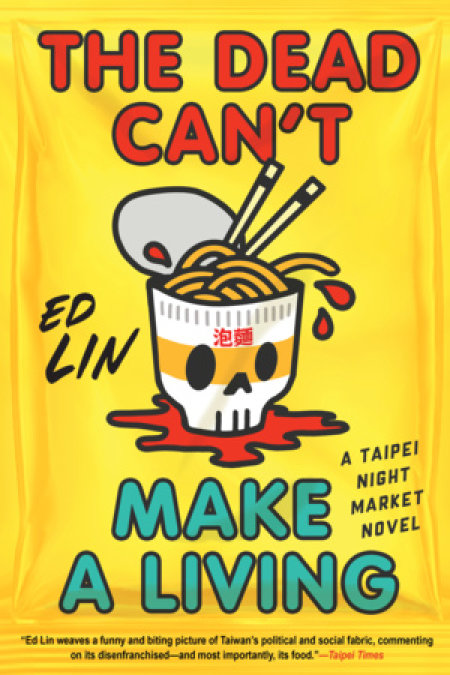
Ed Lin's big-hearted, eye-opening fifth installment in the fan-favorite Taipei Night Market series
Jing-nan, the owner of the most popular food stand in Taipei’s world-famous Shilin night market, is hauling trash after a successful evening of hawking Taiwanese delicacies to tourists when he finds a corpse propped up against the dumpsters. The dead man turns out to be Juan Ramos, a Philippine national who came to Taiwan for a job at a massive ZHD food processing plant.
Jing-nan is haunted by Ramos’s story, and by the heartbreak of his family, who arrive in Taipei looking for answers. ZHD has a history of safety violations, and activists have a hunch Ramos’s death might be part of a cover-up. Meanwhile, Jingnan’s gangster uncle, Big Eye, has his own mysterious, probably illegal, reasons for being concerned about what’s going on in ZHD. He pressures Jing-nan into a daring and risky mission: going undercover as a migrant laborer to get a job at the food processing plant and reporting back about the conditions inside. Jing-nan hopes to find out the truth for the Ramos family, and to save other immigrant lives—but first he has to survive the spy operation.
This rollicking crime novel is a scorching, timely examination of our global dependence on undocumented immigrants.
Release date:
April 7, 2026
Publisher:
Soho Crime
Print pages:
336
* BingeBooks earns revenue from qualifying purchases as an Amazon Associate as well as from other retail partners.
Chapter 1 The teacher of my half-assed night-school class was Mr. Chiang, a man in his late 60s. A veteran of business management in offices stretching from Tokyo to Topeka, Mr. Chiang was so “professional” in appearance and demeanor, he didn’t seem Taiwanese.
Instead of the modestly parted hair that marked many Taiwanese men his age—should they still have an appreciable head of hair by that point—Mr. Chiang must’ve gone to a stylist and said, “Gimme waves that scream ‘southern California!’” He projected an aura of openness and ease, and smiled often. You’d think that at this time in the early evening he’d be wrapping up his day, or wrapping his arms around his secretary in his corner office on the top floor of the Taipei 101 building. But lasting success had eluded Mr. Chiang. Why else was he stuck teaching “Concepts of Business Management,” a preliminary class in a second-rate night school?
More important, why was I here?
Well, I had detoured from the road to success, too. I had been at UCLA, but dropped out when my father got cancer. Soon after I returned to Taiwan, I was an orphan saddled with family debt. I managed to rescue the family business, a night-market food stand, which now represented the totality of what my entire ancestral line had accomplished. Hey, some dynasties have done less.
But slinging skewers was only going to get me so far without a college degree, my girlfriend, Nancy, liked to remind me. As a concession to her and to reality, I’d enrolled in Mr. Chiang’s class, a prerequisite weeder run; students had to excel in order to place into classes that would lead to a degree.
How many of us would they let through? As confident as I was about my business acumen, I wasn’t so sure how my achievements so far stacked up against those of my classmates.
That first night in class, Mr. Chiang put us at ease by talking about himself, and the general state of business around the world today. In all honesty, I tuned out a little, until he said, “So tonight, each of you is going to stand in the front of the room and briefly tell us your life story.”
Briefly? Any words beyond our names seemed like too much! There were audible gasps, and one even came from me.
In Taiwanese society, people are loath to reveal anything personal in public or private, even when there’s nothing to be embarrassed about. Two generations of martial law has left a legacy of restraint in Taiwanese manners. Any detail about yourself—good, bad, or neutral—should be kept private. This behavior extends to money matters and permeates the deepest relationships. In fact, joint banking accounts don’t exist in Taiwan because even married couples keep their numbers away from each other. Only the most irresponsibly romantic spouses know each other’s PINs.
Upon hearing he’d have to speak about himself in front of the class, one young man grabbed his bag and flew out of the room like an evil spirit touched by a Taoist talisman. Mr. Chiang shook his head with amusement.
“There’s one guy who won’t be getting on the degree track,” he said to the class’s nervous chuckles. “Look,” he said in English, “You are the most important ingredient in business today. The persona that you present determines if you’re going to land that job or get that supply contract. Connecting on a personal basis is as important as the business plan. Maybe even more so.” Mr. Chiang swung his candy-red tie to the side and continued. “Say you’re a tea distributor. Would you rather do business with Chen blah blah who graduated from this or that college, or with someone who runs a farm that’s been in the same family for ten generations, through wars, national disasters, and generational divides?”
Mr. Chiang’s tie slithered back to center as he moved his arms animatedly.
“Let’s give more details. At one point that family was on the verge of selling out to the big, evil corporation, but then the prodigal daughter left her Wall Street job and returned to Taiwan to revive the farm.” In his left hand, Mr. Chiang cradled an imaginary canister of tea. “You’d have to be inhuman to not want to be in business with that family, and be a part of the story. In business, you’re always selling your story to customers, and to employees and business partners. You all understand the importance of your stakeholders, right?”
He looked from face to face and we nodded. Yes, we would have nodded at anything the teacher said, but his point really was sinking in.
Mr. Chiang smiled. “Good. Now, Mei-hua, come up and tell us about yourself.”
She seized up immediately, and the rest of us squirmed, knowing we’d eventually go up, as well.
“Class participation is a part of your grade,” Mr. Chiang added casually, knowing that the remark would cut to the heart of our fears. Mei-hua rose and shakily walked to the front of the class. “Don’t worry,” Mr. Chiang reassured her in his best reality TV host voice. “Everyone has to go eventually, and you get a lot of credit for being first.”
Mei-hua probably hadn’t planned on presenting herself to a room. She was wearing a thin gray sweatshirt and a black mid-length skirt. She wasn’t much taller than five feet, and looked shorter because she was hunched over. She tucked a lock of her shoulder-length black hair behind her right ear.
“I didn’t think there would be public speaking,” she said to her feet. “Isn’t this supposed to be a business class?”
“How do you think business is done?” Mr. Chiang said slyly. “Telepathy?”
“I know how business is done,” said Mei-hua. She looked up for the first time, and revealed her face. Tension drew her mouth tight as a closed drawstring bag. Small nose, small eyes. Her dark eyebrows twitched like insect feelers. “I know it’s done with presentations, and with addressing a room, because I’ve seen it. But that’s when there’s a product to talk about, or a new strategy to work out. It’s weird to just talk about, you know, yourself.”
Mr. Chiang held up his right index finger. “Right. Good. Now we’re getting somewhere. We’re learning how business is changing. It’s more personal than ever, and you are in fact the main product you’re selling, Mei-hua. Now tell us your story.”
She had dropped out of National Taiwan University—our Harvard, Yale, and Princeton rolled into one—to join a chip-design start-up that went from five people in a basement office to a publicly traded firm with 500 employees. But the company ran out of money in two years. Everyone lost their jobs, and their only compensation was being allowed to take home their ergonomic chairs. The founder had had to sell off patents to former rival Taiwan Semiconductor to pay off debts.
Mei-hua had gone from a lemonade stand to ringing the stock exchange bell to moving back in with her parents. At least she got a cool chair out of it.
That was the pain-free summary of her story. Mei-hua had stuttered through it all, and delivered her last sentence while running back to her seat. Five minutes never felt so long, and agonizing.
“Let’s all give Mei-hua a hand,” said Mr. Chiang. We applauded, and our teacher cut us off by announcing the next name.
There really was an advantage to going first, because after Mei-hua, Mr. Chiang began injecting questions and comments while students spoke, indifferently teasing out our insecurities, and idly flailing us in public.
When it was my turn, I sauntered my way up the aisle. Who was more experienced and more comfortable with public speaking than me? I was ready to start modestly by opening with something like, “You might have heard of me already, but it’s all right if you haven’t.” Unlike nearly all of my classmates, I cajoled 1,000 strangers every night in English, Mandarin, and Taiwanese to buy my food and hang out with me, in that order.
Before I had even reached the front of the room, however, Mr. Chiang decided to preface my remarks.
“Class, we have a minor celebrity among us,” he announced. “Jing-nan’s name sounded familiar to me, so I searched online, and found quite a bit about him.”
Not willing to let a single detail escape him, Mr. Chiang opened his folded phone and read from the screen.
“A couple of years ago, class, someone tried to shoot him, and he deflected the bullet with a metal pot at his night-market stall. Do any of you remember hearing about that incident?”
A few people nodded.
I said, “Well, that’s not really relevant to my business story, even though my life was in danger.”
I couldn’t stop the Chiang train from rolling on, however.
“And then, more recently, Jing-nan was a kidnapping victim. No one knew where he was until Mr. Thomas Lee Tong-ming—who heads Taiwan’s largest hedge fund, and is someone that I have had lunch with a number of times—rescued him with a private army of sharpshooters.”
“That summary is a little inaccurate,” I said. “The full story is a lot more complicated. When you take these events out of context, it sounds like my life is crazy.” To the class, I said, “I want to tell you about my daily life, what it’s like at the Shilin Night Market, where I have a stand called Unknown Pleasures. Visitors from every continent around the world love our skewers, but don’t sleep on our stews, to borrow an American phrase.”
Mr. Chiang was still scrolling through his phone, so I spoke quickly before he could interrupt me again.
“My stand’s name and decor is based on the cover art of the first album by post-punk band Joy Division. Many people think those jagged lines from the artwork are mountain ridges, but those in the know and obsessed with Joy Division—my people—know those lines are radio waves from a pulsar.” I noticed some nods, and was relieved to find that some of my classmates were my people.
Mr. Chiang wasn’t, though. He returned to his chosen narrative of me.
“That’s not the only trouble Jing-nan has found himself mixed up with,” he declared. “Any person reading about him would think he’s a bit of a publicity hound, trying to drive the popularity of his outlet at the night market with all these, well, stunts. He’s had a number of scrapes with the law, including allegedly assaulting an officer. This man associates with figures from Taiwan’s underworld, and has spent time in illicit gambling dens. On the other hand, he’s also been documented advocating for marriage equality before it was legalized.” He looked at me with a cocked head. “You have to wonder, after taking all of that into account, if Jing-nan’s food is indeed good enough to stand on its own.”
He pointedly didn’t bother to repeat the name of my business.
I cleared my throat. “None of my misadventures were intentional,” I said. “And Unknown Pleasures has a four point eight out of five rating with more than ten thousand reviews. Guys, I’ve never studied business, and yet by almost any measure I have a wildly successful night-market stand. Our skewers are so good, I think we’re the only stand in the country that was visited by all three presidential candidates in the last election. Check out our social media. We keep up an active presence with our past and future customers, and we remind everyone that no visit to Taipei is complete without getting a selfie at Unknown Pleasures.”
Did Mr. Chiang just roll his eyes at me as he turned back to the class?
“What I find most remarkable about this young man,” my teacher said, “is that he doesn’t even have a college degree. Yet he’s doing quite well. This proves you don’t need to be educated to be a success.”
My face grew hot. “I consider myself educated,” I said.
“You attended UCLA for less than two years,” said Mr. Chiang. “Was it too hard for you?”
That was it. He had crossed a red line with me. Leaving UCLA broke me, and although I was mostly fine now, I didn’t appreciate someone circling my scars with a Sharpie.
I squared my shoulders and addressed my classmates. “I left UCLA because my father was sick with cancer. I thought I was going to be gone for a semester or two, but before my plane landed, my mother was killed in a car accident. She was actually on her way to the airport to pick me up.”
Everybody in the room seemed to stop breathing. Man, this really wasn’t how I wanted to introduce myself to my classmates.
We hope you are enjoying the book so far. To continue reading...

 Please log in to recommend or discuss...
