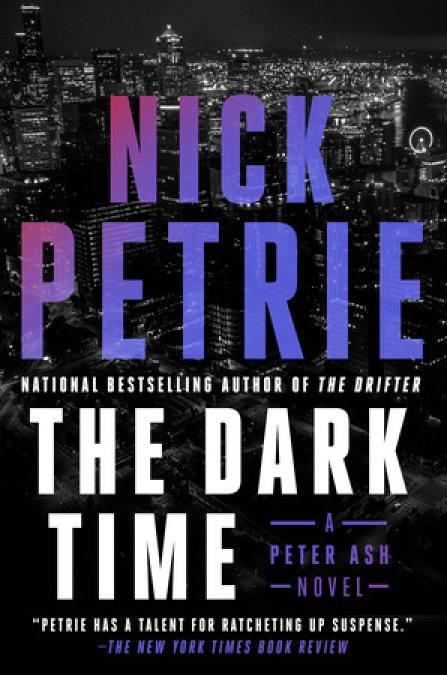
At the suggestion of his girlfriend, June, Peter Ash rides to the aid of an investigative reporter who may have stumbled on a story more explosive than even he can handle in this propulsive new thriller from the bestselling and award-winning series.
Katelyn Thorsen, known as KT to her friends and enemies, is an independent journalist who receives a very specific death threat. Fortunately, Peter Ash has arrived in town to protect KT at the request of his girlfriend, June Cassidy. From the moment of his arrival, he’s thrown into a maelstrom of violence trying to protect KT and her daughter and discover the source of the death threat.
Even after June and Peter’s best friend Lewis arrive in Seattle to help, this challenge may be too much for them - with enormous consequences should they fail.
Release date:
March 10, 2026
Publisher:
G.P. Putnam's Sons
Print pages:
400
* BingeBooks earns revenue from qualifying purchases as an Amazon Associate as well as from other retail partners.
CAUTION: This email originated from outside of Penguin Random House. Please be extra cautious when opening file attachments or clicking on links.
Katelyn Thorsen, known as KT to friends and enemies alike, stood inside the glass doors of Anchorhead Coffee, just down the way from Pike Place Market, staring out at the rain pouring down. She'd come for an appointment, but the anonymous whistleblower she was supposed to meet never showed up. Her next stop was Queen Anne Hill, a mile away, to pick up her daughter from school.
But she couldn't make her hand reach out and open the door.
It wasn't the weather. This was Seattle in November. Rain came with the territory, and KT was prepared in a bright orange hooded waterproof jacket that went down to her knees. She even had a collapsible umbrella tucked into her messenger bag, just in case.
It wasn't the fact that her appointment, whoever he or she was, had ghosted her. It happened all the time. People reached out to a journalist, wanting to spill the tea about something, then got cold feet. KT had pinged the other person's anonymous Signal account several times but gotten no response. Waiting for an hour in the coffee shop, she'd spent the rest of the time reviewing her notes on the half dozen other stories she was working on.
She certainly wasn't hesitating because of the afternoon traffic clogging every possible route to Queen Anne Hill, the sleepy neighborhood where she lived with her daughter. Like the autumn rains, Seattle traffic was both legendary and unrelenting.
In other words, this was a November day like any other.
Except for the feeling that KT couldn't shake.
She was being watched.
It had started that morning. She’d woken at five-thirty, her mind already thinking about the two in-person interviews she had scheduled, plus the countless calls and emails.
As usual, she'd made her daughter breakfast and driven her to school, the chatty thirteen-year-old always quiet and self-contained at that early hour. Then KT had returned home, parked in the driveway, unlocked the front door, and walked inside.
Her plan had been to check out the material the whistleblower had sent in preparation for their conversation at the coffee shop. Instead, she looked down and saw, on the floor below the mail slot, a plain white envelope.
She picked it up. There was no address, no stamp. The flap hadn't even been glued down, simply tucked inside.
Probably a neighbor, she thought. Although she couldn't think of a neighbor who wouldn't simply text her.
She untucked the flap and pulled out the contents. A single piece of white printer paper, folded in thirds like a normal letter.
It was not a normal letter.
It was a message made from partial words cut from magazines and pasted to the page, all different colors and sizes and fonts. Like the ransom notes in Columbo, her favorite TV show as a kid.
But it wasn't a ransom note.
The cut-up words read, Stop your investigation or we will stop your heart. We are watching. We are Legion. If you contact the police, we will kill Eleanor, too.
Her daughter.
She pulled open her door and stepped out into the morning drizzle, the letter in her hand, hoping to see the person who’d left it. Aside from parked cars and the steady stream of traffic that flowed down Queen Anne Avenue, the street was empty.
Although what she would do if she saw someone, she had no idea. She was a journalist, and a darn good one, but the risks she took were professional, not personal. According to a recent visit with her doctor, she was thirty pounds overweight and pre-diabetic, plus her cholesterol and blood pressure were too high. One of these days, when work slowed down, she'd start exercising more than her voice box and her typing skills.
She told herself the letter writer was just a crank. She'd gotten mail like this before. Almost every investigative journalist she knew had gotten mail like this, especially the women. Vague threats, often expletive-laden or outright obscene, from people who were clearly off their meds. Her old copy editor would have had a field day with the grammar and spelling choices.
In the old days, they'd been actual letters sent to her desk at the Star Tribune, where KT had gotten her start covering the cops so many years ago. Now it was a nasty email sent to her public-facing address, or a text to her Signal account, or a DM on one of her obligatory socials. Her current outlet, a nonprofit group of investigative journalists that worked internationally and published online, didn't even have a physical office.
But this was different. Even after thirty years of first covering crime, then Wall Street, and then the tech industry, she'd never gotten anything dropped off at her home. And this was definitely the first mention of her daughter.
Unspoken was the fact that they knew where she lived, which was not publicly listed anywhere that she was aware of. Nor was her daughter's name. Reporting on the sad remains of the Chicago Outfit, she'd learned the hard way to safeguard her privacy. It had not been fun to meet a couple of pissed-off Italian-American tough guys waiting outside her South Loop apartment.
Although she was not in Chicago, and it was not twenty years ago. Today, every piece of information was available somewhere. Reporting on tech had taught her that. Any crank with mediocre online skills could find a way to dig up those details, or pay for them. So somebody in Seattle had found her address and left a note. So what?
Her watch pinged a calendar reminder of her Zoom call in five minutes. Then she'd have to hustle not to be late for an interview in Redmond with the new Microsoft CEO. On the way, she'd call the school to make sure Ellie didn't go home with anyone but her. Later, when she had time to spare, she'd definitely call the police. If past experience was any guide, reporting a threat would eat up two or three hours.
Sure, she'd been scared for a hot minute. But that was letting the dickheads win. So now she was just annoyed at the distraction and, yeah, maybe a little amused at the whole low-rent ransom-note quality of the thing. She took out her phone and snapped a picture of the letter, then texted it to a journalist friend in Milwaukee. "Can you believe this shit?"
After her Zoom call, the amusement lasted until she walked out to her bright orange Honda, thinking about the note again, telling her not to call the police. We are watching. We are Legion.
That was totally something a crank might write. How would he possibly know if she contacted the police? Her phone had decent security. The letter writer wasn't listening to her calls. The government, maybe, if they had a court order, but not a run-of-the-mill lunatic.
But if he was watching, would she even know? She lived on the north end of Queen Anne, in one of the last single-family houses on a busy commercial strip. In the way of Seattle real estate, someone had torn down the houses across the street and built mid-rise apartment buildings with boutiques and restaurants on their ground floors. It would be easy enough for the letter writer to wander from shop to shop, maybe linger over lunch at the falafel place, then move down to the Starbucks. The whole time with a view of her door.
Anyway, if she did call the cops, the detectives would want to talk in person. From her time on the police beat, she knew how it worked. They'd want to see the note, check it for fingerprints and other trace evidence. They'd come to the house. And if the letter writer was actually out there somewhere, watching, he would see the detectives knock on her door. Even in plainclothes, cops always looked like cops.
She could always drive to the West Precinct station in Belltown, she thought. But if the letter writer had eyes on the house? He could simply follow her car.
That was when she felt it. A weird prickling sensation between her shoulder blades. What if he was out there, watching?
She told herself she was paranoid. Imagining things. This didn't happen in the real world. Although she wasn't imagining the death threat. That letter was real.
She opened the car door and climbed behind the wheel, looking around for someone who seemed to be looking at her, someone she didn't recognize. But Seattle was a big city. She didn't recognize anyone.
On her way toward the freeway, she found herself looking in her rearview mirror. A lot.
Had she seen the same car, a small gray hatchback, jockeying through traffic behind her? From Queen Anne all the way across the floating bridge to Redmond?
And wasn't it behind her again three hours later, a hundred yards back, when she left the Microsoft parking lot?
It was hard to say. A lot of hatchbacks looked alike. A lot of them were gray.
But she was pretty sure it was the same car.
2
Outside the coffee shop, the rain eased up a little.
She looked around the place for the umpteenth time. In the sixty minutes she'd allotted for the mystery whistleblower meeting that didn't happen, quite a few customers had cycled through. Some grabbed a cup to go, others stopped to sit for a while. None of them seemed to pay the slightest bit of attention to a middle-aged woman with a laptop.
So why did she still feel that prickle between her shoulder blades?
After sending the photo of the death threat to her journalist friend in Milwaukee, they'd texted back and forth a few times. June Cassidy was fifteen years younger, but she'd been through a few things. She'd asked if KT needed help.
KT was scared, yes, but she still wasn't sure if she wasn't simply being paranoid. Aside from an ill-considered and mercifully brief marriage whose only positive outcome was her daughter, Eleanor, KT had been essentially on her own since college. She'd done a pretty good job of taking care of herself and Eleanor so far, thank you very much. And that's exactly why she told her friend June that she was handling it.
June had asked her to share her phone's location, just in case. Which wasn't weakness, KT thought, just an overabundance of caution. So she'd done that.
The truth was, KT had more than her share of enemies in tech. Just in the United States, the sector was valued somewhere between fifteen and twenty trillion dollars. Which meant that a bad earnings call or product review or funding round could drop company valuations, and personal fortunes, by hundreds of millions or even billions of dollars. KT's aggressive reporting had caused many such drops. Most people killed over money had died for far less. Not to mention the fact that the men running these companies-and they were almost always men-tended to be emotionally stunted assholes who were prone to a wide variety of bad behavior. Taken as a group, tech founders had a long record of being willing to do pretty much anything to expand their empires and increase their net worth.
Another problem, along with wondering whether to call the police, was that the letter had given her exactly zero indication of which investigation she was supposed to stop. None of the stories she had in the hopper seemed to connect to a reason someone might want her dead.
The Microsoft CEO profile was basically three thousand words of cotton candy she'd pre-sold to The Wall Street Journal. She had a litigation follow-up to her July piece about a hardware startup that had gone bust because the battery in their signature product had a tendency to explode, but she wasn't breaking any new ground there. She was doing preliminary reporting on several stories, including one about a social company that had basically been bought for parts, and another on OpenAI's big spend on data centers, plus a dozen other ideas on her tickler list that she'd barely started thinking about. It was true that you never knew where a story might take you, but as far as she could tell, none of these seemed likely to result in a scoop that would be worth killing over.
She'd barely even considered the whistleblower who'd failed to show for today's meeting. A successful journalist was a magnet for unsolicited and anonymous tipsters. Mostly they were offering a thousand varieties of useless crap. But there were enough gold nuggets in the steaming pile to make it worth sorting through occasionally. Of the latest batch, the format of the recording the whistleblower had sent was sufficiently unusual to get her interest. Except Ellie had clomped downstairs demanding her dinner before KT had a chance to listen to it.
The only story that didn't fit that same pattern was a tip she'd gotten about something called Gun Club. She'd asked around for a few months, called every source she had, but came up with nothing. Which in itself was a little strange, because tech was awash in strange drugs, biohacking fads, and bizarre political ideas, not to mention actual orgies at some of the fringier conferences. There had to be at least a few tech bros who'd discovered the joys of firearms.
In fact, the lack of response was interesting enough that, for the last few months, whenever she was working another story, she'd drop in a question at the end of the interview: Have you ever heard of something called Gun Club? The funny thing was, aside from a straight no, the most common answer was: Is that like Fight Club? Making it evident that her interview subjects knew even less about it than she did. But recently, she'd had three guys clam up and look very guilty about something, which, to KT's well-honed reportorial senses, was a signal to dig deeper. But because of her current workload, she hadn't had time to start. Currently, that story was going exactly nowhere.
Anyway, even if she did know what story to step away from, she couldn't help hearing the growly, critical voice of her very first editor, Jim Higgins, who had burrowed deeply inside her reporter's psyche. What kind of journalist would let some crank scare her off a story?
A live journalist, she told herself. With a daughter, safe from harm. But still. It rankled.
Her watch pinged with a new reminder that, with the current traffic, she should leave now to pick up Ellie.
She scanned behind her again. Nobody in the coffee shop was paying the slightest attention to her. She turned to look through the glass door, flecked with droplets of wind-driven rain. She didn't see anyone out there, standing in the wet. She didn't see the gray car, either. Somehow, though, the prickle between her shoulder blades had gotten worse.
We hope you are enjoying the book so far. To continue reading...

 Please log in to recommend or discuss...
