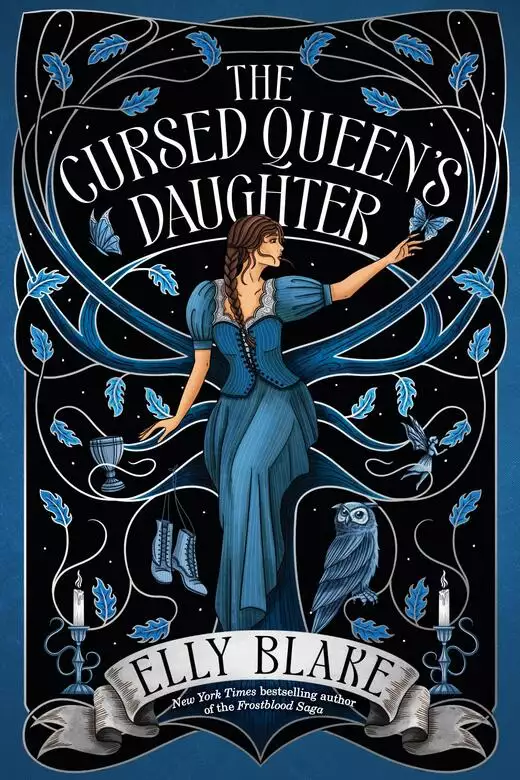
A warrior princess falls for a shadow prince in this darkly romantic companion to The Forest King’s Daughter.
Fearless Thea has never known life outside of war. As the favorite daughter of the Sylvan King, she's a relentless fighter who longs to lead his army as First Huntsman, ignoring the pretty clothes and fanciful notions others enjoy. But when a mysterious dress full of dark magic appears on her hearth one evening, Thea doesn’t know how to fight an enemy she can't see or touch. Still, her curiosity builds as a new gown appears each night—until she gives in to temptation and is whisked to a forgotten land of shadows.
The prince of the shadow realm is a handsome host, and while Thea does all she can to resist his charms, it's clear he knows something about the long-ago disappearance of Thea’s mother. All he asks in return is for Thea to dance with him, their dangerous attraction growing each time she returns for more information. Meanwhile, shadows are seeping into the living realm, and Thea may have to embrace her own darkness if she has any chance of saving her beloved sisters and home from an otherworldly threat.
From the author of the Frostblood Saga comes the second book in a spellbinding series about the daughters of the powerful forest king, with simmering romance and plot twists that will leave readers desperate to enter the Thirstwood themselves.
Release date:
February 10, 2026
Publisher:
Little, Brown Books for Young Readers
Print pages:
400
* BingeBooks earns revenue from qualifying purchases as an Amazon Associate as well as from other retail partners.
Autumn is a harbinger. Leaves turn red. The moon bleeds. The wind bites, carrying a warning that to some, the coming season will be their last.
—EXCHARIAS, SYLVAN POET
Thea sat in her copper tub and stared at her knees as they poked out of the soapy water, wondering at the sense of dread that hung over her like a dark cloud. Where was the satisfaction she used to feel after a fight? When her patrol had encountered Skratti raiders earlier this evening, she and her fellow Sylvan Huntsmen had attacked. She’d slain a handful of enemies, sending their spirits to the Netherwhere, from which they would never return to trouble the living. The remaining raiders had fled.
So why did she have this cold sense of danger creeping up the back of her neck? She was at home in her bedchamber in Scarhamm, a fortress protected by archers and guards and mystic wards. There was nowhere safer for a Sylvan to be.
Add to that, it was her name day. Even now, guests were arriving for a revel in her honor.
Thea sank deeper into the water, trying to shake her strange mood. Maybe it was the fact that she didn’t trust the newly formed truce with their greatest enemy.
For a decade, the forest-dwelling Sylvans had been at war with the Dracu of the Cryptlands over what their queen had considered a theft: A Dracu boy had unwittingly given an artifact of great power to a Sylvan girl, and she’d kept it. The girl was Thea’s younger sister, Cassia, the artifact an amber ring called the Solis Gemma, whose gemstone emitted a glowing blast that harmed any creature who couldn’t live in sunlight, like the Dracu. Six months ago, a Dracu named Zeru, the one who’d gifted the ring, had abducted Cassia to get it back.
But retrieving the Solis Gemma hadn’t been so easy, and Zeru had been forced to work with Cassia to discover the ring’s history: that it was created by the Ancients as a tool for growth and restoration. Its gemstone had been misused during the Ancient Wars as a weapon to murder thousands of forest creatures called moss folk—by the Sylvan king, no less. A shameful history that he’d hidden from everyone, including his daughters.
It was too much to absorb, and Thea had not yet accepted all of it. She wondered how Cassia managed to seem… well, happier than she ever had before.
Cassia was one year younger than Thea but leagues apart in personality. A gentle soul who hated fighting, Cassia had finally refused to use the Solis Gemma against the Dracu after years of trying to meet her father’s demands. Thea had understood that, and when it became clear her sister had deep feelings for Zeru—a Dracu, of all creatures—she had tried to understand that, too.
Or bit her tongue when she didn’t.
But when Cassia invited her sisters to visit a mysterious cloud region called Welkincaster, Thea had declined. She belonged here in Thirstwood. She had blood trees to protect her and Skratti blood to polish her blade. That was enough to keep her content. Or had been until recently.
The Dracu were keeping to their terms of the truce, but the Skrattis—goblins who dwelled underground in the Cryptlands and were often allied with the Dracu—had started coming above and raiding Sylvan villages. Hence the increased patrols that had kept Thea and the other Huntsmen busy over the summer.
But battle was part of life. Thea had grown up during a war. A few Skratti raids could not explain her growing unease.
She pulled herself from the water, dabbing the moisture from her long limbs with linen cloths left on the stool next to the tub, and stood in front of the crackling fire to dry. Gooseflesh broke out over her arms as a cold draft of air came from the chimney.
And suddenly, resting on the hearth at her feet, was a neatly folded pile of cloth.
Tension whipped up her back as her pulse slammed. Had that been there a moment ago? Was she so distracted lately that she would miss something right in front of her?
She snatched up the top garment and shook it out: a short-sleeved blue gown with seed pearls on the bodice and a belt of bright green silk cinching the waist. Underneath lay a pair of thin stockings and green slippers embroidered with white thread.
A name day present from one of her sisters? It would be the type of thoughtful gift Enora might choose. But it was so unlike anything Thea had ever worn. Most of her gowns were simple and dark, and this was bright and fanciful. Thea frowned at the idea of what Enora could be trying to convey. That she should try new things? That her dresses were too plain?
As Thea held the gown closer for inspection, she inhaled. A shock ran through her as she detected the unmistakable stink of magic, and the scent brought back a memory she’d tried unsuccessfully to bury.
One night, when Thea was eleven years old, a sound from the hallway had woken her from sleep. She’d opened her bedchamber door to see her mother descending the stairs. Worried, she’d followed, surprised at how quickly her mother was moving. After all, her mother had been ill for the past three years, from the start of the war with the Dracu. Some said the war had been too hard on her gentle nature. Others guessed that a Dracu witch had put a curse on Queen Coventina. Mages and Seers had been brought in from surrounding villages, but no one had been able to cure her, and the queen had grown listless.
But her mother showed no sign of weakness now. Thea could hardly keep pace as a back door that led outside closed behind her mother.
Half-curious, half-scared, Thea traversed the courtyard and left the safety of the gates, keeping her mother in sight. Where was she going? Sylvans could go to their birth tree to recover if they were ill or injured badly enough. But the Sylvan queen shouldn’t go out at night, much less alone, not when they were at war with the Dracu. And did she really mean to leave without saying goodbye?
Thea almost called out, but the king was so secretive about the location of their family’s birth trees, Thea thought perhaps her mother would turn around and go home if she knew she was being followed. Then Thea might never know where the tree was. She decided to be a silent guard until her mother reached her tree, then she would step out and confront her.
The paths of Thirstwood brought them to an area of elms and willows and walnuts. Her mother put her hand to the trunk of a gnarled walnut, a surprisingly large and old tree, not what Thea would have imagined as the birth tree for her elegant mother. Thea remembered when she was younger, a tree that looked just like this one that had been covered in brambles. Drawn to it for some inexplicable reason, she’d cleared away the thorns and climbed the tree, something about its menacing branches challenging her.
Thea was about to call out when her mother’s voice broke the silence. “Come, then,” said the queen, “and claim me!”
Thea’s gasp was muffled by a gust of wind. A man stepped from the shadows at the roots of the tree. She saw that he was handsome and wore bright gold rings on his fingers. He’d smiled at her mother and took her hand, drawing her forward.
Then he’d kissed her.
Thea froze in shock until a sudden, blinding light forced her to shield her eyes. The next moment, her mother and the man were gone.
After frantically calling her mother’s name, she’d recovered her senses. She was alone in the forest at night during a war. There was a stink in the air that reminded her of the Seer’s workroom. Magic. She could not battle magic. She’d rushed home to find help.
In the end, she’d found no help at all.
Thea came back to the present to find she’d crumpled a slipper in one hand.
“Show yourself!” she commanded. Her voice echoed more than it should in her modest bedchamber. In answer, another frigid breeze caressed her bare skin.
Unsettled by the scent of magic and the horrible memories it stirred up, Thea threw the gown into the flames, followed by the stockings and slippers. A huge gust of air came from the fireplace, forcing her to step back to escape the cloud of ashes. As the wind died, she dusted her hands to rid her skin of the feel of that fabric.
With determination, she donned an old gown, taking refuge in the practical. As she turned back once more to glance at her fireplace, she could almost believe she’d imagined the strange dress.
But for two blackened seed pearls nestled among the ashes like staring eyes.
There are three things a Sylvan needs: sun, water, and revelry. Without these, our spirits wither.
—EXCHARIAS, SYLVAN POET
The great hall of Scarhamm was a large, paneled room with columns stretching up to a beamed ceiling. Windows faced the garden, inviting pink bands of sunset to warm the wooden floors. Normally, the hall was filled with trestle tables numerous enough for most of the Huntsmen, but for revels, the tables were cleared away. Tonight, the beams and columns were wrapped with red leaves from blood trees interspersed with gold leaves of autumn. Lamps hung at intervals, burning with a warm light as the sun’s rays faded outside. A trio of pixie musicians played lute, drum, and pipe to a festive rhythm.
Thea made her way through the crowd, stopping to speak to several Huntsmen before reaching her father. Atop a raised dais, the king’s throne was carved from a massive oak, its sides raw bark, its back sprouting branches that reached toward the ceiling. Thea bowed her head respectfully. Her father did not attend many revels, and she understood he was only present now for her sake.
To everyone else, the Sylvan king was a majestically imposing figure. Born in a time when folk had been wilder, his far larger stature and the broad, white antlers springing from his head were signs of his great age and power. Though enemies shook at his approach, and even allies had trouble meeting his darkly assessing gaze, Thea was accustomed to her father’s intimidating presence.
The Sylvan king’s eyes warmed as she straightened from her bow. “You killed four Skrattis last night,” he said in a deep, approving rumble.
She gave her father a modest smile. “Five. They fled before I could take more down.”
“They shouldn’t trouble us again for a good while.”
“Not if they have a grain of intelligence left rattling around in their heads,” she agreed, “which is questionable after we knocked so many of their skulls about.”
The Sylvan king never laughed, but his lips twitched, which was comparable to hilarity in anyone else.
Thea felt a slight pang, noticing the respect her father showed her in this moment, something her sister Cassia had never received. But everyone agreed Thea was the child who was most like her father—fearless, relentless on the battlefield, a natural defender of the forest folk. Thea planned to dedicate her life to that defense, which for a Sylvan could be hundreds, even a thousand years. If you didn’t die on the battlefield.
The Sylvan king motioned to one of the servants. “Bring my daughter some of our best ale.”
Thea nodded her thanks as a tankard was placed in her hands. “Thank you, Father.”
His nod was one of approbation. “Good name day, Theodora.”
As Thea bowed and turned away, she caught sight of the Court Seer’s wooden seat, carved in the shape of an owl to represent Noctua, the Ancient patroness of spirits and divination. The seat was empty, as usual. Veleda rarely came to the great hall, as she didn’t seem to enjoy attention. Or revels. Or people.
For a moment, Thea thought of asking Veleda about the mysterious dress. But Thea despised magic. She hated the chants, the rituals, and the ephemeral entities Seers called upon to divine the future. Sometimes Veleda prayed to the Ancients themselves to send her a vision, which seemed like a fruitless exercise. The Ancients had never once helped Thea when she’d asked.
Anyway, the Seer was absent, and it was Thea’s name day revel. She took a cleansing breath and examined the assembly. Since the signing of the truce with the Dracu, more forest folk had started coming to Scarhamm. The hall was half filled with winged pixies, small household folk called lutins, lake-dwelling naiads and their cousins the river nixies, as well as other allies who lived under the protection of the Sylvan king. While the Sylvans were about the same size as humans, most forest folk were diminutive in stature and lived in small groups. They didn’t have the strength, training, or numbers to defend themselves, which meant the Sylvan Huntsmen were their last and best protection against enemies who would kill them and steal their land if they could. Enemies included humans and Azpians, the folk like Dracu and Skrattis who dwelled underground beneath the forest.
One of the naiads looked Thea over as she passed. “Good name day, Thea! Is that the same dress you wore last year? Sylvan, you need new gowns!”
Thea straightened her shoulders. It was an old dress. She preferred to let people think she didn’t care how she looked. After all, she was a warrior. There was no place in her life for fine or delicate things.
Saving Thea from having to reply, Tibald, the weapons master, entered the hall, his thick arm raised in greeting, drawing shouts and raised tankards. The jovial, bearded elder had trained every Sylvan Huntsman in Scarhamm, except for Tordon who was older still—the oldest Sylvan alive, except perhaps for the king himself. Their exact ages were a mystery.
“Thea! A toast to your name day!” Tibald said, waving Thea over to a tray of drinks. Thea’s older sister turned from where she’d been talking with a group of nixies. Enora’s silvery blond locks were braided in a crown on her head, a stark contrast to the nixies, who left their hair loose or braided with water lilies. A handsome nixie winked at Thea, and she nodded to him with a smile.
“Ready, name-day girl?” Enora asked, picking up a tankard before moving to Thea’s side. She was dressed in a dark green gown that contrasted with her pale hair. “You know you’re expected to outdance us all.”
“Consider it done,” Thea assured her with a confident grin.
As they toasted and drank, the Second Huntsman, Burke, entered with a group of friends, each with varying levels of swagger. Burke stopped for a moment, straightening to his full, considerable height to show the perfect fit of his jacket, then bowed to Thea with a murmured name day greeting. Thea gave him a nod and watched as he approached the throne, bowing deeply to the king before speaking. She saw the gleam of respect in her father’s eye. No doubt Burke was detailing his success in the skirmish with the Skrattis, as she had done. It was obvious to everyone that Burke hoped to be the next First Huntsman.
Too bad for him that Thea would be taking that role. She didn’t feel the need to announce her plans, opting instead to show that she was better suited. And with the Skratti raids, she was gaining more opportunities. Burke boasted precision and skill, but so did she. And there was one crucial difference between them. He played by the rules, whereas there was nothing she wouldn’t do to protect the people she loved.
Noticing Burke’s head stray toward the door, Thea turned to see Cassia entering the great hall, her pale, feathered wings and gold freckles warmed by firelight. Her flaxen hair was left in loose waves. Enora embraced her and complimented the daisies sewn onto her white dress, drawing a shy smile.
“Where’s your Dracu?” Thea asked with a mischievous grin. “We won’t kill him, you know. Probably.”
Cassia’s eyes narrowed on her sister. “Can I vow to Zeru he won’t end up in a cell if he comes here?”
Thea and Enora exchanged looks. Neither of them knew what their father would do if a Dracu showed up in Scarhamm, even one Cassia trusted with her life.
“Your silence,” Cassia said wryly, “tells me all I need to know.”
Enora looked uncomfortable, but Thea shrugged. “Find any scuccas on patrol?”
Though Cassia no longer used her ring as a weapon against the Dracu, it had proved vital in the fight against scuccas—creatures made from sticks and moss and animated with trapped spirits. Though most of them had been destroyed when Cassia had battled the Seer who’d created them, Selkolla, some lingered. Some of the scuccas were peaceful, apt to hide if a Huntsman caught even a glimpse of them, but others had been skulking through Thirstwood and attacking forest folk.
Cassia’s hazel eyes were distressed. “Not today. I think they hide from me. Maybe they can sense the ring and its ability to release their trapped spirits.”
“At least you slayed the mad witch so she can’t create any more of them.” Thea tried to sound reassuring.
“Thea,” said Enora with disapproval.
Oh, right. Cassia had a weak stomach for violence. “I mean since you caused the witch’s death by vengeful Ancient.”
Cassia’s eyes warmed with humor. “It’s all right, Enora. I’m not that squeamish. Anyway, I think the scuccas are aimless without her guiding them.”
“Nothing we can do about all that for now,” Enora said, grabbing another horn of ale. “Tonight, we celebrate our sister’s name day. To Thea!”
Thea grinned, raising her own mug in reply, then hesitating before drinking. “Where’s the Sproutling?”
“Behind you!” a voice piped.
Thea turned to see her youngest sister, Rozie, coming toward them, ginger curls wild, though someone had made a valiant attempt to tame them with pins. A losing battle if ever there was one.
“Like my dress?” Rozie spun in a circle, her arms out. Her yellow dress was sewn with orange leaves so when she twirled, she looked like a leaf mound in motion.
Thea grinned. “I don’t know whether to embrace you or rake you into a pile.”
Rozie giggled, shaking the skirt out with her hands. “The seamstress said she was inspired by my hair. The season of autumn come to life! Or something.”
Thea reached out with her free hand and tucked a curl behind Rozie’s ear. “No one livelier than our Sproutling.”
Enora handed Rozie a cup of nectar, chuckling when she tried to switch it for ale. For the next few hours as they danced and laughed, Thea was able to push the truce, the Skrattis, and the mysterious dress to the back of her mind.
Nothing could touch them here. Selkolla was dead. The Court Seer had reinforced the wards, keeping magic attacks and enemies at bay. Scarhamm was still the safest place a Sylvan could be.
Beware when the forest folk gather. Pixie wine is the doom of many a Dracu.
—GAXIX, DRACU PHILOSOPHER
AS Thea exited the gates the next evening, Enora and Burke were waiting at the tree line, their breath visible as clouds of fog. Patrols were gathering, some Huntsmen already dispersing, their green-and-brown uniforms swallowed by shadows as they moved into the trees. The sunset stained Scarhamm’s stone walls with a splash of red, as if a giant had been slain at the gates and slapped a bloody hand against the wood. The spikes that had once displayed the severed heads of Dracu were now empty, but Thea had no trouble remembering each one. It felt to her as if the war had ended yesterday rather than months before.
“Have you recovered?” Burke asked, his smile taunting.
Thea’s mind went to the mysterious dress at her hearth, and she stared hard at him. “From what?”
Enora’s eyebrows went up. “From your name day revel?”
“Oh, that.” Thea rolled her shoulders. “I had two hours’ sleep. I’ve survived on less.”
Burke chuckled, a knowing look in his hazel eyes. “If you were suffering, you’d never admit it.”
“Then why ask?” Aware she was being more irritable than usual, she strived for a neutral tone. “Where are we assigned tonight?”
“Same as two nights ago,” Enora said, tilting her head to the right. “The area around the Grotto.”
Burke’s grin widened. “I could use a drink.”
Enora gave him a warning look. “We’ll be going in for information, not pixie wine.”
“Why not both?” Burke quipped.
Thea grinned as they started down the path. She never minded this assignment. You could learn a great deal by asking questions or sitting and listening at the bar. Though forest folk could be shy and reticent to share information outside their own people, most of the customers were willing to talk to the Huntsmen. They knew Sylvan patrols were vital to protecting them.
The threats were many, and not only from the Skrattis and other Azpians. Humans who lived on lands adjacent to Thirstwood were an ever-present danger as well.
Once, humans had respected the land folk who’d inhabited wild spaces, considering their woods, fountains, and rocks as sacred, even giving offerings to appease them. But as humans cleared and cultivated the continent, the folk’s connection with the land and its power weakened. Their numbers diminished as humans multiplied. Finally, humans had called the land folk monsters and demons, using that as justification for hunting and killing them. When the danger of extinction became too great, the Sylvan king had led the tree-dwellers into Thirstwood for their own protection. For a long time, stories of the blood trees trapping and suffocating intruders had been enough to keep people away.
But humans were becoming bolder. It had been too long, some said, for them to remember the old stories. They’d begun clearing trees at the forest’s edges, using the timber to build towns and villages. There were not enough Sylvan Huntsmen to fight off more than a small army of humans. Only the Sylvan king’s blood trees stood against the encroachment that would cause the death of all forest folk.
Thea tried not to dwell on things that she could do nothing about. She focused on her duty, which for now was patrol. She kept vigil with Enora and Burke along the woodland paths, ducking to avoid low branches and inhaling deep lungfuls of crisp air scented with peat moss and the coppery tang of blood leaves. A thin silver mist hung like garlands from the boughs, as if some misguided spirit had tried to decorate for a revel. But the only music was the rustling of birds and nesting squirrels. The moon rose, shivering under a quilt of clouds, and Thea felt no warmer herself. But after all her injuries, she had practice ignoring discomfort.
The night wore on with no sign of a disturbance. Finally, the lantern lights of the Grotto came into view, its frost-rimmed windows glowing with welcome.
Burke chuckled. “Is Wick ever going to fix that foundation? And the roof? The place is falling apart.”
Enora shrugged. “Part of the charm.”
The Grotto’s roofline was rather sad, but the rectangular stone-and-timber structure had sat empty for ten years during the Sylvan-Dracu war, bearing the weight of snow winter after winter without repair. Missing windowpanes had merely been covered by boards, and the steps sagged drunkenly to one side, while masonry crumbled at the building’s base. Wick, the proprietor, was a gregarious lutin and more concerned with persuading her customers that it was safe to return to the Grotto than replacing mortar and glass.
Still, lutins were household spirits, folk who lived indoors rather than in wild spaces. A building like this would be connected to Wick’s spirit, which probably meant she had not fully recovered from the war herself.
As far as Thea was concerned, the sagging roof was as much a Sylvan responsibility as Wick’s. One more reason to keep Thirstwood safe.
Enora entered first, waving to a group of five naiads seated at a round table near the bar. They were dressed in their usual flowing greens and blues, with water lilies tucked into their hair. They wore jewelry made from shells and fish scales, polished or painted so that it sparkled in the warm firelight. Thea scanned the rest of the space, taking inventory. A dozen patrons chatted over ales. A swamp dweller was seated by the window, staring down into his tankard between swigs. Two pixies sat atop a single barstool. And someone was seated by the fireplace. Only broad shoulders and a dark head of hair were visible above the back of their chair.
Wick was talking to the naiads, throwing her head back as she laughed. Her curvy figure seemed to fit her generous personality, though she could be fearsome if someone misbehaved in her establishment.
“Thea, you talk to the pixies,” Enora said, unbuttoning her cloak. “Burke, you take the swamp dweller.” And tossing her cloak onto a hook, she moved toward the naiads. Enora wa. . .
We hope you are enjoying the book so far. To continue reading...

 Please log in to recommend or discuss...
