TWO WOMEN WRITERS. TWO CENTURIES. A CREATIVE KINSHIP.
In the royal courts of nineteenth-century Rampur, courtesan-poet Munni Bai Hijab captivates the legendary Urdu poet Dagh Dehlvi, who immortalizes her in his verses while inadvertently eclipsing her voice.
More than a century later, Rukmini, an aspiring writer, stumbles upon Dagh's letters in the archives of the Rampur Raza Library and finds herself drawn to the fierce, flickering presence of Munni Bai Hijab. Torn between worlds-a Hindu woman in a Muslim household, a cosmopolitan spirit in a conservative town-Rukmini begins to trace the forgotten threads of Hijab's story, even as her own life starts to unravel. Her husband chases yet another doomed business idea. Her daughter walks away from medical school. And when her friendship with Daniyal, the stoic guardian of Rampur's past, deepens into desire, Rukmini must confront her greatest fear: becoming her mother, the woman who once walked away from their family.
The Courtesan, Her Lover and I is a haunting novel of longing, ambition and women who dare to write themselves into history.
Release date:
November 25, 2025
Publisher:
Hachette India
Print pages:
336
* BingeBooks earns revenue from qualifying purchases as an Amazon Associate as well as from other retail partners.
‘Past and present bounce off each other to fascinating effect in a novel that combines an unusual and disparate set of ingredients, producing from them an irresistible Rampuri korma.’—Anuradha Roy, author of Called by the Hills, All the Lives We Never Lived and Sleeping on Jupiter
‘In her languid, capacious and sensitive novel, Khan explores what it means to be a woman, both in the nineteenth century and in the modern day, when so much of the world is stacked up against the expression of a woman’s desires and her ambitions. Patiently, verse by verse and with infinite care, Khan uncovers the hidden heart of the tawaif Munni Bai, and also the stifling and casual claustrophobia of a modern marriage.’—Ira Mukhoty, author of The Lion and the Lily and Daughters of the Sun
‘Tarana Husain Khan deftly weaves two love stories across time: the openly celebrated romance of poet Dagh Dehlvi and the famed tawaif Munni Bai “Hijab”, where the veil becomes a paradox of revelation, and the clandestine affair of a present-day writer and her confidant, a passion that must remain hidden in the shadows. Together, these parallel tales illuminate how love moves between secrecy and disclosure, voice and silence, across centuries.’—Rana Safvi, author of A Firestorm in Paradise and In Search of the Divine
‘A lost love legend, which is one of Urdu literature’s unexplored heritage treasures, weaves its way through a story of contemporary challenges and pressures and a quiet love. Tarana Husain Khan achieves a fusion of recreated time and real time with flexibility and finesse.’—Neelum Saran Gour, author of Requiem in Raga Janki and Three Rivers and a Tree
‘Between multiple locations of space and of time, The Courtesan, Her Lover and I deftly interweaves the telling of the tale and the tale itself. A contemporary story of unfulfilled love deepens the drama and heartbreak of Munni Bai Hijab and Urdu poet Dagh Dehlvi’s tragic love story. The framing device—letters and Urdu couplets—give the book an interesting, unusual narrative structure. With its wealth of detail about the enigmatic figure of the late nineteenth-century courtesan, there is plenty here to beguile and ensnare!’—Sara Rai, author of Raw Umber
‘At the heart of this textured and quietly intriguing narrative stand Hijab—a courtesan of rare wit—and her lover, Dagh, Mughal Delhi’s last classical Urdu poet. Drawing on Dagh’s letters, Tarana reimagines their relationship with intimacy and nuance, allowing archival traces to take on emotion. Threaded through their story is her own—a personal journey into their world and the questions that drew her in. The Courtesan, Her Lover and I takes a bold approach to exploring how romance and literary history intersect, and how the past is not distant but remains alive and breathing in quiet and subtle ways.’—Saif Mahmood, author of Beloved Delhi
First published in India in 2025 by Hachette India
(Registered name: Hachette Book Publishing India Pvt. Ltd)
The shers and ghazals belong to their rightful creators, and are in public domain.
The moral right of the authors and translator have been asserted.
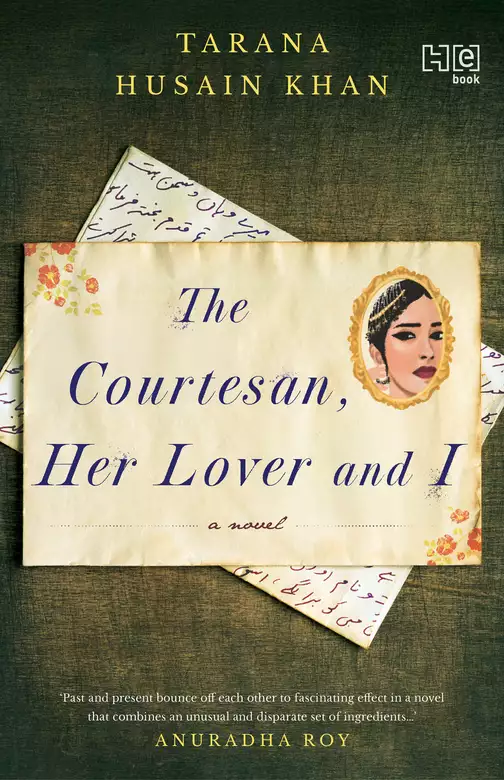
Cover design by Amit Malhotra and front cover illustration by Rishika Kapoor.
Drop cap, ‘Goudy Initialen No. 296’ by Frederic W. Goudy.
Drop cap ‘Zallman’s Caps 1991’ by D. Rakowski.
Section breaks and dingbats: ‘Bergamot Ornaments’ by Emily Lime Design;
‘Eutemia Ornaments’ by Bolt Cutter Design-Industrial Strength;
‘Printers Ornaments One’ by Michelle Dixon.
Endpapers: ‘Guest-house – Fort in Rampur, Uttar Pradesh’ via Wikimedia Commons
All rights reserved. No part of the publication may be reproduced, stored in a retrieval system (including but not limited to computers, disks, external drives, electronic or digital devices, e-readers, websites), or transmitted in any form or by any means (including but not limited to cyclostyling, photocopying, docutech or other reprographic reproductions, mechanical, recording, electronic, digital versions) without the prior written permission of the publisher, nor be otherwise circulated in any form of binding or cover other than that in which it is published and without a similar condition being imposed on the subsequent purchaser.
This is a work of fiction. Any resemblance to real persons, living or dead, or actual events or locales is purely coincidental. Certain place names have been used to retain the historicity and/or character traits in the text as far as possible.
Subsequent edition/reprint specifications may be subject to change, including but not limited to cover or inside finishes, paper, text colour, and/or colour sections.
Hardback ISBN 978-93-5731-287-5
eBook ISBN 978-93-5731-397-1
Hachette Book Publishing India Pvt. Ltd
4th & 5th Floors, Corporate Centre,
Plot No. 94, Sector 44, Gurugram 122003, India
Originally typeset in EB Garamond 11.5/16 and Minion Pro 11.5/15
by R. Ajith Kumar, New Delhi
Contents
Dagh’s Letter to Hijab
1. Faislā (Decision)
2. Talāsh (Search)
Munni Bai Hijab (1881)
Faryād e Dāgh (Dagh’s Entreaty)
3. Tabdīli (Change)
Munni Bai Hijab (April 1881)
4. Ikhtilāf (Conflict)
Dagh’s Letter to Nishapuri (1881)
Munni Bai Hijab (1881)
5. Dilkashī (Attraction)
Munni Bai’s Second Visit to Rampur (March 1882)
Dagh’s Undated Letter to Hijab
6. Sadmā (Grief)
Munni Bai’s Second Visit to Rampur (April–May 1882)
AFTER A WEEK BRACKETED BY TWO SUNDAYS, I ADMITTED TO myself and to my husband, Faraz, that I wasn’t going back to school. Until then, my resignation, which I had handed to the principal with aplomb, was a piece of paper I could crawl back and retrieve. Faraz didn’t ask me why—it was my choice to go and teach at the local school and my decision to leave after six months. He prides himself on being a non-chauvinistic Rampuri, a rare breed.
The decision has solidified into a daily routine of rising late, coffee on the porch and the bliss of watching the bilious yellow school bus carry on without me to the dull grey building. The first day, the bus stopped and honked at the gate as usual. I sent Meezan Bhai, our cook, to tell the bus driver that I had left school. The school was an obnoxious, unsurvivable riot, but the children were amazing, though a bit unruly. I think of my students, wonder about the half-stories I left behind and resist the urge to message them. I will, someday. I was just a new teacher with a fresh outlook and stories from another part of the world. There were a lot of we-will-miss-you-ma’am and please-don’t-leave; they will forget, as teenagers often do. I had celebrated my ‘liberation’ with a hearty kofta and kardhi lunch—a strange Rampuri combo that comforts and satiates at many levels—and was beset with calorie-guilt. We really need a word for that angst, guilt, anger and apprehension one feels after a high-calorie lunch.
I have to tell Baba, my father-in-law, about my decision. He might have heard about it already—he has an uncanny instinct of smelling out everything in our lives. Baba, as if waiting for confirmation, comes immediately, leaving his patients. I ferry the arguments and my defence around in my head. The job that Baba got for me—taking me to the school principal like a child seeking admission—was supposed to be a stopgap arrangement until we settled down in Rampur and I could orient myself to our new reality. Faraz always accuses me of being too eager, rushing on without giving much thought and then regretting. Some days, I inhabit this light, frivolous being and feel weightless, almost feathery.
I’m on my second cup of black coffee, standing on the porch, waiting, when Baba arrives with an impatient blaring of the car horn as Meezan Bhai rushes to open the gate. I gulp down the dregs of coffee, wishing I had something stronger. I imagine Baba’s reaction to the out-of-work daughter-in-law greeting him with a brandy-infused, half-drunk smile. I have plans, I have answers—difficult ones but clearly vocalized in my mind.
Baba gets out of the car, side-hugs me and pats my shoulder. At least he isn’t angry. I relax and ask Meezan Bhai to get Baba’s Lapchu tea with freshly-baked brownies. He settles down in his favourite chair and remarks that Faraz must be sleeping late as usual. Faraz was, in fact, lolling in bed, leaving me to face Baba-music. I was annoyed with him, and we had a mini-argument, but he just wouldn’t budge. While stirring the teapot to make the liquor stronger—twice clockwise and twice anti-clockwise—Baba asks me casually when I last had my period. I assure him I am not pregnant if that’s what is worrying him. He is, after all, a gynaecologist and this is his first thought-reaction to any aberration related to women; for unmarried women, he prescribes marriage as a cure-all. He shakes his head and says, ‘It’s your menopause.’
I lie to him that I just had my period. What did that have to do with anything, anyway? Baba takes a sip, dips the wet spoon in the sugar bowl, taking out a carefully calibrated minuscule amount, and stirs it in his tea.
‘Rukmini, my darling child, menopause is a process that starts in your forties. It’s a difficult time; there is a lot of hormonal disturbance. Hmm?’
Wait, did my father-in-law just blame my decision to leave my teaching job on a hormonal fit? I was prepared for anger or persuasion, but this—this was literally below the belt. Plus, he implied that I was on my last dregs of youth. Akriti, my closest friend, says it’s creepy to have a father-in-law involved with my uterus. Baba, the doctor-patriarch of the family, was into everything—medical and personal—right from the beginning. After years of taking his advice, opinions and medications, now it feels like an intrusion.
‘Baba, I resigned from my job because I hated it.’ I flatten my sentence and try to unclench my teeth.
‘Never mind if you hate it. You go to work; that’s how it is!’
If Jumbo, Baba’s beagle, were here, he would have barked in my defence. He hates loud voices. Feeling bad at his outburst, Baba puts on his calm doctor voice. ‘It’s okay to take a break and get back to work later.’ He suggests gently that I could think of starting a school, a small one; then it would grow, and people would flock for admissions because of my Dubai teaching experience. He even offers to take a loan on his precious orchard to cover the cost of setting up the school. I can see his plans for me expanding in his imagination. I know Faraz will say that it shows Baba’s trust in my abilities; he never made the same offer to Faraz.
‘I’m not going back, and the idea of starting a school here horrifies me. Everything is so disorganized, so… so casual here.’ I try to burst his bubble and end up sounding like a teenager. The good doctor morphs back to being Baba.
‘So you want to sit at home? Can you afford to?’ I hope the antique teacup has resisted the shock of being slammed down. It is one of the several precious crockery pieces Baba bestowed upon me after our return.
I break the real bad news—I have decided to get back to writing. Before Faraz and I got married, I was a features writer writing about the food scene in Delhi—there wasn’t much food writing at that time, just restaurant reviews and an odd column on a cuisine—and human-interest stories for a national daily and doing well. For me, the one positive when moving back to India from Dubai was the possibility of taking up journalism again. I was inside my head already. But Baba found me the job and advised me to let things settle down and then think about it. I should have protested then, but things were so uncertain, and I thought I could start testing the writing space again while still working. He had always looked down upon my career and was quite happy when I gave it up after marriage to look after Gul, our daughter.
‘You want to become a journalist and go around asking people for interviews! And… and write what exactly?’ The temperature of the air he was breathing out and the elevation of his eyebrows were building up into a quintessential Baba tantrum.
‘Articles…’
‘On what? Crime, rape!’ Crumbs from his third biscuit splutter out. Jumbo would have gone berserk licking them up from my too-plump sofa, transposed from my Dubai home; it looks incongruous beside the ornate wooden chairs, the original inhabitants of the colonial bungalow, our new home.
Baba jumps up, pacing around the table. I know he is imagining me wandering in the tiny gullies of this small town, meeting random people, inviting censure and gossip—totally unacceptable for a Rampuri daughter-in-law. I had expected all this; I’m prepared to weather it and put a stop to his plan B for me.
‘I can write about Rampur, the city. People hardly know about Rampur, Baba.’ I try to be gentle but firm—maybe only in my head. Recently, an online magazine published my article on Rampur Raza Library, and the editor wrote to me saying that I had a wonderful voice. Reassured, even though it wasn’t a reputed media outlet, I had enrolled myself in an online writing course that cost me half a year’s pay and tried to juggle school, online classes and writing assignments.
‘Don’t you dare write about me before I die!’
I assure him that I shall wait for all the family members to die before writing about them.
‘You and Faraz think you can leave work and live by selling off land!’ Baba sits down with a thump and shakes his head.
‘Meezan, get me some water!’ he yells. He knows Meezan Bhai is lurking in the corridor listening in on our conversation, very much a part of our life’s travails.
Baba gulps down the water, takes out the prescription pad from his bag, scribbles something, tears it off a leaf and hands it to me—medicines for my incipient menopause. He calls it ‘perimenopause’, which somehow sounds like a flighty, shifting state.
‘Your mother was sweating so much at your wedding, remember? I knew it was menopause.’ He cheers up at his past diagnosis. As we walk out to the driveway, Baba delivers a quick lecture on menopause—as though we didn’t live in a Google-world where we are condemned to know—predicts a tough time for me, pats my back reassuringly and drives off in his battered Maruti to his waiting patients.
Baba comes from a long line of practical, imperturbable hakims and doctors who went to work without a day off. I picture his grandfather and great-grandfather riding in a carriage to the Nawab’s bedside, feeling the veiled begum’s pulse through a perforated sheet, and bandaging sword wounds after epic battles. Rampur was, after all, a princely state under colonial rule till Indian independence and people still harbour a hangover from the Nawabi era, cradling heirlooms and memories.
I return to the drawing room after seeing him off to find Faraz peeping out from the bedroom door and throw a cushion at him.
‘Faraz Khan! You left me alone out there. How could you!’ Faraz laughs and starts making comical Baba faces.
‘I stood with you when he came for you! I’ll never, ever, ever be there for you!’ I scream, throw some more cushions and collapse back on the sofa with him, laughing. Suddenly, we are the way we used to be, when everything was a big adventure and a laugh. He tells me it’s my fault for getting bullied into taking up teaching when I really wanted to write.
‘You don’t understand. It’s not so easy. I haven’t written a single line in eighteen years!’ Nothing that could be called consequential at any rate. I wrote two articles for a friend’s food blog and got some likes and shares. Parameters of success and readability have changed drastically in the screen-obsessed, share and follow world. I’m told we only have two seconds to catch the audience bent on the endless scroll.
‘Did I ask you to stop writing?’ Faraz snaps.
‘I’m not blaming you!’
Everything becomes about him in all our arguments. Maybe I’m overcritical and it drives up his defences. His mobile pings, and he turns away with a shrug.
I miss my old life, I miss us there, and I miss Gul. It has been a year now—nine months, almost a year—since our return from Dubai, and things seem suspended and splintering on the edges. Sometimes, there is nothing to cling to.
What will you do today? What will you write? Who will publish it? Baba’s voice in my head has now mutated into my thought-voice.
2
Talāsh (Search)
APPARENTLY, UNLIKE JANE AUSTEN’S SINGLE WOMAN, AN ambitious woman is a problem to be solved. It infuriates me that Baba and Faraz have probably had this ‘man-to-man’ conversation behind my back on how best to ‘handle’ me and my resurrected writerly ambitions. I know them so well that I can almost see them in their usual roles. Faraz rooting for a ‘let her be’ approach—his normal stance, more out of exhausted indifference than faith in my abilities. Probably after a huge argument—since all their exchanges these days end up like that—Faraz has been entrusted with the task of introducing me to Daniyal Khan—a high-brow culture vulture vetted and endorsed by Baba. It’s typical of Baba to take charge, point me towards cultural relics, curtail my potential meanderings in the town, suggest that I write about Rampur culture while slyly hoping I burn off my writerly dreams and come home. He is hardly subtle, and this makes me even more adamant to succeed. My usual response is resisting Baba’s suggestions, which are actually decisions, like a rebellious child; but I agree to the scheme to maintain peace. I can understand Baba’s frustration—I have unsettled his carefully calibrated equilibrium. He had set up Faraz in a mango trading venture, me at a job and Gul safely lodged in a medical college. Now I was wilfully unemployed with impractical and potentially unprofitable plans. Not that I earned much when I was teaching, but it was enough to ‘put food on the table’, as Baba says. Most of the time, Faraz takes care of the daily expenses, and we live in a rambling colonial bungalow, a British-era club that Baba had bought years ago.
As we drive out to the old city area, Faraz briefs me that Daniyal Khan comes from a family of scholars, is very well-read and has a library with manuscripts inherited through generations. He doesn’t know much about Daniyal’s education or career, just that he would be the best person to assist me at this stage—at least Baba thinks that this scholarly rendezvous with a possibly priggish custodian of Rampur heritage will help or, hopefully, discourage me.
It has been more than two months since I left my job. My table is littered with half-finished articles while I aimlessly net-surf under the pretext of research and detest myself for it. I fed my anxiety by asking Meezan Bhai to prepare his specialities, stress-eating and slumping into post-eating despair. The only bright spot was supposed to be my Stanford University online writing course, but I was falling behind on the assignments. What should I write about? A bored housewife? Displacement? Life in small-town India? I was drawing a complete blank, paralysed by writer’s block in anticipation of mutating into a writer.
I have hardly been to the old city around the Rampur Fort. We live on the edge of Rampur, right where the highway hits the town. Baba’s house is the only place we visit in the walled city besides a few relatives on Eid or for some special occasion. The ancient geography of the town, encircled by centuries-old walls and gates, unspools in Faraz’s commentary. He points out the neighbourhoods named after Pathan chieftains of yore, who settled down in Rampur when it was established in 1774. Some are even named after trees—peepal wala gher, Imli Asmat Khan—or landmarks. I laugh over ‘Inayat Khan ki seedhiyan’ (Inayat Khan’s stairway) named after some person immortalized for building a two-storied house. The houses are arranged in clusters called ghers, with a common courtyard, a mosque and a cemetery. You don’t have to go far for weddings, festivities, prayers and burial; the circle of life is transcribed within the mohallas. Faraz points at the place where there used to be three magnificent stone gateways leading to the Raza Library, the erstwhile durbar of the Nawabs. The famed ten gates to the city have been demolished in the name of crafting a ‘smart city’ by a local politician. I can still see some crumbling old houses with clay-tiled khaprail roofs. They will soon be sold off and replaced by new, uninspired structures in greens and pinks. ‘New money’, as Baba says, or simply a result of old families getting rich again from sons working abroad or the inevitable division of old kothis. The weddings are no longer held in common courtyards. There are several banquet halls where we have attended marriages, receptions and other celebrations. The food is unerringly fabulous, exclusively carnivorous and centred around the awesome trinity of qorma, kababs and pulao. I dress up and zero in unabashedly on the eats. My devotion to food became my redemption in the eyes of the Rampur relatives who had raised their collective eyebrows at our marriage. Marrying a Hindu woman at that time was not politicized but still unacceptable on religious and cultural grounds.
We navigate into an ever-narrowing gully with busy drains on both sides and houses squeezing against each other. I look up at the balconies jutting out, almost meeting over our heads, the web of electric wires slicing the blue sky. There is a small mosque tucked in a corner as we turn into a brick-lined lane. I can feel Faraz getting irritated. He clicks his tongue and gestures to a guy sitting on a motorcycle and chatting to a friend. The man gets off and tilts the motorcycle, and we just about manage to pass through without scraping it.
‘We should have walked,’ I say.
‘And have these louts gawking at you!’ Sweat beads dot Faraz’s forehead. I hand him a tissue, which he rejects with a grunt.
‘I could have worn an abaya and scarf if that would make you comfortable.’ The thought of wearing the abaya brings on a suffocating, unbreathable feeling.
‘I just want this mess to be over!’
I clamp down on my words and endure his silent, martyr-like annoyance. He would have never come if Baba hadn’t forced him to. Still, I’m thankful for his help—anything to jolt me out of the place I’m in now.
The car stops at the end of the lane in front of an ancient, ornate archway. I gasp at the architectural magnificence of the carved stone pillars and the scalloped arch towering over us. Thankfully, it’s not painted in whitewash like other gates and extravagantly displays its open brickwork and red sandstone carved with intricate vines and floral arabesque—typical late Mughal architecture. A massive wooden gate embedded in the arch is opened by an old servant who bows and salams as Faraz parks his car in a vestibule area, which has another car under a tarpaulin shroud.
Faraz tells me that Daniyal’s ancestors were Rohilla Pathan chieftains who came with the original settlers and later became officials in the court of the Nawab.
‘We are also Pathans from Swat, but we came in later,’ he adds, unbuckling his seat belt.
I nod; I have heard the story of his pure Afghan bloodline narrated by the relatives with the silent rebuke against my Hindu ‘taint’. Baba often laughs and says hybridization creates naturally superior survivors.
We walk through a smaller arch into a garden, which gives way to a brick-lined courtyard. A lemon and white painted double-storied haveli, which can easily. . .
We hope you are enjoying the book so far. To continue reading...

 Please log in to recommend or discuss...
