
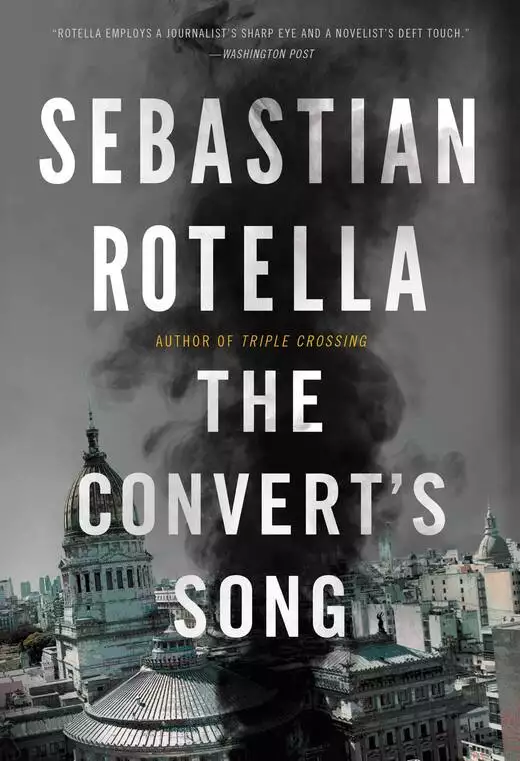
The Convert's Song
- eBook
- Paperback
- Audiobook
- Hardcover
- Book info
- Sample
- Media
- Author updates
- Lists
Synopsis
A global manhunt sweeps up a former federal agent when his childhood friend becomes the chief suspect in a terrorist rampage.
His hazardous stint in U.S. law enforcement behind him, Valentine Pescatore has started over as a private investigator in Buenos Aires. Then he runs into a long-lost friend: Raymond Mercer, a charismatic, troubled singer who has converted to Islam. After a terrorist attack kills hundreds, suspicion falls on Raymond---and Pescatore.
Angry and bewildered, Pescatore joins forces with Fatima Belhaj, an alluring French agent. They pursue the enigmatic Raymond into a global labyrinth of intrigue. Is he a terrorist, a gangster, a spy? Is his loyalty to Pescatore genuine, or just another lethal scam?
From the jungles of South America to the streets of Paris to the battlegrounds of Baghdad, THE CONVERT'S SONG leads Pescatore on a race to stop a high-stakes campaign of terror.
Release date: December 9, 2014
Publisher: Little, Brown and Company
Print pages: 336
* BingeBooks earns revenue from qualifying purchases as an Amazon Associate as well as from other retail partners.
Reader buzz
 Please log in to recommend or discuss...
Author updates
The Convert's Song
Sebastian Rotella
Raymond said tonight was the night.
Raymond said tonight they would make their move. Hit the big time.
Raymond said he kinda hated to bring this up, but he was a little disappointed in Valentín. Felt like he had been fading on him. Making lame excuses: his job, his high-maintenance girlfriend, his folks bitching at him. Raymond felt like maybe Valentín didn’t want to make money anymore. Like he was scared. But down deep, he knew Valentín had heart. They were cuates from way back. Tonight was major. Step up, homes. Don’t punk out on me now.
Basically, Raymond had talked the usual bullshit.
But if he said he needed backup, he probably meant it.
Valentín ate an Italian beef special at the counter of the sandwich shop, careful to keep the grease off his leather jacket. The sun set on the November streetscape: three-story brick walk-ups behind wrought-iron fences. The Italian-ice stand—red, white and green, draped with decorative lights—closed until May. The grocery across the street where, as a boy, Valentín had accompanied his father on Saturday pilgrimages to Benny the Butcher.
Benny did business in back, his little fort formed by freezers, display cabinets, a chopping block, blades hanging from hooks and arrayed in racks. Benny was squat and grave in black-framed glasses and meat-stained apron, sweater sleeves rolled up. He had dental problems: chipmunk cheeks, mouth frozen into a mumble. He chopped and sliced and wrapped, talking to Mr. Pescatore and reaching across the scarred wood to hand Valentín slices of mortadella and prosciutto.
Benny the Butcher had disappeared one day. Just like that. Running from the bookies.
But Vince, the owner of the sandwich shop, was still around. Valentín noticed that a refill cup of Coke had appeared at his elbow. Courtesy of Vince. Valentín looked up. Vince shambled toward a new customer with a grimace. The .45 in the holster on his hip accentuated his limp, which brought to mind Walter Brennan as Stumpy in Rio Bravo. The neighborhood was on the rebound. Town houses and condominiums were luring back children of old-timers who had run to the suburbs. The Italians, blacks and Mexicans had learned to get along or ignore one another. But good luck convincing Vince to leave his cannon under the register.
Valentín had an exam the next day. I should be home studying, he thought. Instead of waiting on Raymond and whatever catastrophe he’s got cooking.
Valentín chugged Coke. He hurried out when the steel-blue BMW pulled up blaring Latin jazz into the dusk. He slid in next to Raymond, who gave him an elaborate handshake and a thump on the chest.
“Cuate,” Raymond boomed. “Right on time. I likes that in you.”
I likes that in you. Emphasis on the in. His latest little catchphrase, acquired from a Latin King who sold him dope. Raymond collected expressions. He repeated them in experimental accents, as if learning a tune. He sounded like an Eighteenth Street Mexican when he said cuate, like a Logan Square cubano when he said comemierda.
Driving fast, Raymond lit a joint. He checked his cell phone. He patted the wheel in time to the radio: island drums, percussive piano, rowdy horns.
“Chano Pozo,” Raymond said, passing the joint. “‘Manteca.’”
“Old school.”
“Nothing wrong with old school.”
Valentín had stopped smoking weed for the hotel drug test weeks earlier. But he took a hit. And then another.
“A badass, Chano Pozo,” Raymond said. “The godfather of the conga. Taught Dizzy Gillespie Afro-Cuban music. A gangster, a cokehead, a tripped-out animal-sacrificing santero. Know how he died?”
Valentín moved his head to the jabbing wail of the trumpets. Ray was an encyclopedia. You always learned something if you listened.
“In a bar in Harlem,” Raymond continued. “Dressed sharp. He put a nickel in the jukebox to play ‘Manteca,’ his big hit. He’s singing along, dancing, havin’ a great time. That’s when they ambushed him. Shot him grooving to his own song.”
“Damn.”
The BMW hit the interchange to Lake Shore Drive. The ramp rose and curved, revealing a panorama of the skyline aglow.
“So what’s up tonight that’s so important?” Valentín asked.
Raymond pushed buttons on the CD player. “Check this out. ‘Pedro Navaja.’ The Latin ‘Mack the Knife.’”
Head back, driving one-handed, Raymond sang in Spanish. He matched Rubén Blades note for note, nuance for nuance. He had limited technique, but a sweet sound. He was a dead-on mimic: Sinatra, Springsteen. In conversation, he came off as if he was enjoying a private joke at your expense. When he sang, though, he sounded as if he believed every word with all his heart. And it became hard to dislike him.
Raymond wore the leather coat, collar up, that he had bought after seeing Carlito’s Way again. His stubble hinted at plans to grow a trim Carlito-style beard. Raymond was a year older than Valentín: thin, long-armed, and long-backed with straight, slicked-back hair. Valentín was curly-haired, sawed-off, and brawny in the shoulders and chest. Still, people often thought they were related. Raymond used it to tactical advantage: Come on, beautiful, let my cousin here buy you a drink, he’s too much of a gentleman to ask you himself.
The BMW zoomed south between lakefront parkland and train tracks.
“You guys play that cut last night?” Valentín asked. Raymond performed with three bands: rock, Latin, and jazz.
“Nah.” After a moment, staring straight ahead, he added: “It was fun, though. College crowd. Fine ladies dancing up front, all frisky.”
Raymond steered into an exit. At a stop sign, he thumped Valentín on the shoulder and said: “Been a while, homes. Whaddya hear, whaddya say? How’s Dolores treating you? La belle et sympathique Dolores.”
Raymond spoke good French thanks to the private school that had finally kicked him out.
“She’s okay.” Valentín sighed. “Busy. Homework, college applications. You know.”
Raymond nodded sagely. “And your folks?”
“Like cats and dogs.”
“That’s dangerous, Argentine versus Mexican. They giving you shit about college?”
“Well, I’m taking the criminal justice courses. My uncle says that’ll help my chances for the PD.”
“The PD.”
“If the police doesn’t work out, my uncle thinks I should apply to the Border Patrol.”
“¿La pinche migra?” Raymond whooped. “Those fascist storm troopers?”
“He knows a boss there. They need Spanish speakers.”
Valentín’s uncle Rocco was a police lieutenant. He disapproved of Raymond even without knowing the extent of his efforts to become a singing gangster. Uncle Rocco had said, “If there’s one thing worse than a thug, it’s a snotty spoiled lawyer’s kid playing thug. Stay away from that jamoke. And don’t get me started on his father. He never met a criminal he wouldn’t bend over for.”
The BMW rolled into a lakeside park. Raymond headed toward a dark corner of the parking lot. He eased into a space with a view of the lot, the traffic, and the columns and cupola of the museum.
“How’s the hotel gig?” Raymond asked.
Valentín suspected that Raymond had a reason for not telling him about the score until they were in position.
“Pretty good. Had a luggage thief yesterday. Smooth brother in a three-piece suit. Way he works it, he hangs out casing the lobby till he sees a bag he likes. The suitcase was by the bell station; he had a bellhop bring it to a cab. Tipped him a buck, too. I chased the cab on foot, but I lost him.”
Raymond chortled. Valentín had known he would love that story.
“He had a bellhop carry the stolen bag? Badass. I likes that in him.”
“This big old beat cop, Henry, on Michigan Avenue? Didn’t lift a finger. Too busy making money. Everybody’s stealing in that hotel: cops, doormen, garage attendants.”
“Yeah, well, the biggest thieves are all the fucking executives and bankers and politicians staying up in the rooms, am I right?”
“So Ray: What’s the caper?”
Raymond turned toward him for dramatic effect.
“Oh, it’s a caper all right. You remember that asshole Wolf? He’s meeting us here. Him and his goofy sidekick Alvin. Carrying fifty grand.”
Valentín had refused to get involved in Raymond’s drug racket on the money end. But Raymond paid him for helping out now and then with security, which basically meant watching Raymond’s back and looking mean. As the loads grew, Valentín had done his best to keep his distance.
“Pure profit,” Raymond said. “Fifty large. I didn’t bring any coke.”
“What?”
Raymond opened the glove compartment with a ta-dah gesture. There was a pistol inside.
“The Smith and Wesson you like. Nine-millimeter, like the PD. Me”—he pulled back a lapel to display a shoulder holster—“I got my Beretta.”
Valentín blinked, his eyelids heavy. He was not sure if they had been in the lot for five minutes or twenty-five.
“You’re gonna take them off? You crazy?”
“What’s he gonna do, call the cops? Call his mother?”
Valentín slammed shut the glove compartment. “What if he freaks? What if they’re packing? You plan on murdering them?”
“Relax. The minute that punk bitch wannabe sees the cuetes, he’s gonna need a new pair of shorts.”
“I am not comfortable with this at all.”
Valentín slumped. Raymond passed the joint. Valentín waved it off.
“Don’t get all worked up, homes,” Raymond said. His deep-set, bloodshot eyes gleamed in the lights of the dashboard.
“You can’t just jack him and walk away.”
“You watch.”
“Last time we saw Wolf, you were all friendly, laughing it up.”
“A facade.” Raymond’s brow furrowed. “I can’t wait to see that Jew-boy shake in his boots.”
“Come on, Raymond. Don’t talk that Nazi shit.”
Raymond shook his head. “You know my mom’s family are Lebanese.”
“They moved to Argentina like a hundred years ago.”
“Still. We got relatives back home. You know what the Jews have done to Lebanon. To my people. People all over.”
“Man, what are you babbling about? You decide to do a drug rip-off, now it’s some kinda political thing?”
“You need to smarten up about the world, Valentín.”
“Bullshit.”
“What’s the problem? You’re worried because you have this notion you’ll be a cop one day? Let me break it to you: the law enforcement thing is not going to work out.”
“Why not?”
“You do everything half-assed. You smoke my dope and take my money, then play it off like you’re not a drug dealer. You fuck up in school, but you feel bad. You piss off your parents, you worry. Like that Los Lobos song: ‘Too weak to live, too strong to die.’”
Valentín checked the dashboard clock.
“Matter of fact,” Raymond continued, “Dolores feels the same way.”
“Dolores?”
“We were talking about you last night.”
Suspicion entered the haze in his head. Raymond always played the big-brotherly gentleman around Dolores. But Raymond was a dog.
“Last night?”
“At my gig.”
“She was home studying,” Valentín snapped. “We talked on the phone.”
“She came to the gig, homes. Dancing, having fun. Looked great too, tight black dress. Está bien buena.”
Rage jolted through him. He imagined punching Raymond in the face. He envisioned the mechanics of throwing the punch: swiveling his torso for power, keeping his shoulder low, following through.
Raymond flinched. “What, bro, you gonna hit me now?”
Valentín spoke through gritted teeth. “You’re startin’ to piss me off.”
“I wouldn’t mess with your lady, you know that.”
Valentín stared out his window. “Listen up, Ray. I’m worried about you. You talk about me not making it as a cop. You’re not exactly a bona fide professional criminal.”
Raymond busied himself with a joint and lighter. “So?”
“It ain’t gonna last. No matter how slick you are, how much shit you talk, it’s a game. A bluff. And you’re dragging me down with you. You had me buying weight with you up in the projects this summer, man. The fucking projects.”
“You handled it fine.”
Valentín had carried the Smith & Wesson for the expedition. Except for hard looks from hooded gangbangers in the dim, urine-smelling lobby of the high-rise, the deal had gone smoothly. He had gotten a charge out of it, a gunslinging street adventure. But he wasn’t about to admit that now.
“Well, I was plenty scared. You need to cut this shit out before you get killed. Man, you could go to college if you want. Your dad has yank. Or you could get serious about the music. If I could sing like you, that’s what I’d be doing. For money and for fun. But you treat it like a big joke. Like you treat everything, basically.”
Raymond’s expression softened.
“Nobody else disrespects me like you, Valentín.”
“Nobody else talks straight to you.”
Raymond’s cell phone rang. He answered, throaty and brisk.
“What’s up, dog? Where you guys at?…That’s close…Keep going south five minutes…Yeah, by the lake…I likes that in you. Bye.”
He hung up. He rolled his shoulders, the sardonic mask back in place.
“As much as I’m enjoying this deep psychoanalytical dialogue, it’s time for business,” he announced. “You need to stop fucking around.”
Valentín felt sad and relieved. Raymond had given him the opportunity he had wanted for months.
“Tell you what,” he said quietly. “I’m gonna walk away.”
Raymond made an umph noise, absorbing the impact.
“If you were in trouble, I’d step up,” Valentín continued. “But this ain’t that kind of situation. My advice is, tell Wolf it fell through. Make up something. Drive away. Me, I’m gone.”
Raymond checked the clock. He swept his hair back, then looked at the windshield, at Valentín. He cocked his head, as if examining the problem from a new angle. His eyes shone.
Switching to Spanish, Raymond asked, “That’s as far as we go, then?”
In Spanish, Valentín answered, “That’s right.”
Valentín opened the door. A cold breeze swept the lot. His legs ached with accumulated tension. He closed the door behind him.
The window lowered. Raymond leaned toward him, grinning weakly.
“Look, man, it’s cool. You made your move. Bad move, but still. I likes that in you.”
“Don’t do anything crazy, Raymond. Please.”
Raymond hesitated. “Sorry about Dolores.”
Valentín could not tell if it was an apology or a taunt. Did he mean: Sorry I mentioned Dolores? Sorry you’re having problems with Dolores? Sorry I’m fucking Dolores behind your back and you’re just now finding out?
He walked fast. Clusters of broken glass glittered on the asphalt. A long low shape scuttled out from under a car into the weeds.
For years, the park had been the spot for soccer, football, hanging out, getting high, talking to girls. People had picnics, walked dogs, sat on the rocks. They looked at the skyline rising from the lake like a science-fiction citadel.
But at night, the park was full of rats. Big bloated galloping rats. You didn’t want to look too close or get too comfortable.
He hurried into a dank, graffiti-smeared pedestrian tunnel. The wind wailed around him.
At the end of the tunnel, he stopped. He listened for an echo in his wake: slamming doors, angry shouts, gunshots.
He heard nothing. He kept going. He did not turn back because he wasn’t sure if he would end up helping Raymond or beating the shit out of him.
1
The whole mess started ten years later on a sunny fall day when Valentine Pescatore was feeling at home in Buenos Aires.
He got up and put on a warm-up suit. He took a quick cab ride on Libertador Avenue to the sports club in Palermo Park. At eight a.m., he had the red rubber track to himself. His breath steamed in the morning chill; May was November in Argentina. He was not as fast or strong as he had been while serving as a U.S. Border Patrol agent. Yet he was healthier than during those crazy days at the Line. He had lost the weight he’d acquired eating home-cooked Cuban meals while living in San Diego with Isabel Puente. Arroz con pollo, ropa vieja, fried plantains. Washed down with drama and heartbreak.
Leaving the club, he caught a whiff of horse smell on the river wind. A nearby compound of the Argentine federal police housed the stables of the mounted division. Facundo had told him the compound was also the headquarters of the police antiterrorism unit.
Pescatore reclined in the cab, invigorated by the run. The driver was a grandfatherly gent with well-tended white hair encircling his bald spot. His shoulders in the blue sweater-vest moved to the tango classic on the radio, “Cafetín de Buenos Aires” (“Little Café of Buenos Aires”). The cab stopped in front of Pescatore’s building on a side street as the song ended in a flourish of bandoneon and violins. It was an homage to a neighborhood café—the best thing in the singer’s life except his mother.
“That was great,” Pescatore said. “What was that last line? ‘In the café I learned philosophy, dice and…’?”
The cabbie studied him over his spectacles. He recited crisply: “‘The cruel poetry of thinking of myself no more.’”
Pescatore took the elevator to the tenth floor. He had found the furnished rooftop apartment through Facundo Hyman Bassat, his boss. The landlord had described it as a penthouse. It was cobbled together from a converted maid’s quarters and a storage attic. The front door opened into the middle of a narrow hallway that led left to a galley kitchen and living-dining area. A bookshelf held his old collection of compact discs and his new collection of books. At the other end of the hall, a skylight in the low slanted ceiling made the bedroom less claustrophobic. Glass sliding doors opened onto a little balcony-patio.
Rain tended to flood the patio. The sun took no prisoners. The wind was noisy. There were bats. But the apartment was cozy. It got plenty of light. From the railing, you could see the river. Bottom line: he was living in a penthouse in La Recoleta, the swankest neighborhood in town.
Forty minutes later, he hit the street showered and shaved. He wore his Beretta in a shoulder holster under a brown leather jacket. He had let his curly hair grow longer than when he was in the Border Patrol, though he drew the line at slicking it back like the locals. If he didn’t talk much, people took him for a local. He preferred it that way.
He turned onto a tree-lined street where a hotel faced a shopping center. Ragged kids from the riverfront slum worked the taxi stand in front of the shopping center, jostling and begging and carrying bags. The high-pitched melodic whistle of a mouth harp echoed among high-rises: the call of the afilador, an itinerant Galician knife sharpener in a brimmed cap and blue smock who looked as if he had been pushing his cart for a century.
In the middle of the street, a paunchy police officer stopped traffic so a couple of lean ladies in short fur jackets could jaywalk. Two cops in boots and helmets stood smoking cigarettes near their motorcycle. They were in an anticrime tactical team. Pescatore had seen them zooming the wrong way down Callao Avenue with siren and lights blasting, the driver hunched like a human rocket, the rider with his shotgun at the ready.
The hotel and shopping center had security guards. The doormen of apartment buildings kept watch even on Sundays, which they spent in vertical trances listening to soccer games on earphones. But no one had seen anything on a recent night when a gang robbed the ritzy Italian restaurant next to the shopping center. The robbers were fit, efficient, their hair close-cropped; they barked commands as they relieved diners of valuables. The word on the street: the stickup artists were off-duty cops from the Bonaerense, the police force that patrolled the province of Buenos Aires, an expanse the size of France surrounding the capital. A wave of robberies downtown was part of an ancestral feud between the provincial police and the federal police, who patrolled the city.
The federal beat cop strode to the curb, his cap at a low jaunty angle. He and the motor cops exchanged greetings and kisses on the cheek. Pescatore made his way around them. He was an armed U.S. civilian on foreign soil. Despite the investigator credentials that Facundo had provided for him, despite the rule-breaking he saw at every turn, carrying a gun made him a bit nervous. And he wasn’t comfortable with all the kissing. Argentine men kissed each other with alarming frequency. It wasn’t some sissified European thing confined to actors and fashion designers. Kissing was a common form of greeting among waiters, garbagemen, bank tellers, soccer players, airport baggage handlers, and, yes, cops.
The hotel had marble columns, plush rugs, and a musty air. Pescatore went up to the suite of the American client. Dr. Block greeted him wearing a suit and tie. They sat in armchairs. Pescatore leaned forward with his elbows on his thighs, fingers interwoven. This was the most delicate assignment that Facundo had given him.
“You doing okay, Dr. Block? Jet-lagged? Want some coffee?”
“I’m fine, Mr. Pescatore,” Block responded in a weary monotone. “Just anxious to get this thing done with and go home.”
“Please, Doctor, call me Valentine.”
Block was a pediatrician from Miami. He had a shiny bald head, a white mustache, a gentleness that came from decades treating little kids. But his blue eyes behind his glasses seemed drained of light. He was the saddest man Pescatore had met in a long time. Block’s son had been an engineer married to a Brazilian woman. A public-works project took him to the Triple Border region where Brazil, Paraguay and Argentina meet. He got into a dispute with an Argentine investment partner: a lawsuit, allegations of embezzlement, death threats. During a visit to Paraguay, the younger Block was shot dead at the wheel in a car-to-car ambush.
The Paraguayans hadn’t done much of anything about it. Dr. Block hired Facundo, who ran a private investigation agency operating in the tri-border area and Buenos Aires. Facundo helped the FBI identify a hit man and track him to Buenos Aires, where the Argentine police arrested him. The evidence pointed at the former business partner as the shot-caller, but the investigation had stalled. Facundo had warned the U.S. embassy that the killer was likely to be released. Official options had been exhausted.
As Facundo’s operative in the capital, Pescatore had been instructed to carry out the unofficial option.
“Doctor, this is the situation,” he said. “Bottom line: The judge is gonna cut this guy loose. Unless he gets paid. The figure they named is forty thousand dollars. We recommend paying. It should keep the suspect in jail and get the investigation moving again.”
The doctor stared with his defeated eyes. “If I may ask: How did they arrive at that particular price?”
“We think he got thirty thousand from the other side.”
“An auction.”
“Exactly. I feel terrible about it, but that’s the deal. We have an appointment with the judge this morning. If you approve.”
“I expected something like this. My in-laws and I agreed to spend what it takes. But Valentine, I don’t have forty thousand dollars on me.”
“Don’t you worry about that, Doctor,” Pescatore said. “Long as you got your checkbook, we’re fine.”
The hired Renault sedan took them down Nueve de Julio Avenue, the pulsing heart of the capital. A dozen lanes, a jam-packed river of traffic. They were en route to a cueva, a cave. A clandestine cash house.
“I come here every month to get dollars for my rent,” Pescatore said. “It’s illegal to use U.S. dollars, but I’m contractually obligated. I give my landlady an envelope full of bills, like a drug deal or something.”
The driver, Fabián, negotiated the traffic circle around the Obelisk at the intersection of Nueve de Julio and Corrientes. Fabián was one of Facundo’s regulars. He chewed a toothpick and wore the blue and yellow scarf of the Boca Juniors soccer team. Pescatore directed him through the narrow, congested streets of the old business district, the Microcentro, with its faded, 1970s air.
Pescatore and Block got out. Pescatore stayed close behind the client as he walked him across the street. His eyes swept the sidewalk, storefronts, parked and passing cars.
They entered a travel agency. Pescatore went up to a receptionist by a closed door and said the password: “Facundo’s American friend.”
The receptionist pushed a buzzer. A narrow flight of stairs led to a space enclosed by curtained cubicles. There was a table in the middle of the old brown carpet. The master of ceremonies, a mix of clerk and sergeant with rolled-up sleeves, stood behind the table. Pescatore had privately nicknamed him Mr. Guita, a slang term for money.
“Pescatore,” Mr. Guita said.
The establishment prided itself on discretion. Mr. Guita dispensed black-market cash in an atmosphere reminiscent of a church or a hospital. Pescatore wrote down numbers. Mr. Guita gestured at a cubicle. Pescatore held the curtain for Dr. Block, then told him to write a check and leave the payee blank. Mr. Guita entered and put a large reinforced manila envelope on a table. He examined the check. He removed stacks of bills from the envelope, counted them, and put them back. Guita and Pescatore exchanged receipts. The moneyman nodded and disappeared through the curtain.
Before he and the doctor left the cubicle, Pescatore drew his gun. The doctor’s eyes widened. Pescatore put the Beretta in the side pocket of his jacket.
“Don’t be alarmed, Doctor,” he said. “I’m just taking appropriate precautions.”
Pescatore carried the envelope in his left hand. He kept the gun gripped in his pocket until they were speeding away. Replacing the gun in the holster, he hefted the envelope. The money made him nervous; he couldn’t wait to deliver it. Turning in his seat, he gave Block a reassuring grin.
“Gotta stay alert, Doctor. This city, it feels like Europe or something, right? People are sophisticated, educated, nice clothes and restaurants, beautiful women. But they’ll rob you at noon in front of City Hall.”
The courthouse was on the other side of the line between the city and the province of Buenos Aires. It was in an uneasy suburb where walled subdivisions, known as “countries,” (from the English term “country clubs”) abutted feral shantytowns, known as “villas.” The courthouse was a modern box that clashed with the cobblestones of the municipal plaza.
On the way up the front steps, Pescatore told Dr. Block that the judge did not speak much English. There was a prearranged signal. If the judge displayed a purple handkerchief, they would hand over the b. . .
We hope you are enjoying the book so far. To continue reading...
