
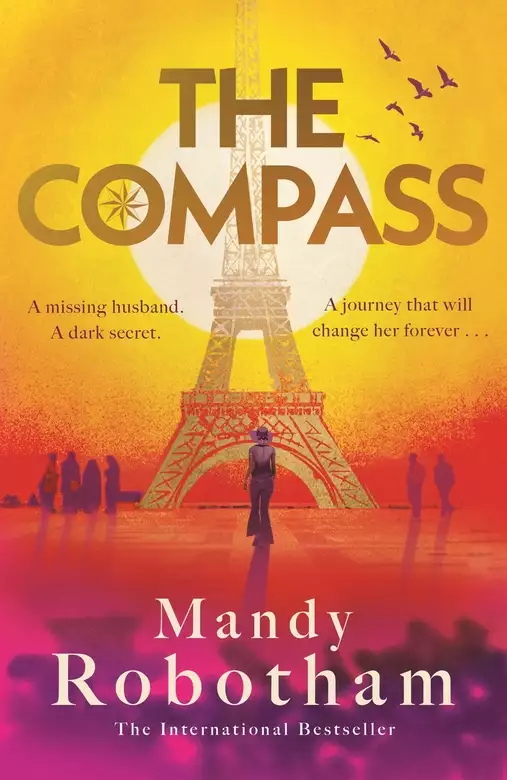
The Compass
- eBook
- Book info
- Sample
- Media
- Author updates
- Lists
Synopsis
June, 1976. Western Europe is caught in the grip of a relentless and sweltering heatwave. In London, the summer marks a milestone of a different kind for Edie - a decade married to the love of her life, and their first child on the way.
But on the night that she plans to tell Joe their news, he doesn't come home. Fearing the worst, Edie scours the city for her missing husband, and eventually she unearths a clue: Joe's wedding ring, alongside a note urging her towards Paris.
Using her heart as a compass, Edie sets off on a journey that takes her across Europe, following a trail that promises to unlock the mystery and lead her to Joe.
As tensions rise and temperatures soar, Edie draws closer to the truth - but unravelling the past comes at a cost.
When the heatwave finally breaks, will it take Edie down with it?
Epic love and long-kept secrets collide in this evocative, enthralling, unforgettable novel, set against the backdrop of the era-defining 1976 European heatwave, from international bestseller Mandy Robotham - perfect for fans of Kristin Hannah, Victoria Hislop and Lucinda Riley.
Release date: August 27, 2026
Publisher: Little, Brown Book Group
Print pages: 90000
* BingeBooks earns revenue from qualifying purchases as an Amazon Associate as well as from other retail partners.
Reader buzz
 Please log in to recommend or discuss...
Author updates
The Compass
Mandy Robotham
His vibrant trousers are the first to appear, inching into a midfield of vision between my two curtains of dark hair as I sit on the grass clutching at my own knees. Tomato soup red, I note, when the Beatles are riding a fashion high in their black and white Nehru jackets, and the kaleidoscope of colour is just beginning to creep across London.
Inside the tomato trousers, his long limbs are moving left to right, a few yards in front of me, running to kick and control a football with a couple of other men. A cluster of women guard a picnic basket nearby, while the guys use their pile of jackets as goalposts, their cheers and jibes of ‘Oi, watch it!’ and ‘What was that?’ swallowed in the vast openness of Green Park and the golden arc of late afternoon sun.
In truth, I think nothing more of the panorama before me, retreating behind my hair again and absorbed by a dog-eared paperback copy of Mrs Dalloway, pleased to be soaking up the last rays after eight hours trapped in some third-floor prison-office nearby.
And then the red flashes into my eyeline again, closer and closer, until I’m forced to flinch at the ball, followed by the tomato-clad legs hurtling towards me. His limbs stop just in time, though the ball doesn’t, bouncing off my knees with a distinct thud.
‘Oh, sorry! Sorry,’ the voice above blurts in apology, bending to pick up the leather ball. ‘That wasn’t meant to happen.’
I hook one side of the hair curtain over my ear, looked upwards and smile meekly at the man beaming down, a fringing of dark curls around his long lean face. Backlit by the glow, he could easily pass an audition to play Judas Iscariot in any one of the nearby West End theatres. ‘It’s OK, no harm done,’ I say. ‘I’ll live.’
He squats, pushing both knees towards me, red weave mixing with a scuff of grass green from the parkland palette. ‘Yes, but you didn’t come here to be a ballboy for our game,’ he says.
‘I believe that might be Wimbledon you’re thinking of,’ I respond, realising too late how snooty it sounds. And yet his head simply cocks to one side, and I should know I’m in trouble from that point on.
‘You’re absolutely right,’ he says, ‘because it’s linesmen at football, and there are solid barriers to stop the ball.’ A row of white teeth emerges from the shadow of his face. One at the front has a slight kink to it, reminding me a little of John Lennon – that tiny imperfection making him seem all the more interesting. ‘I’m sorry if we mistook you for a barrier,’ he goes on. ‘You seem much more malleable than that. Hardy but soft.’
I don’t have a quick enough riposte for that, glad to be saved by a voice cutting through the air. ‘Hey, Joe! Come on, stop having a sneaky break and get back here.’
He levers upwards on those legs and I prepare to watch them striding away without hesitation. Instead, he palms the ball and hurls it back towards the crowd of waiting players, promptly dropping himself on the grass next to me. Seamlessly, he folds one leg under himself, the other splayed out in front, leaning back on one hand and offering the other slightly grubby one in formal greeting.
‘Joe,’ he says, as I take it. Like his legs, his fingers are long and lean, and I have a lightning sensation of his bones and flesh winding around mine, but in a good way. A beautiful plant rather than the strangulating tendrils of some sea creature from the deep. I feel captured all the same.
‘Edie,’ I reply.
‘Lovely name,’ he says. ‘What are you reading, Edie?’
It’s the opening that I can answer to. We talk until the sun dips below the trees, and the cluster of friends signals they are leaving. ‘We’re off to the pub,’ they call. ‘See you there?’
‘Yeah,’ he replies, but without commitment.
The fact is we stay until the light almost disappears, and the never-quite-dark of summertime sky mingles with the phosphorous glow of the surrounding capital. Just talking. About books, and life, and our respective dead-end jobs and how we will one day Do Something Useful. Leaving the park eventually, he and I walk the length of Piccadilly towards the circus, skirting around Eros on his plinth and the tourists taking snaps under it. There’s nothing formal or awkward about it when he asks if I’m hungry, and I nod: ‘Do you know anywhere?’ He does, a tiny Italian tucked away in the labyrinthian Soho streets, where we eat very good pasta and drink too much red wine, and I let him kiss me as we wait for my bus back home to the dingy flat that I share with two others on Hackney High Street. His lips are so soft, and I think it’s lovely that he’s slightly hesitant, waiting for me to respond. It isn’t my first kiss, but feels like it, floating on air and then flying at speed. It’s how they describe it in books, isn’t it? Only this isn’t fiction. When I kiss him back, pushing hard into his warm flesh, there is no doubt of his want, that he likes me, that it isn’t just the cheap wine fuelling our mutual attraction, and that he will ask to see me again.
We swap office numbers as the bus approaches – since neither of us has a phone at home – and he asks if it’s OK to call, and I say ‘of course’. I ride all the way home on the top deck, listening to a couple on the back seat taking verbal chunks out of each other, and yet only conscious of a mini volcano somewhere inside me, firing off a whole display of multi-coloured sparks.
And that’s us: Edie and Joe, Joe and Edie. No great love story, no Romeo and Juliet or Burton and Taylor, or an idiosyncratic coming together. Just a boy and a girl who meet in a park and like the look of each other. Only it soon is love – our love – and it grows so deep that some days I don’t know what to do with myself, as if time without Joe is minutes and hours merely to be borne. Pathetic, isn’t it? Over the next six weeks, I’m felled by the heart: the Edie who has always kept something back in the past, who isn’t quite your classic wallflower, but near enough at parties. Who imagined no man would ever plunder the physical or emotional depths of her soul.
Until Joe. Then, I see his face as I wake each morning – even before the days when he’s physically next to me – and last thing at night. I take to reading cheesy eighteenth-century romances – that ‘beating heart in my breast’ type of thing – and feeling total empathy, lost in love.
Despite being a woman well schooled in knowing my own worth, I begin to divide my life into pre- and post-Joe.
Because from the very first moment I see those tomato-red trousers in the park, that’s how it is for me. Joe and Edie. For ever.
Friday 6 August 1976, London
Day One
It feels like the last day at the end of a school term, watching the wall clock crawl by, second by agonising second, the sun streaming across the gnarly wooden classroom desks. My undercurrent of excitement is the same now, stymied like steam in my mother’s ancient pressure cooker. Even the fly above my head wavers sluggishly, in rhythm with the buzz of the strip lighting overhead.
‘Waiting for something, are we, Edie?’ The unctuous tone of Mr Colman’s voice invades my daydreaming, and I hate him for it. Even more than usual. It’s a Friday afternoon at 4 p.m., and the newsroom is the Mary Celeste – the deadlines have come and gone, the flurry of activity passed and the office barren after the daily exodus of reporters to the nearest pub, where they will imbibe far too much alcohol for those who set the agenda for the country’s thinking. As they do every day, as far as I can tell, and not just on a Friday. The admin staff – lowly typists and filing clerks like myself – aren’t afforded quite so much freedom around their working hours. So, yes, I’m waiting for my turn to flee too. What else does Colman expect? I look at his pasty grey face and work to contain the frustration bubbling under my skin. Just. Never be fooled into thinking the frenzied world of national newspapers is overpopulated with vibrant personalities; it has its fair share of dullards too, and Colman is a prime example as MD – Monumental Dullard.
Ede, don’t be so infantile. Especially now.
‘Go on, then, take an early afternoon,’ he sighs, and I like him a little bit more, until he adds that I can make up the time on Monday. Imbecile.
I manage a smile, but he’s gone already, physically from my eyeline, but also sunk to the bottom of my consciousness. I have only one purpose now. To get home and make things perfect. To be ready. To begin my new life. Our life, Joe and me. My skin pricks at the mere thought, hairs on my forearms hoisted and I shiver, despite the clammy, oppressive heat.
Outside, London ripples with that late summer sheen: the tired, dusty streets having nothing left to give back any more, so drained of the lifeblood that is rain. The afternoon reeks of the capital’s newest cologne, the pungent odour of baking tarmac tweaking my nostrils, mingling with invisible pockets of sweat as men in City suits pass by, jackets over their arms, heading to the nearest bar to decompress. For a second, I crave a cool half pint of beer too, almost feel it slipping down my throat, but there are several reasons why I should resist, not least that I haven’t time to veer from my purpose. I’ve waited so long for this, and it has to be right, choreographed to last detail. In my head, I’ve written the perfect script to a classic love scene, a cinematic masterpiece, and now it’s up to me to stage it.
A punk standing by the station entrance turns so that his stiff, starched fan of orange hair – a Mohican, I’ve heard it called – is backlit to create a ray of sunshine, and it makes me smile. The newspapers tell us they’re the new threat, and this ‘sect’ of anti-hero punks will soon overrun the city. This one, though, smiles back, the safety pin hanging from his ear seeming to wave in unison. I’ll take that as an omen, I think, as I descend into parched, fuggy world of the London Underground.
‘Hallooo,’ I call into the hallway of our Camden flat, kicking the door shut behind me, labouring under the weight of several shopping bags. It’s a habit of mine to call into the empty air, so when there’s no answer I’m unsurprised and relieved. Joe doesn’t finish until five on the dot, with a longer journey home on the overground train, which means I have just over half an hour to make the Bolognese sauce, wash the salad leaves and lay the table, flowers and all, a perfect anniversary feast. The Black Forest gateau simply has to defrost as we’re eating, though he might be too excited by my news, too overwhelmed to touch it, even if it is his favourite. My own stomach is on a spin cycle as the minutes tick away, and I distract myself for a few seconds by unfurling the clammy weave of work tights from my legs and leaving the olive skin bare, as he so loves. I wonder for how much longer I’ll be able to bend down and shave my shins smooth or tie my shoelaces.
Eventually, everything’s ready, bar one more thing. The best bit.
The pasta sauce is bubbling away as I decide where to place the sliver of paper. I settle on placing it under his napkin, where he’ll find it sooner rather than later, because we never normally have them. Joe will make a joke as he unfolds it with a waiter-style flourish and a silly faux-French accent. Then he’ll see the tiny square of folded paper, and my rippling, bridled excitement can be unleashed, allowing my secret joy to become his. Ours.
I can’t wait.
But I’m forced to, as the clock ticks agonisingly past 5.30, when he’s usually home. I watch from the window like a patient, loyal dog, nose almost to the glass. Another ten, then fifteen, minutes. Then I wait some more, until the amber glow begins to wane and the kitchen is simply dim rather than sultry, the air moist with a hazy mix of heat, anticipation and steam from the pasta pan, which still roils with salted water, ready for the second he steps through the door. I switch on the radio and listen to the six o’clock news, for updates on delays, or worse, another bomb blast. There was that terrorist attack last year in Oxford Street, and then Green Park Tube, one dead and many maimed. Please, never, but not today, especially. Life can’t be that cruel, surely?
By half six, my slight angst is weaving the worst scenario. Joe isn’t one of those men who slides by the pub on the way home for a quick half, and he’s only socialised with his office colleagues once or twice, insisting they don’t hold much interest for him. He prefers to come out with the friends we’ve made together, he says, too quiet in himself to be ‘one of the lads’. Only when Arsenal is playing on a Saturday – his ‘other wife’ as he laughingly calls it – does he head to the pub after a match to chew over the game with some of the other supporters. Sometimes, I do feel like we live with the favoured eleven players of the team during the nine months of the year, but it’s still the off-season, so he can’t be there either.
Minutes tick away, more slowly than under Colman’s glare. A call to Joe’s office phone rings out, because they’re all likely to have deserted the stark, uninspiring block of metal and glass hours ago. Unable to sit still, I dial everyone I can think of, half of whom aren’t in, but then it is Friday night and the pubs will be spilling over into the concrete gardens, basking in that golden blanket of late evening sunshine, the beer-fuelled chatter of drinkers rising across the city. It’s a British summer – you have to soak it up when you can, even if this one seems endless. No one I do speak to has heard from Joe today. ‘He’ll be fine,’ is the general refrain from those I talk to. ‘Delayed somewhere on the train, bound to turn up soon.’
He has to, I think. We have a life to map out. Plans to make, years stretching ahead of us.
By seven, my energy is sapped and yet I can’t settle. Turning off the goop of now overcooked sauce, I grab my keys and clatter out of the door, though where I’m heading is anyone’s guess. But the heat and the flat are oppressive, making my head throb and gnawing at my stomach lining as I veer between hunger and nausea. I need air, even if it feels warm and sickly in my lungs, mixing with the noxious traffic fumes of north London streets. Consciously or not, I find myself at the police station several streets away, one of those old Victorian buildings that surely has been in operation since the Bow Street Runners. I’m no great fan of London’s policing ‘Met’, not since Joe and I were caught up in protests in the late sixties, but the old blue lamp hovering above the door oddly calms the thrum inside me. They will know what to do.
‘Evenin’,’ the young, ruddy constable in shirtsleeves says from behind the high wooden counter, hesitating, I note, before he opts for either Miss or Mrs. ‘Can I help, madam?’ he chooses instead, his face flushed from the stifling heat bouncing off the wood-lining of the waiting room, while a tabletop fan ticks away languidly behind him. PC Harrow, according to his name badge, has drawn the short straw of shifts.
‘I’m … I’m looking for my husband,’ I manage. ‘He hasn’t come home.’
The constable’s face drops. Does Friday night behind the desk get any worse, he’s no doubt wondering. ‘How late is he, madam?’
The hands of my watch sway left and right behind sticky eyelids, merging eventually to just gone half past seven. ‘Erm, two and half hours maybe. At least two.’
His face sets. Silly cow, he’s thinking now.
‘Anywhere he could be?’ he asks, reeling off the policeman’s script. ‘I mean, it’s a lovely evening, he might have stopped off for a drink.’ One hand gestures towards the open door and all the people across the capital having a fine old time in a pub garden, where he isn’t.
‘N … no,’ I stutter. ‘I’ve thought of that, but Joe is never late, and he would have rung. It’s our tenth wedding anniversary. I’m worried he’s had an accident, or … I don’t know, been mugged. That he’s lying hurt somewhere.’
The constable wipes sweat from his cheek. ‘Well, it’ll be a good while before he’s officially a missing person, by which time I’m sure he’ll be back home, safe and sound. Have you rung round his friends?’
‘Yes, of course!’ Now I’m cross at his patronising tone. ‘I wouldn’t be here otherwise, would I?’
‘Madam, I’m just …’
‘And I’m pregnant!’ I blurt, instantly hit with a fiery arrow of guilt that PC Harrow should know of this groundbreaking news before my husband, the father of my child. Except it just comes out, as some sort of viable excuse for my concern rather than a cry for help.
Oddly, PC Harrow is galvanised into action. He can’t help leaning over the counter and staring at my belly, which at barely nine weeks is still flat under my thin cotton skirt. ‘Do you need to, um, sit down? A glass of water?’ He glances back at the desk, as if desperately searching for a crib sheet entitled ‘pregnant citizens – dos and don’ts’.
Having not felt faint at all so far, his question sparks an awareness that I do feel light-headed, only the hot, stagnant air holding me upright. ‘Yes, yes, some water please.’
I manage to shuffle backwards towards a bench seat, and a female officer appears from behind the counter, with a glass and a sympathetic expression. ‘Here, drink this,’ she says. ‘I’m WPC Gardiner. Let’s see if I can help.’
I guzzle the tepid London tap water as if it were from a fresh alpine spring. ‘Sorry, sorry,’ I say between gulps.
‘Don’t be,’ she insists. ‘Is it your first?’
I nod.
‘I was all over the place with my first baby,’ she rattles on, ‘flopping about and having to keep chocolate bars in my handbag. Those first few weeks are hard, when you daren’t tell anybody, but you still feel like death.’
I’d been keeping everything in until then, but her compassion and a flood of hormones sets me off. Suddenly I’m sobbing into her shirt, which is crisp and white, and smells of deodorant rather than sweat. In the background, PC Harrow looks on, although he could well have been taking notes.
WPC Gardiner leads me through the security door and into the back office, producing tea in a plastic cup and a saucer of chocolate biscuits, which I go at hungrily, since it’s gone eight o’clock by then and I’ve not eaten since lunch. Sipping and chewing, I give her a full description of Joe – tall, almost six foot, and lean; slightly curly dark hair that’s on the long side and always shiny; pale skin and brown eyes. ‘Beautiful brown eyes,’ I can’t help saying. She smiles but doesn’t write that detail down.
‘Any facial hair?’ Constable Gardiner – Lizzy – asks.
‘Er no, clean-shaven, though his stubble grows thick and fast if he misses so much as day with the razor.’
‘That’s useful to know. Any distinguishing features?’
‘A small scar on the left side of his forehead, next to his eye.’
It’s from a childhood accident, so pale and etched into his skin, but sings out to me as the first thing I see every new day when he rolls over in bed with a smile, and asks: ‘Tea?’ Joe is good in the mornings, much chirpier than I am, and the mere thought of that scene not greeting me when I wake tomorrow causes another painful lump in my throat, swallowing the biscuit crumbs with difficulty. My tea has gone cold, but it serves to push everything back down. Lizzy leaves me alone to go and check for any relevant reports.
‘Nothing,’ she announces, returning after ten minutes spent in the station control room. Seeing my deflation, she adds: ‘And that’s a good thing, Mrs Drummond. There’s been no sighting in any of the hospitals I’ve rung, and no mention in our crime reports across the city divisions. It’s positive.’
Is it? So, what else could have happened? Could he have left of his own accord? Left me. No one has said it outright, but I see it in her fleeting pitiful expression, know that the young constable at the desk was silently writing it off as the same. A domestic. A box will be ticked on a form, sad but all too common. The husband has upped and left.
‘I promise you that in most of these cases the so-called missing person comes back with a tail between their legs,’ Lizzy reassures. ‘In very good health, aside from a huge hangover. He’s more than likely wetting the baby’s head, well in advance and with gusto.’
I don’t tell her that Joe didn’t know – doesn’t know – about the baby, because what else will she do? Joe isn’t a child, or a vulnerable pensioner gone walkabout. He’s an adult, capable of finding his own way home. Or not. And of going elsewhere, running away from his responsibilities. Except I know he wouldn’t.
Lizzy gives me her extension number and says she’s working the weekend. Can I let her know if he turns up? Of course, I nod. ‘Ginger biscuits,’ she says as a parting shot.
‘Pardon?’
‘Ginger biscuits – for the nausea. I swore by them, and they won’t melt in your handbag in this heat, not like chocolate.’
I thank her and step back into the empty street, feeling … well, I don’t even know. The sky is a deep seamless blue as I walk towards home, one of those evenings where the day never quite relinquishes the light, unlike in winter, when the dark holds dominion. The heat still pulses and my forehead is slick with perspiration, wrinkled with angst and a creeping terror. The hallway in the flat is near pitch-black, and I say it again, out of habit, but also with renewed hope that I have simply jumped to conclusions too soon, awash with over-reactive hormones. ‘Hallooo?’
Solid and contained, the silence beats back at me.
The Bolognese sauce has congealed, leaving an orange fatty deposit around the sides of the pan, and the flowers are wilted and starved of air. I slump at the perfectly laid kitchen table and weep, partly for my staging and my efforts, feeling drained and exhausted, but also fuelled by a fear I have never known in my so-far unhindered life. I’m hit by the sudden awful realisation that he is gone. Where to, I have no clue, and by choice or by force, I’m not sure, but my husband is absent.
Wiping my eyes on the napkin sends the folded jewel of paper floating to the floor, and as I bend to retrieve it, I spy the now defrosted Black Forest gateau gone over to molten, the chocolate layers sunken, and the plump cherry on top sliding into a creamy abyss.
My forever Joe is gone.
Saturday 7 August
Day Two
The night waxes and wanes – exhaustion versus anxiety, dry dust in my throat against moist, sweaty sheets, and my brain hosting endless rounds of a dull, sluggish boxing match: where would he go? And why? Joe wouldn’t leave me, would he? Not by choice … So, he must be lying in a ditch somewhere, injured, or worse? How? The thud of my own thoughts emerges as a painful throb, until I surface enough to realise that the rhythm is shaped by a heavy bass riff courtesy of Led Zeppelin carrying from someone’s stereo, across the thermals of city air and through my open window. ‘Whole Lotta Love’. It’s been the soundtrack of my life for so many years, a song I adore, have danced to with abandon countless times, and one of Joe’s all-time favourites. But, right now, I wish Robert Plant would damn well shut up.
I run my tongue over arid teeth and palm at my still flat belly in unison, reaching further down between my moist thighs and holding my breath for an unwelcome visitor, an instinctive action since getting the positive pregnancy test. Relief, though, when my finger pads detect only a thin film of fluid, and not the viscous slip and slide of deep red and dread. I know the difference all too well. Twice in the last ten years, that fear became raw reality, boring a physical and mental hole in me and in Joe. One miscarriage feels unlucky, two drives to convince any woman that she is a physical failure. It was in the early days, both times around eight weeks, but the hole of loss never quite closed up in either of us. Even with my well-honed detection, my breath remains trapped each morning until I pull up my hand from under the sheet in one swift move and scrutinise the colour of my fingers. Pink. Fleshy pink is good, I remind myself, and I’m able to push out the anguish with a loud sigh of relief. Except there’s no one to hear it.
Untangling my legs from sheets that wind around me like bindweed, I lie back for a few minutes, listening to the sounds of Saturday morning, just as we’ve done for years. I’m utterly sure that just as many buses trundle up and down the high road on weekends, sputtering out grey fumes with their throaty rumble, and yet the strains of the engines never seem quite as urgent. ‘Even the buses know it’s Saturday,’ Joe joked once, stretching his lean body into a starfish shape as I deposited our breakfast toast on the bedside table and nudged back in beside him. He was always softer at the weekend somehow, unburdened by work, and I loved nestling my head into the relaxed, accepting muscle of his shoulder. He hated his job, the office woefully underheated in winter and stifling in the summer. Trapped year-round by the grating boredom of pen pushing and paper shuffling, waiting for the right opportunity to ‘go higher. I will get that promotion, Ede,’ he promised. As much I wanted to free him from it, give him licence to hand in his notice and tell the buttoned-up office manager to go to hell, I knew we couldn’t live on my wage alone, not with inflation the way it was, the country’s finances in turmoil and the weekly bills only destined to go up. But oh, how I loved weekend Joe, with his supple sinews and his ready laugh coiling upwards and escaping his taut belly of angst. ‘Breakfast in bed for my princess,’ he sometimes said, levering himself upwards. ‘One golden yolk or two?’ He’d found some frying pan mould in a posh cook shop and surprised me one day with heart-shaped eggs, and I remember actually crying, so overwhelmed by the love contained in one simple act.
‘My daft princess,’ he grinned, but I could see he was secretly pleased at my reaction.
But no crazy eggs today, no cheerful morning hello, no husband. Instead, I make my own starfish on the sheets, wriggling with some odd notion of finding his imprint on the mattress, to slot into his shadow and remind myself that he was once here with me. Only it’s not there. Like everything in my mind right now, it’s wishful thinking.
I should call my parents, and yet the very thought conjures a swathe of unease I can’t face, in predicting what my mother might say: ‘Missing? What do you mean, missing?’ she will squawk into the receiver, her tone dropping rapidly to disdain. ‘Well, I never really trusted him, Edie. Me or your father. I know I shouldn’t say this, but you’re better off without him, love. It’s his loss.’ She might not be quite so blunt quite so soon, but it’s what will travel down the phone line, her relief against my distress. Whatever she says, it won’t be the succour or reassurance I so desperately need.
I could call Sally, my closest friend from school. She would be sympathetic, mutter the right sentiments down the phone, and probably offer to make the journey from deep in the Oxfordshire countryside. Without doubt, I would cry on her, but to what end? She can’t search for Joe, or bring him back, and the thought of bearing anyone else’s pity makes me shudder. Hauling myself off the bed and into the kitchen, I make toast and push it into my mouth, fighting minor waves of nausea but telling myself I have to, for our baby’s sake.
Where in the world are you, Joe?
I’m pulled eventually towards Joe’s beloved record player, flicking through the stack of albums that he maintained were ‘classics’ in the vein of Beethoven’s Fifth – Pink Floyd’s Dark Side of the Moon, and David Bowie’s iconic Ziggy Stardust. ‘I’ll be in my grave before this music ages,’ he argued fervently, his fingers tracing over the artwork. I didn’t disagree, though the sound was more of a wallpaper to our life together. Which is why I can’t bring myself to slip any one of them onto the turntable now, even though the solitude inside the flat is agony.
Instead, I pick out an album I’d bought for Joe, principally as a joke, though the songs quickly grew on m. . .
We hope you are enjoying the book so far. To continue reading...
