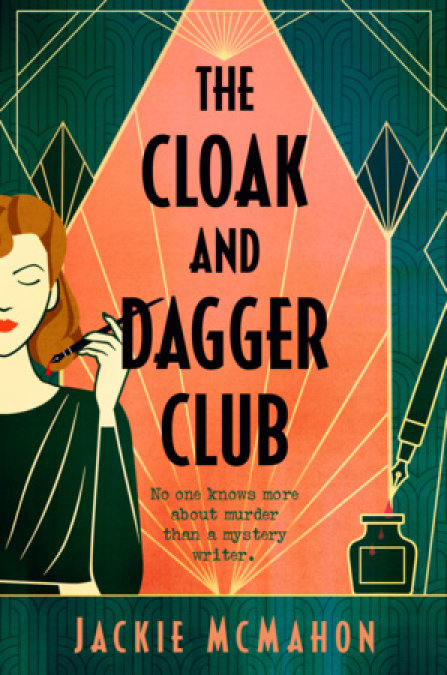
Inspired by Agatha Christie's real-life Detection Club, a murder among a group of golden age mystery writers meets a second chance romance in this debut novel from author Jackie McMahon.
London, 1930. Lucy Hubbard is on the cusp of achieving her dreams. With her first mystery novel debuting with strong sales and glowing reviews, she's been invited by Horace Hazelmoor, the king of crime fiction, to join his elite group of writers—the Cloak and Dagger Club.
Thrilled at the opportunity, Lucy finds herself swept up into Horace's glamorous world at the Ritz hotel. She's even willing to put up with the inconvenient presence of her former fiancé, Frank Murray, the club's rising star who is on track to eclipse Horace as Britain's most popular crime writer.
But when Horace is found with a knife in his back, Frank is the police's prime suspect. Despite their complicated history, Lucy knows he's not capable of murder. With suspects galore and the danger rising, these two mystery writers must race to solve the crime—and fight their lingering feelings for each other—before the murderer strikes again.
Release date:
July 14, 2026
Publisher:
Berkley
Print pages:
368
* BingeBooks earns revenue from qualifying purchases as an Amazon Associate as well as from other retail partners.
The train carriage jerked to a halt, and Lucy's pen slid off the page. Damn it. That was what she got for trying to write on the Underground. Especially when it was standing room only.
She'd been balancing her notebook on her thigh, hunched to jot down an ingenious idea for a clue. Working on these short stories for her editor had cost her sleep, time, and now, apparently, her apparel. Lucy cursed. A splotch of black ink stood out from the pure white cuff of her blouse. Her attempts to rub the stain away made it bleed further into the fabric.
Now the others would think her sloppy. Why had she chosen a white blouse? It was such an unforgiving color.
A crowd rushed to the tube doors as the train slowed toward Dover Street station. Men with jutting elbows and women with large purses blocked the exit, a wall of bodies. Lucy tucked her notebook into her bag, gripping a handrail to brace herself against the carriage's jerky movements.
"Pardon," she said to no one in particular. "Excuse me."
Three and a half years in London had not yet taught Lucy the confident aggression needed to navigate the travails of public transportation. When the doors opened, someone shoved past her, an unruly umbrella hitting her in the chest. The crowd was as sharp as a knife against flesh as they fought to be the first to exit.
Ooh, what a delightfully dark turn of phrase. It would have to go in the notebook.
As she shuffled onto the platform, Lucy checked her wristwatch. Almost noon. She would have to hurry. Unfortunately, the elderly couple in front of her had all the haste of a tortoise, and Lucy sighed, blowing a loose strand of hair from her eyes.
She could not-under any circumstances-be late.
Absentmindedly, she reached into her skirt pocket, fingertips ghosting across the stationery's crisp edge. The invitation was heavy, with gold trim and a white envelope, and over the past week, Lucy had pulled it out countless times. Yes, it really read Cloak and Dagger Club, and yes, that really was her name at the top, and Horace Hazelmoor's at the bottom.
Lucy knew the Cloak and Dagger Club. And she knew Horace Hazelmoor. Everyone did.
She just didn't understand why he wanted her.
Lucy was proud of her novel-Spoonful of Cyanide had received more critical and commercial acclaim than she'd ever dared to hope for-but the Cloak and Dagger Club was exclusive. Surely, there had to be hoops to jump through, tests to be passed. Why would Horace Hazelmoor invite her, of all people? They'd never even met.
Well, they had met once, but Lucy didn't think Horace would remember it.
Dear God, she hoped he didn't.
Thinking of the party still yanked at her insides. The heat of the room. The loud music. The uncomfortable black dress, and how it constricted her chest as she cried. Pain, searing across her bleeding palm. Horace must've forgotten, because if he hadn't, he wouldn't want her anywhere near his club. Not after the scene she'd made. And Frank . . .
Lucy stepped onto the street, squinting against September's golden glow. Frank would probably be at the meeting-he and Horace were close. At least, she assumed they still were. It had been three years since she saw Frank anywhere except in a newspaper.
Would he still laugh the same, have the same drink order, or fiddle with his pen? Would he greet her with a big smile and a familiar "Hey, Red," or would he look at her with scorn, lips curled back from his teeth?
Did this invitation have something to do with him?
No, Lucy was letting her imagination run wild again. Frank hadn't spoken to her since the party, hadn't telephoned. And if he wanted to repair what broke between them that night, he wouldn't summon her to a writing club. That wouldn't make sense at all. Perhaps he hated her for embarrassing him. Perhaps he didn't think of her.
The latter seemed, somehow, the worse of two evils.
Lucy halted on the pavement, examining the Ritz's Parisian facade. Though it had been open only twenty-four years, the Ritz had the stoic elegance of a centuries-old monarch. With its tall windows, elaborate columns, and the open-mouthed copper lions on the corners of the roof, the hotel's presence loomed large. Lucy had seen it many times, but never had she gone inside.
There was still time to turn around.
She could face Frank. For her own good, she could face him.
And, truth be told, she was dreadfully curious.
Lucy took a deep breath and quickened her pace toward the hotel.
Perhaps it’s Agatha Christie,” Jonathan said.
Christine gave a half snort, half laugh. "Definitely not."
"Why not? It could be."
"No, it couldn't, because Horace would never let someone more famous than him step foot into this club."
"Oh." Jonathan crossed his arms and leaned back against the sideboard. "You're right. I suppose it's not her."
They'd spent the past twenty minutes standing there in the Marie Antoinette Suite, staring at the long table: white tablecloth, gold-trimmed china plates, napkins folded into perfect squares. Yellow flames flickered in the candelabras, and a bouquet of bloodred carnations sat in the center of the table, alongside a familiar hollow-eyed, white object. The skull was their macabre mascot, a constant presence at all meetings. Everything looked perfectly normal.
Except the table was set for seven. The Cloak and Dagger Club had six members.
"Goodness," Countess Andrassy said as she surveyed the tea trays, piled high with iced cakes and plump scones. "I do hope it's not Arthur Conan Doyle. I met him once, at the police commissioner's birthday party. What an odd man."
Jonathan's forehead creased. His glasses were halfway down his nose, but he made no move to fix them. "Countess, Conan Doyle is dead."
The countess paused as she lifted a scone to test the weight. "Forgive me, I'd quite forgotten. When you get to my age, you really know a lot of dead people. It gets hard to remember who's on which side of the grave." She discarded the scone, and it landed with a soft thump. "I've been in this country thirty years, and I still don't understand the English fascination with scones. Dreadful things. Almost as bad as the weather-one's always dry, the other's always wet."
"What," Graham interrupted, "is a seven-letter anagram for 'real fun'?" He was sitting with both elbows on the table, his plate and napkin shoved aside to make room for his morning newspaper. That old pencil of his-barely more than a stub-appeared comically small in his calloused hand. Once, Jonathan bought Graham a Smythson fountain pen as a birthday gift, but he refused to use it, not for his cryptic crossword anyway. Graham used this pencil for his crossword every morning and intended to do so until the last speck of lead.
"Funeral," Christine said with a disinterested shrug. Graham's blue-gray eyes brightened, and the pencil stub scratched away again, punctuated by a quiet exclamation.
"Capital!" Graham said. "Just capital!"
While Graham resumed his crossword, Christine and Jonathan stared at the additional seat, and Countess Andrassy quit her inspection of the food to join their vigil. "Could be Margery Allingham," Jonathan mused. "Or that Gordon Daviot fellow. Has anyone else been wondering who he is? I'm dying to meet him."
"I don't like it," Christine said.
"What? Gordon Daviot? I thought The Man in the Queue was excellent-"
"No, I mean that someone's coming here, and none of us know who it is."
Silence enveloped the room, save for the faint noise of Graham's pencil. "Well"-Countess Andrassy's accented voice was barely more than a whisper, and both Christine and Jonathan strained to hear-"one person probably knows."
Countess Andrassy didn't have to clarify who she meant. "Horace," they said, in unintentional unison.
"He thinks," the countess said, "that just because he founded this club, he can do whatever he likes. Well, there are four of us-five, if you count Frank, and he feels the same way, certainly. Horace only gets one vote. Why should he tell the rest of us what to do?"
"You don't suppose he's invited another reporter, do you?" Jonathan asked. That was the last surprise Horace had sprung on them. He'd brought it up at the end of a meeting as they were all standing and fetching their hats. "By the way," he'd said, "a journalist will be joining us next week to write a piece on the club." It hadn't been a question, the way he said it, but a statement. Horace rarely asked questions. If he did, there was the possibility he'd get an answer he didn't like.
Countess Andrassy waved Jonathan off, her bracelets clinking as she did so. "That didn't work so well for him last time. The article was"-she scrunched her nose-"let's say, less than flattering."
"Graham tried to warn Horace. He told him not to trust a tabloid-Graham had plenty of experience with publications like that when he worked at the Yard, and knows how they love to play with facts. Isn't that right, Graham?"
"What," Graham said, not looking up from his newspaper, "do you think about this one? 'Riddle even the nicest mind is not gifted at making easily apprehensible.' Six letters. Second letter should be an n."
Christine groaned. "Enough about that damn crossword, Graham."
"Anyway," Jonathan continued, looking at the countess, "I guess we'll know soon. About number seven."
"Whatever it is, it won't be anything good." Christine pulled a cigarette from her dress pocket and held it between her teeth as she fumbled for her lighter. "Horace probably came out of the womb scheming."
Christine took a slow puff, and for once, the countess didn't complain about the horrendous smell, nor even cover her nose. Instead, they all stared at the seventh chair, wondering what Horace had in store. They were a roomful of crime novelists, and yet they still couldn't manage to decipher his plan.
Because there had to be a plan. There always was with Horace.
After several moments, Graham snapped his fingers. "I've got it!"
The others looked at him expectantly, leaning forward as they waited for his guess with bated breath. Graham had a self-satisfied smile on his face. "Enigma!"
Countess Andrassy's shoulders slumped. "Pardon?"
"Enigma. The clue says 'even,' so you take the first letter of every second word. E-N-I-G-M-A. See?"
Christine tilted her head back and blew a smoke ring toward the ceiling. "Good God," she muttered, pressing the base of her hand against her eye. "I should like to throw that cryptic crossword into the Thames."
Horace swiveled on his bar stool, the condensation from his glass cool and wet against his palm. He’d always loved this seat. It was comfortable. It was easy to get the bartender’s attention. And, best of all, it offered an enticing view. The Ritz’s bar was adjacent to the lobby, and from here, he could see every person who walked through the front doors.
He lifted his gin to his lips, and those lips curved upward when Lucy Hubbard stepped inside.
Her round, freckled face made her appear younger than her twenty-eight years, and Horace sized her up. Lucy Hubbard's hair tumbled to her shoulders in fiery waves, and her eyes-currently looking around in wonder-were large, blue, and accentuated with long lashes. As she walked past the bar, she moved with the halting uncertainty of a baby animal. If baby animals had an ink stain on their sleeves and a rip in their stockings.
Horace had inquired after Lucy Hubbard. He knew her agent-an advantageous acquaintance, as all Horace's acquaintances were. The man had been quite happy to share what he knew about Lucy once Horace got a few drinks in him. Despite her looks, Horace could not underestimate her. That book she'd written was clever, even by his standards, but that was all right. Horace liked his adversaries to be worthy. That made it all the more satisfying when he triumphed over them.
And oh, he was going to triumph. He had one major advantage over this young, clever girl: He knew what was coming.
Horace hummed, his mind darting toward a familiar rhyme. She went to the undertaker, to buy him a coffin. He stifled a laugh, silently toasting himself. The gin tasted better than usual as it glided down his throat.
People wrote books for many reasons-to entertain, to tell stories, to express their feelings-but Horace wrote for something else entirely. Control. The characters did whatever he told them to. They lived and loved and died at his command. It was the closest Horace could come to being a god. He loved how powerful it made him feel, how he could stare at a blank page and know anything could happen, that the possibilities were as limitless as his imagination.
Only one other thing could replicate that feeling.
When a plan came together.
Horace smiled. Poor Lucy Hubbard. He almost felt guilty for what he was about to do to her.
Almost.
two
Lucy grew up in a hotel, but her parents' inn looked nothing like the Ritz.
The Bournemouth Inn was a two-story along the Dorset coast, with sagging sofas in the lobby and a constant aroma of sea salt and battered fish. The walls were painted blue, and a pair of seagulls lived on the roof. Young Lucy read or practiced arithmetic at the hotel bar, swinging her legs because her feet couldn't touch the ground. Her father would bring her his own special concoction, a mixture of pummeled blueberries and soda water he called "Lucy Juice." Lucy used to sip it as she doodled in the margins and looked out to the sea.
The Ritz had no waterfront views, though that seemed its sole detriment. As she walked inside, Lucy slowed her pace, admiring the crystal chandelier hanging in the entryway. Piano music and the clinking of silverware floated from the hotel restaurant, and Lucy's heels echoed against the marble floor. She did not know where to rest her gaze. The opulence was overwhelming.
Lucy cautiously approached the man at the front desk. He was slim and brown-haired, perhaps forty-odd, with a mustache and a bow tie. He didn't look up, scribbling something down in the guest book. "Excuse me," Lucy said, "but where might I-?"
"Pardon, mademoiselle," the man said in a sharp, heavily accented voice.
"I'm sorry-"
"Pardon." His pupils darted toward her, his hand momentarily stalling in the middle of a word. This time, Lucy conveyed her apologies with her facial expression instead of her speech. The man shook his head, muttering, "Ces invités . . . toujours pressés . . . tellement irrespectueux . . . "
We hope you are enjoying the book so far. To continue reading...

 Please log in to recommend or discuss...
