A PROFOUND REFLECTION ON THE HUMAN CONDITION IN THE SHADOW OF LOSS, DESIRE AND DECAY
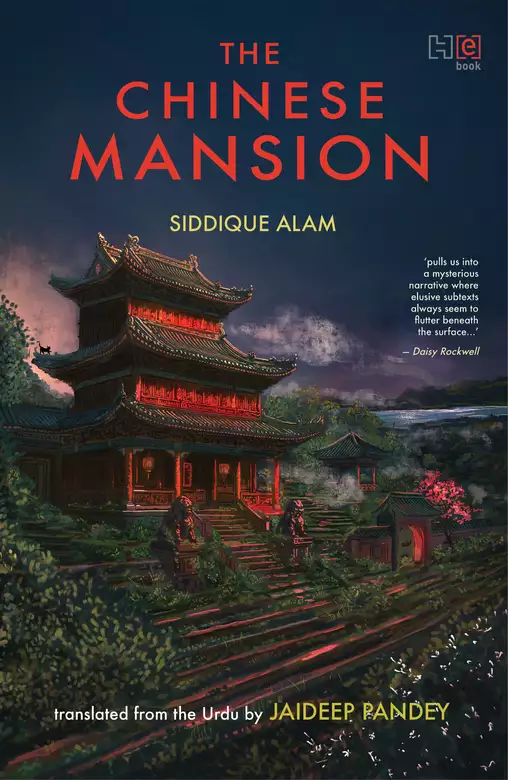
One night, a boy glimpses a dragon slipping into his bedroom - or thinks he does. The image lingers, strange and unshaken, like a riddle with no beginning and no end. Nearly two decades later, he is a lawyer in a quiet town in West Bengal, where days unfold in a hush of heat, dust and muffled lives. And across his street stands the crumbling and half-asleep Chinese Mansion, watching him as he watches it, as if the secrets it holds might one day explain his own.
By day, he navigates the ambiguous corridors of law. He defends a man accused of violating a child. He represents Aisha, a recently widowed woman fighting her family to claim her inheritance, drifting into a tentative companionship with her - never quite defined and always unfinished. He does not seek company, yet a few remain close: a retired sub-inspector who speaks to cats and his housekeeper with a murderer's past, both drawn into his orbit without ceremony or demand. The world, for him, doesn't fall apart, it simply dims and slips out of his reach every day.
Siddique Alam's The Chinese Mansion is a haunting meditation on the human soul caught in the crosshairs of grief and imagination. First published to critical and commercial acclaim in 2016, it reimagines storytelling with bold formal grace and dreamlike intensity. At once a study of small-town India and a deeper excavation of the human psyche, it moves through memory and myth, prejudice and longing, guided by a narrator whose vision grows more fractured and more revelatory with every page.
Release date:
August 19, 2025
Publisher:
Hachette India
Print pages:
272
* BingeBooks earns revenue from qualifying purchases as an Amazon Associate as well as from other retail partners.
credited with cultivating a highly symbolic, surrealistic and experimental style in Urdu prose fiction, Siddique Alam (b. 1952 in Purulia, West Bengal) is one of the most important contemporary voices to have graced Urdu fiction in India.. Alam published his first collection of short stories, Aakhri Chhaon (Last Shade) in 1982. It was followed by a long hiatus, broken with the publication of his first work of prose poetry Charnok Ki Kashti (The Four Pointed Boat), in 2003, on the landscape of Kolkata, followed by collections of short stories, Lamp Jalane Waalay (The People Who Light the Lamp) in 2007, and Bain (Mourning) in 2012.
The Chinese Mansion was published in Urdu as Cheeni Kothi, in 2016, to widespread critical acclaim. Alam followed the success of the novel by entering the most prolific period of his literary career, publishing a short story collection, Marey Hue Admi Ki Laltein (The Dead Man’s Lantern, 2019), two novels – Saliha, Saliha and Marzboom (Native Land, 2021) – and another short story collection, Nadir Sikkon Ka Baks (A Box of Rare Coins, 2022), followed by two more novels – Bioscope Wala and Marg-e Dawam (Eternal Death, 2024).
Alam belongs to a new generation of experimental Urdu writers – along with Naiyer Masud, Shamsur Rahman Faruqi and Khalid Jawed from India, and Mirza Athar Baig and Syed Kashif Raza from Pakistan – who began their literary careers in the long aftermath of the mid-20th century – appearance of avant-garde literary trends in Urdu, captured in the term jadidiyat, or literary modernism. Avant-garde trends appeared in Urdu literature as a rebellion against demands of clarity and incisive social realism created by the earlier movement – the Progressive Writers’ Association (PWA). Modernism instead emphasized the alaamati kahani (symbolic story) and declared an open revolt against established conventions and rules for literary composition by relying on complex symbols and obscure and layered use of language and metaphors that sought to challenge and confound the readers’ comprehension. While it would be reductive to say that this was an opposition between political versus aesthetic functions of literature, modernism and the PWA followed two different understandings of language and its power in relation to the world that it sought to describe. Farhat Ehsas aptly describes this as a battle between pabandi (regulation) and azadi (freedom), between the mahdood (limited) and the la mahdood (unlimited).
Alam’s work attempts a truce of sorts. His prose is grounded firmly in specific socio-political realities of eastern India – particularly Bengal – and draws on local caste politics, language debates and class structures to paint a heavily layered world and the complex structures of power that produce it. At the same time, however, his novels and short stories are impressionistic, and experiment with forms, perceptions of realities, and ways of communicating meaning and emotions to readers. To this end, Alam’s novelistic worlds demand an active reader, one who is willing to continuously engage and participate with the world of his prose, where meaning is made through a play with language, a sharp yet distorted perception of reality, and a wide range of malleability around the notion of ‘event’ in narrative fiction. Large stretches of Alam’s novels follow his appreciation of Chekhov’s style where nothing happens, but everything happens. So, in this overwhelming lack of conventional ‘events’, Alam expects the reader to plunge deep into the labyrinth of emotions and experiences of reality that shape the world of his characters, to actively pick up strands and structures of meaning. Alam achieves a sort of truce between the specificity of the PWA and the non-specificity or openness of modernism, by relying heavily on the unconscious of both the writer and the reader to craft a world where they communicate with each other in landscapes shaped mutually by their conscious and unconscious minds. This communication is often not direct or clear, but through cryptic symbols, which make the world of the novel both specific, but at the same time, infinitely expansive, and open to interpretive possibilities.
Another hallmark of Alam’s literary oeuvre is his belief that ‘humans have forcibly occupied the entire planet’, and his subsequent interest in animals, landscapes and the non-human. Alam rejects the human claim of being ashraf al-makhlooqat or the most honoured of all creations, instead thinks of them as occupiers consumed with violent instincts. Animals appear frequently in his work bearing the brunt of human violence and egocentrism. A very clear example of this is the storyline of the cat, Payal, in this book. His world also goes beyond animals to include pieces of land, trees and rivers, all of which suffer under our anthropocentric imaginations. Alam’s novels thus force characters and readers alike to confront the limits to their imagination and read for the silences and emotions that the novels’ landscapes breathe. He shares this tendency with his contemporaries such as Naiyer Masud’s interest in birds, Khalid Jawed’s interest in archaeology, or Rahman Abbas’s interest in natural disasters.
Combining elements of surrealism, magic realism and absurdism, The Chinese Mansion sketches out a picture of the terrifying dark corners of everyday life in small-town eastern India. The novel takes a hard philosophical look at how caste, gender and legal processes structure encounters with questions of life, death, trauma, morality and deep-seated bigotry in the South Asian countryside. It follows the life and career of our protagonist, a lawyer, through five seemingly unrelated plot lines that become symbolically linked through the narrator’s consciousness. The first is his obsession with the titular Chinese mansion, which is next to the lawyer’s house. Inhabited by a Chinese family for a long time, the house is the center of town gossip ripe with unserious though malevolent racist speculations and stereotypes. The protagonist is obsessed with what goes on inside the mansion, even as he acknowledges the deep prejudices and bigotry against the Chinese that he grew up with. The second is a court case involving the rape of an eight-year-old girl by a forty-year-old man in a village located close to the protagonist’s town. Alam’s protagonist is the defence lawyer for the rape-accused and even as he slowly realizes the accusation to be true, he continues to fight for him through the legal circus that unfolds in the courtroom. The third is another client named Aisha, who is an attractive, widowed mother of three and has employed the protagonist as her lawyer in a long-drawn family property dispute. Aisha and the protagonist develop a relationship, much to the anger of her eighteen-year-old son, Nadir, who tries to stalk and chase him away. The fourth is his reticent friendship with a retired police officer whom he encounters in his daily strolls along the riverbanks that flank the town. The retired policeman, who lives alone, is depressed as he looks for his adopted cat, Payal, who disappeared a few weeks ago. While the protagonist is initially dismissive of this quest, he becomes more and more drawn to its morbid details as the novel progresses. The fifth is the protagonist’s relationship with his staff – Hiranmoy, a Bengali clerk who assists the protagonist in court cases and suffers from a difficult family life and a deluded ‘upper caste’ pride; and Mir, an erstwhile Naxal who was accused of killing his wife and child. The protagonist had unsuccessfully defended Mir in court, and after serving his prison sentence, has been the caretaker of the domestic affairs of the former’s house. All these psycho-sexual negotiations are set against the protagonist’s troubled family history, and the novel brings together these plots to produce a powerful meditation on loss, trauma, death and transformations.
The storytelling sees a mix of genres. It often reads as courtroom drama, given that the protagonist is a lawyer, and the reader is brought uncomfortably close to the goings-on of several of his cases. It also reads as a star-crossed romance between Aisha and the protagonist, soon to reveal the deeply troubling currents of sexual attraction that form their tumultuous relationship. Most importantly, however, the novel is an urban chronicle of small-town India, which comes alive for the readers in minute historical details of the caste, class and gender politics that crisscross the characters’ relationships with each other as well as with the city’s geography. Alam’s chronicle explores the Indian small town through the dreamlike and phantasmagorical visions that haunt it, beyond history and reason, guided by the increasingly unreliable and morally murky mind of the central character.
The Chinese Mansion was acclaimed by Urdu readers and critics across India and Pakistan alike upon its release, and has already seen multiple reprints and editions since 2016. Mehr Afshan Farooqi, Associate Professor in the Department of Middle Eastern and South Asian Languages and Cultures at the University of Virginia, hailed the novel for how it ‘successfully employs surrealism to access innermost experience and emotional trajectory – the heart, mind and creative process’. The Pakistani literary critic M. Salim-Ur-Rehman compared Alam’s style to the giant of modern Urdu prose, Naiyer Masud, and said that in his work, ‘new facets of existence constantly discard or put on makeshift meanings, and it is illusion which threatens to become real.’ In 2023, the Hindi translation of The Chinese Mansion by the veteran translator and professor, Arjumand Ara was shortlisted for the Bank of Baroda Rashtrabhasha Samman Award.
Translating Alam’s work was a humbling experience in working with language for me. On the surface, his prose is presented in a straightforward style where language exists as a transparent medium that describes buildings, landscapes and everyday actions. However, the dangerous stillness of his language and landscape slowly pulls in the reader into a world teetering at the edge of physical, psychological and semantic catastrophe, one which fully implicates the reader through its strategy of placing the onus of finding the unreal, the uncanny and the awry on them. Several parts of the novel are written in present tense, which draw the reader quietly into the moment of action, until they inhabit the landscape of the writer’s and characters’ unconscious. This balance between the placid and the truly unsettling was the biggest challenge in translating Alam’s prose. I have attempted to keep the English as unobtrusive as the Urdu original, to allow the reader to invite themselves into the interpretive capaciousness of the text. At the same time, the Urdu original employs extensive caste-, race- and gender-biased vocabulary to allow the readers to fully confront these structures within this interpretive capaciousness. I have kept these terms as they are in the English to avoid sanitizing the landscape of the novel riddled with prejudices of various kinds.
For me as a translator and reader, the immense value of The Chinese Mansion lies in its ability to make us contemplate the nature of violence, sex and prejudices that structure our worldviews, even when we are at our unassuming best. This contemplation is fostered by the novel’s seemingly nondescript and neutral language where the writer, translator and reader can come together in one shared emotional landscape, to communicate with each other through one’s own conscious and unconscious predispositions towards desire and catastrophe. My translation is an attempt to preserve this quality of the original, where reading and translating become a way of achieving an uncomfortably deep intimacy with characters, their worldviews, and shared histories that threaten to blow the cover of calmness that we weave around our worlds.
Chapter One
waving its tail from side to side while rolling its eyeballs in its sockets, it would always materialize in the same fashion, either from behind the cluster of fuzzy stars or piercing through the moonlit clouds. Occasionally, its craggy jaw would drop open with teeth glinting like crooked icicles. An animal it was, shaped almost like a dragon, though not fully one. Or perhaps it really was a dragon, but instead of flames, its mouth would emit jets of steam. When he had first spotted the creature eight years back, he was only ten years old. On that day too, he had seen it from under the same window curtain, which was billowing out in the same manner as it billows today as he looks at it from his bed set against the wall, his elbows piercing the pillow, his face cupped in his palms. The sky was overcast that day, but there are no clouds today. There is only a light haze on the horizon, and the creature is struggling not to become one with it. It does not take long to gain in stature, as if it is gradually coming closer to the earth. Right then, he hears a hard, muffled thud at the door, and a man stumbles into the room. His bald head is sweating profusely, wisps of hair sticking out of earlobes, shirt buttons undone and eyes bloodshot. Together, they give him a frazzled look. The man flops on the bed and hugs him. As the man kisses his forehead, his lips tremble. The boy is not used to these outbursts. They rarely cross each other’s paths. Why is it then that the man has suddenly become so emotional, sticking his head out of his lair? It is nothing but a nightmare, the man is repeating over and over. Why don’t you try to give sleep a chance? You aren’t usually up at this odd hour.
To get rid of him, the boy shuts his eyes, and the dragon pops up in the canopy of his eyelids, more vivid than before.
He has no idea how much time has passed. He opens his eyes as he hears a crackling sound on the staircase outside. He is alone in his bed. The sound vanishes. Once again, he looks at the sky. That dragon is still there, stuck at the same spot. But now, its eyes have acquired an icy coldness while its body is gradually growing faint. Its eyes shine one last time, and it is gone. He hasn’t even been able to shake off its afterimage from his retina when he hears a loud explosion from the floor below.
Two dogs emerged from behind the Chinese Mansion, fighting loudly and bitterly, robbing me of my sleep. But am I really awake, or am I seeing these two dogs having this brawl in my dream? What is the matter with the Chinese Mansion that it blurs the line between dream and reality? What is so special about this mansion, except that its old, latticed windows below the three-cornered roof of country tiles always remain shut while the puny birds perched atop the telephone and electric lines between the gate and the house try to be as invisible as possible until they soar in the air to swap positions? The stone pillars of the gate support a lintel topped with country tiles. The left pillar has a large, square alcove – god knows for what arcane purpose! – its corners darkened by cobwebs. The right pillar has a lamp bracket jutting out of it, the remains of an iron cage resembling a rat’s snout. At some point in time, coloured glass must have adorned it, framing it on all sides, to allow a kerosene wick to maintain its flame. Now, this cage is empty. The fact is, as far as I can remember, I have always seen it in the form of a cage. Made from cast-iron and shorn of its original colour due to the vagaries of weather, it stands as a relic of a golden past. The pigeons, who sit still on the wooden ornaments of the roof or take shelter in the narrow skylights or hide under the eaves with their wooden teeth slanting downwards, are always bewitched by their own cooing while one or two of them can be seen draping the lamp bracket with their white or chequered wings.
Once, in my dream, I noticed a bird, mandarin red in colour, the size of an eagle, perched atop it. Waking up, I wondered how I could see it there in its full splendour when such birds are conspicuous by their absence in our country. To be honest, I doubt its very existence! Was this on account of those loud colours with which the Chinese usually paint their walls that this bird had imprinted itself in my dream? It was difficult for me to figure out whether I was sleeping or awake, as the clouds had transformed the day into night while a gale kept sweeping the rain across the road as if it were a sort of fog, not to speak of another draft that kept spraying rainwater through the window into my room. I was about to close the shutter when my gaze fell on the wooden gate of the Chinese Mansion, whose gold paint had disappeared long ago. It was flung wide open, and a chocolate-coloured coffin was being brought out. My eyes instinctively went up to the lamp bracket. No red bird was there. In its place, a plastic Chinese lantern was hanging from an electric wire, swaying to one side like a balloon. With the light coming out of the mandarin red paper, the wooden door and the adjoining walls bore a bizarre look as if blood was dripping on them. Beams of light from innumerable torches danced in the opening at the gateway. The light of dry cell torches fused together, forming dark and hazy human silhouettes, silhouettes intermingling, criss-crossing, getting stuck and separating to their original shapes. Some of these human silhouettes, holding umbrellas in their hands, were opening and closing vehicle doors. It mystified me to see Chinese people rally there in such a large number.
Had people of Chinese origin taken over this small city?
Maybe they had travelled this far from neighbouring towns to attend the funeral, I reassured myself. But why was I standing in front of the window, getting drenched for no reason? Did it matter to me who was being carried away in the coffin when I knew that, in the end, some or the other Chinese would remain in our town?
I don’t know anyone from the Chinese Mansion. The only Chinese dentist in our town has his clinic on Station Road, and the skylight above its large entrance is always shut and foggy. We children would always be terrified by this skylight. Whenever we had occasion to pass by the place, we would imagine children screaming and wailing inside the clinic as their teeth were being pulled out by the unrelenting Chinese holding sharp pincers in their scraggy hands. We would hear these screams even when the glass door of the clinic was wide open, giving the clinic an empty and quiet look. The dentures and toothless gums, arranged in a row in the display windows, would look like they had been wrenched out of the jaws of demons. The truth was, we would always take them for real things. Though I never had a chance to go to this Chinese dentist, I had once seen him up close, when he was travelling in his personal rickshaw. He was swaying sideways, holding the pipes in his firm grip lest he topple down, though, at that time, he was swaying more under the influence of liquor than the rickshaw’s jerky movements. Now and then, he would keep batting around his hand to dri. . .
We hope you are enjoying the book so far. To continue reading...

 Please log in to recommend or discuss...
