
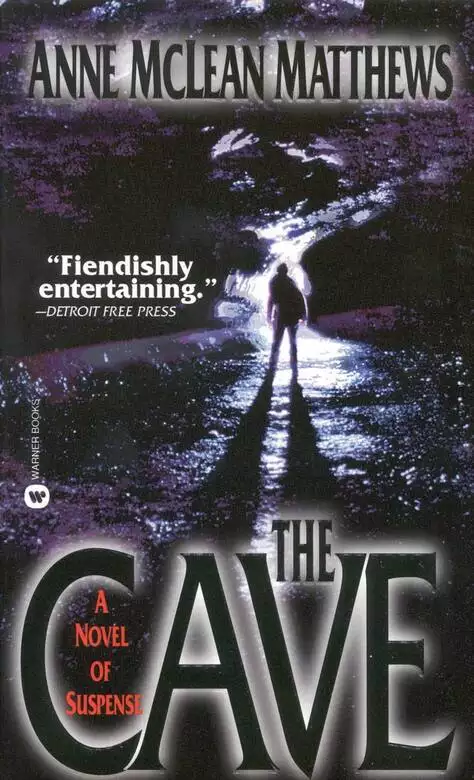
The Cave
Available in:
- eBook
- Paperback
- Hardcover
- Book info
- Sample
- Media
- Author updates
- Lists
Synopsis
Feeling tired and burned out, psychologist Helen Myrer seeks respite in the woods of New Hampshire, where a vicious, diabolical serial killer lies in wait, determined to make her his next victim
Release date: September 26, 2009
Publisher: Grand Central Publishing
Print pages: 278
* BingeBooks earns revenue from qualifying purchases as an Amazon Associate as well as from other retail partners.
Reader buzz
 Please log in to recommend or discuss...
Author updates
Close
The Cave
Anne McLean Matthews
Helen Myrer's heels rattling on the floor reminded her of guns in battle. As she hurried along, she found herself almost sickened
by the stale, wax-tainted air of the Capitol building, aware that she was late, aware that everything she did on this day
mattered. Once she entered that committee room, even the slightest error would be disastrous.
Today she might well see the destruction of all that she had worked for, all that she cared about. The Subcommittee on Health
Services was considering the worst cuts in mental health support in the history of New York State. If they passed, she would
be converted from the head of one of the world's great mental health systems into a demolition expert. But she would not go
gentle. The report in her briefcase—the last of ten she had presented to these twelve increasingly unresponsive and hostile
politicians—showed the devastating cruelty of the planned cuts, demonstrated their brutal consequences.
A lifetime of work with the mentally ill, first as a clinical psychologist and more recently in administration, had sensitized
her to the overwhelming need and helplessness of the patients. She believed in the ability of her department to relieve suffering;
she believed in the value of the work.
No matter what she did here, today the Omnibus Health and Welfare Bill would be sent to the floor of the state legislature,
where it was sure to pass. The question was, would her budget be gutted or just trimmed? A ten-million-dollar fiasco or a
two-million-dollar problem?
She wished to God now that she'd never taken this appointment. She had been brought in to downsize the department. But not
to kill it, not to be a murderer like this!
Her husband Al's friendship with the governor had gotten her the position, a job that traditionally had been held by a psychiatrist.
She was not an M.D., only a Ph.D. psychologist. If the budget was gutted, she would be in the position of relieving over fifty
psychiatrists of their positions, in addition to all the other carnage. The mental health community in this state would remember
Helen Myrer for a hundred years.
The committee was only passing sentence today; she was the one who would have to do the actual killing.
Maybe—just maybe—this last cannonball would do the job the others hadn't. It was full of pictures, highly quotable—the kind of thing
that might get her the press coverage that she had been missing all along.
As she circled the senate chamber, she could see the doors of the committee room looming up ahead. Senator G. G. Joiner could
be heard over on the floor, droning to an empty chamber about riparian rights. Farther along the hall, a maintenance man ran
a floor waxer. In the distance a siren rose and fell, and sunlight shone down from the high arched windows that surrounded
the dome.
She had once loved this old building full of marble glory, loved the way it glowed in the light of the sun, loved its history.
She loved the state itself, its wonderful, open people and its rolling, verdant land, its history and that fabulous city to
the south also called New York. She had an apartment in Manhattan, where she had become a subscriber to the Philharmonic and
the Metropolitan Opera and an enthusiastic supporter of the New York Film Festival.
She loved being alive, if the truth be told, despite the hollow place at the center of her world, the emptiness that Al had
left behind him. In a sense, though, it was a good emptiness. Their marriage had been happy and long, and it was right that
she grieve and right that Al's place in her heart remain empty. It's not really empty, Al, she said within herself, you're
still here, my love.
The day she had taken her oath from the governor, just weeks after Al's death, had been one of the saddest and most beautiful
days of her life, a sublime moment dedicated to the great and gentle man who had been at her side for twenty years.
She reached the committee room, found herself pausing before the closed doors. If they made the big cuts, maybe the thing
to do would be to resign. How could she retire Dr. William Walker, who had been chief of the Department of Psychiatry for
thirty years and was one of the leading psychiatrists in the world? She couldn't do that to a man of such stature—and he was
only one of many.
Not to mention the patients, the poor patients! How could they hurt the autistic children like this and the helpless schizophrenics
and paranoids—how could they put all those people into the dingy, understaffed, dangerous facilities that awaited or even
out onto the street?
Her last report was called “Passing Sentence on the Mentally Ill, the 1997 Budget and Its Consequences.” It was only ten pages
long, ten pages of brutal statistics and one-line explanations, of horrendous pictures of mentally ill people in need.
It was a last cry for help to anybody who would listen.
A long, rolling laugh came through the closed door. She continued standing there, trying to make her heart stop thundering,
trying to make her jaw work properly. She'd gotten TMJ from the stress of the job and had to wear a prosthetic insert to keep
her left meniscus from tearing itself apart.
All right, take a deep breath, put the facial muscles into neutral. Al, she said to his place in her heart, here we go.
She put her hands on both knobs and threw open the doors. There was a brief hush, then a swell of whispered conversation as she came
in—not exactly a sweeping entrance, but an effort in that direction.
Mal Camber's camera clicked. Tom Woolsley of the Times raised his eyes from a page of what looked like fascinating doodles, and Senator Warner gave her a sharp little smile. “M'lady
enters,” he said.
“Traffic, Tom,” she said, vaguely referring to the fact that she was late. She took her seat at the witness table alone. She
had not brought any of her assistants, not for this last battle. Let her do it alone, let her take the loss herself, if there
was to be a loss. Her people had been through all nine grueling sessions, some of them chief psychiatrists made to explain
the number of towels and lightbulbs their facilities used.
She looked up at Warner, a sharp-faced, gray-eyed young man of thirty-two, handsome and tanned from his recent skiing expedition
to Vail. With his tan and his Savile Row suit, he looked every bit as wealthy as he was.
He was not a bad man. In fact, he had many wonderfully innovative ideas about budgets. But he also had a fundamental lack
of belief in the very idea of mental health.
This was not his only blind spot. As far as Helen was concerned, there was something decivilized about him. Except on paper,
he was not well educated. She had once confused him merely by mentioning the DSM-IV, the diagnostic bible of the American Psychiatric Association. She'd learned early in the hearings that she had to avoid
professional phraseology or he'd feel threatened and start needling. In a sense, this sweet-tempered young man was really a sort
of savage. For him the only justice was retribution. The idea that some people, criminals included, might be insane and thus
helpless to control themselves only angered him.
By contrast, the therapeutic promise was the foundation not only of her career, but of her meaning as a person. The mad could
be helped and even cured; that was basic.
“I'm ready, Senators,” she said as she heaped copies of the report on the witness table. A secretary began handing them out
to the committee and the press.
They told a brutal truth: the proposed cuts would leave state mental health with only one basic mission—to confine the criminally
insane.
“We've gotten all this stuff before,” Senator Warner said.
She must not let him go to a vote, not just yet. She leaned in to her mike. “I just wanted it charted. So the stats are clear.”
“Well, it's nothing new.”
He was in a hurry, and that was bad. She needed a little more time. She plunged in. “You must face the reality that these
cuts create, and I don't think you've done that. You will see every outpatient facility in the state reduced to part-time
or occasional operation.”
“You were brought into your job to downsize the division,” Warner said mildly.
Good, he was talking instead of racing toward that damn vote. “Downsizing and destroying are two different things. Public
mental health will be destroyed as a state function after this. I want to put a question to all of you: Have you considered
this from the standpoint of the human suffering involved? Have you personalized it?” She looked from face to face—and saw
that the truth was that they had. They were suffering with her, even Warner.
A silence fell, filled only by the humming of the fans that moved warm air through the room. There was a stir in the back,
and Helen saw that her daughter, Selena, had arrived. She gave her a wink. The response was a thumbs-up. Good Selena, loyal
Selena.
She briefly enjoyed contemplating Selena's success as a young businesswoman, and her son Mike's brilliant beginning with his
law firm. Your kids will give you their support, she thought. Selena would take her to lunch, Mike would have dinner with
her. Under pressure, this family circled wagons. This family had a secret weapon, which was its love and its loyalty.
Then, very suddenly, the vote was called. She started to protest, but it was too late. They'd spoken softly among themselves,
using her moment of inattention as a sort of doorway.
They're doing it like thieves, she thought as Warner murmured a few words and there was a show of hands.
It was over. The Omnibus Health and Welfare Bill would go to the floor, with the cuts, and would be passed, she knew, by a
landslide. She would try for a veto, but she knew that the governor wouldn't do it. He'd been elected on a “stop taxing us
to death” platform, and he wasn't about to defy his own mandate, not even when it went too far.
People were getting up, people were speaking together to confirm lunch dates and discuss afternoon appointments. She was part
of the committee's past now, left to her department and her disaster.
It had all been so brief and so pointless. She thought, Barbarians don't care about reports, followed by, I don't have to
be nice to Tom Warner anymore. She champed down on her oral appliance; her jaw cracked and pain shot through her left temple.
Without speaking, she closed her briefcase and walked out, Selena behind her. She wished that Mike had come, but he would
have had to take an early-morning flight and rush right back. They would have dinner at eight, after his day was over.
Still, she wanted him, she wanted them both with her and with the secret Al within her. She was being selfish, she knew, but
she really needed her kids right now, because it was a very hard thing to be undone like this, to see a lifetime of work swept
away in a strange budgetary tide that she did not fully understand, and suddenly to find that the last place you were needed
was… well… gone.
“I'm gonna be an executioner, looks like,” she said as Selena caught up with her.
“You're double-timing, Mom, slow down.”
“I can't, I'm too mad.” She went even faster, did it on purpose. Let them see her anger.
Distantly she heard Tom Warner call after her, but her eyes were now getting damp and she was damned if she was going to let
him see that.
“Lunch,” she said to Selena. It wasn't a question, but an assumption. She had been planning to eat at the Capitol
Restaurant, but not now. Now she would eat at Cristal, the best place in Albany and the only one that approached Manhattan-level
excellence. She was even tempted to use her state credit card, but she knew that she wouldn't.
“Mom, it's just so wrong.”
She regarded Selena. “I want to go to Cristal. I can't face the Cap today, not with all those happy faces waiting for me to
keel over.”
“Cristal—Mom, that would be great. But—I know this is awful—I have to get back by one, and ljust don't have the time.”
She stopped. “You're gonna let me cry in my beer all alone?”
“Sorry, Mom.”
Helen stood on the steps of the building, looking down the wide esplanade with its view off into the southern tier of the
state.
Selena's hand came into hers. “I really love you, you know.”
“Dinner? Mike's flying up.”
“I'm finalizing my first proposal. It's an all nighter for sure.”
Helen would be strong now. This was the time to be an understanding mother. Kids had their lives, and that had to be respected.
“Look, thanks for coming. Thanks from the bottom of my heart.”
She watched her daughter leave, the sun shining on her long, swaying hair, on her pale arms, this beautiful young woman who
was the outcome of her love for Al, who mixed his exotic eyes with her regular features and managed to come out just wonderful.
She watched her and yearned after her and felt as she went toward the visitors' parking lot an anguish of soul that was much,
much stronger than she had expected.
Then she went off to her Taurus, her shoulders back, her head high beneath the white clouds of summer. She tried to tell herself
that she had done the best that could have been done, that Selena was genuinely busy. At least Mike would come, and they could
have a long, serious talk about her political future. Should she even continue? Maybe resignation was the best next step—make
a statement with her career.
She got in the stiflingly hot car and leaned her head against the steering wheel and would have bawled, but she simply was
not the type.
After a few moments she sat up straight and started the engine. When the air-conditioning was roaring, she headed off to Cristal.
She had driven about three blocks when she began to think how it would look to be sitting there at a table alone after a debacle
like this. Warner went to Cristal occasionally. What if he was there today? After all, he had something to celebrate.
She turned toward her apartment building instead. There was some bread and lunch meat in the fridge. She would make a sandwich
and maybe listen to a little music before going back to the office.
In a few more minutes she was pulling into the garage. She stopped the car and got out. Hoping that she wouldn't have to face
the garage attendant, she hurried toward the elevator. “Hi, Benny,” she said as he came out of his cubicle.
“Hello, Doctor,” he replied. “Hope you done some good.”
“Not a lot,” she said.
“I'm sorry to hear that.”
He had a sister in mental health maintenance at a local outpatient facility, the very sort of place that Helen would be closing
down. She found herself hugging Benny, much to the surprise of both of them.
Thank God nobody was in the elevator this time of day. Ascending to the twenty-second floor, she felt tears trickling through
her makeup. Deeper she went into her privacy and herself, and deeper into her failure as the whisper-quiet elevator took her
to her very silent apartment.
Like all of her places, it was decorated in shades of blue. She'd brought her collection of Mexican masks and Days of the Dead sculptures here, because they were such a contrast to life in Albany, New York. She had gone through a period of being fascinated
with the unique Mexican view of death as a celebration of life. She'd even written a paper on it, “Death as Enterprise and
Celebration in the Nahuatl Cultures of Northern Mexico,” which had been published in Psychological Anthropology in 1984.
“The dead,” she said, lifting a dancing skeleton from its black base. The skeleton wore a flowered bonnet and had a cigar
in its mouth. Madre Morte, she was called. Mother Death. She went to the broad living room window, which on this clear summer day had a view all the
way to the Berkshires.
She turned away from the view outward and the long canyon down to the street. The refrigerator came on, filling the silence
with its soft humming. She didn't want food. She couldn't think of food.
Then she noticed that the light on the answering machine was flashing. She almost didn't want to push the button, but on this
machine it had to be either the family or the office, as the number was private.
“Hi, Mom, it's me and guess what, I can't manage it tonight. What I want to do is try brunch on Sunday, say you come down
to old Trollhattan and we meet at the Palm Court? Love ya, darling.”
She slammed her thumb into the erase button. Wow, but this was really painful. This made her chest ache with loss, tears choke
her throat.
Maybe it was Al's charisma that had kept the kids close. Now, at her moment of crisis, it turned out that they just didn't
feel the same kind of concern they would have had for their father. She had to face this.
“Don't be ridiculous,” she said. “You're just feeling sorry for yourself.”
True or not, something broke in her at that moment, as if some hope or essential part of her had come loose and floated off
down the river. She threw herself on the couch and sobbed. It went on for some little time. In the end, though, it faded into
silence. She stared around her at an apartment that seemed to belong to a stranger.
The phone rang, then rang again. Each time it rang she lurched toward the receiver. But she did not pick it up. She listened
instead as the machine clicked on and her announcement played, her own voice droning. She hoped that it would be Mike with
a change of plans, or even Selena, but it was Victor at the office. “Just trying to track you down, boss. The gov's called
to cry, all the supers are calling to beg. As if you didn't know. Am keeping hatches battened. When do I get my pinkie?”
She would not put V out to pasture, never, which she told him.
After they hung up, she found herself gazing at a particularly droll skeleton that was cavorting with a pretty young thing
in the back of a black plastic car. “Why in the world did we collect this stuff?“ she said to Al. It probably wasn't good
to talk to Al like this, but she had to talk to somebody. “At least I have your attention.”
Maybe she ought to go to Mexico, to Mazatlán for fishing, or maybe to one of the big resorts. Then she thought of the couples
vacationing in those glittering places and found her eyes tearing again. Lonely in a crowd was a very bad place to be. What
she wanted to do was go on a nice trip with Al.
“Al,” she said as she stared into nowhere and the past, “let's you and I go to the Old Secret.”
She got up and went into the study. Would that guy's name be on the computer? Surely not, not after—how long? Twelve years?
No, she'd lost all that.
The Old Secret was a cabin, a very special and wonderful cabin on a lovely New Hampshire lake. When last there, she had been
a mother with two preadolescent kids and the handsomest, smartest, strongest, sweetest lawyer husband in the entire Northeast.
The most recent address on the laptop she kept here was three years old. Now, what town had the cabin been in? It had been
owned by a little man in… was it Carlton?
She picked up the phone and tried to get an area code, but there was no Carlton, New Hampshire. Suddenly she wanted to return
to the Old Secret very badly, to be there with her memories, to talk to Al and let the night wind bring his answer.
Most of their belongings were in the Manhattan apartment or in storage, but she knew that there was one thing of Al's, a shoebox
in the top of the closet, that contained the correspondence he'd been working on the week he died. She'd kept it against possible
requests from clients but had never opened it. His personal address book, the one he carried in his pocket, was in there.
She'd dropped it in with his keys.
The letters, written on fine legal bond, were still white. She saw one on the Allied Chemical case, another about the new
desk he would never sit behind, a third from the executor of the Trammell estate, transmitting a fee check. Another to her:
“Hey, lady, I am sitting in my room at the Stanhope wishing that you were here and we had the drapes drawn and the TV on and
an obscene pizza and a whole night just to explore it.”
She took it out and pressed it to her face. It was one of his small, delightful habits to send off these notes when he was
traveling. She had saved them all; there were hundreds of them in boxes in her storage space in Manhattan. But this one was
here, and maybe it even smelled a little bit like him, of sunburn and bay rum.
Then she found the ancient alligator-skin address book. Holding it in her hands, she paged along. Restaurants, friends she
hadn't seen in years, his tennis partner, Gower Chambers, golfers, his poker and bridge buddies. It was what he'd called his
“guy” book.
She groaned, told herself, “You're being stupid. Five years is enough time to accept a death.”
Had a patient come in grieving like this after so long a time, Helen would have treated it as mild pathology, an anxiety disorder.
Then she found it. Meticulous Al had listed it. . .
We hope you are enjoying the book so far. To continue reading...
Copyright © 2026 All Rights Reserved
