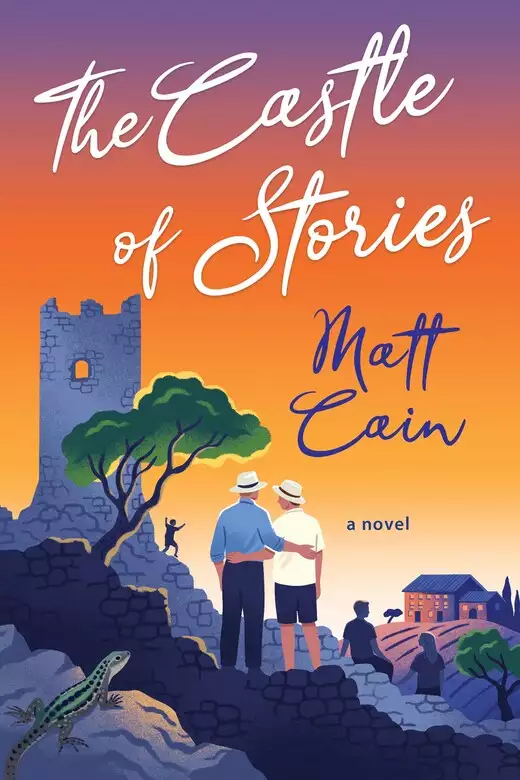
In a life-affirming, poignant, and evocative novel set against unparalleled beauty of the Tuscan countryside, a couple’s plans to spend the summer renovating an old property go awry in surprising and sometimes wonderful ways . . . Full of heart, charm, and queer joy for readers of Steven Rowley, Linda Holmes, Bryan Washington, and Paul Rudnick.
Stories don’t always unfold quite the way you expect them to, and Adam Webb has reason to be glad of that. Out of the blue, he’s inherited a farmhouse and castle in Tuscany from a great uncle he never met. It’s the catalyst for Adam to give up his HR job in Manchester and fly out to Italy for the summer to do repairs on the home he hopes to turn into a rental. The best part: he’ll be sharing this summer of adventure with his partner of two years, Theo. It’s a fairytale in the making.
But there’s a last-minute twist, in the shape of Theo’s three children. Theo’s ex-wife can’t take them for the summer after all, so Callum, Mabel, and Archie are coming to Italy too. Their open hostility to their dad’s boyfriend isn’t helped by the lack of Wi-Fi and the mounting chaos of renovation problems and bad plumbing, not to mention the resident lizards and mice.
Despite everything, Adam finds himself falling in love with the place, whether he’s watching golden sunsets from the castle ruins with Theo, sipping coffee on the patio, or driving around the neighboring medieval towns. And as they sort through Uncle Wilf’s possessions, another story begins to take shape—one that will help Adam navigate the family secrets that have marred his past and the decisions that will shape his future. What emerges isn’t a fairytale, but it’s a rich, complex narrative of love, acceptance, and second chances that could pave the way for the best kind of happy ever after.
Release date:
April 28, 2026
Publisher:
Kensington Books
Print pages:
400
* BingeBooks earns revenue from qualifying purchases as an Amazon Associate as well as from other retail partners.
It’s beautiful. Much more beautiful than I imagined—or dared let myself imagine.
“Mr. Webb,” says the lawyer in his strong Italian accent, “I present you il Castello Montemagno!”
Signor Mancini gestures to a ruined castle perched on top of a little hill, a vineyard snaking along its slopes. At the bottom stands the sole remaining wall of a stone chapel, which is painted with a flaking mural of a man he tells us is San Bartolomeo—which I can only assume translates as Saint Bartholomew. We’ve already driven through an olive grove containing nearly fifty trees and Signor Mancini leads us around the side of a terracotta-tiled garage to reveal a handsome three-story stone farmhouse, with a smaller cottage built onto the side. Both are framed by the magnificent, velvety green Apuan Alps, while in front of the property stands a paved patio covered by a pergola entwined with gnarly—and what look like very old—vines. We cross it and step onto a small lawn, which runs up to the ridge of a hill, along which have been planted bushes, shrubs and trees. From there, Signor Mancini shows us a spectacular view over the Freddana Valley, the Ligurian Sea in the distance. I let out a breath.
“All of this now belongs to you!” Signor Mancini announces, waving his arm with an extravagant flourish.
Theo gives my shoulder a squeeze. “Adam, I can’t believe it.”
Neither can I.
“But you must believe it!” protests Signor Mancini, a dark-haired, wiry man wearing a fitted navy suit and square spectacles in silver frames. “The castello was the property of your great-uncle Wilfred Treadwell, and he named you his heir.”
“But that’s just it,” I say, “I never even met my uncle. I only vaguely knew he existed. Why did he leave it to me?”
The lawyer shrugs. “He did not have a wife or children so I do not think it is unusual.”
“But why not leave it to friends?” I lay my hand on the trunk of the vine. “I didn’t think he even knew about me.”
“He was not in contact with your family?” asks Signor Mancini.
“No, there was some kind of disagreement.” I tug at the collar of my polo shirt. “Well, it was more a rift, I suppose. But that was way before I was born. By the time I came along nobody even talked about him. I didn’t know he lived in Italy till I got your email.”
I think back to the day that email arrived, just over a week ago. I’d been in the office, trying to feign interest in yet another meeting—one of the least enjoyable elements of my job as Head of Human Resources in a big insurance company. As the Chief Operating Officer ran through the latest list of employees who’d applied for voluntary redundancy, I spotted an email pop into my inbox from an Italian address. I couldn’t resist lowering my phone under the table and opening it. On reading the first line, I gave a gasp, which I quickly disguised as a coughing fit, excusing myself and ducking outside for some water. Within an hour, I’d called Signor Mancini—who confirmed I was the sole beneficiary of a house, eleventh-century castle and nearly fifty hectares of land just outside the village of Montemagno in the remote hills of Tuscany. I immediately followed this up with a call to my boyfriend, who was even more surprised than I was as he’d never heard me mention a great uncle. As Theo’s a headmaster and had just broken up for the Easter holidays, he suggested we fly out to Italy as soon as possible.
We landed in Pisa yesterday, picked up a car rental from the airport and drove to Lucca, which is where Signor Mancini had suggested we stay. It’s the provincial capital, fourteen kilometers from Montemagno, and the location of his office. By the time we’d checked into our hotel it was early evening, but we still made time for a quick stroll around what we discovered to be a charming medieval city, before stumbling on the adorable Piazza dell’Anfiteatro. As it was warm, we sat at a table outside and shared one dish of pasta with wild boar and another of risotto with porcini mushrooms, accompanied by a bottle of local wine. We held hands as the sun went down and the lights in the square flickered into life. I told myself how lucky I was to have such a gorgeous man—a man who’s over six foot tall, with fair hair, dazzling blue eyes and a physique that can still be described as athletic. It was such a magical evening, I convinced myself it had to be the start of something special—a special adventure for the two of us, together.
This morning we reported to Signor Mancini’s office, handed over my identification documents, and listened to him read out a translation of the will. Then we followed his car up here—to the house where Wilfred Treadwell lived for over sixty years. Sixty years during which the rest of his family was in Manchester. But what did they fall out about in the first place? And how did he end up here?
“I am sorry,” Signor Mancini says, his forehead creasing. “It is always sad when families do not speak.”
“Yeah, it is,” I answer. I remember how long it’s been since I spoke to my dad. “Can we go inside?”
Signor Mancini takes out a set of keys and inserts a long iron one into a pair of wooden doors that have been painted turquoise. He slowly pushes them open and we step into a stone-floored, wood-beamed kitchen with larder—both of which are probably best described as “basic.” The patterned brown ceramic wall tiles look like they date back to the 1960s, the wooden units are rickety—with one of the cupboard doors missing and another hanging off—and what’s being used as a sink is just a slab of stone with its middle scooped out. Along the far wall is an open fireplace, the back of which has been stained black and over which hangs a brass cauldron that looks like it belongs to a witch. As a keen cook, I’m more struck by how little counter space there is. I also notice that there’s only a small, freestanding oven. Even so, I picture myself zipping around, preparing a risotto or a pasta sauce, the room filling with enticing aromas.
We climb up a stone staircase to the first floor, where we find not one but two lounges, the first of which is snug and cozy, the second double-ceilinged and more like a hall. Both of them are filled with battered old couches and dark wooden furniture, much of it tatty or dilapidated. The floors are paved with terracotta-colored bricks and the walls of irregular-shaped stones have been left exposed, some of them stained with patches of damp. Although Wilfred only died a few months ago, the surfaces are already covered in dust and there are cobwebs trailing from light fittings. Between the lounges there’s a study stuffed with old books—their spines faded and their pages yellowed—and a bathroom fitted with a suite that must once have been white but is now streaked with an orange almost as bright as the Aperol Spritz I drank last night. Not just that, but the sink’s cracked, the toilet’s so old the chain has rusted, and the inside of the bath is spattered with animal droppings. It’s a grim sight. But despite this, there’s something romantic about the place, something I find enchanting.
But how does Theo feel about it? I turn to see him rushing around, flinging open doors and poking his head in and out of rooms.
“Bloody hell,” he booms. “This place is amazing!”
Relief sloshes through me.
We follow Signor Mancini through a connecting door into the little two-story cottage, which has its own—even more run-down and less user-friendly—bathroom and kitchenette. He directs us back into the main house and up another flight of stone stairs to the third floor, which has yet another big lounge, another grimy bathroom, and a couple more rooms that have been left completely empty.
“It’s so weird that there are all these rooms but hardly any beds,” I comment.
“I’m sure we could get hold of some beds quite cheaply,” offers Theo. “The kids could have a bedroom each.”
My stomach dips. I was only making an observation: the last thing I wanted was to suggest bringing Theo’s children here. It’s six months since he introduced me to them but only the youngest has shown me anything other than hostility—a hostility I’m desperate for Theo not to witness. I don’t want him to think that in the long term we’re only going to be incompatible.
Signor Mancini cocks his head. “I did not know you had children.”
“Yeah, three,” says Theo, breaking into a grin. “They’re fifteen, thirteen and eight.”
“In Italy it is very unusual for a gay couple to have children,” the lawyer observes.
“They’re not mine!” I butt in. “We’ve only been going out for eighteen months.”
Signor Mancini scrunches up his forehead.
“Theo used to be married to a woman,” I explain. “He came out as gay when they split up, two years ago.”
Theo looks uncomfortable.
I’m annoyed at myself: I need to remember he doesn’t like sharing the personal details of his story, especially those that have been the source of intense emotions—that continue to be the source of intense emotions, emotions that I know torment him and keep him awake at night.
“Did you say the house is eleventh century?” I quickly toss in. “Or is that just the castle?”
Signor Mancini smiles. “Both. The rooms at that end are the oldest.” He points to the section farthest from the castle. “That part was originally a tower. Sorry, I’m not sure how to say it in English: it was where soldiers watched for enemies.”
“So it was a lookout post?” says Theo.
“Yes, exactly! Then later it was extended and became a farmhouse. Over the years more and more rooms were added.”
“That’ll be why there are no corridors and the layout’s a bit random,” Theo suggests.
“But why’s it so run-down?” I ask. “Why haven’t the bathrooms been modernized? Did my uncle have no money?”
Signor Mancini throws up his hands. “I’m afraid I know very little about Mr. Treadwell. But he did not leave any savings—just a few hundred euros in a regular bank account.”
I’m desperate to know more but there’s no point in persisting. “Do you know how he died?”
“Yes: Mr. Treadwell died in his sleep. His neighbors found him—Signor and Signora Fiore. I understand they helped him with jobs on the house and land.”
“Well, it’s the perfect way to die,” Theo remarks. “Isn’t that how we all want to go?”
I smile but feel a tug of sadness. I would like to die in my sleep but not on my own.
“Which was his room?” I ask the lawyer. “Do you know?”
Signor Mancini nods and guides us downstairs. On the right he opens a creaky door into a square room that has plastered white walls, a large wooden wardrobe and chest of drawers, and a wrought-iron bed on which lies a bare mattress. Standing next to it I spot a framed photo of two men. It looks like it was taken in the 1970s, as one of them is wearing flared jeans and a paisley shirt with a wide collar. This man’s probably around my age—in his mid-forties—but still has a boyish face and caramel-colored hair.
“Is this him?” I ask, picking up the photo. “Is this Wilfred?”
Signor Mancini peers at it. “I believe so, yes.”
“Let’s have a look,” says Theo.
I hand it to him.
“You can see the family resemblance,” Theo comments. “He’s got the same dimples in his cheeks!”
I lean in to examine it. “Oh, yeah.”
“Although he isn’t as cute as you, Ads,” Theo says, handing back the frame.
I smile my thanks.
“And who’s the other bloke?” I ask Signor Mancini. The second man is quite a bit older than Wilfred, with a bald head and five-o’clock shadow, and is dressed more traditionally, in a crisp white shirt with beige chinos and brown leather shoes. The two men look stiff and uncomfortable next to each other. I wonder if they might have had some kind of business relationship. Except it looks like the picture was taken outside the house.
“I’m sorry, I don’t know,” confesses Signor Mancini. “There was no mention of this man in the will.”
I put the photo back on the nightstand and sit down on the mattress. The old coils squeak.
“I must also show you the wine store,” says Signor Mancini, exiting the room and trotting downstairs. “It occupies most of the ground floor.”
As Theo follows him, I remain sitting on the mattress and run my hands over its surface. So Wilfred died right here on this bed. I wonder what he was thinking before he went to sleep. Did he still think about his family?
I jog downstairs and follow the sound of Signor Mancini’s voice—and the smell of his strong aftershave—outside, then back into the house through another big door, entering a cavernous ground-floor chamber that looks like it hasn’t been used as a wine store for some time. Although there are a few empty kegs and barrels, it’s clearly been repurposed as a dumping ground for all kinds of domestic items, such as broken tables and stools, tins of dried-up paint and varnish, and a storage heater that looks like it hasn’t worked for years. There’s also an enormous old mustard-yellow boiler, a washing machine that—thankfully—seems to be in working order, and various dustbins for rubbish and recycling. It smells damp, musty and a bit rank.
The lawyer’s phone pings and he lifts it out of his briefcase to read a message. “I am sorry,” he states, “I must return to Lucca. But I think you have seen most of the important things.”
I try not to look disappointed. “But what about the castle?”
Signor Mancini leads us outside and around the wall of the chapel, where he points towards a crude path that zigzags up the side of the hill. “That is the way. But I am afraid the castle is only a pile of stones.”
“I’d still like to see it,” I say. “If you don’t mind.”
“Not at all. But it is difficult to climb and I cannot do it like this.” He gestures to his smart suit and black leather shoes. “If you like, I can leave you the keys and you two can enjoy more time here?”
We accept his offer and he takes us back to the house and shows us how to lock up.
“Please return the keys to my office in the morning,” he says. “And we must start the process to get a codice fiscale—that is an Italian social security number. We must also deal with the issue of inheritance tax.”
Shit, I didn’t think of that. I’ve never inherited anything before—I’m not from that kind of family, nor are any of my friends.
“What do you mean, inheritance tax?” I ask, aware that the pitch of my voice is rising. “I’m not going to have to pay any money, am I?”
Signor Mancini rakes his fingers through his hair. “Yes: in Italy everyone who inherits property over a certain value has to pay tax.”
“But how much?”
He runs his hand up and down the strap of his briefcase. “I do not know for sure but I have done a very rough calculation.” He tells me what it is.
I give a yelp. “Where am I supposed to find that kind of money?”
He raises his shoulders. “Most people who do not have the money choose to sell the property.”
“Sell it? But I haven’t even finished looking at it!”
Theo puts his arm around me. “Ads, let’s not worry about that for now. I’m sure you’ll have plenty of time to decide what to do before you have to pay.”
He thanks Signor Mancini and we shake hands. Once his car has driven up the graveled lane and disappeared around the corner into the olive grove, Theo suggests opening a bottle of wine. “Come on, I spotted some in the larder.”
“But can we just take it?” I ask, following him through the turquoise doors. “None of this belongs to me yet. And I don’t think I can afford to keep it!”
Theo reassures me it’ll be fine, finds a bottle opener in a drawer he has to yank open, and rinses a couple of glasses under a tap that splutters out water. We fetch some chairs and sit on the patio, looking out over the valley.
As it’s only April and the trees aren’t yet in full leaf, the landscape contains patches of brown as well as green. And there are various grays in the stone of houses, farm buildings and churches, plus splashes of blue in the smattering of swimming pools. The blue of the sky is much lighter and broken up by a strip of little clouds, like puffs of smoke released from a stuttering engine. It’s quiet, apart from the odd snatch of birdsong and the sound of the occasional car or motorbike driving through the valley.
“Cheers,” I say.
“Wait, how do you say that in Italian?” asks Theo. “Is it salute?”
“Something like that.” I tap my glass against his. “Salute!”
“To the Castello Montemagno!”
“Prego! Certo! Buonasera!” I say, affecting an over-the-top Italian accent. “Do we know any other Italian?”
“Mamma mia!” joins in Theo.
“Mamma mia!” I warble, even louder.
We both laugh.
I gaze out at the sea, which is nestled in the V between two mountains, the diminishing foothills of a third stretching behind it, as if wrapping it in an embrace. The sunlight is reflected on the sea’s surface, so it shimmers, almost winking at us.
“It’s like something out of a fairy tale,” Theo says, rubbing stubble on his chin that—even though he’s about to turn forty-seven—is only just flecked with gray.
“I know.” I turn to face him. “And it’s got so much potential.”
“Yeah, but there are loads of jobs that need doing,” he points out. “I’ve already spotted a few rotten window frames and missing roof tiles.”
I take a swig of my wine. “And there’s the damp.”
“And a couple of leaks.”
I let out a long sigh.
The sun has started slipping down the sky. Soon it’ll be setting. When I was little—and the weather was half-decent, which wasn’t guaranteed in Manchester—I used to watch the sunset with my mum. She used to say it was our way of saying goodbye to the day. The two of us would sit on a wooden bench in our back garden and look out over the playing fields. But these have since been turned into a housing estate and Mum’s been dead for over thirty years. Thirty-four to be exact: I was eleven at the time.
I stand up. “You know what, if we’re going to see the castle, we should probably get up there—it’ll be dark soon.”
Theo tips back what’s left of his wine. “Yeah, come on.”
We walk around the chapel, find the path and begin our climb. Well, Signor Mancini called it a climb but if he’d known the word scramble, I’m sure he’d have used that. The hill’s steep and there’s been no attempt to flatten the earth, so we have to cling onto stones, trunks and tree roots to haul ourselves up. When we finally reach the top, we stop to dust ourselves down, then push through the thick overgrowth, taking care not to prick ourselves on the brambles. I’m glad my legs are covered with jeans but wish I was wearing long sleeves. By the time we emerge in a clearing, I’ve picked up several scratches on my arms.
The land in front of me is stepped and there are thin strips of wall visible between the different levels. But that seems to be all that remains of the castle—which is strange as looking up from below, the walls were several meters high. I realize that the rooms of the castle must have been filled in with earth, which would explain why they have so many bushes and trees growing out of them. I wonder if it would be possible to dig the earth out again and restore the castle’s basic structure.
We find a spot on a stone wall, only half of which is intact: the other has fallen away. We sit down and go back to enjoying the view over the valley. It’s pretty much the same as it was from outside the house but the higher vantage point makes it even more breathtaking. It’s also much quieter up here, with none of the sounds of cars or motorbikes. And there’s less birdsong—only the odd tweet.
The sun’s about to disappear behind the mountain and is spilling out rays of pumpkin, apricot and peach.
“I don’t think I’ve ever been anywhere as beautiful,” I tell Theo.
“I know. And it’s so romantic.” He takes hold of my hand. “It makes me realize how much I love you, Adam.”
He moves in to kiss me on the lips.
“I love you too, Theo.” I snuggle up and rest my head on his shoulder.
Even though we’ve only been going out for eighteen months, I’ve already decided I want to spend the rest of my life with him. He’s all I’ve ever wanted.
But I’ve always worried that the turmoil around Theo’s divorce—plus the hostility from his kids—might one day get in the way, that it might lead him to the conclusion that the relationship is more trouble than it’s worth, that all the negativity weighing down on him might overwhelm the love he says he feels.
I tell myself that we could come here to get away from the stress and negativity. This could be our happy place.
There must be some way of keeping it. …
I sit up. “I just thought, I could apply for voluntary redundancy. I’m sure they’d give it to me: if I went they could hire someone younger and cheaper. And you know the job doesn’t make me happy. I’ve been bored of it for years.”
Theo blows out his cheeks. “I’ve always said you’re wasted in it. You could do with a change.”
“Well, now I’ve got one—or the chance of one.” I feel excitement taking hold. “I’ve been in the job for more than ten years so I’m pretty sure I’d get a year’s salary. If I threw in my savings I’d probably have enough to pay the inheritance tax and do some basic renovations. Although we might have to chip in and do some of the work ourselves.”
Theo inches forward. “That’s OK. But what would happen afterwards? How would you earn a living?”
“I’d put it on the market as a holiday let.”
“Is there a demand for that?”
“I don’t know but I imagine so—loads of people come here on holiday. And I think it’s mainly posh people with money.”
Theo tilts his head so it catches the sun’s rays, taking on a tinge of apricot. “Would you manage it yourself?”
“I guess so.” I run my hands along the rough stone. “But we wouldn’t rent it out all the time: we’d keep a few weeks free so me and you could come here too.”
Theo waggles his eyebrows. “I must admit, that does sound appealing.”
My heart’s thumping. “Why don’t we come here in the summer and just get on with it? You’ve got the school holidays—we won’t get that opportunity for another year.”
He frowns. “Yeah, but I’d still have work to do.”
“Well, I could get Wi-Fi installed and you could do it from here.” I slap out a rhythm on his thigh. “What do you reckon?”
Theo chuckles. “It does sound superb. But what about the kids?”
I feel a clutch of fear. “Didn’t you say Kate’s taking them to the States?”
“Yeah, she’s taking them to her sister Shona’s. So I’ll probably only have them for a week anyway.”
I release a breath. “Well, you could always fly home for that week.”
“Or I could bring them here. …”
Shit.
I suddenly realize my plan could backfire. What if Theo finds out how much his kids hate me? I wouldn’t be able to cover it up if we were together all the time. And then he might get scared. He might realize how difficult the relationship’s going to be, long-term. He might look to the future and decide the relationship’s impossible.
“But do you think they’d like it?” I attempt, meekly.
“Ads, how could anyone not like this?” His forehead puckers. “Alright, they might moan a bit at first but I’m sure they’d fall in love with it in the end.”
I pause and watch the sun disappear behind the mountain.
I smile back at him. “Go on, let’s do it.”
“Are you sure?”
“Yeah. It’s only a week. What could possibly go wrong?”
“Six weeks?”
We’re in my kitchen and Theo’s on the phone, talking to his ex-wife. He has her on speaker as he irons his work shirt for tomorrow. At the start of the conversation I was happy to listen in, sitting at the island pretending to do my online Italian course. But then Kate told Theo she’s had a change of plans for the summer: her sister in Atlanta has found her an interior design job and it runs over the entire school holidays, so she won’t be able to take the children after all. She said they’ll have to come to Italy for the whole six weeks. At which point Theo stopped ironing and I spilled my glass of wine—thankfully not on my laptop. I stand up and grab some paper towels to wipe it up.
“Kate, it’s not as if I don’t want to spend the summer with them,” Theo says, resting the iron in the cradle. “You know I was gutted when you said I could only have them for one week. But all six? It changes our whole summer.”
“Well, what do you want me to do about it?” snaps Kate. “I can hardly dump them on Shona.”
I put the sodden paper towels in the bin as quietly as I can and tiptoe back to my seat.
“I’m not suggesting that,” protests Theo, unplugging the iron. “But couldn’t we split the time?”
Kate huffs. “Theo, I can’t leave them with her for three weeks. She’s got a job, remember?”
“Oh yeah.”
He widens his eyes at me as if to say, “What can I do?”
I slosh more wine into my glass.
“And before you ask,” Kate steams on, “I’m not saying no to this job. I put my career on hold for years to have our children, to bring up our family. And you threw it back in my face when you walked out on us. So now I need to claw something back and build it up again. And I won’t let you stop me!”
Theo rubs the crease between his brows. “I understand, Kate. And I’m not trying to stop you. But this isn’t just my summer—it’s Adam’s too.”
Bad move, Theo!
Kate makes a sound as if she’s being strangled. “Right, so you’re not satisfied with making me put my career on hold for you—now you want me to do it for your boyfriend!”
I can just imagine the face she’s pulling as she says that word. I’ve only met Kate once—and that was briefly when she came to Theo’s flat to drop off the kids. He was on the phone and I had to answer the door. I have to admit, part of me was glad I had an excuse to see what she looked like in real life. And she was pretty, slim and stylish, with honey-blond hair cut in an asymmetrical bob. But she refused to say hello and looked at me as if a bird had just shat on my face.
“That’s not what I’m saying, Kate,” Theo insists.
“That’s exactly what you’re saying!” Kate fires back. “You know, you really are unbelievable. You want to dump your kids on my sister so you can go swanning off to some castle in Italy with your rich boyfriend!”
I want to point out I’m not rich. But if she finds out I’m listening, it’ll only make things worse.
Thankfully, Theo does the job for me. “Kate, Adam’s not rich.”
She scoffs. “That’s what all rich people say.”
“He grew up in a two-up two-down.”
“Well, he’s not living in a two-up two-down anymore. From what I hear, that place in Italy is enormous. And he can hardly be strapped for cash if he’s giving up his job.”
I feel a kick of anger but try not to let it take hold.
Theo lets out a sigh. “Kate, Adam’s taking redundancy.”
“I’m not interested, Theo! The point is, he doesn’t need to work. And you’re not going to be working over the summer, so what’s the problem?”
Theo kneads his eyelids. “We’re supposed to be renovating a house. And I’m just not sure the kids will enjoy it—at least not for six weeks. And, you know, they were excited about America. They were excited about the pool.”
“Stop pretending you’re thinking about the kids,” Kate barks. “As usual, you’re just thinking about yourself. You know, you didn’t used to be so selfish. It’s like you’re a different person now you’re gay.”
“He’s always been gay!” I want to yell at her.
But Theo looks as if he’s been wounded: she’s hit him in his weak spot.
I move over and give his back a rub.
“I suppose this is Adam’s doing, is it?” Kate blasts on. “Is he putting you up to this?”
I take a step back.
“Bloody hell, Kate,” says Theo, “how can it be Adam’s doing? You’ve only just told me about it.”
There’s a beat. “Wait a minute, is he listening? Is that why you’re on speakerphone?”
Theo picks up the phone and trudges out of the room.
I can’t hold my anger back any longer. Theo stayed in the closet for years to protect his family. We’ve talked about this a lot, so I know that when he was younger, he was confused about his sexuality: he knew he was attracted to men but also thought he was attracted to women. When he slept with Kate, he felt good about himself. But he didn’t realize this was because he desperately didn’t want to be gay. By the time he’d worked that out, they were married with a baby—and he wanted to do the right thing. That’s why he ended up sacrificing his own happiness and living a lie for years. Until he couldn’t do it anymore. And I do understand that it must have been really difficult for Kate, but she’s showed Theo no compassion—and still refuses to forgive him.
I fill my lungs and let out a long breath. I decide to empty the dryer and start pairing the socks and piling them on the worktop.
The kitchen’s my favorite room in the house, a house I moved into five years ago, when I became a first-time buyer at the age of forty, just a few years after finally paying off my student debt. It’s a sm
We hope you are enjoying the book so far. To continue reading...

 Please log in to recommend or discuss...
