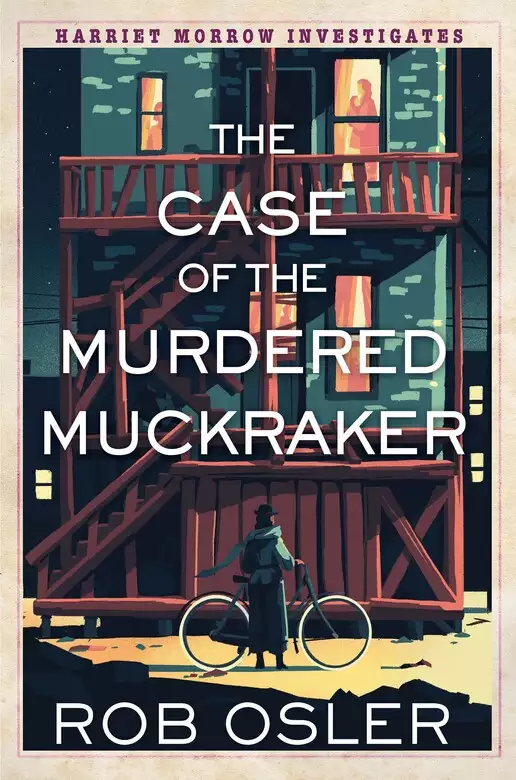
Harriet Morrow, a spunky, bike-riding, independent, lesbian P.I. in turn-of-the-20th century Chicago, is back on the case in this brilliant historical mystery inspired by a real-life Windy City detective – from theacclaimed author of the Anthony, Agatha, Macavity, and Lefty Award-nominated Devil’s Chew Toy. For fans of Lev AC Rosen, Ashley Weaver, and Stephen Spotswood.
Chicago, 1898. In the midst of the Progressive Era, twenty-one-year-old junior detective Harriet Morrow is determined to prove she’s more than a lucky hire as the Prescott Agency’s first woman operative. But her latest challenge—a murder case steeped in scandal—could become a deadly setback . . .
As the Windy City thaws from a harsh winter, Harriet Morrow finds herself doubting her investigative skills when she’s assigned to solve a high-stakes murder case well above her pay grade. And there’s also a catch. Harriet must somehow blend in as an “unremarkable” young woman—one who feels confident in skirts, not men’s clothing—on a quest to infiltrate the immigrant community at the center of the grisly crime . . .
The mystery has more twists and turns than her morning bike commute, with a muckraker found murdered in a southside tenement building after obtaining evidence of a powerful politician’s corruption. While Harriet gains the trust of the tenement’s women residents to gather clues, the undercover mission reveals an innocent mother might have been framed for the crime—and exposes ties to another violent death . . .
Harriet soon realizes she has few allies as new dangers explode around her. Enlisting the help of Matthew McCabe, her only true confidante at the agency, and growing more protective of her budding relationship with the lovely Barbara Wozniak, Harriet will need to survive rising threats to assert her place in a world that’s quick to dismiss her—and out a killer who’s always one step ahead . . .
Release date:
January 27, 2026
Publisher:
Kensington Books
Print pages:
304
* BingeBooks earns revenue from qualifying purchases as an Amazon Associate as well as from other retail partners.
Harriet Morrow’s morning bicycle ride to the Prescott Agency had left her overheated and agitated—and she ran hot as it was. Shedding her black suit jacket and bowler hat, she dabbed her nape with a handkerchief, wishing she could loosen her bow tie and unbutton the collar of her men’s dress shirt. Feeling the damp fabric clinging to her back, she wondered if ironing her wardrobe before each workday would be time wasted now that Chicago had finally emerged from another frigid winter—her twenty-first, and by recollection, the most severe. As for her undercarriage, she was grateful that her trousers, also men’s, were no warmer than conventional attire, although she’d be first to admit a petticoat and long skirt provided superior air circulation, especially when pedaling her Victoria bicycle at high speed. Desperate for a cooling breeze, Harriet plucked a letter opener from her desk drawer and stabbed at the dried paint holding the window sash firmly in place. Apparently, the office’s previous occupant, another junior field operative, had never desired the relief of outdoor air.
“I say, Miss Morrow, Lizzie Borden might admire your approach to subduing that window.”
Recognizing the voice, Harriet spun around, wearing a wry smile. “I’ll have you know, the case against Miss Borden lacked sufficient evidence, whereas I’ve been caught red-handed and readily admit my murderous intention.” She waggled the letter opener before her colleague. “I might as well be trying to carve a Christmas ham with a spoon. You don’t happen to keep a crowbar in your office by chance?”
Matthew returned a grin. “As would any reputable operative, I keep mine in a locked cabinet nestled between a blowtorch and sticks of dynamite.”
“Jest, if you like, but I’ll be looking no better than those”—she nodded toward a vase of wilted roses on the edge of her desk—“if I don’t get this window open right quick.” Grimacing at his long wool coat, she added, “You must be half reptile to withstand wearing that heavy thing indoors.”
“My office may be next door, but it’s freezing.” He pointed to a vent high in the wall. “The heat from the boiler blows directly into your office, bypassing mine altogether. It’s like that throughout the agency. Half the staff are threatened by heat stroke and the others hypothermia.”
“Before it comes to that, perhaps I could have your assistance in prying open this dadgum window.”
“We both know I’m no stronger than you are,” he said matter-of-factly. “Perhaps if we both put our muscle to it …” After much tugging and whispered curses, he snapped his fingers. “There might be a useful tool in the janitor’s closet. I’ll be right back.”
Harriet watched Matthew depart, knowing the swoony effect his lean physique and meticulously oiled red hair, with a touch of curl, had on the other women in the office. That he did nothing to stir her desire simplified their friendship. Moreover, the feeling was mutual. As decisively as Harriet Morrow was attracted only to women, Matthew McCabe would forever disappoint any woman who lingered in his office doorway hoping for a luncheon invitation. Although they were both junior field operatives, Matthew had worked at the Prescott Agency for two years, whereas Theodore Prescott had hired Harriet only three weeks earlier as his agency’s first-ever female detective. Matthew had not only helped her solve her first case, involving a missing maid, but he’d also become her trusted—and only—true friend at the agency.
Harriet swept the dried rose petals from her desk and into the rubbish bin. Although the flowers were a week past their prime, she hadn’t been able to bring herself to discard them. Even in their lifeless condition, they reminded her of their sender, Barbara Wozniak. Thoughts of the woman reliably added a tinge of pink to her apple cheeks.
Sensing someone’s presence, Harriet turned to see Madelaine, Mr. Prescott’s private secretary, standing in the doorway. “He wants a word,” she announced, radiating the charm of a prison matron.
Before Harriet could respond, Madelaine added a curt “Now” and marched off, her heavy footfalls rattling the frosted panes of the office doors lining the corridor. Knowing her boss was not to be kept waiting, Harriet snatched her suit jacket from the stand and pulled it on as she hurried after the secretary. She caught up to Madelaine at her desk, where she sat like a sentry before the double doors leading to the principal’s inner sanctum.
“He’s expecting you. No need to knock.” Madelaine’s words, although perfunctory, marked a change. Most of the women in the office had yet to warm to the notion of a female detective and remained standoffish. That Madelaine offered any remark at all was a sign, however modest, of progress. Standing at the threshold of Prescott’s office, Harriet took a deep breath and set her shoulders. In three short weeks of employment, she’d learned her boss valued confidence as much as brevity in conversation—unless he was doing the talking, which was usually the case.
She opened the door.
Theodore Prescott sat behind an enormous desk befitting a man of his position but nearly eclipsing a man of his diminutive stature. Always nattily attired, the agency principal wore an immaculately tailored charcoal suit and white shirt, no doubt made in Paris or New York and purchased from Mandel Brothers at State and Madison. Although they were hidden from view, she also knew his silk-stockinged feet would be perfectly fitted into a pair of finely made shoes, not even the laces of which she could afford. Prescott’s plush surroundings always struck Harriet as more suitable for someone of the aristocracy than a detective, even considering this particular detective’s chief rivals were Robert and William Pinkerton, sons of founder Allan, who jointly ruled an agency tenfold the size of Prescott’s just a few blocks away.
“You wanted to see me, sir?” Harriet stepped farther into the room, squinting against the sunlight pouring in through the tall windows behind Prescott’s desk.
“This is Miss Morrow,” Prescott said, looking past her. “The operative I was telling you about.”
“So it would appear.” The voice, pinched and affected, came from behind her.
She turned as a man emerged from the back of the office. Wearing a pince-nez, he struck her as the type of man to make grand gestures, ensuring his diamond cufflinks never went unnoticed. He exuded an air of importance or wealth—which was more or less the same thing. She wouldn’t be surprised to find him among the dozens of well-dressed, bearded men gripping golf clubs or tumblers of brandy captured in photographs on Prescott’s office wall.
“I need not inspect her, Theodore,” he declared. “If this girl is your choice, you have my agreement.” The man stepped closer still, appraising Harriet from head to toe; his gaze lingered on her trousers before settling on her men’s shoes. “Provided she makes the appropriate modifications, of course.”
Prescott introduced the man as Gerald Cole, a leader of the Municipal Voters’ League, an organization in the long tradition of the Citizens’ Association. Harriet was familiar with the latter, having heard of it from her late father, a lawyer who had fought on the side of labor. Founded by George Pullman and Marshall Field, the Citizens’ Association sought a more businesslike administration of municipal affairs and wished to protect citizens against the evils of bad government. Cole explained that he had formed the like-minded Municipal Voters’ League with the express purpose of ridding Chicago of corrupt politicians by working to elect candidates who were vetted as honest.
Cole went on to say that earlier that morning, he was sent a substantial amount of money along with a letter from an anonymous supporter regarding the recent murder of a muckraker found stabbed to death in the hallway of a tenement building south of downtown. The letter’s author claimed the victim, one Eugene Eldridge, had confided to him that he had obtained incontrovertible proof of a powerful local politician’s corruption. That evidence should have been in Eldridge’s possession when his body was found, but it wasn’t. Furthermore, the letter instructed Cole to use the money to hire a professional detective agency to find the missing proof of corruption and see that justice was done.
While Cole spoke, Harriet occasionally glanced at Prescott, curious that he refrained from interrupting with questions, as was his habit. It then occurred to her that he had already heard Cole’s story.
“Given the information’s profound sensitivity,” Cole continued, “and that one man has already been killed because of it, once recovered, this proof, whatever it may be, must be handled with extreme care.”
The comment drew Prescott’s remark. “Naturally, Gerald, we would handle it no other way, but precisely what would you have me do with it?”
“That, Theodore, is not as simple an answer as you might think, considering the corruption that pervades every pocket of government. But the letter instructs that the recovered material be turned over to John Scanlon in the prosecutor’s office.”
“Scanlon?” Prescott repeated. “I know the men in the prosecutor’s office but not him.”
“I believe he is new. Which I take as a good sign. Over time, those holding the position lessen their resistance to corruption and its financial rewards. When so pervasive, a person looks around them and thinks, ‘Why should I be the only honest person? Why should I be the only one not benefitting from the system as it’s set up? I can’t win, so why continue trying?’ ”
Cole held the letter out to Harriet, then hesitated, appearing to have a second thought. Receiving Prescott’s approving nod, he handed it over. Harriet fought the urge to scrutinize every sentence, unusual word choice, or distinctive lettering for hidden clues about the sender, knowing it would test Prescott’s patience. As her eyes fell upon the final line, “With appreciation and humble respect, a most enthusiastic supporter of your work,” Cole reached out, asking for the letter’s return.
“I don’t understand,” Harriet said. “Why the subterfuge? Why didn’t the letter’s author simply hire an agency directly?”
Cole was quick to reply, apparently familiar with the question. “Some wealthy citizens who support our organization’s progressive reforms prefer discretion. If their efforts appear too forceful, they might be misconstrued as reflecting radical beliefs and alienating those in one’s social and business circles.”
Prescott summarized. “When you’ve got yourself a golden goose, you’re reluctant to ruffle feathers.”
Harriet shook her head, uncertain of her boss’s meaning.
He explained, “Being rich and championing social justice risks undermining your own standing.”
Harriet scoffed at such equivocating, as would her parents were they alive, but she knew better than to argue with her boss in front of his important new client.
Cole further explained that given the victim’s occupation, unpopular among many government officials and persons of power, not to mention the place of the crime, the police had been eager to solve the murder with minimal effort. They simply arrested the woman who found the body, a Mrs. Lucy Fara, mother of four young children. Cole asserted—and Prescott’s silence suggested he agreed—that the police had concocted a story of convenience: Mrs. Fara, nearly destitute from her husband’s abandonment, had taken up with Eldridge. When Eldridge threatened to leave her, she stabbed him in a fit of madness. The crime and arrest would have usually received little attention were it not for the letter sent—and money.
The discussion continued with Cole’s description of the living conditions common to tenement buildings, such as the one near the Union Stock Yards where Eldridge was killed, five miles southwest of downtown. On each floor, four to six families—some as large as a dozen—lived crammed in a few dim, poorly ventilated rooms. Household members as young as ten worked as many hours as possible at nearby factories, leaving a woman, usually the mother of each house, to do the backbreaking chores of raising the younger children, shopping, cooking, cleaning, and hauling water from a backyard spigot and coal from the basement up flights of narrow stairs in the dark. Eugene Eldridge was killed in one of those hallways in the middle of the day. The adults in the building at the time were likely to have all been women.
“If anyone can shed light on the crime or what might have happened to the evidence,” Cole asserted, “it is one of them. However, immigrants tend to fear talking to the police or anyone else outside their small, tight-knit communities.”
Seemingly satisfied that Cole had said his piece, Prescott fastened his gaze on Harriet. At long last, she sensed the conversation was getting around to why she had been summoned.
“You do recall why I hired you, Miss Morrow?”
Harriet’s mind raced. Prescott’s intonation made clear there was an obvious answer, but she was unsure. Although reticent, she said the only thing that came to mind. “You mentioned something about my stout ankles, sir.”
Cole’s brows jumped at hearing the scandalous remark.
Prescott frowned. Glancing at Cole, he explained, “That was an observation, hardly my reason.”
Thankfully, she recalled something else. “I said that because I am a woman others won’t suspect me of being a detective. And because of that, I will be more successful in gaining people’s confidence.”
Prescott offered as much praise as he ever did by nodding abruptly. “Quite right. And now you shall have the opportunity to prove yourself correct. As this agency’s lone female operative, you will get the women at the tenement to tell you what they saw and if anyone knows anything about this supposed evidence that should have been in the possession of the muckraker, Eldridge.”
Cole stepped forward. “Presuming the claims in the letter are true, and there’s no reason yet to doubt them, whomever the evidence incriminates will be desperate to recover it.”
Prescott lifted himself from his high-back leather chair. “This Eldridge fellow was murdered in a tenement building. We must ask ourselves, why?”
Harriet didn’t know Theodore Prescott well but had observed on several occasions that he could not stay seated when particularly captivated by a topic. “Was the muckraker on the job or the make? Had he been pursuing a story or a strumpet? Or had he been drawn there for some other reason? What was the man after? It could be connected to the evidence. Or it might not. Still, it’s a place to start.”
The scheme Prescott described was simple. Harriet would pose as a settlement house representative and infiltrate the tenement’s immigrant community. “We must consider the possibility that the place of the crime is connected to the missing evidence. That being the case, the guilty party could well be a resident or keeping watch of the tenement. A woman doing the work of a nearby settlement house should draw little interest.”
Harriet admired Prescott’s clever thinking. Settlement houses provided local immigrant communities with essential services including English language instruction and job training. Associating herself with one would provide an ideal cover for her investigation.
Cole returned the letter to his case. “So then, I take it we’re agreed, Theodore? You’ll take the case? For the fee provided by the letter’s sender?”
“The terms are agreed. I’ll find your missing evidence,” Prescott replied confidently. “And I suspect the murderer along with it.”
The men shook hands. Cole tipped his hat, acknowledged Harriet with a sharp nod, and left.
The moment the door closed, Prescott sat back and grumbled, “Politics, Miss Morrow. The only thing that drives men to take up arms against one another more than religion is politics. Unlike Pinkerton, which grew by leaps and bounds by providing muscle to industry and beating the daylights out of labor, I have tried very hard to steer this agency clear of such thuggery. We are gentlemen detectives, not an army of roustabouts masquerading as honorable law enforcement. Pinkerton’s involvement in the strikes at McCormick Harvester and Homestead are just two examples of why I’ve turned down many a good-paying case that takes a side between business and labor. That includes many opportunities brought to my attention by the Progressive Age and Chicago Tribune, as well as that mouthpiece of big business and nationalism, the Inter Ocean. But Gerald Cole is an old friend, an honorable gentleman, and well-connected. I can’t turn him down. Nor do I want to. And so it happens that the reputation of this agency, my agency, depends on you successfully retrieving the evidence in question—with dispatch.”
Harriet’s stomach twisted. When she’d been assigned the case of the missing maid, Prescott had considered it nothing more than a favor to his neighbor and was at first unconvinced the woman was really missing. Although the search for the maid had become perilous, a murder investigation was something altogether different. What’s more, the victim claimed to have had evidence of a powerful politician’s corruption. She liked to believe she had what it took to be a good detective but also acknowledged her inexperience. Did Prescott actually think she was prepared to solve such a case on her own? Or, with no other woman operative to assign, was she his choice by default?
“Are you familiar with the University of Chicago Settlement near the stockyards?”
Stuck in worry, she heard only the tail end of his question. “A settlement? I’ve only a general knowledge of them. I do recall reading about the Hull House, however.”
“Precisely. Hull House has its Jane Addams and Ellen Gates Starr. My wife is a booster of Mary McDowell, head resident of the university’s settlement. As it happens, it’s not far from the tenement where the muckraker was murdered. I’ll arrange for your visit to the settlement as soon as this afternoon. We won’t reveal your true purpose. That will be kept strictly between you and me. The less anyone knows about an investigation, the better. I shall say you are my visiting niece who is interested in learning about Chicago’s settlement houses. Advocacy is as much Mary McDowell’s work as is providing services. The woman can talk the stockings off an auctioneer. Speaking with as many people as possible about her mission is to her benefit. You’re to listen and learn as quickly as you can. Don’t dillydally. We’re already playing catch-up. Every hour that passes after the moment of a crime is an opportunity lost. Evidence disappears. Memories fade. Alliances are formed. Lies constructed. You need only learn enough to speak convincingly about the settlement’s offerings to the women living in the tenement. That’s how you will disarm their distrust of outsiders. Get them to talk, Miss Morrow. And while their chins are wagging and their guard down, slip in a few questions about the recent murder. It’s a delicate balance. Be measured. Be deft. You can’t waltz into a home—even the most squalid imaginable—and start interviewing its residents. When you feel the time is right, don’t ask straightaway about the murder. Instead, inquire whether the woman feels safe in the neighborhood. Don’t ask if anyone in the building is known to consort with corrupt ward bosses or is involved in politics, but do raise the issue of tenement conditions and whether the household believes their local representative is advocating for their best interests. You get my point, Miss Morrow? Sleuth. Don’t interrogate. Your task is straightforward: discover whether Eugene Eldridge did, in fact, possess incriminating evidence on someone of importance and, if so, retrieve it. It’s more likely than not that your success in either endeavor will first require that you discover the muckraker’s true killer.”
Harriet listened intently for another thirty minutes as her boss relayed additional instructions and advice, concluding with, “Any questions?”
“Just one, sir. What did Mr. Cole mean by his remark about me making ‘appropriate modifications.’ ”
“Ah, that.” Prescott’s expression softened. “While office whispers of your men’s clothing interest me no more than what flavor jam you spread on your morning’s toast, the investigation requires that you present yourself as an unremarkable young lady representing a reputable local settlement house. There is also a legal matter. Am I correct that you are unfamiliar with Chicago Ordinance 1297, pertaining to indecent exposure?” With Harriet’s blank expression providing her answer, Prescott continued. “Let me illuminate you. No person shall appear in a public place in a state of dress not belonging to his or her sex. The fine shall be no less than twenty dollars, not to exceed one hundred dollars.”
He paused a moment to allow his remark to sink in. “Your dollar trousers could cost you twentyfold—or more. Do I make myself clear?”
Harriet nodded, hiding her dismay at hearing about the preposterous law. Worse was her disappointment about returning to skirts and shirtwaists only a week after making the bold move to start wearing a full suit of men’s clothing. Surely, a city as large as Chicago had more pressing problems than criminalizing a woman for preferring trousers. And the fine! One hundred dollars was the equivalent of three months’ salary.
“Never forget, Miss Morrow, a man was savagely murdered in that tenement hallway. While there’s no reason for you to be suspected of being anyone other than who you claim to be, you must tread carefully and never presume safety—not for one second. I trust you carry your pistol at all times?”
Harriet nodded. “I keep it in my handbag, sir.”
“Loaded?”
“Not always, no.”
Prescott held her gaze for a long moment. “From this moment forward, I insist that you do.”
Returning to her office, Harriet found Matthew McCabe with a hammer and screwdriver, chiseling free the stuck window. She explained her absence by recounting her mee ting with Mr. Prescott, the agency’s new client, and the particulars of what was to be her second case at the Prescott Detective Agency. Matthew appeared undecided whether to be impressed or concerned that she’d been assigned a murder investigation so soon.
Sensing his mixed emotions, she added, “As it happens, I stand alone among Mr. Prescott’s operatives in possessing the one essential qualification for the job.”
“Hmm.” Matthew tapped his chin. “Let me guess. Courage? Resilience? No?” He slapped his forehead. “Of course! It’s your sharpshooting!”
“Ha! As my tutor on the gun range, whatever skill I do or don’t possess is as much your doing as mine.” Turning serious, she glanced at her handbag, where she kept her .41-caliber derringer pistol. “Speaking of such matters, Mr. Prescott insists I keep my gun loaded from now on. I’m not so brave that his request isn’t worrisome.”
“But you’ve proven yourself competent with the weapon,” he said, referencing a life-threatening encounter during her previous case.
“I wouldn’t go that far. Pulling the trigger under sudden duress is instinctive. It’s quite another thing to operate with a cool head when the threat of danger is persistent. I wouldn’t say my upbringing was sheltered, but I have only ever passed by the tenements. I’m not without trepidation in entering one.”
Still at work on the stuck window, Matthew looked over his shoulder. “You do realize, Harriet, that crime knows no geographic boundaries. Given the right—or wrong—circumstances and proper incentives, anyone is capable of nearly any crime. In my few short years as an operative, I’ve worked the case of a rich old granny using a hatchet to murder a too-noisy neighbor and a priest poisoning the sacramental wine to kill a parishioner after he’d been discovered canoodling the man’s wife in the organ loft. The only difference between those living in a tenement and supposedly upstanding citizens is that tenement residents, immigrants mostly, are desperately poor.”
He set down the tools and gripped the window sash. With one easy push, it opened. “Voila!”
“My knight in shining armor!” Harriet moved closer to the incoming breeze. “Thank you, Matthew. To be both handsome and handy”—she lowered her voice to a whisper—“you’re sure to be the catch at the Black Rabbit.”
Her reference to the secretive queer club he frequented and she’d once attended startled him. “You must speak with more discretion, Harriet.”
Although it was impossible for anyone to overhear, she wilted; her remark was inappropriate for the office. This was all new to her. The job, of course, but also having Matthew as a confidante. She had found in him someone who understood, as no one else did, her struggles to prove herself as a professional detective while yearning for a romantic life that society deemed anathema. As much as their camaraderie delighted her, she couldn’t blur the lines. Here, he was her colleague.
Before she could apologize, Matthew lightened the mood by posing on the sill as if sitting for a portrait. “I’ll forgive you this once, but only because what you say is true.” He flashed his winning smile. “But one can never be too careful, Harriet. Not unlike being a detective, the wrong slip of the tongue could invite grave danger.”
Reflecting on Prescott’s caution about wearing men’s clothing in public, Harriet asked, “Are you familiar with Ordinance 1297?”
“You sound as though you are not.”
“It’s only recently been brought to my attention.”
“. . .
We hope you are enjoying the book so far. To continue reading...

 Please log in to recommend or discuss...
