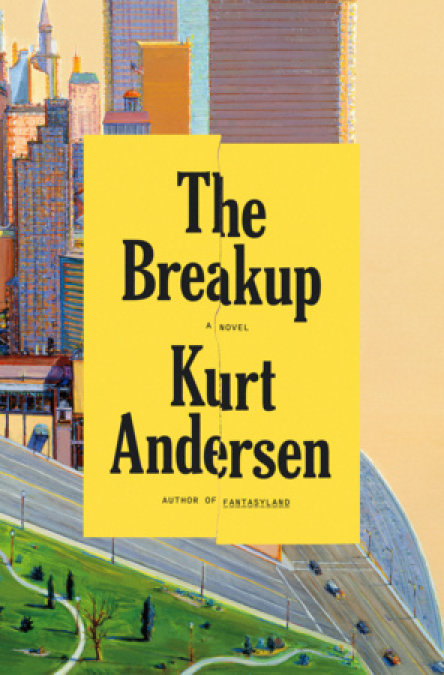
A marriage cracks apart as a near-future United States redraws its borders in this penetrating and moving novel from the New York Times bestselling author of Fantasyland.
“This remarkable book contains multitudes. With wide-ranging intelligence and his trademark wit, Kurt Andersen has written an epic elegy for a country strained past its breaking point.”—Tom Perrotta, author of Ghost Town
Natalie and Asher’s marriage has long been marked by fault lines, quiet rifts in how they view their fellow Americans and navigate AI-suffused life in 2045. After twenty-three years together, and after surviving the two years of civil war in the 2030s, Natalie in rural Tennessee (part of the new Free American Republic) and Asher in San Francisco (in the now smaller United States).Natalie and Asher’s relationship mirrors America’s own unraveling—confused, messy, painful, ambivalent, and impossibly intimate.
When Natalie and Asher are brought back into proximity while touring far-flung colleges with their seventeen-year-old, they find themselves on a road trip through a strange, uncertain new American landscape, transformed by both the terrorist uprising and technology, all while dealing with the flux—and resilience—within their own family. They face the questions the nation has reckoned with for a generation: what differences are irreconcilable, and when is something broken worth saving?
Razor-sharp, ambitious, ranging from tragic to comic and brimming with imagination, The Breakup is a sweeping story where the personal and sociopolitical intersect in ways bracingly plausible, keenly insightful, and surprisingly hopeful.
Release date:
August 18, 2026
Publisher:
Random House
Print pages:
560
* BingeBooks earns revenue from qualifying purchases as an Amazon Associate as well as from other retail partners.
I took longer than some people to start calling it the war. And by some people, I mainly mean my husband, Asher. “This is it,” he said to me that first Friday in June nine years ago after watching the news coverage for three hours straight. “It’s started. The civil war.”
He claims I rolled my eyes. I don’t think I did. “Well,” I said, “these idiots in Oklahoma obviously want us to think that’s what it is.”
Ever since I met Ash, in 2021, he has both dreaded and expected this or that political nightmare just around the corner, some other ghastly shoe always about to drop. Occasionally one did. To me his sincere alarm often seemed mixed with a doomer’s touch of anticipatory relish. And he always thought I was too disengaged from politics, sometimes guilty of “willful obliviousness” and “toxic positivity,” generally “in denial” about the inevitable American apocalypse, the end, the horror, the horror.
Even now, seven years after the insurgency ended, he says I’m too quick to move on. “You know people are still getting killed, right?” he asked during a call last November on our first Thanksgiving apart in twenty-three years. I replied that people are also still dying from nipah and the pandemic virus but not even most of his fellow San Franciscans wear masks.
During that summer of the first attacks, I referred to the violence a few times as the hillbilly intifada. I meant it ironically, disparagingly, but Ash didn’t approve of comparing these terrorists to the Palestinian terrorists. I referred more earnestly to the early bombings and shootings as the Troubles. It seemed right to me, because I thought the militia attacks might turn out to be like the decades of organized violence in Northern Ireland, continuing sporadically for years and years. Ash objected to that one too. “You like it,” he said, “because it doesn’t take a side. And you’re a twee Anglophile even when it comes to these gangs of mass-murdering fascists right here, right now.”
“Keep calm and carry on,” I replied. “Although in this instance? Actually more Hibernophile?” Writing down and reading this touché of mine now, it does remind me how comments like that can be annoying in a marriage, as opposed to a movie or a show or a novel.
Calling the mass shootings and bombings and assassinations and kidnappings and disappearances a rebellion or insurgency or uprising, Ash said when they started, unless modified by Christian fascist or white nationalist or neo-Nazi, “just romanticizes these psychos and their ‘anti-tyranny’ delusions.” In another conversation that first summer he referred to them as “your psycho friends,” which prompted a big fight. My friends because I grew up in Tennessee.
During a panel discussion at Vanderbilt a couple of years ago about the impact of the insurgency on American culture and intellectual life, blah blah blah, I called it “the Troubles” for the first time since 2036. I said the melancholic shade of that term seems even more apt now, in retrospect. Asher still objected, said now it’s like Southerners in the 1870s referring to the Civil War as “the Late Unpleasantness.” I reminded him that the panel moderator, “an actual historian,” had complimented my Irish analogy. “But if you want,” I said to Ash, “next time I’ll just call it the War of Yankee Aggression.” That was a joke.
It was a war, and wars are ghastly. Things fell apart, anarchy and a blood-dimmed tide were loosed upon our world for a while. Twenty-eight thousand Americans were killed, half of them innocent civilians, and another forty-five thousand wounded. But it was a brief, manageable war as wars go, eighteen months long. Altogether not much compared to longer and/or ghastlier wars, like the U.S. versus Iraq or Ukraine versus Russia or Israel versus Palestine or Iran versus Israel.
I couldn’t bear the people who immediately, eagerly started referring to it as Civil War II ––or, worse, Civil War 2, as if it were a game. If what we’ve put ourselves through was really equivalent to what our American great-great-great-great-great-grandparents put themselves through in the 1860s, a hundred times as many of us would’ve fought and maybe ten million of us would’ve died.
On the other hand, Ash said to me a year ago: “So you’re happy to call the big one that didn’t succeed a civil war, but not this smaller one that did?” Fair enough, Professor. I finally ended my semantic resistance. Okay, I told Ash, if history repeated and this counts as our second civil war, the first one was tragedy and this one is farce plus tragedy. But my favorite remains the term Walt Whitman used for the first one, the War of Secession.
God knows the last decade has been painful. Crushingly. It’s a lot. It’s the most. And I expect the sadness to linger for the rest of my life. But we don’t all now inhabit some Mad Max or The Blazes or Last of Us hellscape, do we? To quote a catchphrase of my father’s, who lived through the Cuban Revolution: “Podría ser peor,” and occasionally “Pudo haber sido mucho peor.” Could be worse. Could’ve been lots worse. So annoying to me when I was a kid unhappy about something, yet so often seems so true now.
I’m a writer, fussy about words. I’ve always thought way too many things are “tragedies” in America, mainly as a result of media hacks defaulting to that cliché every time they possibly can—robo-empathy, I called it before AI newscasters became a real thing. Life is half tragedy, for Christ’s sake, maybe more than half, which is one of the reasons I grade almost everything on a curve. And don’t we all, really? If we didn’t, we’d become undone contemplating the numberless tragedies that occur every instant in some life somewhere.
The violence was horrible, a terrifying nonstop psychostravaganza filled with daily terrors and tragedies that made me cry often. I still think of the random towns like Inkster, Michigan, and Chuichu, Arizona, that nobody had ever heard of until their names became overnight synonyms for mass death or other horrors. Until a week or two afterward, when some unfortunate new nowhere became suddenly infamous.
Come to think of it, that happened 180 years ago when little towns like Chickamauga and Spotsylvania Courthouse got famous overnight. For decades after that civil war, Americans were familiar with those battlefield names. But have you heard of them, let alone know where they are? (Not far from where I grew up and not far from where I went to college, respectively.) You’re reading a book, so you probably do know what happened in Hiroshima and Nagasaki a hundred Augusts ago, but the other day I saw a poll that found that more than half of Americans have no idea. Even though they were back in the conversation in a big way a dozen years ago after Bandar Abbas.
My point is that almost everything’s got a half-life, and surely you sense the half-life of our own recent trauma. Yes, cutting up the country still feels weird, and probably always will. Yes, the politics of Disunion are still driving some people to kill, but—grading on a curve—three or five or ten deaths a week among 375 million basically rounds down to zero. The acute, constant fear is gone. The pain is fading. Easy for me to say; the violence barely touched me. Nobody I loved was killed. That’s not counting a very close friend of Asher’s. Or two of my childhood friends and a cousin I met once. And the ex-husband of a college friend murdered in federal prison while serving time for the Fort Lewis attack of 2037, the cockamamie military-prison breakout scheme in the state of Washington that involved a homemade ten-man submarine painted to resemble a penis.
But beyond the individual tragedies endured by individual Americans, I sincerely wonder: At the end of the day, how great of a tragedy will most people consider the whole thing? In twenty-five or thirty years, when our children are our age, will it seem to them like such a big deal? Or to their hypothetical children?
I kind of doubt it. Given the way things are playing out. An improbable plan was improbably agreed to, then supported by a large majority of us—large majorities, I should say, on both sides—and negotiated and renegotiated over the last seven years. Messily, fitfully, ruefully, exhaustively, meticulously, more peacefully than not. And now very nearly complete. When he was president, Andrew Im used to love saying “win-win” and “win-win-win” and “everyone wins” about almost everything, including Disunion. In my opinion, everyone lost. But everyone who calls themselves American, from sea to sea and border to border (to border to border ad almost infinitum), is still using the same air traffic control and interstate highway systems, eating the same Mega Macs and GimmeChimichangas, sharing intimacies with the same digital phantoms, and about to spend a Sunday all watching Super Bowl LXXVII. Kumbaya. And the U.S. stock market’s now back up to where it was before the war, higher. Plus ça change.
We hope you are enjoying the book so far. To continue reading...

 Please log in to recommend or discuss...
