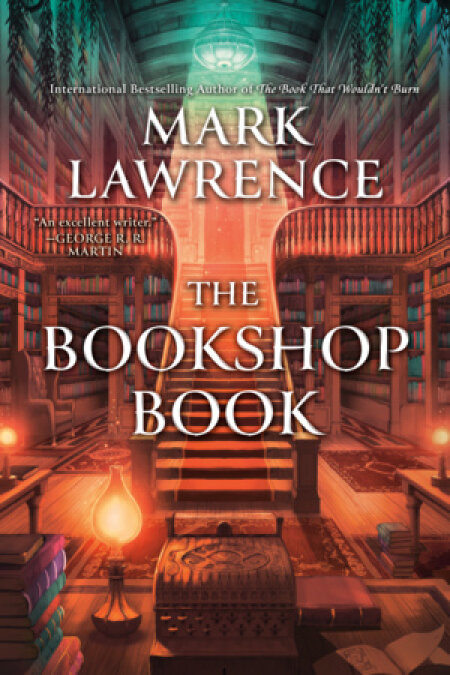
A fantasy adventure through cozy, cluttered bookshops and into the pages of classic literature itself, set in the world of international bestselling author Mark Lawrence's groundbreaking The Library Trilogy.
Bookshops have always been places where worlds collide. Places where ideas make war, where cultures meet and mingle. For Frederick "Red" Archer, a young man hanging on at the edge of society, a bookshop he wanders into will be the place that changes his life.
Rose Penrose is watching the world from the other side of the page, transported by an act of awful violence into a book her mother wrote. When a terrifying pursuer has Rose cornered, she is somehow able to leap from the book she inhabits into another—one that happens to be in the very bookshop where Red is standing.
Set in the world of Mark Lawrence's groundbreaking Library Trilogy, this fantasy adventure winds through the stacks of beloved bookshops and into the pages of classic literature itself.
Release date:
October 20, 2026
Publisher:
Ace
Print pages:
224
* BingeBooks earns revenue from qualifying purchases as an Amazon Associate as well as from other retail partners.
Everyone thinks they're special as a kid. At least I hope they do, or I've just revealed myself as a narcissist. Also, it's sad to think of children not believing themselves special, at least for a little while. Sure, they're setting themselves up for a big slap in the face from Mr. Reality, but it feels like a price worth paying in order to be able to dream.
I suppose that the age at which you stop thinking you're something else is the proper indicator of narcissism. A true narcissist never gets the slap, or if they do, they just shake it off and carry on. And even those few of us who genuinely do have some talent that makes us different will generally develop the maturity to put it in perspective. The world's best X, Y, or Z has benefited from a roll of the dice-they're no more or less special than the lottery winner on whom the finger of fate has descended from the heavens to bestow a great sum of cash denied to millions that same week.
You'll have seen by now that I like to talk. In my head at least. I'm chatty on the inside. On the outside, not so much.
My parents heaped the regular sort of praise upon me. My crayon-drawn picture of the dog was a work of art. The doling out of such plaudits never compared me to others though-I wasn't the "best," simply "marvelous."
That healthy avoidance of comparison came to an end the day I stepped into Madam ZaZa's tent at the Hernden Primary School summer fair. Madam ZaZa wore a turban or a headdress of similar volume, and incense sticks smoldered in defiance of all tent-related health and safety regulations.
She asked my name, and with my mother at my shoulder to give me courage, I told her: Frederick Archer. That was before I became Fred, and then Red, despite my hair being blond enough to make people think I'm Scandinavian.
I was nine at the time. Young enough to be amazed when, after some frowning and handwaving, Madam ZaZa guessed my birthday. It was an embarrassing number of years later that I realized Madam ZaZa was the French teacher who always smelled of cigarettes, and that perhaps she had the school records open on her lap behind that rickety table with the flowery tablecloth, spread of tarot cards, and crystal ball.
Madam ZaZa had it on high authority that I was not only a brave and clever young man, but special as all get-out. The spirits had told her-the same spirits that knew the very day of my birth! A great destiny awaited me, and was I courageous enough to seize it?
I was!
I crossed her palm with nickel-plated steel to hear my fortune and get the full skinny on a future so bright I was definitely going to need shades.
The following mixture of vague but flattering prediction, filled with carefully crafted nonspecifics onto which any young person could project their own yearnings, must have been delivered to every child who parted with a ten-pence piece that day, but I ate it up.
A chance wind swirled around the tent as she spoke, shuddering the sides and putting a vibration into the light. There had definitely been something in the air-I was sure of it. Even my mother felt it, tightening her grip on my shoulder.
And as the pièce de résistance, the crystal ball started to glow. Which was simple enough I suppose, but when I reached out to touch it, a crack ran through the whole thing, not there one minute, and there the next, with a crystal-clear snap like that ultimate pop we're hunting when we burst all those bubbles in the Bubble Wrap. The one that's going to be so satisfying, we'll never bother popping another ever again.
At the time I was gobsmacked. I was the CHOSEN ONE! I mean, I'd known it all along, but it was great to have the universe admit this self-evident truth at long last.
In hindsight, I suppose the crystal ball was cracked the whole time, and she just rotated it while we were distracted so that the light caught the fracture. But even now I'll give her ten out of ten for how well she acted out her shock. Imagine doing that fifty times in a row on a hot afternoon. Definitely a member of the local amateur dramatics society.
She even managed to put the willies up my mother-which wasn't hard, to be fair-and I was ushered out of there in quite a hurry with old Mademoiselle Lefevre slipping in and out of French as she gabbled something about being a crack in the world at our backs.
The slap from Mr. Reality, when it came, was hard enough to make my teeth rattle. Our dad had left shortly after the marvelously crayoned dog. I say “our” because I have a sister, Sophie, the firstborn. She isn’t special either. Mum-I think she tried, she truly did, but it wasn’t really in her. I think maybe that when her turn came to get her own slap around the chops from Mr. Reality, it just shook something loose that should have stayed tight. She tried, and she certainly hoped. She hoped harder than kids do, which is saying something. And when the world let her down, over and over again, as it does, as it always will, she just kinda . . . broke . . . a little bit at a time until it couldn’t be hidden.
So, we're in The Togetherness Trust's Home for Young People. Together. Wards of the state. Our case traveled all the way to the High Court thanks to belated interest from our absentee father. But Mr. Justice Smith ruled against him and here we are. Held in what's basically an open prison. Together with half a dozen other kids, most of them kleptomaniacs with zero impulse control and a burning desire to punch someone. Not that they're here because of that. What they are-what we are-is what this place and the process that put us here made of us. We're Play-Doh, and the holes we're squeezed through in that stupid nursery school press are what shapes us.
They say I have "oppositional defiant disorder." That means I like to say "no" a lot. I'd disagree, but that would be kind of making their point for them. I won't tell you all the labels they've plastered across Sophie's forehead in their mind's eye, but one of them is "low self-esteem." They say she's too eager to please. And maybe she is when it's strangers. Me, she'll only please by accident, and even then, try to take it back. But I do believe she'd stop a bullet for me if flying bullets were ever a thing around here. Maybe just a little too eagerly. And she did headbutt Jason the other day when he started picking on me. So, there's that.
She says I'm a wimp for never fighting back. And I suppose I am. It's true that guys like Jason scare me. He may only be fifteen-just a year older than me. But he's six foot two for Christ's sake. There's more to it, though. I'm not just scared of getting punched, I'm scared of the idea of fighting back, of what I'd do. In my imagination, I pick the fork off the table and stick it in his eye. And where would that get me? Sophie's only just being let out today for the first time since breaking his nose. Plus, you know, he's a piece of shit and all, but blinding him with a fork . . . nobody deserves that. Maybe he'd have been a friend if his mum hadn't necked a daily bottle of vodka before, after, and during her pregnancy. I shouldn't have read his records, but I'm a reader, it's what I do. Plus, I had to learn how to lockpick early on, and I need to keep in practice in case things go bad again.
That's one lesson everyone should be taught: just how quickly things can go bad. We think we're ambling down this wide road into the future, family on both sides, and everything's rosy. But the truth is that it's a gangplank, a balance beam reaching out into the dark, and if you put just one foot wrong . . . the dark'll take you.
On that happy note, I abandoned my chronic overthinking and followed Sophie out into a blustery March day. I hunched into my puffer coat and tried to keep up with Sophie's almost comically fast walking pace. She wanted away from that place, and badly. At sixteen she was the same height as me-I told people I was going to spring up anytime soon. And she was nose height to Jason Dean, so she was tall for a girl.
"Wait up!"
"Hurry up!"
I hurried up. She wasn't going to wait. She needed to keep moving-wasn't wearing enough for the weather. Just leggings, that tan jacket of hers, and the wide Aztec headband she got from the charity shop but swears is new. Winter still had its teeth in Werton, too cold to dry out, not cold enough to freeze. The crocuses and snowdrops huddled tattered and muddy around the tree roots in the park.
We headed into town at a speed that might indicate that the high street had something better to offer than the chippy, Chinese takeaway, Indian takeaway, and assorted hairdressers, along with the nail bars and vape shops that seemed to have taken over everywhere. It didn't, though. Those were the highlights.
For some reason we turned left on Wright Street and came at the shops from a different angle than normal. That's how I found the bookshop, tucked away on a side street where almost nobody tramping past the nail bars would ever see it.
I stopped and, although our sibling bond had grown pretty brittle of late, Sophie stopped too.
"'Books'?" I stared at the sign. "They called it 'Books'? Wow . . . the imagination . . ."
"I said there was a bookshop." Sophie shrugged. "I didn't say it had a great name."
"You never said anything about a bookshop. Ever!"
"Did so. You just don't listen."
"It looks like the place books go to die." I squinted across the street. Behind narrow windows in arched, green-painted frames, the volumes on display leaned in sagging piles. The general beige spoke of printing in an era when color was not an option or came from a palette with three choices. Too long a time in the sun might also have contributed to the bleaching of what looked to be an unenticing heap.
"Books died ages ago." Sophie waggled her phone at me. "Nobody reads anymore." She gave me a push toward the road and the shop on the far side. "Except nerds like you." And with that she was off, leaving me unsure whether she was serious or not.
I watched her negotiate the traffic on the high street-too much for a small town like Werton, almost all of it just passing through on the way to the city. She'd be heading to the Red Cross shop on the corner. Their secondhand clothes were cheap enough, and local kids hung out there sometimes on weekends.
When she left my line of sight, I crossed over to the bookshop. The building itself was old. Wright Street, our history teacher had told us-though I'm probably the only one who paid her any attention-used to be Werton's main street. It's where the Roman road ran. The high street got promoted to its current station after Werton's own version of the Great Fire of London and the subsequent redesign a couple of centuries back. Most of the bookshop's neighbors were newer, though still old and shabby looking. The bookshop, or whatever it was back then, must have been one of those curious islands you get in areas of devastation, whatever the cause, be it nuclear bomb, tidal wave, or conflagration-one of those little patches here and there that somehow escape with hardly a scratch to show for it and stand there shell-shocked, like the first man to run up the Normandy beaches on D-Day, headlong into the withering bullet storm, and somehow make it, when all his comrades nose-dived into the sand.
I hesitated at the door, which, with its flaking paint revealing a many-layered archaeology, looked more like my grandmother's front door than that of a high-street shop. That's Nanna Robbins, the one who definitely didn't want us, not the other grandma, who I don't remember meeting and who was too frail to be looking after her son's children.
A deep breath for no particular reason, and I pushed through, setting a small bell on a spiral spring chiming.
Instead of an open shop, I found myself looking at a booklined corridor, shelves stretching to the ceiling well beyond reach. At first it seemed as if the passageway ended after just five yards, a wall of books facing me, but a brief study revealed a right-hand turn disguised by the visual complexity of the scene.
The books themselves were of all shapes and sizes, seemingly from every era, and without apparent order. I felt momentarily daunted, as if this might be some eccentric's home rather than a place of commerce, and me the intruder, uninvited. The smell drew me in. Old books. A mix of neglect and love, a promise of secrets to be told and doors to other worlds waiting to open. One glance back at the street, even now being sealed away by the lever arm of the door, and I forged ahead.
The right turn led to a small "room" formed by floor-to-ceiling bookcases. Two passages carried on, one straight ahead and the other to the left, and in the enclosed space, backed against one of the book walls, a battered counter, behind which a man sat in a rather fine chair, reading. He didn't look up.
Something clicked into place. Almost loud enough for other people to hear. I looked at the man, at the book cave around him, his kingdom. And I knew from one moment to the next what I wanted to do, what I was for. I had never until that moment seen a future into which I fitted. I don't say this to be dramatic, but simply because it was true. The world was full of people with plans, or ambitions-which are just a vaguer sort of plan-or goals, or perhaps only hopes. But most of them saw a world with a place for them in it. The only question was whether they'd manage to reach it, to get it, to make it happen.
We hope you are enjoying the book so far. To continue reading...

 Please log in to recommend or discuss...
