
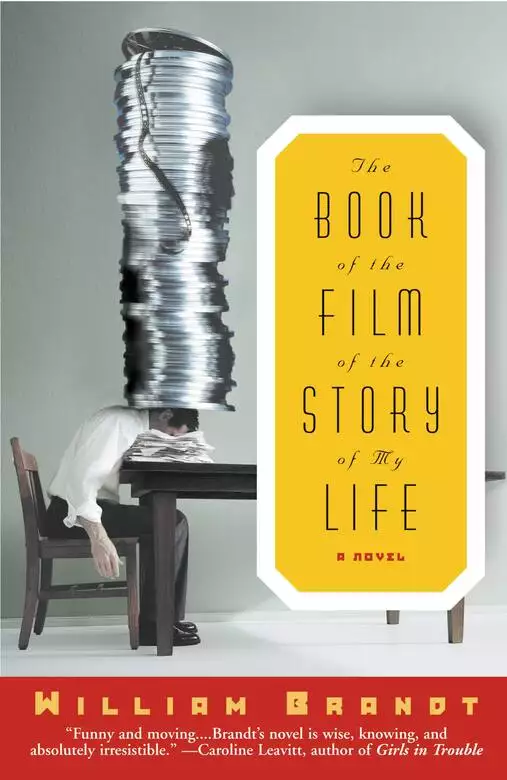
The Book of the Film of the Story of My Life
Available in:
- eBook
- Paperback
- Book info
- Sample
- Media
- Author updates
- Lists
Synopsis
Originally published in New Zealand and in the UK, Brandt's hilarious first novel about life, love, and the film business delves into the mind and mystery of the modern adult male.
Release date: September 3, 2007
Publisher: Grand Central Publishing
Print pages: 340
* BingeBooks earns revenue from qualifying purchases as an Amazon Associate as well as from other retail partners.
Reader buzz
 Please log in to recommend or discuss...
Author updates
Close
The Book of the Film of the Story of My Life
William Brandt
Chapter 1
“. . . FREDERICK? Are you there? Dear?”
“Yeah, I’m here. I’m just . . .”
I brace my arm against the wall. I change weight, I try to breathe. My forehead is prickling.
“Or even if it was just for a holiday, just for six months.”
“Yeah, that would be nice.”
“How long has it been now?”
“How long? Oh, must have been a while.”
“It must be three or four years, dear.”
“Yeah, probably about that.”
“At least.”
“Yeah.”
She pauses. It’s one of those crystal-clear lines you get sometimes and I can hear the catch in her voice. “We do miss you, you know.”
“Oh, yeah, of course, I mean hell, I miss you too. You know, it’s just, you know how it is, I’m up to my eyes out here. Otherwise, wild horses, I mean, like a shot.” I put my back against the wall, lean on it and slide.
“Well, think about it.”
“I will. I’ll give it some serious thought. I’ll think about it. Seriously.”
“Just for a holiday.”
“I could do with a holiday, that’s for sure.”
“I hope you’re not working too hard.”
“Don’t worry, I’m fine.”
“I saw Sophie in the paper this morning.”
“Mm-hm.” I dig my fingernails into the wallpaper. I don’t want to hear about Sophie being in the paper.
“She looked quite thin, I thought.”
I don’t want to talk about her.
“Do you think she’s eating properly?”
“Gee, I really don’t know.”
“Have you seen her at all lately dear?”
“Well, she’s in the States right now, but we keep in touch, sure. We see each other when we can. You know. It’s fine, it’s cool, we’re mates. We’re just both pretty busy, so, you know, we don’t, that often . . . but when we can yeah. For sure.”
“If you did come back we could take the boat up to Russell.”
“That would be nice.”
“Dad’s getting the transom rebuilt.”
“Oh, that’s good. He never did like that transom.”
“Well . . .” She sighs, and I can hear her fingernails drumming on the receiver. Tappity tappity. Here it comes. The clincher. This is the part where she offers me money. I then refuse, breezily. She then offers again, vaguely, we let it drop, then just before we hang up we agree on a sum and it turns up in a few days. Then I go to Selfridges and buy clothes. I go to Jermyn Street and buy cheese. I take taxis everywhere. I go to restaurants and cafes. I buy watches, electronic goods, shoes, knickknacks and gewgaws. I sit in parks. I take train rides to nowhere.
“So . . . did you get the card?”
“I got it. It’s great. The socks are great too. They . . . just great socks. Great.”
“I hope you’re having a happy birthday.”
“It’s great. It’s great.” When I woke up this morning I was forty-two. That’s when it hit me. That’s when I realized I was forty. I’d always suspected that forty went over a little too easily. Now it’s kicking in.
“So you’re sure everything is okay, dear?”
“Oh, sure. Great. Couldn’t be better.” I resolved a long time ago to protect my parents from my life. After all they’ve done for me, it’s the least I could do.
“. . . Are you all right for cash, dear?”
Normally, a forty-two-year-old man doesn’t need money from his parents. A forty-two-year-old may well not have parents. Instead, he has his own money. He has children. Responsibilities. A career. I’m sweating bricks. “Oh, yeah, I’m fine, I’m fine. I’m just fine.”
Another pause. I can hear my dad’s voice rumbling in the background. “Dad says do you want him to send some money over?”
“No. No, I’m fine. Don’t bother.”
“The exchange rate is murder nowadays.”
“Well, that’s what you get.”
“Sorry, dear?”
“That’s what you get for devaluing.”
“Yes.” She sounds a little unsure. “Still, it’s good for the farmers, isn’t it?”
“And what’s good for the farmers is . . . good for the farmers.”
“Sorry, dear?”
“What?”
“What do you mean?”
“I don’t know, what do I mean?”
“So, do you want Dad to . . . ?”
I hang up a few moments later. I hang up and sit and I try to breathe. I’ve done an insane thing. I said no. I said love to all, I said take care, I said thanks for the card. I said I’d really think about that holiday, seriously. Then I said no, three times. And the last one did it. She actually believed me. They aren’t going to send any money. I really think they aren’t going to send it. I told them not to send it and they aren’t going to send it. She was waiting for me to change my mind and say, Oh, send it, and I was waiting for me to say it, but I didn’t. I didn’t say it and she believed me, she believed that I actually didn’t want it. We said good-bye and she said happy birthday one more time, and we hung up.
What really rocked me was when my mother suggested that it’s time I go home. She said a holiday, but she didn’t mean that. I know what she meant. They want me to come home. There are only two reasons for going back to New Zealand to live. One, you’ve got kids. Two, you’ve failed. I don’t have kids.
If my mother is suggesting that I have failed, it’s serious. My parents are pathologically supportive. Despite overwhelming evidence to the contrary garnered over the last forty-two years, they still think I’m wonderful and can do no wrong. Heartbreaking. That’s why I am the way I am. It’s not their fault. They just backed the wrong horse, God bless them. How were they to know? How was I to know? How was anyone to know? But sometimes I think, if they’d just made it a bit tougher, deprived me of a few things now and again—money, opportunity, love—I wouldn’t be in the mess I’m in now. Still, you have to be philosophical. These things happen. Lives turn out wrong, or they don’t turn out at all. It’s no big deal, it happens all the time, for all sorts of reasons. God almighty, people die. Entire families are crushed by falling masonry. Men are tortured, women are raped, and vice versa. We won’t even start on the children. No one is doing any of those things to me. I’m not dead, I’m not even hungry. Christ, I need to lose a few kilos. I should be grateful. Life is a strange and wonderful gift and today is the first day of the rest of it. There is no such thing as failure, only opportunities to learn. I should be jumping for joy. I should be over the moon.
But I’m not. I don’t know what’s wrong with me, I’ve gone all limp, I’ve gone all gutless. I lack ambition and drive. I’ve become soft and passive and weepy and sentimental. Anything can set me off. It’s got so bad I can’t go to the movies anymore. And the children, oh, God, the children. An ad for nappy cream is enough to reduce me to tears. I walk past playgrounds and I have to cross the road. Maybe it’s a natural part of the aging process.
BEEP BEEP BEEP.
I have ten seconds. I sit on the edge of the bed, rest my left arm on the bedside table, and keep still.
POCKETA POCKETA POCKETA.
The pressure cuff hidden on my left biceps begins to fill with air. A prickly feeling on my forehead. I force myself to relax. I look around the room. Flowery wallpaper. A small window with a view of a chimney pot forest against a gray sky. A light drizzle falling. A 747 inching its way across the windowpane. In one corner a bed. In the other a hand basin. Next to that a tiny fridge with an electric jug on top.
In the fridge, I happen to know, is a bottle of Stolichnaya. By now the cuff has tightened until it’s almost painful; it hesitates, inflates a little more until it is, then deflates slowly in increments. My hand throbs as the blood floods back. My fingers tingle.
BEEP BEEP.
All done. I glance at the LCD display on the cigarette-packet- sized apparatus attached to my belt. Up a couple of points.
But now, to work. I open my Foster and Sons leather satchel. I pull out three original screenplays. I take up the first, which consists of 120 A4 pages bound with three brass studs. Plain and unpretentious, the cover page is blank except for the title, centered and typed in twelve-point Courier: Blood Count. So far so good. I get myself comfortable, inhale deeply through my nose, clear my mind of all extraneous influences, and begin to read. About ten minutes later I put it down. I reread the end of the last scene:
. . . SUDDENLY THE CLEANING LADY DROPS HER MOP AND PULLS AN UZI OUT OF THE BUCKET.
Cleaning Lady
Fuck you, mother fucker.
SLOW MOTION: THE UZI SPITS LEAD, BUT THE CLEANING LADY IS SHOOTING WIDE. THE PRICELESS STAINED GLASS WINDOWS DISSOLVE INTO A MILLION SHARDS BEHIND BAKER’S HEAD AS HE CARTWHEELS, DRAWS HIS WEAPON AND EMPTIES ALL SEVENTEEN ROUNDS OF THE NICKEL-FINISHED HECKLER AND KOCH P7M10 SPECIAL INTO THE CLEANING LADY’S FACE.
TIGHT ON: CLEANING LADY’S FACE DISSOLVES INTO A BLOOMING FOUNTAIN OF BLOOD AND BONE.
ANGLE ON: CLEANING LADY’S BRAINS SPLATTER ACROSS THE RECENTLY-CLEANED LINOLEUM SURFACE.
Baker
Mop that.
BAKER CHUCKLES. MAYBE IT’S NOT GOING TO BE SUCH A BAD DAY AFTER ALL.
Now, Baker is the good guy. I don’t know, I guess I really am getting old. I sigh. I return to the script. After another hundred-odd pages, six violent deaths, two maimings and an extended torture sequence, I lay the script aside and stare at the ceiling to give my stomach time to settle. I make a few notes for future reference and turn to the next script. This is an entirely different kettle of fish. It is elegantly spiral-bound. Centered on the glossy black plasticized cover is a color reproduction of the part of the Sistine Chapel roof depicting God and Adam fingering each other. The title is discreetly embossed: The Eternal Round. There is a subtitle too: A Pseudo-Shakespearean Romance. I flip through the pages. The paper is heavy, one hundred grams at least. Laser-printed. Everything bespeaks enormous effort, attention to detail, and great care. My spirits rise. This is more like it. I breathe deeply, clear my mind of all preconceptions and begin to read.
It is subliterate. It is sub-subliterate. “Their” and “there” are treated as alternate spellings. Every time a word ends in “s” it has an apostrophe. Furthermore, the characters speak in a ghastly parody of Elizabethan English, with frequent lapses into nineties vernacular. It is set in a sort of science-fictionized seventeenth-century Venice, observed by little invisible green men who have floated down from the sky and are, I think, supposed to be cute.
Blakensop
Antonia, Antonia, I beg thee, just don’t do this thing that you are thinking of, okay?
Antonia
Blakensop, I wouldst that I could not but consider it for thou art passing spunky in those tight’s.
SHE GRIN’S IMPISHLY, KISSES HIM IMPETUOUSLY, FLASHES HER BUTTOCK’S AT HIM AND DISAPPEAR’S OVER THE BALCONY RAILING. THE CUTE LITTLE MARTIAN GIGGLE’S IMPISHLY AND FOLLOW’S BLAKENSOP TO THE MARBLED BATHROOM WHERE HE SIGHS AND BEGINS TO WASH HIS GENITAL’S.
I stare at this passage for several minutes, trying to project myself into the mind that wrote it. I fail. I do not believe that a mind was involved. I wonder if it has perhaps been computer-generated. Or maybe it’s a terrorist plot. Script number three is simply bound. It is entitled Jacko. I open a page at random.
JACKO HOVERS IN THE DOORWAY. HE WATCHES SAL’S DEFT FINGERS AS SHE WORKS ON THE WALLABY.
Sal
You orf?
PENSIVELY SHE GLANCES OVER HER SHOULDER, HER HEART POUNDING WITH REGRET. HE LOOKS BACK AT HER, THOUGHTFUL BUT DISTANT, FINGERING HIS BROW, A FLICKER OF SPENT PASSION PASSING ACROSS HIS FACE EVERY NOW AND THEN LIKE THE LAST RUMBLES OF A THUNDERSTORM AS IT DRIFTS ACROSS THE PLAINS AND VANISHES OVER THE HORIZON. BUT THE MOMENT HAS PASSED AND A BLEAK SENSE OF SEPARATION SETTLES HEAVILY BETWEEN THEM. SILENCE FALLS IN THE CRAMPED HUT. TURNING BACK TO THE SINK, SAL CONTINUES TO SCRUB THE WALLABY’S LIMP SCRAWNY CORPSE, WITH SLOW, HOPELESS MOVEMENTS. CAMERA TRACKS AND ZOOMS AS THE DEAD WALLABY’S PAWS FLOP TO AND FRO LIKE THE PATHETIC CAPERINGS OF AN AGING CLOWN. THIS THOUGHT STRIKES THEM BOTH AT THE SAME TIME, AS JACKO STANDS IN THE DOORWAY, UNMOVING, AS STILL AS ROCK. SHE SEEMS TO HIM SO LIKE HIS LONG LOST MOTHER AT THIS MOMENT EXCEPT FOR THE COLOR OF HER HAIR BUT THIS IS A THOUGHT HE ONLY HALF FORMULATES EVEN TO HIMSELF AND WILL NEVER EVEN BEGIN TO FIND THE WORDS TO THINK ABOUT EXPRESSING.
Jacko
Reckon.
SAL TOSSES HER HEAD MOURNFULLY, AND CATCHES HIS EYE.
ZOOM IN TO EXTREME CLOSE-UP OF JACKO’S EYES. THE PUPILS FILL THE SCREEN. THE BOTTOMLESS DEPTH OF HIS PUPILS EXPRESS A SENSE OF LOSS, A LOSS SO DEEP, SO INEXTRICABLY WOUND INTO THE CORE OF HIS BEING THAT NONE BUT SHE CAN TRULY UNDERSTAND WHERE AND HOW IT CAME TO BE THERE. BUT EVEN SHE CANNOT REACH HIM NOW. SHE BEGINS TO SKIN THE WALLABY.
Sal
Yeah?
JACKO TURNS TO LOOK OUT THE WINDOW AT THE LONE TREE. ITS BRANCHES DEAD AND BARE, IT HAS NOT CHANGED, THERE IS NO FLICKER OF GREEN ANYWHERE ABOUT IT, IT IS JUST AS BLACK AND BARE AND HOPELESS AS IT HAS EVER BEEN. THE HILLS TOO ARE UNCHANGING, THE RED EARTH BAKING IN THE HARSH GLARE OF THE PITILESS SUN. THEIR DEEP TECTONIC SHIFTS, INVISIBLE, UNGUESSED AT, UNSEEN, FAR FAR BELOW THE SURFACE, SEEM TO REFLECT AND COMMENT IRONICALLY ON THE GRIM HAGGARD LANDSCAPE OF JACKO’S IMPASSIVE FACE. IT IS AS IF THIS MAN, THIS MOMENT, THIS TIME AND THIS UNIVERSE WERE BORN THE ONE FOR THE OTHER, AS IF ALL TIME AND ALL CREATION HAS BEEN DIRECTED BY THE GREAT UNSEEN HAND OF NATURE TO THIS ONE INDESCRIBABLE MOMENT.
Jacko
Yeah.
On balance I think I prefer Blood Count. At least it has a story. I’m constantly coming across scripts in which either nothing happens at all, or anything that does happen has nothing to do with anything else that happens. My job is to read them anyway. It’s hard work and thankless, the pay is shit and I can’t get enough of it to survive, but someone has to do it. Someone has to read this stuff so that others will never have to. Yes it’s a war we’re fighting down here, protecting the innocent. Not perhaps the reason I got into the film business. My reasons for getting into the film business were more Olympian. Right up to my thirty-seventh birthday I believed, passionately, that I was destined to change the world and that I was destined to do so through the medium of film. The articles of incorporation of Godzone International Proprietary Limited actually include the phrase “development, production and exploitation of cinematic works of a seminal and world-changing character.” So it’s right there, in black and white. On my thirty-seventh birthday, as a matter of fact, I was riding through Paris with Sophie in a sports car when I realized I was never going to change the world. It came to me, quite suddenly, waiting for a red light on the Champs-Elysées. It just wasn’t going to happen. Okay, I said to myself at the time, no need to panic, I’ll just change my strategy. I won’t change the world, I’ll make the most of it as it is instead. No problem. I’ll screw the bastard. This morning I woke up and I was forty-two and I realized something else. I haven’t changed the world. I haven’t even made the most of it as it is. I certainly haven’t screwed the bastard. And now I get this uncomfortable feeling—now it’s the world’s turn.
But first, a bathroom stop. I let myself out of my room, and into the potato-smelling staircase. A couple of flights down there’s a new family. For some reason their doormat is always thickly strewn with potato peels and children’s shoes. It looks like something you’d see at the ICA.
And this morning it’s even more surreal than usual because someone is waiting for me on the landing. Someone in red leather, top to toe, a bright red helmet on his head. He looks like one of Satan’s little helpers. Under his arm is a package. How I wish I was a motorcycle courier. Someone who actually does something. “Can you help me, mate? I’m looking for a Mr.”—he squints at the package—“a Mr. or Ms. Case-Carlisle.”
“That’s me. I’m Frederick Case.”
He looks at me, then back at Mrs. Traversham’s door. The two or so square inches of face visible behind the helmet appear to be suspicious.
“I’m the boarder. That’s my address too. This is my room. I live on the landing but that’s my address.” I get out my key to demonstrate, eyeing the package. It’s about the size of a duty-free pack of cigarettes. It’s wrapped in brown paper. “Also, for your information, it’s my birthday.”
“Sign here.”
I sign with unseemly haste.
“Happy birthday.” The courier clumps away down the stairs. I take the package back into my room. I shut the door and rip off the wrapping. It’s a wooden box, the proportions of a tiny coffin. It’s wrapped in about a mile of shiny red ribbon. There’s an envelope taped to the outside. I open the envelope. Inside is a card, and a tiny pair of golden scissors. Inside the card is a message: Cut the red tape. I take the scissors and cut the tape. I open the box, which has hinges. Inside the box, in a nest of tissue paper and straw, is an old Coke bottle. Looks to have spent some time in the sea—it’s clouded and abraded. It’s very heavy, thick glass.
There’s a message in the bottle, rolled up. I pull it out. It’s a piece of paper, burnt around the edges in traditional ye-olde-pirate style. It’s been photocopied, with our names written in by hand:
EXPERIENCE THE LAND OF FIRE AND MAGIC!
Dear Frederick and Sophie,
Charles C. Menard would like to take this opportunity to heartily solicit your participation in celebrating the occasion of his fortieth year here on planet Earth.
I note the split infinitive, but read on anyway.
The festivities will take place on the Pacific island paradise of Makulalanana. Makulalanana is a sacred volcano. Smoke rises mysteriously from the summit. Witness for yourself the glowing lava-filled crater.
Nestled like a jewel inside its protective coral reef, this tiny completely uninhabited island forms part of the Guelep archipelago, a little known group of islands approximately two hundred and fifty nautical miles north of Vanuatu and accessible only by seaplane or boat.
Charles will be celebrating throughout the week of November 14, 2002, and you are welcome to join him for part or all of this time in the luxury tent-town of Makulalanana, erected especially for the occasion.
Please come prepared for a fancy dress gala event dinner on the Sunday night.
All amenities will be provided. (And we do mean all, darlings . . .)
RSVP to Karl Bell of Bell and Beauchamp Ecstatic Experiences, Ltd.
PS: It is Charles’s great pleasure to offer you this entire island experience as his guest.
I blink. This is ironic. Charles C. Menard is offering to fly me all the way around the world and back, to celebrate his birthday. Not my birthday. His birthday. Plus, it’s all a mistake anyway. He’s really inviting Sophie. Must be a glitch in the system somewhere. He has yet to update his database. I suppose I should let Sophie know, but I’m fucked if I’m ringing her on my birthday. She’ll probably find out anyway. She’ll probably go in fact, which means I’d better not. I can think of better ways to spend a week than hanging around sad and single in a sandy confined space with my estranged wife and her film-star boyfriend.
I run my hands through my hair. I feel primal. I feel dizzy. I sling the box under the bed and climb the half-flight to Mrs. Traversham’s flat, knock lightly and let myself in. Mrs. Traversham has returned from her morning constitutional. I know this because of the yapping.
“Ah, Mr. Case, is that you?”
“Yes, Mrs. Traversham, it is indeed I.”
“I wonder could I possibly prevail on you to render me a moment’s assistance?”
She’s in the kitchen with a jar of Branston Pickle that won’t open. Freddy, her King Charles, is jumping around her feet. He adores Branston Pickle. Can’t get enough of it.
“I’m most terribly sorry but I simply can’t seem to induce this lid to budge.”
“Allow me.”
Mrs. Traversham is ninety-six. She’s thin as a bird, covered in large brown liver spots, hunched over, small, white-haired, and dresses exclusively in tweed with enormous wrinkles in her support stockings. She has the plummiest accent I’ve ever heard in my life. She’s worse than the Queen. She can see about twenty-five feet, which is just enough to get you across the road if you trust the signals. As far as I know, Mrs. Traversham has no relatives, no friends and no acquaintances. She has lived alone in this small flat off the Edgware Road for the last sixty-odd years with a succession of King Charles spaniels ever since Mr. T was crushed, along with their two small children, by a collapsing building in 1941, which is ironic because he was a bomber pilot at home on leave. She still has his uniform hanging up in the hall closet in a dry-cleaner’s bag with a handful of mothballs. Every single one of her King Charles spaniels, except for one who was mauled to death by a cat, has died of heart disease. She says it’s congenital. I say it’s Branston Pickle.
I’ve been here for about four months. I came here almost straight from the split-up with Sophie, after a short stint at Tamintha’s. I was a mess when I got here. I was manic. I kept going on and on about nothing at all. Then I’d suddenly become silent and black. Mrs. Traversham wasn’t too sure at all at the interview, but when she discovered I have the same first name as her dog she cheered up enormously. Then she found out I was a New Zealander and that clinched it. “Oh, that explains it,” she said, greatly relieved. I think she meant the ponytail; I’m not sure.
I open the jar and hand it back with a flourish. Freddy is by now going berserk. He slips on the linoleum and almost brains himself on my kneecap.
“Mr. Case, you are a constant source of delight and amazement.”
“Mrs. Traversham, it is, as always, an inexpressible pleasure.” It is too. It’s the most useful thing I’ve done all day. All week. All . . . no, stop. That way lies madness. “Oh . . .” I reach into my back pocket and pull out a hundred and fifty quid. “I owe you for this month.”
“Very kind of you, Mr. Case, thank you so much. I’ll make out your receipt directly.”
After relieving myself in Mrs. Traversham’s 1942-era bathroom, I make the classic mistake. I stop to look in the mirror. For some little time now I have been aware of pressure building in my upper lip. I was right. It’s an enormous blind pimple the size of Hawaii, pushing out from the corner of my mouth. It changes the shape of my entire face. I look like a spawning salmon, one of those doomed hook-jawed monsters fighting their hopeless upstream battle. Forty-two years old and erupting all over the place like a teenager. Happy birthday.
I went to a Chinese herbalist once for my skin. He was all the rage. He had this tiny little practice in Soho. He was wearing Hush Puppies. I remember that bothered me. I believe that clothes maketh the man. He looked at my eyes, at my fingernails, my neck, my earlobes. He told me no bread, meat, whiskey, beer, wine, orange juice, eggs, potatoes, corn, breakfast cereals or flour. Which left rice, raw vegetables and lentils. For alcohol I was allowed vodka. I ignored most of his advice but I did go straight out and buy a bottle of Stolichnaya. I’ve drunk nothing else since. Everyone tells me it’s stress. It’s just stress. “You’re under a lot of stress.” Well, it’s not stress. It’s acne.
Back in my room there’s a message on my cellphone. My pulse instantly goes to two hundred because I get this insane idea that it’s Sophie calling for my birthday. It isn’t. It’s a call from Mee, the mad Singaporean-New Zealander. He wants to know if I’ve read the manuscript he sent me and when he can expect a contract. And he wants to remind me that the contents are copyright. That’s classic, a sure sign. The less valuable the idea, the more obsessed the author is with protecting it. When you’re a producer, you get a lot of phone calls. Calls from mad, bad people who have written mad, bad scripts, people full of fear and anger, people obsessed with betrayal and copyright and fees and stars and let me tell you I might bitch about these three scripts I’m reading today but they’re Shakespeare compared to what I’ve seen. I’m reading these scripts professionally, for Biscrobus Film, an established production house that actually, incredibly, gloriously, makes films. Yes, these scripts already have a producer. Sure, Biscrobus doesn’t want to make them, but there are actually people who want to. They’re Nobel quality compared to what’s out there. The stuff I get, at my bottom-hugging, below-radar, hedgehopping level, is beyond belief. All you have to do is say the word “producer” and it comes at you from all over, like flies to a corpse. Dross, crap. Sub-dross. Just say the word “producer.” You’ll see. Film is a world of big fish and little fish, sure, but it’s a world where the little fish chase the big fish.
BEEP BEEP BEEP.
I sit still, rest my arm on the bedside table.
POCKETA POCKETA POCKETA.
I try to relax and think neutral and low-pressure thoughts. On the bedside table at my elbow is the birthday card from my parents—Birthday Thoughts and Love to a Special Boy. Sheesh. Next to that is a photo of me and Sophie on our wedding day. I keep it by the bed. Just my little joke. I have a very postmodern sense of humor. Sophie is gorgeous in black leather, black lipstick, fuck-me-now stilettos. However, I—frankly—in my Workshop suit, barefoot, with long blond hair drawn back in a flowing ponytail, and delicate, chiseled features, am equally gorgeous. Damnit, I am more gorgeous. Even my feet were attractive then. I was a demigod. Tall, graceful, athletic. Not, in fact, an athlete, I couldn’t run to catch a bus, but I looked athletic. That’s what counts. I sit and stare at this photo and I just can’t understand where it all went. I just don’t get it. Of that wonderful creature in the photograph all that now remains is the ponytail. And that’s thinning.
Still, that really was some wedding, best damn wedding I ever had.
BEEP BEEP.
A hundred and sixty-five over a hundred and eight. Must . . .
We hope you are enjoying the book so far. To continue reading...
The Book of the Film of the Story of My Life
William Brandt
Copyright © 2026 All Rights Reserved
