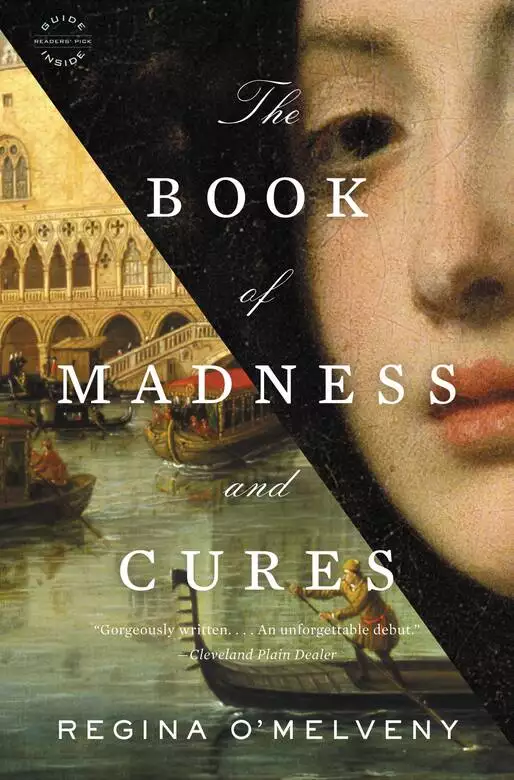
Gabriella Mondini is a brilliant young woman who possesses something rare in the Venice of 1590: the access, learning, and intuition to become a doctor. Her entrée to this profession is provided by her father, himself a renowned physician. In return she helps him research his magnum opus, a vast, encyclopedic work called The Book of Diseases, recording how the water of rue lends second sight, how the manifestations of solar madness arise, and how the horn of the unicorn cures lack of desire.
In her own practice, Gabriella has honed her natural ingenuity in administering to the women eager to be her patients. Then Gabriella’s father mysteriously disappears. Without him to vouch for her, Gabriella is banished from the guild of physicians. To pursue her life’s calling, Gabriella must find her father and bring him back. With two trusted servants she sets out across Europe, following clues from her father’s enigmatic letters. Has he been gripped by madness or seized by some shattering medical discovery?
Gabriella crosses the mountains of Switzerland and the wilds of Germania; she meets with the greatest medical minds of Europe in Padua, Leiden, Edenburg; she traces him through strange and forbidding cities, all the way to the spice-scented streets of Morocco. With each step, she expands her own fluency in healing. By the end of her search, Gabriella will encounter the hidden truths of her family and unfold the deepest mysteries within herself.
Layered with medical lore and vivid details of Renaissance life, The Book of Madness and Cures spirals through a remarkable period of cultural turmoil and astonishing discoveries in science and art: an intoxicating and unforgettable debut.
Release date:
April 10, 2012
Publisher:
Little, Brown and Company
Print pages:
336
* BingeBooks earns revenue from qualifying purchases as an Amazon Associate as well as from other retail partners.
“I don’t know where my own body begins or ends,” said the young girl of Imizmiza. Her mother had summoned me, the only woman physician within hundreds of miles, to tend her twelve-year-old daughter, who suffered the grave consequences of corporeal confusion. The girl sat at a cedar table near a narrow window in the red earthen house. She told me, through a dark veil that flickered as she spoke, that she sensed the fear of entrapment that the tethered horse knew in the field. His visible breath pulsed in the cold air as he drew the rope taut, while the groom approached, currycomb in hand. She told me, “The man who strokes the horse with five different brushes in strict order of succession, the man with a head like the knot at the end of a rope, he is smaller than my thumb—” And then she laughed suddenly, surprising me.
Before I could puzzle this out, her mother approached us and chided, “Come, Lalla, put on your riding skirts. You’re taking the horse out today.”
The girl stared at the plank table where her left arm lay with the grain, her right arm resting bent against it. She whispered, “I’m too heavy today, I can’t move.”
And though she made an effort, she couldn’t budge.
When I placed my hand upon the wood lightly, as if touching the fuzzy scalp of an infant, she sighed and closed her eyes. When I removed my hand, she sensed it immediately. I tried to lift her arms from the table but she was rigid. Later, inclined by some inner urging, she separated herself and wandered as if in a trance, when at last her mother could direct her to her beloved horse or to her bed for an afternoon nap.
Wherever Lalla stopped, she became part of the thing she touched. When she rode her walleyed and snorting animal, she sweated like a horse. Froth gathered at her lips and neck. When she slept, she might not wake for days, for the bed itself was her motionless body. Meals were the most difficult. She refused whatever food she touched, confessing a horror of eating her own flesh. Though her mother fed her like a babe with a small wooden spoon, she grew thinner and thinner.
At length I suggested a slow cure. I would need the assistance of her mother and aunt—though the aunt, a large, choleric woman, obstinately insisted that Lalla was not in need of curing, and certainly (she glared, scrutinizing my face and my dress) not by a foreigner. The girl simply possessed a clairvoyant body, the aunt said, challenging me. “We mustn’t take away the girl’s talent.”
“The girl doesn’t have command of her own life! One must stand apart in order to truly know another,” I said.
Lalla’s mother, a small, dark mountain of a woman, also veiled, asked, “Will she be able to marry and bear children?”
“I don’t know,” I confessed.
The cure, then, consisted of words. I advised her mother to name her hand, to name the distaff upon the table, and the table itself. When I came to visit, I’d ask Lalla, “Where is your arm, your hand, your hip?” Sometimes she could answer and point to that part of her body. Other days she regarded me with a kind of panic, as if she didn’t understand my question and feared terrifying penalties for this. I touched her hand, and then her mother or aunt would repeat the word for hand, to calm her. Gradually she responded with more and more movement until her ability to unfasten herself from her surroundings was accompanied by a kind of plaintive joy. For separation meant that she had changed and that the unknown surged forward to meet her.
I’ve since come to believe that the world is populated by multitudes of women sitting at windows, inseparable from their surroundings. I myself spent many hours at a window on the Zattere, waiting for my father’s return, waiting for my life to appear like one of those great ships that came to harbor, broad sails filled with the wind of providence. I didn’t know then that during those fugitive hours beneath the influence of the damp moon, I was already plotting my future in pursuit of the past. I’d grown transparent as the glass through which I peered, dangerously invisible even to myself. It was then I knew I must set my life in motion or I would disappear.
CHAPTER 1
Venetia, 1590
From the foreign marks and characters in diverse hands and languages upon the sheet of paper that enclosed it, I could see that my father’s present letter had traveled, a lost communiqué, through many of the cities on his route. It had been nearly a year since I’d heard from him. All told, he’d been gone since August of 1580. Olmina, once my nursemaid and now my servant, had slipped the letter lightly on my desk that stifling July afternoon. She may as well have released a viper that gives no warning before it strikes.
“If my mother reads this, you know she’ll twist it into some kind of offense, no matter what it contains,” I warned, tapping the closed letter nervously on my palm as we stood in my shuttered room, the summer tides slopping noisily on the stones below my window, the warm stench of brine stinging the air. Poor Mamma. She’d always perceived the world to be against her. Happiness was never to be trusted. And yet, I thought vaguely, neither was sorrow. Didn’t each come to season in the other? Sometimes our Venetia gleamed a miraculous city on the summer sea, and later during the winter acqua alta, she sank into cheerless facade. Then the floods engendered spring. Someday she might all be submerged, a dark siren whose lamplit eyes have gone out. Yet others might see beauty there where we walked in the place become water.
“Don’t worry, Signorina Gabriella.” Olmina pressed a forefinger beside her broad peasant’s nose, a sign that she knew how to keep a secret. Her pale blue eyes glinted in the dim light, though I’d seen those same lively eyes turn dull as slate when she was questioned by my needling mother.
“I don’t think she’s even missed him these ten years.”
“Ah, signorina. She seems to yearn for the role of widow…”
“So true, dear Olmina. But even there she’s unsuccessful. She’d have to give up her luxuries and frippery.” Though I often sensed a sad futility under her frivolous pursuits. There was more to her, perhaps, than I knew. I’d often seen a fear without cause flickering across her face. If she were a widow, she could wear it more openly, even though the source was still obscure.
“Well, if you don’t mind”—Olmina rolled her hands within her linen skirts, nodding, her gray hair poking out from under her pale, unraveling scarf—“I’ve a stack of dishes to wash in the scullery and my own luxury of a nap waiting for me at the end of that.” She grinned and then stumped down the stairs, her short, formidable figure still strong in middle age.
As I stared at the unopened letter, I thought of the ways my life had shrunk since the departure of my father ten years ago. I didn’t dream of many things anymore, of traveling to distant countries, even with the rare—though ever declining—freedom I could claim as a woman doctor. As we say in Venetia, the world comes to us to beg favor, and I consoled myself with this. Still I could see even now my father’s kindly yet remote ash-brown eyes, his raven-and-carmine robes, and as I held his letter, a small voice that had long been silent within me spoke. Let me accompany you, Papà. Don’t leave me behind.
His previous letter had arrived last year from Scotia, where he expressed his vague intention of traveling even farther north to collect the powdered horn of the unicorn fish, a cure against lethargy. Or perhaps south to the torrid clime of Mauritania or Barbaria, where he might find the rare bezoar stone that takes all sadness into its density and renders lunacy its wisdom. As with the arrival of all his letters over the years, I had marveled at these cures, at the riches his medicine chest must contain by now—and wished deeply to see them for myself, to acquire them for my own. But his words hid something I couldn’t quite name, though they crept like sighs under my breath. Words like lethargy, bezoar, sadness.
I broke the red waxen seal of the letter, which clearly had already been opened several times, the Mondini crest obliterated and then reaffixed. I could make out the smudged name of Tübingen below it, though not in my father’s hand. Was this the city of origin or had it been forwarded or returned there by mistake? How many strangers had read his letter? Looking for evidence of heresy? Surely they were disappointed. As I shook its contents out upon my desk, a single sheet of bone-white paper unfolded. My father’s usual courtesies were absent and his scratchy handwriting appeared labored.
Gabriella,
You may have denounced me or given me up for dead. I cannot justify what has happened any more than I can explain the friction that underlies the harmonious rotations of the spheres. It would be too simple to say, God’s work or the devil’s machinations. I will not be returning and it will be the better for you. I now entirely prefer my own company to that of others. The days perplex my will and yet I have become a perpetual traveler. Do not blame yourself, as you are wont to do. Above all do not send after me.
DecemberYour father, E. B. Mondini
I let out a long breath.
Then a heat rose in me. Even though my blue room, lit by the slatted green window, gave cooler refuge than most other rooms in our villa on the canal, I felt that I was burning underwater.
After some time, when I folded the missive, I caught a faint whiff of rose attar, my mother’s favored scent. Had she already read my father’s words, or had this essential oil traveled all the way from Mauritania?
I stood up, withdrew from my bodice a chain that held a key warmed by my body, and moved to the foot of my bed. The cassone (once meant for my dowry) now concealed the packets of my father’s letters and could only be unlocked by this key. I turned it and the catch sprang open. The letters were organized in order of arrival rather than creation, because lately I couldn’t tell when he’d penned them. The exact dates no longer appeared on the last few letters. They’d arrived close together but seemed to come from cities as distant from one another as Almodóvar and Edenburg. Had he simply forgotten to note the date? Sometimes the day and month were there, but not the year. Sometimes he wrote only, Winter. And because the letters were entrusted to different couriers, from the princes of Thurn and Taxis’s messengers to traveling merchants, pilgrims, and doctors who’d undertaken scholarly journeys, their dates of arrival were useless in determining his whereabouts at that moment. His words described a meander through Europe that had finally—until today—vanished in silence. My father had become a voice out of time.
A quick, rustling footfall outside my half-open door alerted me to my mother. I slammed the cassone shut, briskly locked it, and fumbled the key back into my blouse.
My plump mother entered in some disarray, her violet red-lined dressing gown flapping about her shoulders, her long, pointed slippers down at the heel though fashionably slashed with many small cuts to reveal the blue beneath purple leather. She came and stood very close to me, setting her green eyes anxiously upon mine.
“So? What did he say?” Her yellow hair (a shocked white at the roots) fell about her face.
I stepped back. “What are you talking about?”
“The messenger left a letter with Olmina.” She waved her white hands. “I followed her and stood outside your door listening to a most charming conversation.”
For the love of the Virgin… “I’m a thirty-year-old woman, a doctor who deserves some privacy and respect.” I spoke calmly but clenched both fists at my sides. Though accustomed to my mother’s petulance, I also felt slivers of panic driven under her words. She didn’t want to be cast aside. Sometimes I forgot that my father had left both of us.
“What does he say? Is he returning home, that profligate husband of mine?” She grew more shrill.
“No,” I said. “In fact, it seems he’s never coming back.”
She brought up a hand as if to strike me, or was it to protect herself? Then she let it fall to her side. For a moment her dejection clenched me. My mother, who’d always loomed large, shrank to a troubled child.
We stared at one another.
Olmina appeared on the landing behind her, hands still dripping with dishwater (for she’d rushed up to my room the minute she’d heard the commotion). She shook her head. “Come, Signora Alessandra,” she murmured to calm my mother. Olmina touched her elbow but my mother stepped back, crying, “Your hands are wet!” as she pushed past her, descending the staircase in a tumult.
“We live on the water,” I said after she’d gone, “and she fears a drop.”
“Oh, we know it’s not just the water.” Olmina shrugged. “She can’t bear the touch of the tide, any hint of change, you know. When one has known too much early on, then any change is a threat.”
I nodded, recalling the swift rot and death of her father from the plague of 1575. Though a young woman of fifteen, I hadn’t been permitted to say good-bye to my grandfather. My father and mother didn’t want me to see him so disfigured (it was all right to view a patient but not one’s kin), and so, oddly, he remained well in my mind, then gone. But my mother had witnessed his end and somehow she was never done with it. We didn’t ever speak of him.
Olmina added, “I’m sorry, signorina. I didn’t think your mother saw me when the messenger came.” She dried her hands vigorously now on the stained brown topskirt that was folded up into her waistband.
“It’s not your fault,” I said. “Olmina, remember Signor Venerio lo Grato? Married to the same woman for fifty-one years. He wanted to mend her distrust, I suppose, with his kindness, though it never seemed to be enough. Then one day he took his slow stroll along the canal, and when he returned he stood at the bottom of their stairs shouting, ‘Finito. Finito. I’m done—do you understand?’ And he left her. They say a spring returned to his step.”
She smiled and said, “Yes—his unreasonably bitter wife now had something to be bitter about. I hear he went to live alone on one of the outer islands. Hmm, he was such a handsome youth, those fine calves and thighs…”
Then Olmina came over to hug me. “Don’t mind her fits. She’s as regular a squawker as the crows, as Lorenzo likes to say.” Lorenzo was Olmina’s husband, a man who usually kept such comments to himself. I laughed a little at his foolishness. I wished it were that simple.
When Olmina ushered the gentleman from the Physicians’ Guild into our courtyard later that day, I’d just awoken to the bells of evening rebounding back and forth across Venetia. One belfry set up a clanging, then another started up slightly off pitch, and others followed until a resonant din shook the air and rang the grogginess from my head. My book of poetry by Veronica Franco lay open on the bench to the passage
Nor does virtue reside in bodily strength,
but in the vigor of the soul and in the mind,
through which all things are known.
I sat up on the bench in the courtyard where I’d been napping, and parted the low branches of pomegranate. There he stood, Dottor Orazio di Zirondi. His ample paunch advertised his wealth. I noted the black robe, the chains of gold and silver, and his doughy hand laden with rings. I quickly gathered my thick hair back into the net from which it had fallen, though I still must have appeared untidy. Out of the corner of my eye I could see my mother sitting in the shade of the wall, fanning herself above the lacy leaves of rue.
“Ah, there you are, Signorina Mondini.” He bowed slightly in my direction, his round face like a poorly kneaded loaf.
“Come and sit over here, dear Dottor. Olmina will bring us some lemon water,” my mother said. “You can join us, Gabriella.”
“Thank you, signora. Very kind, but I have business with your daughter, a communiqué from the Guild of Physicians. Then I regret to say that I must be on my way.”
My mother snapped her fan shut.
I stood up and faced the doctor. “What is it the good doctors wish to tell me?”
“Dear signorina—”
“You may call me Dottoressa Mondini.”
“You cannot expect me to do that, my dear. The title belongs to your father.”
“Ah.” I was starting to suspect why they had sent Dottor Zirondi instead of my friend Dottor Camazarin. “I detect the reek of some scheme—”
“Gabriella! I never taught you this lack of civility,” my mother said, stepping forward to touch his sleeve. “Please excuse her, Dottor Zirondi.”
The man sighed and narrowed his eyes. His gaze flitted uncertainly between the two of us, trying to discern what ancient rivalry he’d interrupted. Then he went on. “Given that it’s been a decade since the departure of your father from this serene city, and especially now that no one has heard a word from him for the past two years…the guild…the Council of the Guild of Physicians can no longer support your membership without the mentorship of your father. We have allowed this to go on too long. Women physicians, as you well know, are not permitted. I am sorry. The guild is sorry. But this is by order of the council.” He gave a peremptory little bow, nodded meekly at my mother, and excused himself.
“Wait!” I cried. “What about the women, my patients?”
He gave me a cool glance. “The women will be looked after, signorina. Have you forgotten the many excellent doctors we have here in Venetia?”
Though the guild had restricted my practice to women after my father departed, then forbidden me to attend their meetings, I didn’t believe that they would expel me altogether. I thought about the young courtesan five months gone and spotting blood (who would tend her during her pregnancy without scorning her for her profession—as some male doctors were known to do?) or the old wife who suffered from chronic catarrh and a drunkard husband who refused to pay for her herbs. I tried to keep my voice level, to maintain my composure. “But they are men. And most women much prefer a woman. Surely, sir, you would want your wife to be looked after by a woman, rather than some prying man, professional though he may be?”
Zirondi sighed. “My wife is in excellent health and I would look after her myself.”
“What about those women who have no doctor as husband, who are sometimes”—I paused—“examined overmuch, if you take my meaning?”
He shot me a look of disdain. “Signorina, you are insulting my colleagues. I’ll listen to no more of this. Good day to you both.” And he swiftly left the courtyard.
After a moment, my mother turned back to glare at me. “See?” she said quietly, snapping open her fan. “This is all the result of your insolence.”
I couldn’t bear to look at her or surely I’d say something I’d regret that would fuel our long-standing dispute over my decision to work as a doctor. How my mother loved the spice of quarrel! I had no wish to feed her anger. Instead I stalked into the kitchen and found Olmina at the table cutting an onion. She dropped her knife when she saw my face. “Walk with me,” I said.
She quickly drew a shawl about her shoulders and took my arm. We walked past my mother, still fanning herself in the courtyard, and left the house to pace the slippery, water-stained stones at the edge of the sea until night forced us indoors. When at last I returned to my room, I reread my father’s letter repeatedly. No, I wanted to tell him, it will not be the better for me if you don’t return. I’ll lose my vocation. And it will not be the better for you. For I could detect in his words that something was off. The days perplex my will and yet I have become a perpetual traveler…Above all do not send after me. It barely seemed that my own father was speaking.
I will not send after you, my father, I decided that evening. I will come myself.
CHAPTER 2
When I last saw my father, in my twentieth year, he was pacing uneasily near the tall open windows in his study. “I’m planning a journey north,” he’d announced abruptly, his broad back to me as he pulled a book bound in red maroquin from the shelf of his voluminous library. “I’ll be gone for some time.” His black hair, speckled with gray, hung damply about his neck in the noonday heat. “I won’t be able to take you with me.”
He turned and peered at me with hard, indiscernible eyes through round black-rimmed spectacles, holding The Book of Diseases like a small shield and then setting it down upon his slanted desk. As I hesitated to respond, clutching my hands within the pale blue folds of my skirts, he moved closer to the window, his pointed slippers hissing on the smooth terrazzo floor. He removed his jerkin and tossed it on the windowsill, then leaned forward in his linen shirt and claret breeches as if to catch a cooling breeze from the lagoon. None was forthcoming.
I couldn’t find my voice, though I nodded and stared at the reading wheel, which stood at least two meters high, opposite him on the other side of the window. The upright circular device resembled one of those pleasure wheels seen at fairs, hung with little seats (in this case, lecterns) that revolve with much shrieking from the children. It awaited completion by Agostino Ramelli, my father’s friend and an architect of rare literary machines.
“Gabriella. Is that silence of yours…impudence or assent?” my father asked, clasping his hands resolutely behind his back. He would often carry his hands this way, in the manner of men who walk through the city, pondering the silent stones or the rumor of water that lies beneath them.
I shrugged. The air grew closer around us, and though I suffered the heat, I withdrew into a dry, cold temper. I moved toward the reading wheel, edgily tapping one of the larch spokes and setting it in lopsided motion. The oak axle creaked and three small lecterns swung to and fro. There would be eight when it was done.
My father glared at me briefly. Then he sighed, not unkindly, looking back to the sluggish sea. The wheel, motionless now, resembled a large clockwork arrested by neglect. As if the great hub of the sun, to which all other cycles were bound, had lapsed in the sky. The wheel anticipated my father’s volumes on diseases. But his work had come to an unforeseen halt in the universal malaise of August.
“What about Ramelli’s wheel, Papà?” I asked in a pinched voice. “Don’t you want to see it finished? Won’t you complete The Book of Diseases?”
He groaned. He’d been unwell lately and endured a bitter humor. For months I’d devoted time every day to copying his nearly illegible, rapidly scrawled notes on diseases and cures, occasionally taking liberties with those phrases I couldn’t understand and inserting my own. He gently berated me on that account, though he was reluctant to take the time to clarify his intent. So I continued with my own interpretations and simply didn’t show them to him, compiling my own parallel encyclopedia—a mute companion to my father’s volume—which I kept in my chest.
Across the broad canal the gray-green island of the Giudecca shimmered dully in the heat. Thunderclouds lurched upward and sideways, lending their leaden color to the sea and their implausible dead weight to the air.
I spoke again. “You know that I’m your best nurse and scribe. Let me accompany you, Papà. I don’t flinch from a wound; why would I fear a journey?” I placed my hand gently on his thick shoulder. It still conveyed some of the strength of his youth. At that moment one of the great trading vessels slid into view, its sails slack in the windless afternoon.
“I’ve no need for an assistant now. I’ll simply be gathering more notes.”
I removed my hand, leaving a faint, clammy print on his shirt. “But surely you’ll be called upon as a doctor? Who will suture the wounds for you? You know I employ the finest stitch.” It was true, though my hands were rather large and coarse for a woman of my class. What I left unsaid was the fact that his hands were no longer as steady as they had once been. “And the strands of my hair provide the best thread.”
My father once told me affectionately that my wiry red hairs were stronger than threads of linen.
But he shook his head now and placed both arms upon the marble sill, as if struggling to steady his resolve. We watched the mullet fishermen standing in black gondolas upon the water, heard the fletched sound of their arrows stinging the air. How I loved to stand by him in quiet observation of the world. He was my spyglass and magnifying lens, my kind instructor and stern doctor. We witnessed the mingling of cruelty and cure in disease, the loss that redeemed itself in healing and also the loss that never ended. My father possessed no other children and so he had always shared the gifts that were destined for a son with his daughter.
From this distance, the fishermen were almost stationary, planted on a solid gray surface, the tilting of their boats imperceptible. The black cormorants that surrounded them stood out with the certainty of inked type rising from the flat bed of the sea as if they were spelling out the letters of a word. The illusion of I (swallowing fish), S (at rest), T (wings outstretched to catch the sunlight). Was it istante, istanza, istmo? The illusion slipped away when the birds plunged into the water after a stricken fish. From time to time the fishermen struck at the cormorants with poles, oars, nets, or whatever was at hand. The rattle of oars against rowlocks and the cries of the birds disturbed me. My throat tightened suddenly, as if I would cry like a little girl.
“Daughter,” my father finally said, “there will be no discussion on this matter.” He didn’t turn from the window and improbably addressed the air. “You must look after your mother. Your earnings will be hers as well, though I’m leaving ample gold behind to keep the two of you for years. My bags are packed. I need your assistance now in replenishing my medicine chest.”
“I’m occupied this afternoon,” I answered sharply, considering the irascible charge—my mother—being hefted on me. Would she appreciate me finally if I were her support? I doubted it. I clasped my hands upon my stomach. “I have to clean the lancets. We agreed to assist Dr. Torrigiano with a bloodletting while the moon is still in the second quarter, or have you forgotten?”
“You’ll have to go in my place,” muttered my father. “I must attend to the final details of my departure.”
What caused this hasty decision? Or had change formed slowly in the alembic of his discontent?
We were still beside the edge of the sea
like people who are thinking about their journey
who in their hearts go a. . .
We hope you are enjoying the book so far. To continue reading...

 Please log in to recommend or discuss...
