
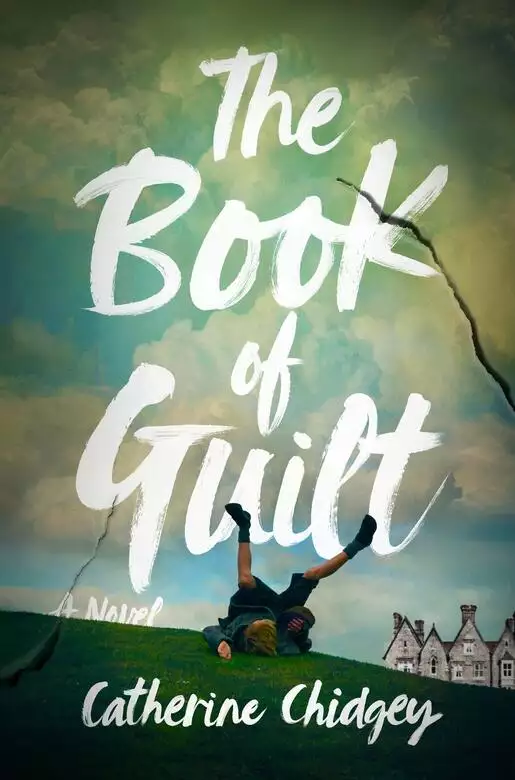
The Book of Guilt
- eBook
- Hardcover
- Book info
- Sample
- Media
- Author updates
- Lists
Synopsis
In 1979, in a version of England where nobody won WWII, 13-year-old triplets are the only boys left in an orphanage whose dark secret is the reason for their existence – and the key to their survival.
After a very different outcome to WWII than the one history recorded, 1979 England is a country ruled by a government whose aims have sinister underpinnings and alliances. In the Hampshire countryside, 13-year-old triplets Vincent, Lawrence and William are the last remaining residents at the Captain Scott Home for Boys, where every day they must take medicine to protect themselves from a mysterious illness to which many of their friends have succumbed. The lucky ones who recover are allowed to move to Margate, a seaside resort of mythical proportions.
In nearby Exeter, 13-year-old Nancy lives a secluded life with her parents, who dote on her but never let her leave the house. As the triplets’ lives begin to intersect with Nancy’s, bringing to light a horrifying truth about their origins and their likely fate, the children must unite to escape – and survive.
Release date: September 16, 2025
Publisher: Grand Central Publishing
Print pages: 304
* BingeBooks earns revenue from qualifying purchases as an Amazon Associate as well as from other retail partners.
Reader buzz
 Please log in to recommend or discuss...
Author updates
The Book of Guilt
Catherine Chidgey
The house was one of the Sycamore Homes purchased in 1944, after the war, to accommodate children like us—although numbers dropped over the years. Perhaps you’ve heard of the Scheme…? But then again, perhaps not. For the most part, for decades, everyone ignored us—never gave us a second thought. And afterward, people didn’t like to talk about the Homes because they didn’t like to feel guilty, which I can understand. Anyway, they’re all gone now: boarded up or bulldozed, or turned into flats that bear no trace of what happened there.
Ours was for boys. It stood on the edge of the woods just across the river from Ashbridge village, and was called Captain Scott after the great doomed explorer. The outside was painted white, but here and there it had flaked away, and you could make out the rust-red brickwork showing through. The grounds were enclosed by a high flint wall with broken glass set in the top to keep us safe; we were very special, our mothers told us, and needed looking after. If we went outside early enough we could see the low sun shining through the pieces of glass, shards of amber and emerald alight in the quiet morning, and the flint opaque, like chunks of gristle in a white rind.
My brothers and I spent a lot of time in the garden, collecting horse-chestnut leaves big enough to cover our faces, cutting worms in half to find out if they would regenerate, digging for ancient coins and treasure because we’d heard of farmers unearthing fabulous hoards, and who knew what was under our feet? We trapped centipedes and kept them in matchboxes and jars, caught peacock butterflies and blew on their powdery wings that were patterned with eyes to scare away predators. We made sacrifices to the garden gods: little cairns of beetles, moss pressed into the shape of a bird, a circle of heart-shaped petals plucked from the white camellia bush, a snail rammed onto a sharp stick like the head of a traitor on a pike. In the fernery we studied ourselves in the gazing ball—a mirrored sphere that changed us into peculiar creatures and stretched the Home behind us out of all proportion. Good boys, helpful boys, we gathered peppery watercress from the nearby stream to put in our sandwiches, and mushrooms to make the stew go further, but we knew not to touch the death caps, or even the false death caps, which were also poisonous. When we were quite alone we poked at patches of long grass in the hope of flushing out adders, though we kept that to ourselves. From the ancient lemon tree we picked the knobbled lemons and took them to Mother Afternoon, who cut them in half and juiced them by hand on the glass lemon-squeezer, pausing every few moments to scoop out pips or pulp. The discarded skins gathered at her elbow, their insides all silky and ruined, and she poured the juice into ice-cube trays and froze it.
We never dreamt of trying to escape. Those days were happy days, before I knew what I was.
Our mothers had their own quarters in the North Wing of the house, which we hardly ever saw, and each day they came to look after us in shifts. They weren’t our real mothers—we understood that from the start—but they seemed to love us as their own; often they said they’d like to gobble us up. At any time we were permitted to take the albums from the shelf in the Library and look at the photos of them holding us as babies on their laps, shaking rattles at us, bathing us, testing the heat of our milk on their wrists to make sure we wouldn’t burn our little mouths. It was all documented. There we were, lined up with the other Captain Scott boys in our highchairs, banging our spoons on our teddy-bear plates. We had no memory of these scenes, but our mothers told us how hungry we were, how they used to tickle our tummies and say You’ll pop! You’ll explode! In the albums, too, curls of our downy hair tied with ribbon—how white it was, how fine—and labeled Vincent, William, Lawrence, because otherwise you couldn’t have told one curl from another. Our first teeth, also labeled, also identical. We knew how special we were when we looked at the precious little bits of us our mothers had saved. Oh yes, they loved us. If they had favorites, they never showed it.
Mother Morning’s shift began at 5 a.m., when we were still sound asleep. Silently she unlocked the door in the upstairs passageway separating their wing from ours, then crept down to the Kitchen to relieve Mother Night. They had a quick chat, keeping their voices low so as not to risk waking us, Mother Night passing on to Mother Morning any information that might be useful for her to know. One of us was talking in his sleep, one of us had wet the bed again—ordinary things like that, we supposed. While we slept on, she made her way to the Laundry, where our dirty clothes waited at the bottom of the chute to be washed, and our clean clothes waited to be ironed and folded and given back to us—green shirts for Lawrence, red for William and yellow for me. We were always nicely turned out; that was important, Mother Morning said, because people judged other people on things like clothes and hair and fingernails—it was just human nature.
At half past six, tucking The Book of Dreams under her arm, a floral housecoat buttoned over her plain skirt and blouse, Mother Morning tiptoed up the stairs to our room.
Sometimes we woke before she entered, and we made ourselves lie there still as stones and think of our dreams and only our dreams. Underneath us the sheets had wrinkled and twisted, and we longed to wriggle our bodies clear of the bulky seams where the candy-striped cotton had been repaired—but if we started to move, if we so much as opened our eyes, the dreams might trickle away to nothing, and we’d have to say we were sorry but we couldn’t remember. Mother Morning would speak to us in her sad voice then, as if we had hurt her, jabbed at some soft and secret part of her with the nail scissors that were not a toy. More often, she woke us, touching our shoulders and whispering our names. On those mornings we scarcely knew she was there; we were recounting our dreams to ourselves, we felt, still more asleep than awake. Lawrence slept nearest the door, so she went to him first, sitting on the edge of his bed and opening her Book, entering the date and his name, waiting for him to speak. Next she went to William, who slept by the old fireplace, and at last she came to me, over by the windows. I had to block my brothers’ voices as they gave their accounts, otherwise their dreams would creep into my own, and that would really mess things up, said Mother Morning. That would seriously muddy the waters.
“Vincent,” she’d murmur when it was my turn, her pen poised, her freckled face and auburn curls beginning to take shape in the brightening room. “Tell me everything you remember.”
“I’m wandering across the empty heathland and out of nowhere a pony rears up in front of me,” I’d reply, or “I’m eating my lunch and I bite down on something hard, and it’s one of my teeth come loose,” or “I’m wrapping a present and I want to keep it for myself, but Mother Afternoon says that’s as good as stealing.” My brothers and I always spoke in the present tense for our sessions with Mother Morning, pretending we were still dreaming the dreams, because that was how she preferred it. The past tense, she said, distanced us from the material; it was full of forgetting. “I’m trying to light a fire, but the matches won’t work. I’m sewing name tags into my new clothes, and every time I look the pile is bigger, and I don’t know how I’ll ever wear that many jumpers.”
She wrote it all down in her Book, day in, day out. All the nonsense, the garbled fragments. Sometimes, when I think of those mornings now, they smudge and flatten into one long morning, one long dream. Our sleepy voices. Our crochet blankets made by Mother Night slipping from our beds. The feather pillows that huffed out invisible dust. Mother Morning’s pen scratching across the page as she noted every detail.
You probably don’t remember your own ancient dreams, let alone somebody else’s, so you might not believe me when I say that I remember one of Lawrence’s dreams with total clarity. It’s such a long time ago now—March 1979—but I remember it because it was the first I heard of her.
“I’m chasing a girl through the woods,” he said, still half asleep.
“A girl?” said Mother Morning, something different in her voice. Something brittle. “How old is this girl?”
“About my age—about thirteen. It’s springtime, and I’ve picked a bunch of bluebells for her.”
William said, “Lawrence has a girlfriend,” and I laughed even though I should have been concentrating on my own dream.
“Quiet!” hissed Mother Morning, who never spoke to us like that. “Lawrence, go on. What does the girl look like?”
“Skinny. Bare feet. Long black hair.”
“And her clothes?”
Lawrence was silent.
“What is she wearing, Lawrence?”
A pause. The air in our bedroom taut, charged. “Nothing,” he whispered.
I laughed again; I couldn’t help myself.
“Will you be quiet!” said Mother Morning. “Now, Lawrence my darling, do you catch this girl?”
“No. She keeps looking over her shoulder at me, laughing, but I can’t catch her. That’s the end.”
“Nothing else?” said Mother Morning. “Are you certain?”
“That’s the end,” he repeated.
After we’d made our beds and washed our faces and gone outside for Morning Exercise, William and I tried to find out more. Was she a sexy girl? Was it a sexy dream? We’d just begun to have those, the three of us, losing control of our bodies as we slept, waking to wet sheets that we bundled down the laundry chute. At first we were worried we might be sick, or even dying, but Mother Morning said it was just something we had to take in our stride, unpleasant as it might be for all concerned.
Lawrence shrugged off our questions and did the stretches we had to do at the start of Morning Exercise so we didn’t injure ourselves. He grimaced when he rotated his shoulders, circled his hips, raised his bent knees to his chest; his joints had been hurting for a few weeks. She was just a girl, he said. Nothing special. Even when William and I sat on him—making sure that none of our mothers could see us—he made the sign for zipping his lips. He could be stubborn like that, especially if we ganged up on him.
We did our press-ups and star jumps, shaking off the cold of the March morning. A half-moon still hung in the sky, which always seemed wrong, no matter how many times we saw it. We squinted and tried to make out the flags our mothers had told us were flying up there, the American, the German and the British, planted into the moon’s dust in 1957.
Later, as we waited in the Library for Lessons, William started asking about Lawrence’s dream again, but Lawrence busied himself with choosing half a dozen colored pencils from the treacle tin and sharpening them one by one. He was blushing, though. Blushing about the girl with no clothes on.
I wandered to the back of the room and peered at the photographs that hung next to the Equipment Cupboard. For as long as I could remember, we’d lined up outside once a year so Mother Morning could take a picture of us all for Dr. Roach’s records. She used a big, proper camera—every Home had one—and we stood in a row by the lavender beds. I looked at the photo from three years earlier, back when we must have had forty boys left. I could see the Jones twins, the Brown quads, the Smith triplets—all gone to the Big House in Margate. John Wilson and David Collins, who had no brothers so everyone felt sorry for them but at the same time didn’t want to be their friend—also gone. Paul Brown was wearing the Aran jumper Mother Night had knitted him for his birthday; he loved it so much he wore it till the waistband unraveled and the cuffs rode way up past his wrists. Richard Jones had removed his glasses but his brother hadn’t; they’d always tried to differentiate themselves in little ways. Roger Smith was grinning from ear to ear because he knew what William was going to try—and there he was, my beautiful brother, at both ends of the long row of boys. First he’d stood on Mother Morning’s far left, smiling for the camera, and then, as it panned across us, he’d sprinted to her far right. But who was the boy next to me? And the one next to him, for that matter? I realized I couldn’t remember their names, now that they’d gone to Margate. Could barely remember them at all. And no newcomers had joined us in years—at Captain Scott, we were the last.
“Right, boys,” said Mother Morning when she arrived for Lessons, “take out your work, please. We’ve a lot to get through today. How are we feeling? Bright-eyed and bushy-tailed?”
Yes, we nodded, no problems. No real problems. I felt a little flutter in my chest.
We were finishing off World War II that week, and Mother Morning took Volume 7 (SEV–ZWI) of The Book of Knowledge from the shelf and turned to the section on the Gothenburg Treaty. “On 16 November 1943,” she read, “Adolf Hitler was killed by a bomb concealed on the person of Major Axel von dem Bussche. Bussche was modeling the Army’s new winter uniform for Hitler and carried the modified landmine in a backpack. On approaching the Führer he activated the detonator, clearing his throat to cover the sound of the hissing. As he embraced Hitler, the blast killed both men instantly.”
William hissed air through his teeth and grabbed Lawrence in a hug, then made a noise in his throat like a bomb and hurled himself to the floor, taking Lawrence with him.
“Yes, thank you, William,” said Mother Morning. “Very realistic. Take your seats, please, boys.”
“He hurt my wrist!” said Lawrence, though he knew that complaining never got us anywhere.
“Take your seat,” said Mother Morning, twirling her finger at Lawrence’s chair and reading on. “In the wake of the assassination, the conspirators executed senior Nazi leaders and established an interim government. Two weeks later, peace talks began in Gothenburg, Sweden, with the Western Allies. The American President, Franklin D. Roosevelt, initially demanded nothing less than Germany’s unconditional surrender, but after complex negotiations, Germany agreed to withdraw from France and not to resist an Allied occupation, which afforded them protection from full-scale Soviet invasion. Germany also agreed to democratic elections before the end of the year; these saw Claus von Stauffenberg take over as Prime Minister and Field Marshal Erwin Rommel as Chancellor. Following the urging of our Prime Minister, Lord Halifax, the Allies then acquiesced to Germany’s retention of Sudetenland, Austria and Alsace-Lorraine. Minister of Defense Winston Churchill regarded this compromise as a bitter pill to swallow, but Halifax declared, ‘The hour of urgency is upon us. Further delay will cause only further suffering: we must act to bring about peace, whatever the price.’” Mother Morning’s voice dropped several notes when she spoke these words, and she paused. “In this world,” she said, “it’s not possible to have everything we want. Everything we think is right. Sometimes we have to make difficult decisions. Yes?”
We nodded, though we weren’t entirely sure what she meant.
“Who won the war, then?” said William.
“Well,” said Mother Morning, “nobody.”
“Somebody must have won,” he said.
“Nobody won and nobody lost,” said Mother Morning. “That’s what the Gothenburg signatories agreed to. And many wonderful things came of the Treaty,” she went on. “Not only a swift end to the war, but the sharing of all sorts of important research. As we know, crucial advances in the biological sciences had already been made in the wake of World War I, when millions of soldiers and civilians were lost and terrible diseases ran rampant. Scientists had scrambled to…” Here she faltered. “Scrambled to stamp out those diseases, and were beginning to achieve miracles. Things the world had never dreamt possible. Penicillin mass-produced by…?”
“Nineteen thirty,” we said.
“A polio vaccine by…?”
“Nineteen thirty-eight.”
“DNA’s double helix discovered in…?”
“Nineteen thirty-nine.”
She beamed at us; she was always pleased when we remembered material from earlier Lessons.
“And then,” she said, “with the collaborations made possible by the Treaty, huge progress was achieved. Our own Dr. Roach made astounding progress in—in his field, with access to studies conducted in the camps before and during the war. Terrible information, some of it, but of immense scientific value. So you see, those poor people did not die in vain. They live on, in a way—we can think of it like that. We must keep in mind the greater good.”
We nodded again, and then she looked at the clock, and it was Break Time. She went to the Kitchen to cut us up our apples and cheese, tip the raisins into the little blue bowl and measure out our medicine.
William took down Volume 1 (A–BON) of The Book of Knowledge and found the entry for Adam and Eve. We’d often studied it when we were alone, mainly for the nude painting, though it was just a hazy reproduction—a black-and-white copy that dissolved into fly-dirt dots if you held it too close.
“Is this what the girl in your dream looked like?” he asked Lawrence. “She has long dark hair. Maybe this is where you got her from.”
Lawrence sighed: we weren’t going to drop the matter. He considered Eve’s fleshy arms, her generous hips. “Too lumpy,” he said. “And I still think Adam’s trying to grab her bosoms.”
We’d had this argument before. “He’s trying to stop her from taking the fruit,” I said.
“And grab her bosoms.”
William slid the Book back into its place and sat on the edge of the windowsill, picking at the glass eye of the ornamental goat we’d made on Craft Day. It stared back unblinking, strangely human. “I think I might have dreamt of her too,” he said.
“Who, Eve?” said Lawrence.
“The skinny girl, running through the woods.”
“What?”
Other sets of brothers had shared dreams before, but not us.
“You never told Mother Morning,” I said.
“No.”
“Did you forget it?”
That happened now and again—we forgot dreams and later they returned to us, triggered by something we saw or heard, and we reported them to whichever mother was on duty so she could make a retrospective entry in the Book.
“No,” said William. “I was… a bit scared of her.”
“Mother Morning?” I said. She could be strict, but was never frightening. Not really.
“The girl in the dream.” He was still picking at the goat’s eye, and finally it fell from the wooden head, the wire at its root clogged with glue.
Lawrence was frowning. “Scared of her?” he said. Nothing scared William.
“I thought if I talked about her, I’d be… making her real.”
I could tell William was spooked. “It was just a stupid dream—it doesn’t mean anything,” I said. I took a tube of glue from the Equipment Cupboard and fixed the goat’s eye, feeding the wire back inside its head. “I know what we’ll do. This afternoon, when we’ve finished lunch, I’ll be you and you can be Lawrence and he can be me. Okay?”
We’d done this ever since we were little—pretended to be one another to see if anyone noticed. Sometimes they did—we’d answer to the wrong name, which is to say the right name, or we’d forget to hide a tell-tale rash or bruise—but mostly we got away with it. That’s how alike we were.
I needed to use the lavatory, so I flung open the Library door and strode into the passageway, saying, “The hour of urgency is upon us. Further delay will cause only further suffering.” As I passed Mother Afternoon’s ikebana arrangement of plum branches, hydrangeas and buddleia that represented the cosmic balance between abundance and emptiness, I almost collided with Mother Morning. She raised her eyebrow at me—we dreaded the raised eyebrow—and carefully set down the tray of apple quarters, cheese, raisins and medicine before telling me that she’d heard what I’d said, and while I might think I was being funny I should show some respect for our British heroes like Prime Minister Halifax. He had made the best of a bad situation, and our country had benefited—science had benefited—thanks to the decisions he’d taken.
“Do I need to write you up, Vincent?” she asked.
“No, Mother Morning,” I said, and the weakness came over me. Another flutter in my chest. “Sorry.”
“Hm. Very well. But watch yourself.”
“Yes, Mother Morning.”
We trembled at the thought of being written up—for just as our dreams were recorded, so too were our crimes. The Book of Guilt sat on the bottom shelf of the Library, next to the photograph albums, and in it our mothers wrote all our bad behavior; things we should feel guilty for. Lying, kicking, interfering with ourselves, displaying the wrong attitude. When I think about it now, no punishments were ever meted out. Being written up was the punishment. Disappointing our mothers was the punishment.
That day, after lunch, we disappeared to our room and swapped our clothes—Lawrence took my yellow shirt, William took Lawrence’s green one, and I took William’s red. The dark-haired girl all but forgotten, we giggled as we looked at our changed reflections. Wicked creatures, we whispered—wicked, wicked. When Mother Afternoon came on duty at one o’clock she noticed nothing out of the ordinary, and we didn’t change back into ourselves until bedtime.
In March 1979, on Nancy’s thirteenth birthday, her mother handed her a tiny parcel wrapped in pale-pink tissue paper. What could possibly be inside? Was her mother playing tricks on her, and really the parcel was empty? But when she opened it, two sparkling studs no bigger than pinheads fell into her palm. “Are they real?” breathed Nancy, because they seemed too lovely, too precious.
“Real glass,” said her mother, “and quite old.”
Nancy had seen ladies on television wearing earrings like these: little points of light that flashed with every movement.
“We thought they’d look nice with your special frock,” said her father, gesturing to the silvery-green dress Nancy was wearing because it was her birthday.
“But I don’t have pierced ears,” she said.
“That’s the other part of your present,” said her mother.
She sat Nancy down at the kitchen table and draped a tea towel over her shoulders to protect the dress, then drew a dot on each earlobe with a blue biro. “Kenneth,” she said, “the ice.”
Nancy’s father twisted a cube from the tray in the freezer, and her mother pressed it to Nancy’s left lobe.
“You don’t want to numb yourself, Marjorie,” he said. “You’ll need the use of your fingers.”
“You’re quite right,” said Nancy’s mother.
She capped the top of the cube with tinfoil while Nancy’s father lit a candle and held a sewing needle in the flame. Watching the little hot tongue as it flickered and bent about its sharp heart, Nancy could not tell if her ears were burning or freezing.
“What’s that for?” she said, but her parents simply smiled and said it would all be worth it in the end.
Her father waved the needle through the air to cool it, and then her mother held it to her ear and said, “Can you feel anything?”
“No,” said Nancy, though her chest felt full of tiny winged creatures trying to bash their way out: hummingbirds, honey bees, blowflies.
“Now,” said her mother, “you must sit very still. Don’t move a muscle.”
“What if I need to sneeze?”
“Do you need to sneeze?”
The creatures thrashed themselves against her ribs, scuffed her throat with the tips of their frantic wings.
“No,” she said. “But what’s the needle for?”
“It’ll be over before you know it. Perfectly still now.”
And it was not pain she felt. Not pain, exactly, but a dragging sensation, a strange shifting and parting of the structures of her flesh. And then it was pain.
“Still now! Still!” said her mother, and she whisked the needle out and there was blood on her wrist, and Nancy’s father handed her an earring and she pushed it through saying, “Easy as pie!”
Her father was smiling, nodding. “You see?” he said. “Didn’t we tell you?”
“I don’t want the other one,” said Nancy.
Her parents glanced at each other. “But goodness me, poppet!” said her mother. “You can’t go around with just the one!”
“How silly would that look?” said her father. “All lop-sided and peculiar.”
“I don’t want it!” said Nancy.
Her mother was already icing the other ear.
When it was done, her parents stood back and regarded her in a way they often did. Assessing, considering. Measuring her up somehow.
“Would you look at that, Marjorie?” said her father after a moment. “I think you’ve got it just right.”
“Just right,” her mother said, and took Nancy’s photograph.
All our lives we’d wondered about the village just over the river. From our upstairs corner bedroom we could see across the heathland and woodland and down to Ashbridge, where the clock told four different times on its four blue faces, and the church steeple rose above the red roofs. On rainy days the clay tiles looked shiny, slick as wet leaves, and in winter the smoke rose from the chimneys, the fires inside the houses keeping all the families cozy and warm—so we imagined. As little boys, when we’d asked our mothers why we couldn’t go there, they’d told us we were delicate; our health was delicate. If we ventured beyond our gates we might catch something from the villagers, which could prove very dangerous indeed. So that was the rule.
Then, in the spring of 1978, everything changed: provided we were well, we could accompany our mothers when they needed to visit the bank or the Post Office, or treat themselves to the new Woman’s Realm when they’d saved up enough money, or find us some new shoes because we were growing like vines. That was the new rule, which replaced the old rule.
We could hardly believe it. We asked Mother Morning exactly who had decided to let us out—had she?
No no, she said; she possessed no such powers.
Dr. Roach, then?
No, she said, certainly not Dr. Roach. The government had decided, although she doubted they’d be the government for much longer.
So a new government could change the rules back?
Perhaps, she said.
And would a new government also start sending boys to Captain Scott again? So we wouldn’t be the last ones?
She didn’t know, she said. She couldn’t see into the future.
At first we were nervous—we worried we’d pick something up from the villagers. But no, Mother Morning assured us: as long as we felt healthy, and maintained the right attitude, there was no danger. And how thrilling those first outings were! How strange to see the flint wall from the other side, and to leave the Home behind us as we walked with Mother Afternoon along the narrow road! We jumped when we heard a car approach, but it slowed right down to pass us, the driver peering through the window with a puzzled look on his face. Mother Afternoon told us to ignore him. We skipped along by the hedgerows, passing the sleepy-eyed cows and the skittery ponies that flicked their tails in the green air, and the crab-apple tree that was hollow at the heart but still growing, and then we crossed the stone bridge that separated us from the village. Through the high-street windows we saw whole sides of pork and whole jars of sweets, mannequins wearing real clothes and painted-on hair, tins of rice pudding arranged in precarious stacks, and, in the bakery window, a little automaton dressed in a white apron and white hat, nodding his head and tapping on the glass with a wooden spoon. But although we were locals—we’d lived in Ashbridge our whole lives, after all—the villagers never really warmed to us; they gave the briefest of nods if we said hello, and the schoolchildren in their smart uniforms nudged one another and stared wide-eyed, and the shopkeepers stonewalled most attempts at small talk. One man hurried his daughter across the street to avoid us, and when she said that we looked quite normal, he muttered, “They’re not like you and me.” Another man said to his wife, “They’ll be wanting the right to vote before too long. The right to marry. You mark my words.” And Lawrence soon learned not to try to pat people’s dogs.
“Rise above, rise above,” Mother Afte
We hope you are enjoying the book so far. To continue reading...
