
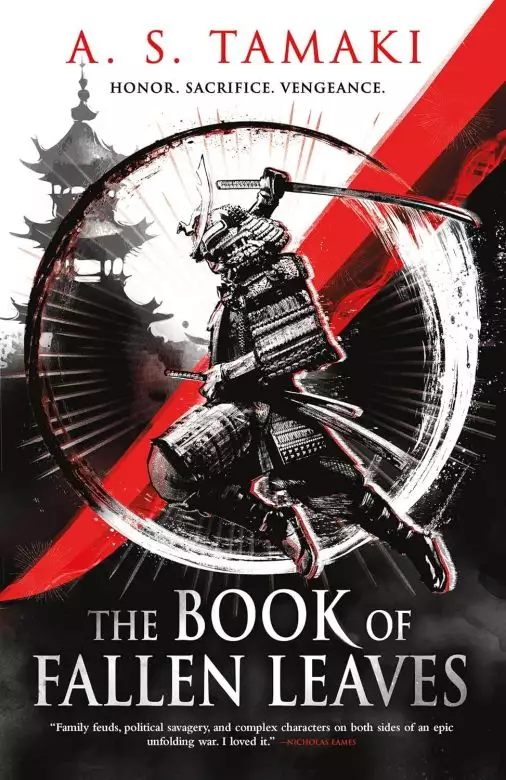
The Book of Fallen Leaves
- eBook
- Paperback
- Audiobook
- Book info
- Sample
- Media
- Author updates
- Lists
Synopsis
Shogun meets Game of Thrones in the blockbuster epic fantasy event of the year. Debut author A. S. Tamaki weaves a powerful tale of ambition, vengeance and sacrifice in this masterful fantasy retelling of an ancient Samurai saga, packed with memorable characters, stunning worldbuilding and epic adventure.
Sen Hoshiakari is an exiled prince of a clan that lost everything in his father's failed rebellion. Deprived of his birthright, Sen is determined to restore his family's lands and honor at any cost.
Rui is a peasant girl who saved Sen's life on the night his family were put to the sword. But now, she is adrift and unsure of her place in the world, not knowing that the gods themselves have plans for her…
As civil war throws the empire into chaos, and demons seek vengeance on the living, Sen and Rui must fight for both their clan and their shared future…
But vengeance demands a bloody price.
Release date: March 17, 2026
Publisher: Orbit
Print pages: 592
* BingeBooks earns revenue from qualifying purchases as an Amazon Associate as well as from other retail partners.
Reader buzz
 Please log in to recommend or discuss...
Author updates
The Book of Fallen Leaves
A. S. Tamaki
Era of the 78th emperor, Suji Ten’in
10th day of the first month
Winter
The man took too long to die.
He thrashed and screamed and trembled in the girl’s arms, and at the end, he begged for mercy, clutching at her with a wet, wavering voice, choking and full of fear. But he was just a priest. She was small, no more than a child, and the man was weak, and the knife was not too heavy.
When it was done, his lifeblood warm over her fingers, the girl crouched beside him, waiting for the last of his spirit to leave. The red spilled a darkening ochre into the dirt; she held his hand. “You don’t have to be afraid,” she said. “It will be over soon. You’ll be all right.”
When it was done, she let the body fall.
When it was done, she looked up, and slowly seemed to remember where she was. She peered into the night, the rotten fence, the winding line of cobblestones and weeds. She saw a clump of steps that crowded at the foot of a decrepit hut, dark and so ramshackle that a ghost could knock it down. There, the woman she called her sister stood waiting like a statue in white mourner’s robes, gazing up into a black and hooded sky. Two more dead monks lay in broken pieces at her feet.
“Sister.” The child went to her, hesitantly, and tapped a finger on the woman’s arm. “Look, sister,” she said, peering upward. “The gods are walking. Do you see?”
“Yes,” the woman said. Her face shone pale as alabaster, smooth as stone. “Yes.”
The rain had stopped long before the two figures had entered the courtyard, leaving the air wet and heavy. But when the dark-eyed woman in the long white mourner’s cloak stepped across the gate, a chill fell through the night and even the crickets stopped their clamor. The lack of a breeze and the oppressive feeling of the low clouds overhead filled the air with a cloying fullness, a kind of thick humidity that made it hard to move; it was as if the dark itself had weight. There were no stars.
Storms had come hard and fast, flooding the little courtyards of the decrepit shrine and the temple just beyond, but now, everything was still. The two figures walked past the gate, sandals squishing in the mud and between the sodden stepping-stones. The small temple lay before them, hardly more than a shack. A thin stream of smoke unfolded itself from an opening in the roof, and the crackle of a fire whispered faintly from within.
“We will stop here,” the woman said.
If not for the lines and the shadows under her eyes, she would have seemed almost young. But there were shadows, and there were lines. Criss-crossing a gentle face, the trace of a dozen written marks cut across her features as though she’d been splashed by ink. Words written onto skin, fine strokes almost too faint to see. When she stepped into the light, the writing vanished, leaving her skin unblemished. When she looked down, her face falling into shadow again, the letters reappeared, faint as they were, and hard to see in the darkness. She took the young girl’s hand.
The girl didn’t notice the marks. Or if she did, she didn’t mind them.
“Let us hurry,” the woman said, leading her toward the shack at the edge of the courtyard. “Before the rains return.”
Her voice was but a whisper, sibilant and thin; like the trickle of water on the shores of Onji River in the spring. Her eyes were polished stones, shining in dim cloudlight. She was tall, towering over the child, and her movements were gentle, but slow, careful as a tiger on the hunt. She seemed, with her steady gaze and calm, unnatural look, to be somehow disconnected from the earth.
By the time they reached the little temple, her face lay smooth and mournful again. The words, like spells, had disappeared.
The girl shifted as they got close, listening to the sound of the fire inside. “Someone’s in there.”
“Yes, child,” the woman said. “Come. He has been waiting for us. Though, perhaps, he does not know it.”
The hut, a simple open space, had a shrine on peeling wood, a place for tea, a hearth, a dying fire: nothing more. There was barely any warmth. A young monk sat in meditation by the wall. In his third decade on this earth, he swayed, turning prayer beads with slim hands, counting each one, click, click, click. “Namu Ohirume Kotaijin,” he intoned.
A breeze swept past, the fire flickered, and in the space between one breath and the next, the woman was there. She stood as if she’d always been there, floating in the dark beside him. Finally, she sat. The prayer continued in silence. The incense burned. The woman said nothing, but in the end, he glanced up, his young face no more than twenty-two or three.
“Welcome, sister,” said the monk. The fire cast tremulous shadows over his features, black as lily seeds, then warm and orange in the glow. “The storm has not ended yet. I fear it will return soon, and you must be weary.”
“Thank you, young one.”
He tried a smile. “You are surprised. Am I so young on this earth, and yet remove myself from it already?”
“There are many children sent to temples in these days,” the woman said, settling beside him. “I know this. But you were not one. Your robes are new.”
“Observant.” He faced her now. “Have you come from the west? You must have seen my associates on the road. They left not an hour ago.”
“We did,” said the woman. “They offered prayers, directed us to this place, to pray before Ohirume… We sent them on their way.”
“Is that why you’re here?” he asked. “To pray? You may join me. I know I’m young, but I will aid in what I can. What troubles you?”
“On a night like this,” the woman said, “everything. Tell me, monk, do you believe in the cursed gods?”
He paused, considering. “There are many hungry spirits now,” he said at last, “searching for something to calm their wrath. Vengeful, bitter. Corrupted…”
The woman inclined her head. “Once, when I was young, I was sent to a temple in the northern islands, to the order of the sacred law. Just a child, alone. I was told to seek enlightenment. They said I was suffering.”
He held out his hands. “We all suffer, and we all have the elements of enlightenment inside us. Eventually, we may change.”
“Change,” mused the woman. “A funny word. Where were you, may I ask, in the recent wars?”
He grew still. “I was in the royal city.”
“You must have seen it, then. I saw many things myself. For a time, I too thought the Age of Plagues was upon us. I despaired. I fell ill. Then, one day, the wind changed. The tides were stayed. And when I woke, I could hear.”
“Hear what?”
“The other place.” She moved closer, reciting an ancient verse. “‘Waves, lapping onto the Awa shores, are still unchanged; while you are so very different than I remember.’” She gave the faintest sliver of a smile. “But such is life.”
“Do I know you?” the young monk asked.
“No,” she said. “But I know you. I have been with you every day of your life.”
He glanced at her, then away.
“I am troubled,” she said. “Such death and devastation in this world. War, rebellion, unrest. The clans and noble families. I fear the gods will punish us. I fear that I am… cursed.”
“The gods are kind,” he said. “They show compassion.”
“No,” she said. “It is for the gods that I am cursed. I seek to end it.”
The spellwork writing became visible on her face as she lingered at the edge of the hearthlight. “You see,” she said, “I am their messenger.”
He blinked. “Who are you?”
“A ghost,” she said. “Like you. Remaining, and yet changed. I am brought unto this world at the will of the gods. I am their servant. Their… voice. I am here in search of sinners. There are so many on this road to hell… so many who wander the wastes of the world. And so must I wander, until I fulfill my purpose and bring their souls to justice. You see… then will my curse be ended, and I will become one of them.”
“One of who?”
“The gods.” She leaned forward, letting the light of the dim fire spill across her eyes. “They brought me back for a reason. I know, now, what that reason is.”
He tried to move, found himself pressed upon the opposite wall. The fire burned dim in the hearth. Each time she left a flicker of light, the strange, dark writing returned. “I am but a mirror,” she said. “A servant who walks the earth to correct a great and terrible wrong. The gods ask me, even now: Deliver us, they say. Deliver our divine punishment for the sins of the three.”
His breath caught at the words. “You need to leave.”
“I cannot, young prince. Not until my work is finished.”
“I’m not a prince.”
“But you are,” she said. “You are.”
“I have renounced that way.” He trembled. “I am a monk of the sacred law. My name is Joren…”
“You are a son of the Keishi line.” She blocked him every time he tried to move. “You have blood on your hands the same as your father. You know this, Shigemune. You know it in your heart.”
“I’m not that man anymore. I left that behind…”
“You cannot leave it behind,” she said. “The gods are watching.”
“Why are you here?”
“Because of you, my prince. ‘Three will die.’ You know these words.”
“Get out.”
“Three will die,” she said again. “Gensei. Keishi. Ten’in. Three great families to which I am bound. I must reclaim their children. You see? A child, for a child.”
His eyes widened. “You’re a demon.”
“There are many demons in the world now,” she said, “and all have suffered. Tell me about the Gensei family.”
He tried to rise. She caught him in her gaze and laid a hand on the wooden table. Her eyes glinted like broken pearls, reflecting light.
“I… told them not to,” he whispered, as though under a spell. “I knew it would lead to nothing but death…”
“Which you took part in.”
He said, “I have no illusions about what I’ve been a part of. Now I dedicate my life to something better…”
“Better?” She gestured at the small shrine room, the decrepit hut. “Yes. Maybe this is better.”
“The gods will forgive me,” he stammered. “I am their servant…”
“As am I,” she said.
He paled at that, said nothing. Outside, the wind howled. “I don’t have much,” he said at last, “but, if you would have it, I can offer you some food. Then I would ask you to go.”
She smiled again, as if amused. But her eyes were dead. “The fighting will be over soon. Even now, your father is out hunting traitors… while you sit here in the rain. Soon the Gensei clanline will be broken. Their leader, Katsusada, will never be forgiven for insulting your father. He will be found. He will be killed.”
“Why are you here?” He was shaking now, unable to move.
The woman withdrew the small sword she kept tucked into her belt. The scabbard gleamed, inky black and lacquered, with reflections of the hearth. She set it on the maggot-eaten wood. “When Katsusada rebelled against the Ten’in emperor, he left two heirs behind,” she said. “Your father has decided to spare them.”
“He left one heir behind. Kai Gekko’in is a child… She caused none of this. She’ll be a ward, she’ll grow up under my father’s control.”
“It won’t help you if you lie,” the woman said.
The monk stirred, taken aback. “What?”
“There is another heir. His name… is Sen. And you know where he is.”
“No…”
“You know where they’ve hidden him away. You helped them.”
“Why would I do that?”
“Because you don’t like what your father Lord Keishi is doing. You think his ambition has gone too far. You think he deals with gods beyond his control. So, you turn. You think, something must be done… Tell me, where is Sen of the Gensei family?”
“… I can’t,” he said.
“You must.”
He shook under the flat glare of her eyeshine. The writing on her skin began to change, glimmering: “Speak,” she said.
He choked. Words gasped themselves out of his throat. “I heard only whispers. But… he is an infant. He will never come back…”
“Tell me where, prince.”
“He is protected. Your magic cannot harm him.”
“Where?”
His hands shook as he clutched his prayer beads. His breath shuddered, and when he spoke, it was as though against his own will:
“East.”
The woman made a slicing movement, like a blade across his heart. He jerked, pale, gasping. “Take the sword,” she whispered. “Take it.”
So he did.
Suddenly, drawing a vicious hate from within himself, he slashed at her, but he was clumsy with fear, and only the tip of the sword caught her across the jaw.
The moment it did, he fell back, clutching his own jaw with a hiss of pain. The sword went clattering to the wood. His fingers were covered in blood. The moment he struck, his own jaw was sliced open, as if an invisible knife had cut the skin, exactly where he tried cutting her.
The woman, on the other hand, remained untouched. The spellwork marks that crossed her features shifted into different words. Then faded.
He held his face, blood already seeping through his fingers. “What are you?” he asked.
“I don’t know,” she said. “When you look at me, what do you see?”
“I see a monster—”
“A monster?” she echoed. “Maybe. Yes. Maybe.”
“The gods will strike you down,” he said, shuddering. “And you will die. Your body will burn.”
“Burn?” She repeated him again. “No. I don’t think so… but, in truth, only time will tell. I don’t know what will happen to this body. Maybe it will burn, as you say. Maybe. Either way, what does it matter? One day it will die, as all things die. Then I will return and find another. Such is the way of things. Now take the sword.”
“I will not…”
“You must take it.”
Under the power of her words, he reached for the sword again. His hand moved as if on its own; he gasped, his arm following her command, shaking and convulsing as he tried to stop it, but he couldn’t, he continued. She whispered:
“Do it.”
He impaled himself in the abdomen, slicing through his own belly, then up toward the heart.
“This is what you want,” she said. “Accept it. This is what you want. This is how you end your disgrace…”
He made a heavy, choking sound, drowning in his own blood.
“Higher,” she said. The hissing of her voice hung in the air. He tried to say no again, but his arms obeyed, pulling the blade up, and with a thick, wet gasp, he cut through his own ribcage, fat and tissue, organ, bone. His body trembled. His hands shoved higher yet again, forced by her spell. Blood bubbled through his lips. He continued until there was a final shudder, and the sword in his hand reached his heart, and he stopped. Viscera pooled in an ocean before him.
“Thank you, prince,” she said. “As you see, I am a mirror. You wanted to die, for the guilt, deep down… and so, you did. Such is the will of the gods.”
She wiped her hands on her white robe. He fell forward. His intestines, or what remained of them, spilled out over his legs; his ribcage, sawn almost in half, opened awkwardly as it landed on the floor. The sword remained where it was, where she’d made him bring it into himself, jutting from the gory blossom of his bones, and organs, and his heart.
Quietly, she stood, and turned from the folded body on the oak. The floor and the hempen mats were a mosaic now, red and white and brown. She drew her sword from the mess, began to clean it with a cloth, before sheathing it again. “Not yet,” she whispered. Then a second time in the stillness, “No, not yet.”
A wash of embers and bright ashes from the hearth had spilled onto the wooden floor, but she ignored them. She crossed instead toward the thin sliding doors, and when she stepped outside, she found the child waiting for her on the steps. “Come, child,” she said. “It’s time to go.”
They left behind them four dead bodies and a burning shack that no one would remember. Already the flames had started to take hold, growing hotter as the child followed her into the dark.
“Sister, look,” the girl said, nodding toward the shadow of the mountains. An immense shape lingered there, high above them, moving slowly. A giant. “Gods.”
“Yes,” she said. “The pilgrims.”
Above them, great shadows churned and shifted in the sky, elemental shapes in human form, but skeletal, made of a darkness thicker than smoke and far off as the moon. Huge, they lingered, so huge it seemed they might reach out, carve the entire mountainside away in one soft scoop of bone and shadow. As the white-clad woman tightened her black cloak, and took the girl’s hand, the giants vanished, floating through the edge of the horizon and merging with the night itself.
“They come when there is blood now,” the woman said. “Soon, perhaps, they will return into their world, and ours will have some peace.”
When they had passed the gate and found the road again, the girl tugged at the woman’s hand. “Sister,” she said, “I can’t remember anything. About before.”
“I understand, child. It’s all right.”
“How come?”
“You have been harmed by great evil, child. Your spirit is hurting. Are you scared?”
The girl shook her head. “I just want to remember.”
“That may come, in time,” the woman said. “Until then, we must continue on our path. But remember, this is all for you, child. You must remember that. Everything that happens now, it will all be done for you. Now come.”
The temple burned behind them, slowly at first, but then with a surge and a great sheet of flame that consumed the right-hand wall and showed no sign it would abate. The cobbles glinted bright as tiny mirrors in the rain.
The girl spoke. “Sister, you said you’d tell me why so many people have to die.”
“I will,” the woman said, “but it’s a story that will take some time to tell.”
“Sister,” the girl asked again, “where are we going?”
The temple burned, flames rising to the black of night, and as they left, the roof began to collapse. A stream of life-streaked embers shot into the sky and the darkness came again. The woman watched, for just a moment. Then she led the girl down the road.
“To end a war, my dear,” she said. “To end a war.”
17 years later
Shōho Year 3
Era of the 80th emperor, Ashihara Ten’in
5th day of the fifth month
Summer
Sen Hoshiakari, adopted son of Lady Iyo of the East, rode toward the straw-woven target at full tilt. It was midsummer. A high, towering day, with a brilliant painted sky over the sloping meadow, light tufts of pampas grass swaying in the wind. Hawk-feathered arrows sliced the air. He eyed the target on approach. Twenty horselengths. Ten.
He loosed the bow—
And missed.
“Shit!”
The arrow cut cleanly through the air, passing the target and thrumming as it hit the dirt a dozen paces off.
He wheeled his courser, Kaminari, through the meadow-waves, preparing to be rebuked for missing the shot. He had a strong arm, he knew, tall as he was, and slim in the waist and shoulder, yet still he struggled with his bow; Hakaru, his adoptive stewardbrother, would never let him forget it. His eyes were dark, his features sharp, his black hair tied behind his ears. Like his stewardbrothers, Sen did not wear the gaudy colors of the royal city, preferring gentle, earthy tones instead, greens and blues and whites that would suit a forest waterfall; and always, the small jade stone around his neck, a legacy from his birth.
There was a whinny as Hakaru came about. “What would your father say,” he mocked, a spear of wood-grass in his teeth. His brown horse stamped the earth. “Best archer in all the sixty countries, he’d be ashamed of you now. Ha!”
“Shut up, Hakaru!”
“I thought you were a Gensei!” Hakaru roared his laughter. “Shall I show you how now, brother?”
That’s the last thing I want, Sen thought bitterly, burning red. He gripped the reins. Why couldn’t he hit the target? Sons of the warrior lines were taught their worth lay in a bow, and even as an adopted Kitanohara, Sen didn’t want to admit how much it stung. Instead, he stormed off, frustrated. Let it go, he told himself. The summer was here, the day was calm. His stewardmother, Lady Kitanohara-no-Iyo Ogami’in, had wedded the lord of Kurogane, Taga Azamaro, in a union of the eastern people. They were out now to celebrate with a hunt; from here you could see all the land-beyond-the mountains, the ancestral Taga and Kitanohara home, and the sweep of their island nation as it stretched south and west to the central capital far away. From here, it was said, you could even listen to the whispers of the gods, if you were keen enough at hearing.
All summer they had ridden and practiced on the fields, trading shouts and rebukes with their city’s other sons. All summer they had trained, relishing the heat on their hair and the breeze on their skin, the gentle smells of hay in the meadows of Kitano. Sunlight dappled the grass. A low scoop of earth cut west, to where the trees of the Blue Woods rose silent as deities, guarding the mountains beyond. There the old monastery of Kannagara, the Godspath, lay hidden in a sea of trees, where the crow monks lived and practiced their ascetic arts.
Already it had rained. The clouds unfolded themselves from nothing and spat thin, hissing drops across their faces; Sen had laughed and opened his arms in embrace of the squall. Nihira, the eldest, cried, We go in, but Hakaru whooped and raced Sen down the hill.
Now the sun was back, and with it, the airless pause of afternoon. The winds would come tonight. Young Lord Hakaru, who had predicted Sen would take his turn with the bow and miss, began to laugh. He was three years older, with a trickster’s gleam in his eyes and the stubborn jealousy of a middle child; they often butted heads. His brother, Nihira, rode behind him. The thunder and the lightning, people called them; “Because my brother makes all the noise,” Nihira joked.
“I like swords better anyway,” Sen muttered, trying to save face.
“Swords are useless on a horse,” said Hakaru. “But I guess you’d have to learn to ride, regardless.”
“Race you to the road,” Sen challenged.
As Nihira watched with an amused expression on his face, Hakaru shouted, darting off on his horse before Sen could grip his reins. Together they left a trail of dust in the air, thundering across the meadow.
“Damn it, Hakaru!” Sen brought Kaminari over the swaying field, racing to catch up. But of course he couldn’t, which only made it worse.
Hakaru called, “Anything to win, Sen! That’s what you gotta learn!”
The trail wound high above the meadows and back down into the lowlands and the streams, and soon Kitano city lay before them, the jewel of the east. From atop the north hill, they could see all of the Aizumi valley in the west, below a rocky highland called the Serpent’s Scales, and in the other direction, long roads that wandered toward the coast-towns by the sea. With its arched roofs, gatehouses, watchtowers and keeps, Kitano fortress lay like a sleeping dragon on the hillside; Kitaiji, which would be the Temple of Hope, stood half-built at its peak. The city sprawled below, second only to the capital, but far more beautiful, and as the low road spindled from the heart of town, from hillocks to the valleys, Sen saw the outvillage in Lady Iyo’s manor to the west, at the mouth of the low-lying fields that divided Aizumi into two parts. The towering slopes of Mount Kanzan lay to the north.
In summer it was pleasant, with flowers and fleeting butterflies above them on the grass – spirits of dead ancestors, folks said, come to wish us well. In winter, woven gates held fast against the cold, strong walls and sturdy rooftops kept the fire in; and all the while, white snow blustered from the mountain, painting Iyo’s woods the color of clouds.
Along the river, the village bustled with activity. Summertime meant trading from the harvest more than pelts; merchants came along the lowland, surrounded by farmers with their carts, dedicants, well-wishers, Kitaiji priests, and families. Night would bring faint firelight upon the river, and with it dancing, the sound of songs. Sen had long watched the boatsmen with their oars and narrow transports coming up the flow, from Otsuzaka and the ferry slope with its great hub of trade along the coast. He used to think he’d travel there one day, sail the river to the sea, cross the country, and see the world.
It was in these moments that he thought, as he often did, of his family, the mother and father who had been taken from him, the clan he never knew.
I might as well have no name, he thought, as he followed his stewardbrothers’ horses along the grassy trail. He’d been raised as a Kitanohara; but though he loved them and lived well, he couldn’t help but feel apart. For he was a Gensei, and the Gensei were all gone. He would inherit no lands, he would be always the half-brother, the one who was raised in ward. He couldn’t help but wonder about the place where he’d been born, about the great Gensei name that once would have been his own. When his father, Katsusada Asa’in, rebelled against the sovereign, he’d been told, the clan was ruined. Stripped of its lands, its rights, its titles, its glory; stripped of its heart. His father had tried, and failed, to change an empire. And he had been murdered, killed by his ally’s army in the dead of night. Killed begging them to save his daughter, Kai, the heir who would one day have led their family, and the older sister Sen had never met.
I wonder if she even knows about me, he thought, as they made their way along the path. He didn’t know how he had lived, that night, when so many others died. He’d been told his uncle had saved him. Hidden him, no more than a toddler, three years on this earth and helpless to his fate. His tutor, Old Yozora Hogen, wouldn’t tell him anything else. He didn’t know if he was the only one to have escaped, or if there were others. But he knew he wanted to learn more.
The skies were clear above him, passing silent with the clouds. The air, warming in the summer sun, danced with a scent of flowers and dried grain, the herbal scent of roots. Soon the light had grown into a different shade, and they rode past the crescent of an evening. Storms lingered in the far-off west. The sun itself descended on the rim of distant mountains.
Sen allowed his mind to drift, from thoughts of home – whatever that would mean – to clouds, to the earth and his brothers and his bow again. He let Kaminari lead him down the trail. The horse knew these hills, and the meadows in the valley, better than he ever could, and he knew them like a piece of his own skin. Kaminari would bring them back to Kitano. Their city, their home. But Sen felt his mind still floating toward the past, thinking again about his family, both his families, the one that birthed him, and the one that took him in. And to him it felt as though he had two hearts. He wondered what the future would bring.
A moment passed, and something changed in the wind. Ahead of him, Nihira stopped. They’d found the cutback where the trail split off toward the village, sloping down on one side of the hills, the other climbing up with branches crawling through ravines. Hakaru had ridden ahead, but now he too began to slow, finally stopping altogether and turning back toward his brother. “What is it?”
“Sen,” Nihira said, in his stern, flat voice. “Look here.” He was motionless, peering down at a damp impression on the path. “Blood, on the trail.”
“There’s more,” Hakaru called. “Over here.”
“Something’s been hurt.” Nihira turned his mare from the path. “Not too long ago… it looks like…”
He trailed off, punctuating his words with a flick of his heels, and together the three of them left the main path, tracking through the trees and the red-fresh trail of blood in the woods. They followed its winding trail into a gorge, where the slopes began to rise up against them and the endless sea of trees of the Blue Woods scored along like waves, reaching almost vertically into the mountains. There Nihira slowed, staring through the gulley, his eyes sharp as glass. He began maneuvering his horse like he wanted to climb down.
“What is it?” Sen called. And then he saw.
Hakaru gasped. “Oh, horrible—”
A serow, the sacred goat-antelope of the woods, lay wedged between the rocks where it had fallen. An arrow protruded from its side, cutting in each time the poor creature tried to move. Someone had shot it and left it to die.
“Heartless,” Nihira said.
“Who would shoot a serow and abandon it to rot?” Sen muttered. “Gods bless these animals…”
“A dead serow,” Hakaru swore. “That’s bad luck. The gods will come into this land… they won’t abide the death of one of their own.”
Sen looked to Nihira. “Help me.” He dismounted, got down on his hands and knees and began trying to roll the serow over, gripping beneath its forelegs to drag it up the hill. A loose rock shifted in the soil and spilled out from under him, sending him sideways on the dirt beside it. But after a moment, his brothers came down to join him, and together the three of them began to work their way around the panicked animal, grunting and whining in its pain.
“Who would do such a thing?” Hakaru rose suddenly, face contorted in a scowl. Sen wondered if he
We hope you are enjoying the book so far. To continue reading...
