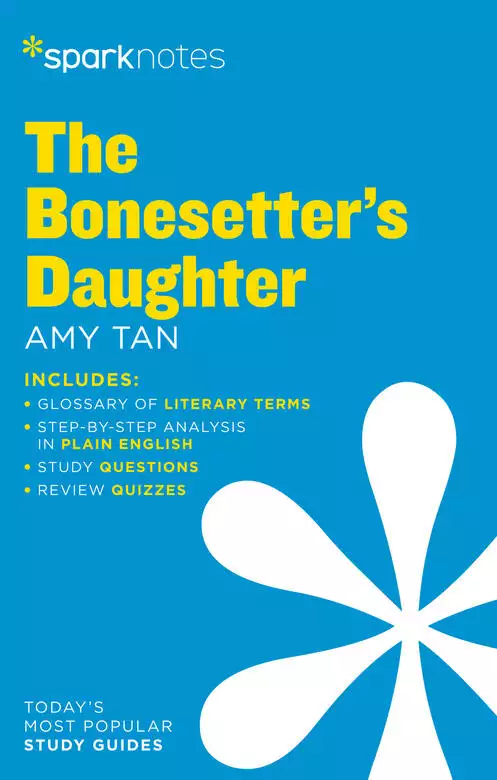
Simplify studying with this portable literature guide, filled with resources to help you thrive in English class! The Bonesetter’s Daughter, written by Amy Tan, depicts the fraught relationship between a Chinese immigrant and her American-born daughter. This literature guide includes a complete plot summary and analysis; key themes, motifs, and symbols; explanation of important quotes; suggested essay topics; and a review quiz.
Complete Plot Summary and Analysis
Key Facts About the Work
Analysis of Major Characters
Themes, Motifs, and Symbols
Explanation of Important Quotations
Author’s Historical Context
Suggested Essay Topics
25-Question Review Quiz
Publisher:
Union Square & Co.
Print pages:
96
* BingeBooks earns revenue from qualifying purchases as an Amazon Associate as well as from other retail partners.
The Bonesetter's Daughter SparkNotes Literature Guide
Amy Tan’s fiction, including The Bonesetter’s Daughter, often focuses on the Chinese-American experience and the bond between mothers and daughters. Tan’s interest in these themes comes from the circumstances of her own life. She was born in Oakland, California, in 1952. Her parents immigrated from China, and Tan’s experience growing up as the American child of Chinese parents shaped her identity and her writing. Tan has openly spoken about her difficult relationship with her mother, and the complicated bond between mothers and daughters is a major theme in many of her novels. Tan’s mother kept significant aspects of her own past secret for years and only revealed them once Tan was grown. For example, Tan eventually learned that her mother had been previously married and had children from this marriage, whom she left behind in China. As an adult, Tan traveled to China with her mother to meet the half-sisters she had never known. The idea that mothers have secret pasts unknown to their daughters is an important theme in Tan’s fiction, appearing in The Joy Luck Club and The Bonesetter’s Daughter, two of Tan’s acclaimed novels.
Details drawn from Tan’s life and family history appear in The Bonesetter’s Daughter. Tan’s maternal grandmother committed suicide when Tan’s mother, Daisy, was young, and throughout Tan’s childhood and adolescence, Daisy often threated to commit suicide herself. Because of the trauma she experienced in China, Daisy was regularly preoccupied with the idea of curses and ill fate. Around the time Tan began writing The Bonesetter’s Daughter, Daisy was diagnosed with Alzheimer’s, and she died before the novel was completed. When she was a college student, Tan’s roommate was murdered, and due to the trauma of identifying the body, Tan temporarily lost the ability to speak. For years afterward, she would lose the ability to speak on the anniversary of the murder. All of these details appear in the novel in some form.
Tan also interweaves historical events into the plot of The Bonesetter’s Daughter. In 1927, a team of scientists began a formal excavation of a site in Zhoukoudian, China. They discovered fossilized remains of a previously unknown subspecies of the prehistoric species Homo erectus (a species of archaic human). This discovery attracted worldwide attention, and excavations yielded approximately 200 fossils from at least 40 different specimens. The subspecies became known as Peking Man and was widely celebrated as an important archaeological discovery that could shed important light on the history of human evolution. In 1937, the excavations ceased due to the outbreak of war between China and Japan. The fossils were first stored at Union Medical College in Peking (modern-day Beijing) in hopes that excavation could resume after the end of the war, but as hostilities increased, it became too dangerous to leave the fossils in Peking. In 1941, the fossils were packed up to be shipped to the United States but vanished en route. They have still never been located, and the disappearance remains unexplained.
While the excavation of the Peking Man represents a specific historical event, the broader scope of twentieth-century Chinese history creates another important context for the The Bonesetter’s Daughter. In the novel, LuLing is born in 1916, when her mother is approximately twenty years old, which means that Precious Auntie is born some time at the very end of the nineteenth century, when China is still under imperial rule. By this time, however, the Emperor had lost significant power. In 1912, a few years before LuLing’s birth, the Republic of China is established. By 1927, civil war breaks out in China between the Republican government and the Communist Party of China. This conflict is reflected in the fates of LuLing and GaoLing’s brothers, who either choose to fight on the side of the Communists or are conscripted into the opposing army. Civil war continues to rage until the outbreak of hostilities with Japan in 1937. The Second Sino-Japanese War (which eventually becomes part of World War II) is usually thought to originate with the Marco Polo Bridge Incident, which Tan references in her novel. Other effects of the war—such as Americans in China being considered prisoners of war after 1941—also appear in the novel. Tan includes this historical content in The Bonesetter’s Daughter, but she mainly focuses on the ways in which these historical events affect the lives of individuals, especially women.
Ruth Young is a Chinese-American woman in her forties who lives in San Francisco and works as a ghostwriter. Ruth has a stable life but is sometimes troubled by doubts about her relationship with her boyfriend, Art. She often feels overwhelmed by the stress of managing her career and her family life, which includes acting as a stepmother to Art’s two adolescent daughters. Ruth has a close but ambivalent relationship with her elderly mother, LuLing. LuLing raised Ruth as a widowed single mother, and the two of them often fought, especially since LuLing has always had a bad temper and a history of depression. Ruth is distressed to find that her mother is showing signs of forgetfulness and confusion. When LuLing is diagnosed with dementia, Ruth becomes eager to learn about her mother’s past. Years before, LuLing gave Ruth a document in which she wrote down some of her life story, but, since the document is written in Chinese, Ruth struggled to read it and has made little effort to persevere. After LuLing’s diagnosis, Ruth finds the remainder of the document and decides to have it professionally translated. While she waits for the translation to be completed, Ruth moves in with her mother to help care for her.
The handwritten document tells the story of LuLing’s life. She was born in 1916 in a small town in China, not far from the city of Peking. LuLing was born into the Liu family, a prosperous family of ink-makers, and grew up in an extended family unit with her sister GaoLing, brothers, parents, aunts, uncles, and cousins. The most important person in LuLing’s life, however, was her nursemaid, Precious Auntie. Precious Auntie was a mysterious woman who had severe scarring and was unable to speak. LuLing communicated with her through writing and other means and acted as a translator for the rest of the family. In the document, LuLing reveals events from Precious Auntie’s life that took place before she was born. It is later revealed that LuLing knows this information because of a document Precious Auntie wrote for her.
Precious Auntie was raised by a man who worked as a bone-setter and healer, using both traditional and modern medicine. Because she was the only surviving child and her father was a widower, Precious Auntie grew up well-educated, independent, and accustomed to thinking for herself. She was also very beautiful, and her beauty eventually attracted proposals from both a man named Chang, who worked as a coffin maker, and Baby Uncle, the youngest son of the Liu family. Precious Auntie accepted the proposal from Baby Uncle because she was in love with him, and the couple began to have a sexual relationship before they were married. On the day of the wedding, Baby Uncle followed tradition and escorted Precious Auntie and her father to his house along with gifts from the bride’s family. These gifts included the “dragon bones” that were found in mountain caves nearby and used in healing rituals. The traveling party was attacked by men who appeared to be bandits. Precious Auntie’s father was killed in the attack, and all the valuables were stolen. Baby Uncle was killed immediately after the attack when he vowed revenge and his horse kicked him. Precious Auntie was convinced that Chang orchestrated the attack as revenge for her rejection of him.
Precious Auntie was taken to the Liu house to recover from her grief, but in despair, she tried to kill herself by drinking burning ink. This left her scarred and permanently unable to speak. When it became clear that she was pregnant with Baby Uncle’s child, the Liu family decided to cover up the scandal of an illegitimate birth. The baby, LuLing, was adopted by Baby Uncle’s eldest brother and his w. . .
We hope you are enjoying the book so far. To continue reading...
The Bonesetter's Daughter SparkNotes Literature Guide

 Please log in to recommend or discuss...
