'A brilliant noir thriller set in the darkest days of the Second World War' Stephen Leather
'A gripping World War Two thriller . . . Every shadow hides a potential threat and the tension never lets up. A must read' Reader review ⭐⭐⭐⭐⭐
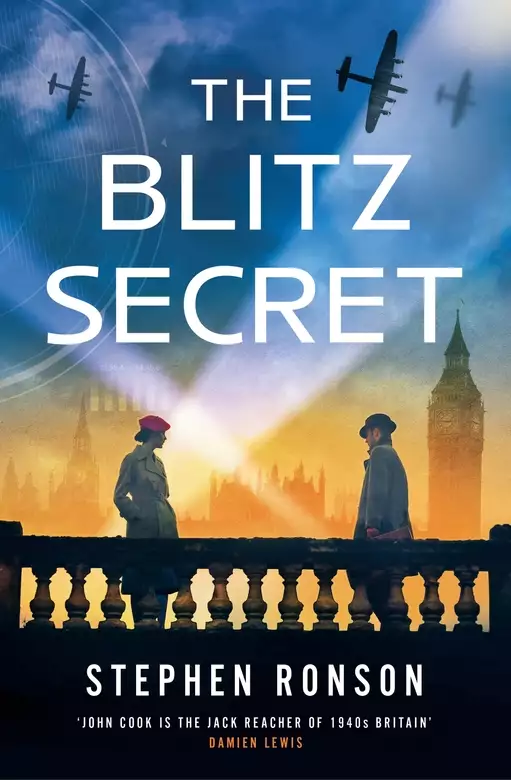
'Ronson delivers a cracking yarn, convincingly told. John Cook is the Jack Reacher of 1940s Britain' Damien Lewis
'My God, this was great. It left me with a book hangover. I felt like I was there in 1940s England . . . The writing is really 3D. You really feel like you're there. It's very immersive, and I love the witty humour' Reader review ⭐⭐⭐⭐⭐
'A vivid sense of place with tension on every level, The Last Line dripped with historical detail and authenticity. I absolutely loved it' Marion Todd
'A tough, taut wartime thriller that reads like a cross between Alastair MacLean and Lee Child and atmospherically conjures up the spectre of war, the threat of Nazi invasion and other evils uncomfortably close to home. Dad's Army, it ain't!' Robbie Morrison
'Thrilling and intriguing in equal measure. Like Jack Reacher on the Home Front in WWII' Mason Cross
Release date:
November 6, 2025
Publisher:
Hodder & Stoughton
Print pages:
320
* BingeBooks earns revenue from qualifying purchases as an Amazon Associate as well as from other retail partners.
Bunny didn’t like Sundays. What he liked even less than Sundays was being summoned from his flat and dragged out to the middle of nowhere. But when Churchill sent a driver to pick you up, you didn’t ask questions. Which was how he found himself in Uxbridge, descending sixty feet into the bowels of the earth, wishing he’d brought his hip-flask.
Churchill and Clemmie were already in situ, front-row seats in the dress circle – a balcony above the Group Operations Room. Below them, in a circular space, twenty highly trained men and women worked silently, pushing markers across a large map of south-east England. At the edge of the room, assistants stood with telephone receivers to their ears, gathering intelligence from secret stations across the region. Bunny had been inside some of those secret stations. People had died in those secret stations.
Bunny took his seat diagonally behind Churchill. The right hand of the father. The Prime Minister gave Bunny a disapproving scowl before turning his attention back to the action below.
‘You’re late,’ Churchill said.
Bunny didn’t reply. He’d learnt not to when the old man was in one of his moods. He settled in to watch the performance. Would there be lunch? Tea, surely, at the very least.
Covering the opposite wall, where the theatre curtain would have been, a gigantic blackboard was divided into six columns, one for each of the fighter groups tasked with defending the country. Within each column were sets of lights for each squadron. The lowest row of lights, when lit, showed the squadron was ‘Standing By’. Above that, the next light indicated ‘Ready’. Above that – ‘Available’. Above that were two more rows – ‘Enemy Sighted’, and finally, red lights that signified ‘Engaged With Enemy’.
To the left of all this, a glassed-in theatre box held five air-force officers, monitoring additional information from the many thousands of volunteer observers out in the field – men and women watching the skies with binoculars and calling in their observations.
‘Expecting much of a show today?’ Bunny murmured to the man sitting next to him. Air Vice-Marshal Park shook his head.
‘We’re hoping for a quiet one,’ Park said. ‘Not sure we can take another big push.’
Yesterday had been a disaster, Hitler throwing everything he had at the Royal Air Force, focusing his attention on airfields and landing strips across the country. If he wanted to invade, he had to break the RAF. The Germans knew it. The British knew it. Every man on the street knew it, watching anxiously as the battle played out in vapour trails high in the blue summer sky. And everyone knew how it would end. Not a matter of if, but when.
Hitler had more fighters, more bombers, and more pilots.
It was only a matter of time.
Bunny sat quietly for half an hour that felt like a week, checking his pocket watch every twenty seconds. It looked like Park might get his wish. Perhaps the Germans had awarded themselves a lazy Sunday.
The first sign of activity came from a young woman directly below. Her telephone operator approached her, whispered calmly in her ear, and retreated. The young woman, a plotter, marked up a wooden sign and placed it on the vast map. Her sign read ‘Forty-plus’, and she placed it on the other side of the Channel – over Calais. Forty enemy aircraft, identified by the top-secret new technology they were calling radar.
In quick succession, more markers were placed on the board, and the bottom row of lights on the far wall started to glow, as squadron after squadron was brought to readiness. All of this proceeded in the hushed tones of a reading room at a library. None of the plotters or telephone operators exhibited any emotion, but Bunny wasn’t born yesterday – he could feel the tension rising.
Still, the young men and women in the pit moved quietly, whispering commands to each other, pushing their markers across the table.
Soon, markers littered the map. ‘Forty-plus’, ‘Sixty-plus’, and in one instance, somewhere above Sussex, ‘Eighty-plus’. Every minute the plotters pushed their markers further inland, the paths of the invading aircraft becoming clear – they were coming for the airfields. Those airfields had been hit every day and were on their last legs.
Now, glowing red bulbs topped every column of lights – every squadron in action. Bunny had his eye on a man walking calmly around the edge of the room. One of Bunny’s recruits – picked him up from Oxford only a few months earlier. Lord Willoughby de Broke, solid chap, steward at the Jockey Club. Lord Willoughby looked up and made eye contact with Bunny. He was a fine poker player, Bunny knew from first-hand experience, but today his poker face was cracking. As they locked eyes, Willoughby gave the minutest shake of his head.
Bunny felt a cold chill shoot through his body.
Next to Bunny, Air Vice-Marshal Park made his apologies and rose to make a call. When he returned, he explained his absence.
‘I’ve asked Dowding at Stanmore to lend us a hand. He’s sending three more squadrons from reserve.’
Churchill nodded approvingly.
About time, too, Bunny thought.
Three new columns of lights were illuminated in swift succession – the reinforcements joining the fray. Now, every column was headed by a red light – every squadron engaged.
‘Do you think he’ll launch tonight?’ Bunny asked, under his breath. Hitler had a fleet of ships standing by across the Channel. The thin strip of sea the only thing standing between Britain and the largest, most mechanised army the world had ever seen.
‘Would you?’ Churchill asked, turning to Bunny.
‘Whether I would, or not, is the wrong question,’ Bunny replied. ‘The question is – what will Hitler do? Which I’m finding increasingly difficult to answer, because I’m not a raving lunatic. What would you do?’ Bunny asked Churchill.
Churchill examined his cigar and found it had gone out. He patted his pockets for his lighter, until his wife reached over – lighter in hand.
He lit the cigar, puffing on it to build up a good head of steam.
‘I’d be crossing the Channel already,’ Churchill said. ‘Synchronised landings while we’re distracted by all of this.’
Bunny noticed more and more of the young men and women below were stealing glances up at the audience in the circle.
‘How many more reserves do we have?’ Churchill asked.
Park paused before answering. He shook his head. A slight movement. Involuntary.
‘None.’
Churchill took another puff from his cigar.
‘None?’
Park shook his head again.
‘None.’
Churchill grimaced. Bunny detected a note of satisfaction. A grim welcoming – they’d been waiting for the worst. Now the worst was upon them.
‘So this is it,’ Churchill said.
Churchill turned to Bunny. Bunny knew what was coming and he was tempted to turn away. To remove himself from the process. To give himself a chance that in the future he’d be able to tell himself he wasn’t part of it. It wasn’t his fault.
‘It’s time,’ Churchill said.
1
One week later
Saturday, 7 September 1940
Ruby checked her wristwatch for the hundredth time as the air-raid siren wailed to life. Her arm was sticky from where she’d let it rest on the polished marble. Only half five and the bar was packed solid. Seemed like every day more people arrived in London, coming from all corners of the globe, all of them headed straight here, eager to find out who else had got away. A boisterous crowd of Scandinavians had taken up residence at the end of the bar. One of them looked familiar – one of those European royals you read about in the papers, arriving in a small plane with a suitcase of jewels, getting out ten minutes ahead of the German invaders.
She had to go. She’d had to go at four thirty, and then quarter to five, then five, but each time she’d gathered her things, the bartender had delivered another drink, each with the compliments of one of the seemingly endless number of airmen crowded into the bar, mixed in with the aristocrats and the refugees. Invariably, each had come over to try their luck. Some had been nice, wanting to talk, others assuming they’d get something in return for the cheap G and T she’d never asked for. Still, better than buying your own drinks.
She saw him, at the far end of the room. Her pulse quickened with fear. She’d heard he’d moved on to another hotel, trying his luck with a different crowd, but here he was, his distinctive copper hair like a warning flag.
Now she really had to go. She should have been getting off the number nine bus at the end of her street by now, hurrying over the narrow bridge onto the docks, to the dark row of houses anchored by their pub on the corner. Still, no use crying over spilt milk. And she did want to see Frankie again, of course she did, after he’d been sent away to the country. Ruby couldn’t think of anything worse. How miserable, biding your time in a godforsaken farm in the middle of nowhere, missing out on everything. There’d been a suggestion that Ruby should accompany Frankie, keep an eye on him, but she’d put her foot down. Besides, she wasn’t a child, she had a job to do here in town.
The lights flicked off, then back on. Off again, then on again. A visual warning – a workaround for times like this when even an air-raid siren wouldn’t penetrate the hubbub of the crowded bar.
Last September, the siren would have emptied the place. The first Ruby ever heard, she’d been sure it was the end of the world. Straight after Chamberlain had been on the wireless, telling them war had been declared. Mum had bundled them into the dank cellar and they’d sat there, gas masks fogging up, waiting to die. Two hundred thousand people would be killed in the first raid, the papers said. But the planes hadn’t come. Frankie had been the first to take his mask off, earning him a clip round the ear from Mum, but half an hour later they’d all been back upstairs, talking excitedly about their first air raid. Had they heard a plane? Annie from round the corner had said a thousand parachutists had landed on the Kent coast but got rounded up by the police. Ruby heard stories of a landing craft going down in the Channel, and hundreds of bodies washing up on the beaches, all in their German uniforms, rifles clenched in their hands, bayonets fixed. None of the stories true, of course. Even at the time Ruby hadn’t believed them. Hitler was busy razing Poland to the ground, all you had to do was watch the newsreels. He wouldn’t have thought about England if Chamberlain hadn’t declared war. He certainly wouldn’t have been able to mount an attack with the whole of the French army lined up against him, their Maginot Line the eighth wonder of the world, the most heavily defended strip of land in history.
But that was a year ago. A lot had changed since then.
Ruby flashed a smile to the bartender as she climbed down from the stool, smoothed her dress and went through the familiar panicky grabbing for her gas mask. She’d left it on the bar but it wasn’t there. With a flash of relief she felt it hanging from the coat-hook under the bar, the grey leather box she’d bought with her first pay packet from Lyons. If you had to carry the blasted thing around, might as well have it look half decent, as she’d told Mum in response to the raised eyebrow. In Mum’s day, young women didn’t go out to work, apparently. Certainly not Up West. If they had, they certainly wouldn’t have spent half their pay on a replacement for something the government had already given you for free.
He was pushing through the crowd towards her. Last time they’d met he’d made it very clear she wasn’t to cross his path again. Last time, he’d hurt her, and said it would be worse if it had to happen again. Said the powers that be had made it very clear – he was to disappear her if necessary. Or even if not necessary. Perhaps he’d do it just for the fun of it.
2
Ruby hurried across the lobby, to the side door out onto Arlington Street. They didn’t like the girls to use the front door.
It was hot outside. It had been in the nineties earlier, and it hadn’t dropped off yet. It was jarring, emerging into the light. She’d usually be inside until the early hours, until the party moved to the downstairs bar, the one buried under twenty feet of concrete and steel. The safest place to get a drink in London. Safe, until she’d crossed paths with him, of course.
A bus was lumbering its way up Piccadilly from Green Park. Ruby squinted. Number nine. Perfect timing for once. It was on the far side of the road, and the stop was a hundred yards further down. If she hurried, she’d make it.
Something was wrong, though. People were standing on the pavement in groups, looking at the sky, pointing down the road towards Piccadilly Circus. Pointing east, the way her bus was heading. The way home.
The door opened behind her and he stepped out. He was distracted at first, looking up into the sky. But then he looked down and saw her. He started towards her with purpose. She had to get away.
The bus was pulling up at the stop, still fifty yards away and on the far side of the road. From experience, Ruby knew it wouldn’t linger. If she could thread her way through the traffic she’d make it. She hurried into the road, anticipating the forward movement of the car in front of her, but the car slammed its brakes on and she smacked her hip against the boot. The driver’s door opened and Ruby turned, ready to argue, to defend herself, stupid motorists thought they owned the road, but the driver wasn’t looking at her. He was looking past her, into the sky.
Ruby skirted around the stopped car and ran into the road, but turned back when she heard a cry next to her. An old lady with her heel caught in a drain. Some people shouldn’t be allowed out on their own, Ruby thought, as she bent to pull the woman’s heel clear of the grate. The ironwork scraped off a long peel of paint, leaving the elegant heel disfigured.
‘Are you all right?’ Ruby asked. The woman looked at her with such undisguised distaste, Ruby took a step back.
‘Take your hands off me this instant,’ the woman said, clutching her purse to her chest.
Ruby smiled, a fixed grin. Don’t let them see they’ve got to you. She glanced up. He was gaining on her. Her Good Samaritan act was going to get her into trouble.
The air-raid siren wailed again. Different this time – instead of the rising and falling tone it was a repeating note meaning danger was imminent. The woman heard it, fear flashed across her face.
Ruby felt a rumble that went right through her. A bomber. Not a speck in the sky, but a very real plane, above the rooftops, much lower than it should be. It was turning, almost on its side, like it was doing acrobatics at an air show. Smaller planes were on its tail. She heard a distant rattle, like a sewing machine. Fighters, trying to bring it down.
The woman with the scraped heel was the only person on the street not watching the sky. She bustled her way across the road, oblivious to the traffic, a black cab making a point of passing by with only inches to spare.
Ruby looked for her pursuer. He, too, was watching the dogfight in the sky. Her chance to evade him. She doubled back. Instead of crossing the road, she ran for the entrance to the bookshop, took shelter inside the recessed doorway.
She’d have to steer clear of the Empire for a few weeks. Try her luck elsewhere. She’d heard the Savoy was worth trying.
The bus collected its passengers, ready to move off. A young woman in a Lyons uniform ran to catch it, jumping onto the platform at the back as the bus pulled out into traffic, gathering speed. Ruby recognised her, and raised her hand to wave.
‘Irene!’ she shouted, before she remembered she was meant to be lying low, but it came out muted against the roar from the planes.
The woman she’d shouted to turned, hanging on to the pole at the back of the bus. It was Irene, the only one at the Green Park Lyons who’d been remotely nice to Ruby. Not exactly a friend, but an ally. The bus was already moving off into the traffic, heading past Simpsons, about to be swallowed up by the swirl of cars and buses threading their way through Piccadilly Circus.
Ruby watched as Irene disappeared from view. She imagined her pushing her way into the crowded bus, perhaps finding somewhere to sit, a gallant soldier standing up to make room for the pretty young waitress who’d need to get off her feet after a day serving tea.
What Ruby remembered most, when she thought about it later, was the swish. Like someone had drawn a pair of curtains. There’d been a flash, like lightning; a feeling of being pushed, like a giant hand had reached down and swatted her off the pavement, against the front door of the bookshop.
There never was a bang, like when a bomb went off in the flicks. There must have been, of course, but she never heard it. Just the swish, then the feeling, then staggering along the road, down towards Pall Mall, holding her hand to the back of her head, sticky and warm, not wanting to look.
The bus had caught it. Irene’s bus. A bus that was suddenly not a bus at all, but a cage of twisted metal. A raging inferno.
3
Ruby staggered away from the main road. She couldn’t quite remember why, but it felt important. She’d been about to cross, to catch a bus, but she’d changed her mind.
It would take another ten minutes for another number nine. There weren’t enough of them on the route at the best of times, everyone said so, now they’d be down one. Would they bring in a replacement? They could take one from a lighter-used route? She should write in, suggest the idea.
She fumbled in her bag for a notepad. Suddenly it seemed very important to write. They’d thank her for it.
‘Ruby?’
She looked up. A face in the crowd.
‘My God, you’ve been hurt.’
He pulled a hankie from his pocket as he moved towards her. She stepped back, confused. It didn’t fit, seeing him here, with the screaming behind her from Piccadilly, and the ringing of the bell from the fire engine, already making its way to the scene, and above all of it the siren – redundant surely now the attack had arrived.
‘Let’s get you home,’ he said, taking her arm, a firm grip. Ruby recoiled but the grip didn’t yield.
The car door closed with a clunk. A heavy car. Expensive. The inside smelt of leather and petrol and something else, talcum powder perhaps. Ruby felt for the door handle as he bustled round to the driver’s door, but it didn’t work, just pulled towards her without any click.
‘Let’s get you somewhere safe,’ he said, as he started the engine. ‘Get you cleaned up. What luck I was here.’
The world was spinning. There was a tartan rug, folded neatly on the back seat. Ruby laid her head on the scratchy wool. There was a distant explosion, and the car rocked, but it carried on. Soon it was threading its way through rights and lefts, and Ruby let herself give way to sleep, or at least a version of sleep, in which she dreamt she was a doll being shaken by an angry child.
She’d be late for Frankie’s party, but at least she’d get there. Her mum would take care of her, make it better.
A tear slipped down her cheek as she thought of Frankie. She’d let him down on his birthday. Not the first time she’d let him down, not by a long shot.
4
John Cook wasn’t a London man. He’d grown up in the countryside, working on his father’s farm as soon as he could shoulder a bale of hay, learning what it was to be part of the land. To know the smell of the soil, the feel of it in your hands. To know your neighbours, for better or worse. When he’d gone away to war – The Great War – it had been to defend his own version of England, a rural country with more horses than cars, where people minded their own business, where a man could make his own luck if he was willing to put in the work. London was something else entirely. The biggest city the world had ever seen. Black stone buildings and smoke further than a man could see.
Cook was familiar with the aphorism – ‘When a man is tired of London, he is tired of life.’ But a clever sentence wasn’t enough to turn the tide. Give him a quiet pub and the company of men who’d spent their days in the fields. You could keep the city and have done with it. It was too big. Too many buses and cars, and too many people.
But Cook had been out-manoeuvred. A train of events leading to him sitting on a double-decker bus crossing Tower Bridge, the dirty brown waters of the Thames drifting slowly out to sea.
It had started with taking in the evacuee. At first, back in ’39, he’d put his foot down and told Mum he couldn’t have a young child running around the place. A lot of dangerous machinery on a farm. A lot of ways a child could get themselves into trouble, unless you were watching out for them, and a farmer didn’t have time to be continually looking after a child. Certainly not a farmer who’d lost most of his labourers to the war effort, one who’d put his life into the land, who felt a responsibility.
But he’d weakened. A winter of reproachful looks from Mum. Long nights of silent criticism from Uncle Nob, who’d returned from Flanders a broken man and hadn’t spoken a word since they’d dumped him at the end of the lane, dressed in an oversized de-mob suit, carrying an empty cardboard suitcase. Funny how a man who didn’t speak could make you feel his disappointment. So Cook had relented and said they could take an evacuee – if, and only if, the government saw fit to send another wave out from the cities.
May had come, and Hitler had turned his attention west, his armies rolling unchecked across Holland, Belgium, and then France, until the only thing that gave the blitzkrieg pause was the thin strip of the English Channel, and suddenly it had once again seemed prudent to send England’s future out of London, into the countryside – away from the bombers and the parachutists and the poison gas that was surely on its way. Cook hadn’t understood why the brains in Whitehall had thought sending a child out of London to the Sussex countryside – towards the predicted invasion route – had been a good idea, but he’d done his bit nonetheless. He’d escorted Mum to the dusty church hall, where the newly arrived children had been fought over like so many jars of chutney at a jumble sale – the pretty girls going first, the strong boys next, the weakest boys last. Cook and Mum had taken the last boy standing – a grey-faced lad who wouldn’t look Cook in the eye, who gave every im. . .
We hope you are enjoying the book so far. To continue reading...

 Please log in to recommend or discuss...
