The extraordinary true story of the codebreaking women of World War Two
'Nothing has breathed life into WWII in the same way as this truly engaging portrait of life at Bletchley Park sharing the memories of the women who worked at the code breaking coal face' - READER REVIEW ⭐⭐⭐⭐⭐
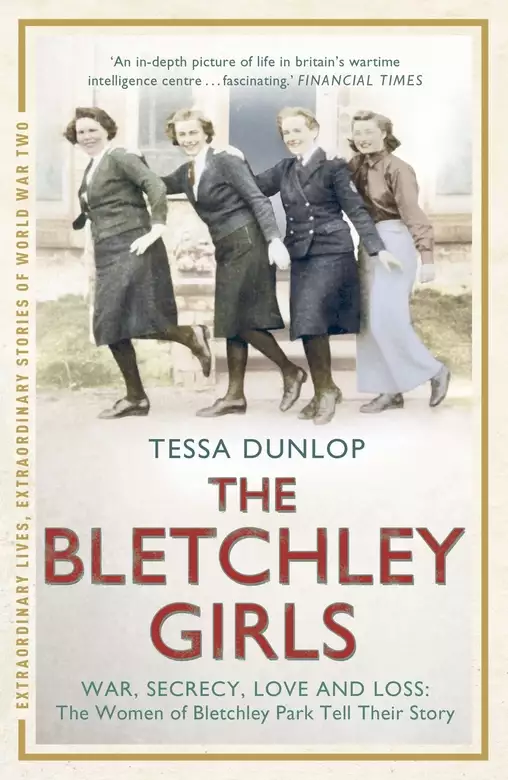
The Bletchley Girls weaves together the lives of fifteen women who were all selected to work in Britain's most secret organisation - Bletchley Park. It is their story, told in their voices; Tessa met and talked to 15 veterans, often visiting them several times. Firm friendships were made as their epic journey unfolded on paper.
The scale of female involvement in Britain during the Second World War wasn't matched in any other country. From 8 million working women just over 7000 were hand-picked to work at Bletchley Park and its outstations. There had always been girls at the Park but soon they outnumbered the men three to one.
A refugee from Belgium, a Scottish debutante, a Jewish 14-year-old, and a factory worker from Northamptonshire - the Bletchley Girls confound stereotypes. But they all have one common bond, the war and their highly confidential part in it. In the middle of the night, hunched over meaningless pieces of paper, tending mind-blowing machines, sitting listening for hours on end, theirs was invariably confusing, monotonous and meticulous work, about which they could not breathe a word.
By meeting and talking to these fascinating secret-keepers, Tessa Dunlop captures their extraordinary journeys into a terrifying world of war, secrecy, love and loss.
A must-read for anyone with an interest in the real stories of World War Two.
----
Critical acclaim for The Bletchley Girls: 'An in-depth picture of life in Britain's wartime intelligence centre . . . The result is fascinating, and is made all the more touching by the developing friendships between Dunlop and her interviewees.' Financial Times
'Lively . . . in giving us the daily details of their lives in the women's own voices Dunlop does them and us a fine service.' New Statesman
'Brings the unsung heroines of Bletchley into the limelight and gives them a share of the credit that so often goes to their male counterparts.' The Scotsman
'Candid about the hardships and heartaches of wartime work and its knock-on effects.' The Times
Release date:
January 8, 2015
Publisher:
Hodder & Stoughton
Print pages:
352
* BingeBooks earns revenue from qualifying purchases as an Amazon Associate as well as from other retail partners.
I owe an enormous thank you to Rozanne Colchester, Pamela Rose, Betty Gilbert, Cora Jarman, Doris Moss, Gwen Watkins, Georgette McGarrah, Muriel Dindol, Joanna Chorely, Pat Davies, Charlotte Webb, Ann Mitchell, Kathleen Kinmonth Warren, Ruth Bourne and Lady Jean Fforde. It is their stories, so generously shared, that made this book possible. It was with trepidation that I sent out their extracts prior to publication. Thank you for the candid feedback and grammatical overhaul! Thanks also to husbands Angus Mitchell and Philip Jarman, daughters Chloë Fithen and Margy Kinmonth and nephew Adam Raphael for input and support (and in Margy’s case impressive historical sleuthing!). I reserve a special thank you for Lady Margaret Stirling-Aird and her important, albeit brief, appearance in this book.
I could not have unravelled much of what I was told without the unstinting expertise and support of Dr Joel Greenburg who was busy writing his own book about code-breaker Gordon Welchman, but always found time for my code-breaking questions. Thank you very much. Thanks also to Professor Bruce Collins for casting an invaluable eye over the manuscript. Any errors are entirely my own.
The gem of an idea from which ‘The Bletchley Girls’ sprang was brought to me by Charlotte Robertson, thank you for sharing it. And thank you also for finding the project’s perfect match with editor Rupert Lancaster at Hodder & Stoughton, whose steady hand has overseen the scramble from idea to timely execution. Assistant editor Maddy Price has been an outstanding support, coping with last minutes changes and my constant queries, while Karen Geary has enthusiastically championed the book from first (very rough) manuscript onwards.
For research assistance I would like to thank Stephen Fleming at the National Museum of Computing, Katherine Lynch and Jonathan Byrne at Bletchley Park Trust, Carrie Fehr and Oliver Mahony at Lady Margaret Hall, Oxford University, Anne Wickes at The Second World War Experience Centre, Nicola Allen at Woburn Abbey and Paddy Meiklejohn at home in Forres. The British Library and the London Library have provided me with a second home and my mother has, as usual, always said the right thing. Thank you.
Bibliography
Unless cited all references concerning the fifteen veterans featured in this book were taken from face-to-face interviews and subsequent telephone conversations, letters, email exchanges and visits throughout the course of 2014.
Supplementary sources relating directly to the 15 ‘Bletchley Girls’ include:
Published Memoirs
Bourne, R., ‘Eastcote and Stanmore’ in Page, G., (ed.), We Kept the Secret: Enigma Memories, Geo. R. Reeve Ltd, 2002
Briggs, A., Secret Days, Code-breaking in Bletchley Park, Frontline Books, 2011
Fforde, J., Castles To Catastrophes, Help-Yourself.net, 2011
Kinmonth Warren, K., Shared Lives, Self-published, 2001
Mitchell, A., Winifred, Self-published, 2012
Trumpington, J., Coming Up Trumps, A Memoir, Macmillan, 2014
Watkins, G., Cracking The Luftwaffe Codes: The Secrets of Bletchley Park, Frontline Books, 2013
Watkins, G., Portrait of a Friend, Gomer Press, 1983
Webb, C., Secret Postings: Bletchley Park to the Pentagon, BookTower Publishing, 2011
Unpublished Memoirs
Colchester, R., Handwritten recollections
Williamson, A., Personal Diary, 1943–44
Poetry
The Collected Poems of Vernon Watkins, Golgonooza Press, 1986
Websites
www.bbc.co.uk
www.bletchleypark.org.uk
www.war-experience.org
Newspapers
The Daily Mail
The Guardian
The Telegraph
The Times
Bletchley Park and Code-breaking
There are an ever-increasing number of books, journals and memoirs on the subject of Britain’s Second World War code-breaking efforts. This is in no way a comprehensive summary, rather a list of the publications that I found instructive during the writing of The Bletchley Girls.
The Bletchley Park War Diaries: July 1939–August 1945, Secret Intelligence and the Second World War, Wynne Press, 2011
Briggs, A., Secret Days, Code-breaking in Bletchley Park, Frontline Books, 2011
Brunt, R., ‘Indexes at the Government Code and Cypher School, Bletchley Park, 1940–1945’, American Society for Information Science and Technology, 2004
Calvocoressi, P., Top Secret Ultra, M&M Baldwin, Cleobury Mortimer, 2001
Greenburg, J., Gordon Welchman: Bletchley Park’s Architect of Ultra Intelligence, Frontline Books, 2014
Grey, C., Decoding Organization: Bletchley Park, Codebreaking and Organization Studies, Cambridge University Press, 2012
Hill, M., Bletchley Park People: Churchill’s Geese That Never Cackled, The History Press, 2004
Hinsley, F. H. & Stripp, A. (eds.), Code Breakers: The Inside Story of Bletchley Park, Oxford University Press, 1993
History of Bletchley Park Huts & Blocks 1939–45, Bletchley Park Trust, 2009
Hodges, A., Alan Turing: The Enigma, Burnett Books, 1983
Howard, K., Dear Codebreaker, The Letters of Margaret Rock (Bletchley Park Codebreaker) & John Rock (Parachute & Glider Forces Pioneer), Booktower Publishing, 2013
Jackson, J., Hitler’s Codebreakers: German Signals Intelligence in World War 2, Booktower Publishing, 2012
Jarvis, S., Japanese Codes, Bletchley Park Trust, 2009
McKay, S.,The Secret Life of Bletchley Park, Aurum Press, 2011
McKay, S., The Secret Listeners: How the Y Service Intercepted German Codes for Bletchley Park, Aurum Press Ltd, 2012
McKay, S., The Lost World of Bletchley Park: An Illustrated History of the Wartime Codebreaking Centre, Aurum, 2013
Moran, C., Classified: Secrecy and the State in Modern Britain, Cambridge University Press, 2013
Page, G., (ed.), We Kept the Secret: Enigma Memories, Geo. R. Reeve Ltd, 2002
Pether, J., Funkers and Sparkers: Origins and Formations of the ‘Y’ Service, Bletchley Park Trust, 1998
Sebag-Montefiore, H., Enigma: The Battle for the Code, Weidenfeld and Nicolson, 2000
Segrave, E., The Girl from Station X: My Mother’s Unknown Life, Union Books, 2013
Smith, M., The Secrets of Station X: How the Bletchley Park Codebreakers Helped Win the War, Biteback Publishing, 2011
Smith, M., The Emperor’s Codes: Bletchley Park’s Role in Breaking Japan’s Secret Ciphers, Biteback Publishing, 2010
Smith, M. & Erskine, R. (eds.), Action this Day, Bantam Press, 2001
Smith, M., Station X: The Codebreakers of Bletchley Park, Channel 4 Books, 2001
Stubbington, Wing Commander J., BMP Reports by the German Air Section, Bletchley Park Trust, 2012
Walton, C., Empire of Secrets: British Intelligence, the Cold War and the Twilight of Empire, Harper Press, 2013
Wescombe, P., Bletchley Park and the Luftwaffe, Bletchley Park Trust, 2009
Winterbotham, F., The Ultra Secret, Weidenfeld and Nicolson, 1974
Young, I., Enigma Variations: Love, War & Bletchley Park, Mainstream Publishing, 1990
Websites
www.bletchleypark.org.uk
General Bibliography
It is hard to know where to draw the line when it comes to writing a bibliography of a book that spans the best part of a century. If it was to be truly representative it would even have to include my A level textbooks on the rise of Nazism in Germany! I have therefore decided to limit the below list to texts that I have consulted during the course of writing The Bletchley Girls.
Ackroyd, P., London: The Biography, Vintage, 2001
Atkinson, R., The Day of Battle: The War in Sicily and Italy, 1943–44, (Liberation Trilogy, Book 2), Henry Holt, 2008
Baldwin, S., ‘England’ in On England and Other Addresses, P. Allan & Co., 1926
Bennet, T., et al. (eds) Formations of Pleasure, Routledge, 1983
Briggs, A., The Birth of Broadcasting, Oxford University Press, 1961
Corner, P., The Fascist Party and Popular Opinion in Mussolini’s Italy, Oxford University Press, 2012
Drummond, J., Blue for a Girl: The story of the W.R.N.S; W.H. Allen, 1960
Footitt, H., and Tobia, S., War talk: Foreign languages and the British war effort in Europe 1940–47, Palgrave Macmillan, 2013
Gilbert, M., The Second World War, Phoenix, 2009
Glancy, M.,‘Going to the Pictures: British cinema and the Second World War’ in Past and Future, Institute of Historical Research, 8, Autumn/Winter 2010
Grieve, M., Millions Made My Story, Victor Gollancz, 1964
Harris, C., Women at War 1939–45: The Home Front, The History Press, 2010
Heinrich, A.,‘Theatre in Britain during the Second World War’, New Theatre Quarterly, 26(1), 2010
Holdsworth, A., Out of the Dolls House: The Story of Women in the Twentieth Century, BBC Books, 1988
James, C., & Porter, V. (eds), British Cinema History, Weidenfeld and Nicolson, 1983
Koonz, C., Mothers in the Fatherland: Women, the Family, and Nazi Politics, St Martin’s Press, 1988
Kuschner T.,and Knox, K., Refugees in an Age of Genocide: Global, National, and Local Perspectives during the Twentieth Century, Frank Cass, 1999
Jackson, S., The Savoy: The Romance of a Great Hotel, Muller, 1964
Jose, H., ‘War and Social History, Britain and the Home Front during the Second World War’, Contemporary European History, Vol. 1, No. 1 (March 1992)
Lamb, C., I Only Joined for the Hat, Redoubtable Wrens at war . . . their trials, tribulations and triumphs, Bene Factum Publishing, 2007
Langhamer, C., ‘‘‘A Public House is for all Classes, Men and Women Alike’’: Women, Leisure and Drink in Second World War England’, Women’s History Review, Vol 12, No. 3, 2003
Light, A., Forever England: Femininity, Literature and Conservatism between the Wars, Routledge, 1991
London, L., Whitehall and the Jews, 1933–48: British immigration policy, Jewish refugees and the Holocaust, Cambridge University Press, 1999
Millgate, H, D., Got Any Gum Chum? GIs in Wartime Britain 1942–45, The History Press, 2009
Nicholson, V., Millions Like Us: Women’s Lives in the Second World War, Penguin Books, 2011
Nicholson, V., Singled Out: How Two Million Woman Survived without Men After the First World War, Penguin Books, 2008
Noakes, L., Women in the British Army: War and the Gentle Sex, 1907–1948, Routledge, 2006
Priestley, J, B., English Journey: Being a rambling but truthful account of what one man saw and heard and felt and thought during a journey through England during the autumn of the year 1933, Victor Gollancz, 1934
Robbins, K., Past and Present: British Images of Germany in the First Half of the Twentieth Century and their Historical Legacy, Göttingen: Wallstein, 1999
Ross, S., At Home in World War Two: Rationing, Evans Brothers Ltd, 2002
Smith. H., (ed.) War and Social Change: British Society in the Second World War, Manchester University Press, 1990
Storer, C., ‘Weimar Republic as seen by an English Woman: British Women Writers and the Weimar Republic’, German Studies Review, Vol. 32, No. 1 (Feb 2009)
Sugarman, M., Fighting Back: British Jewry’s Military Contribution in the Second World War, Valentine Mitchell, 2010
Summerfield, P., Reconstructing Women’s Wartime Lives: Discourse and Subjectivity in Oral Histories of the Second World War, Manchester University Press, 1998
Taylor, A, J, P., English History 1914–45, Oxford University Press, 1965
Wallis, R., Britain, Germany and the Road to the Holocaust: British Attitudes towards Nazis Atrocities, I. B. Tauris, 2014
Williams, B., Britain at War 1939–45, Pitkin, 2005
Wilson, C., Churchill on the Far East in the Second World War: Hiding the History of the ‘Special Relationship’, Palgrave Macmillan, 2014
World Committee of the Victims of German Fascism, The Brown Book of Hitler Terror, Gollancz, 1933
Websites
www.bbc.co.uk
www.striking-women.org
1
Children of the Armistice
Pamela was the product of her mother’s direct line to God. Dolly had asked for her young husband to be wounded in the left leg during the Great War and her prayers were answered. Thornly returned to England with an injured thigh that, as Dolly had anticipated, removed him from front-line service. The angel of death wreaked havoc among Europe’s young men for another two years but Thornly had been saved. Baby Pamela arrived a year later in 1917 – living proof of her father’s full recovery.
Despite her protests to the contrary, it is not hard to imagine the striking young woman Pamela once was. At ninety-six she retains an ethereal beauty: startling blue eyes, sculpted features and elegant poise, all wrapped in soft wools and silk. Meeting her for the first time in the 1950s, Pamela’s little nephew Adam thought she had fallen off the front of a chocolate box. She jokes that her parents sent their rotund teenage daughter off to Europe one summer in the hope she would return slim and pretty; they can’t have been disappointed.
Born into the English Establishment before women were granted a vote, looks mattered for girls like Pamela. But nothing could compete with being a boy. She admits with a chuckle, ‘I always knew my brother was the favourite.’ The painful hole left by the 722,785 young men who, unlike Pamela’s ‘blessed’ father, never returned from the Great War ensured that in the 1920s a little boy’s stock had rarely been higher.
Pamela’s parents were not a conventional upper-class Edwardian couple. In the Gibson household music was the governing force. When her father Thornly thought of Germany it was opera that sprung to mind, not Prussian might. He duly abandoned his studies at Oxford to cut his teeth as a professional singer in Berne where his wife-to-be fell in love with his easy-going manner and baritone voice. They married in 1913. Dolly was the quintessential English woman who, as befitted her class, enjoyed artistic pursuits on the Continent. The fact that her father had been a German Jew was rarely mentioned. Since 1890 all restrictions for positions within the British Empire had been removed for Jews,2 but the whiff of anti-Semitism among the British upper classes would take much longer to disperse. Dolly was simply trying to fit in. And she succeeded. Thornly used his German to translate for Prime Minister Lloyd George at Versailles before he got a sensible job back in England as a stockbroker, ensuring there was time and money for husband and wife to pursue their passion for opera. Pamela remembers musical evenings every Wednesday; a heady mix of professionals and amateurs in front of whom she and her brother, Patrick, occasionally had to perform. It was a privileged, artistic start to life and, just as her mother wished, she grew up every bit a little English girl – albeit with a sprinkling of German.
As an adult, Pamela once danced with the writer and broadcaster J. B. Priestley, ‘both being rather small we nearly fell over!’ The voice of a generation, he openly coveted the title ‘little Englander’, noting ‘that little sounds the right note of affection. It is little England that I love.’
Pamela sheds light on an expression that has subsequently been associated with bigoted parochialism. ‘You see, just after the war people wanted to get back to the safe and familiar, to what they knew and a land they had dreamed of.’ Reeling from the protracted horrors of 1914–18, beset with a series of recurrent economic crises and an exhausted, over-stretched empire, Britain’s imperial diet of militaristic heroism and tub-thumping had gone right out of fashion. National sentiment changed; there was no place for Victorian bombast in 1920s England.
Unlike the other women featured in this book, Pamela was not a child of the Armistice – she was born during the First World War. But like them, she grew up in a country that struggled to articulate its grief; instead shell-shocked Britain resorted to an annual silence that stopped the empire. Telephone operators, traffic, department stores – everything came to a halt for two minutes once a year on 11 November. Only the children, tight buds of hope, were unable to remember the horror that could never be allowed to happen again. World war must be avoided at all costs.
It was fitting that avuncular pipe-smoking Stanley Baldwin became Prime Minister in 1924 and again in 1926. He helped ensure the nation’s swingeing military retrenchment was sugar-coated with a more private, domestic vision of Englishness. In 1926 Baldwin appealed to his St George’s Day audience with a pastoral idyll. ‘The tinkle of the anvil in the country smithy, the corncrake on a dewy morning, the sight of a plough team coming over the brow of a hill.’ Here was a country stripped of all pretension; the perfect place for little English girls to grow up in.
Country Girls
Baldwin’s vision of a timeless England chimes perfectly with the picture Charlotte paints of her 1920s childhood. The centre of her universe was a three-acre grassy smallholding sandwiched between the undulating peaks of Herefordshire. In fine summer weather she would take her bed outside and gaze at the stars, dreaming of infinity and beyond. Visitors to the family home may have been startled by a small dark-haired girl hanging by her knees from a tree. The Vine-Stevens (‘neither rich nor poor’) expected Charlotte to pull her weight; she got up early to tend the pigs, goats and poultry. There was no electricity and no running water and Charlotte’s father was away all day in Ludlow where he worked for Lloyds Bank.
In her ninety-second year, Charlotte is still in remarkably good health. A strong sturdy child, she suited the great outdoors, but her little brother wasn’t so lucky. Baby David was born disabled into a way of life that demanded robust physical health, miles from any medical help. He died when Charlotte was just four.
‘That’s my earliest memory – my grandmother coming down the path to meet me. “Where is David?” I asked. I was told to “ssshh!” ’
The subject was never mentioned again. To this day Charlotte isn’t entirely sure why her brother died. ‘You didn’t talk about those sorts of things and children didn’t ask questions.’
The sentiment behind Charlotte’s words is precisely echoed by Betty, born a year later, on George V’s birthday.
Her mother Gracie was pregnant with Betty when her husband left. ‘He went AWOL. Let’s put it like that.’ Betty thinks her father was called Albert. He was a policeman in London but she never met him and ninety years on she still doesn’t know what happened. ‘To say there was another woman would be speculation.’ Albert’s disappearance left Betty’s mother in dire straits; pregnant and with four teenage children, no job, no home and no man she went back to live with her old father in rural Northamptonshire. Gracie took in washing and went out cleaning in the market town of Higham Ferrers where Betty still lives, to supplement the little bits of money her older children were able to earn. Minus their main breadwinner, the Quinceys were dirt poor. ‘It was a tough life. Very tough.’ But despite the hardship, Betty’s father was never mentioned.
Nobody talked about him. ‘Oh no, we didn’t do that, not ever.’ Little Betty grew up in a household with secrets and like Charlotte she knew better than to ask questions. Both girls were schooled in the art of discretion from a very early age.
Charlotte and Betty’s families, like much of rural Britain, knew their place in the feudal pecking order. The Vine-Stevens were positioned midway between the Lord of the Manor and the humble cottager. Charlotte remembers ‘each class helped the rung below’. Her mother would provide hearty meals for local ‘lads and lasses’ who lent a hand. Meanwhile further down the social scale, Betty’s mother relied on offers of piecemeal work and sustenance for her family’s survival.
At the opposite end of society sat the aristocracy. Born in 1920, Lady Jean Graham’s arrival was the cross-pollination of two mighty ducal houses – the Hamiltons and the Montroses. The family’s lineage can be traced back to King James II3 and their fiefdoms straddled two enormous Scottish estates, each with its own castle. Lady Jean remembers a lonely childhood; growing up, the only real playmates she had were her second cousins, the Prince of Monaco’s children. Among other notable relatives was Germany’s Margrave of Baden. So much for little England – this was glorious Scotland.
There was one castle for summer (Arran), and one for winter (Buchanan). Ninety-four years later, step off the ferry onto the Isle of Arran and any local will know her.
‘Aye, Lady Jean. Take the short cut across the golf course. She’s the born to rule sort, but ach she does a lot for us.’
As she herself explains, ‘I was brought up to understand with privilege comes duty.’
A formidable presence in her exquisite drawing room, Arran’s spring sunshine bouncing through the bay window, it is immediately clear that Lady Jean learnt much of her life philosophy from the Duchess of Montrose, her indomitable mother. During the First World War, Jean’s severely deaf father was only permitted to command a minesweeper in the Clyde; however, the Duchess more than made up for her disabled husband. She threw herself into nursing, occasionally returning at weekends to oversee the staff who looked after her first three children and ran the castles. A hard worker, Jean’s mother was soon promoted to theatre nurse in a mainland hospital before riding straddle-legged (very daring) on a motorcycle to and from Arran’s rehabilitation centre. But afterwards, duty done, the war was rarely talked of. Perhaps ‘it was just too ghastly,’ suggests Lady Jean, born two years later. There was, however, one exception.
It nearly broke my mother’s heart when the cavalry came at the beginning of the war and took away twenty-one of her heavyweight hunters. All those lovely horses off to the front line never to be seen again. She did speak about that.
If few in Britain could boast a couple of ducal castles, Pat’s family, the Owtrams, had made enough money from the cotton-spinning industry in the nineteenth century to fund a gentrified country existence in the north of England. ‘My mother said we were squirarchy – one below aristocracy. I grew up in a big sandstone house near Lancaster; it had ten bedrooms including the attic and we had staff.’
Pat’s early life was a far cry from her current existence in London’s Chiswick. Just as Lady Jean was forced to hunt against her will on Arran, as a child Pat was obliged to beat during pheasant shoots and carry her father’s dead game and rabbits. He was a good shot, as was her grandfather. Both men were military minded, but a broken hip ensured her grandfather never got further than the local militia. That did not stop him serving his country. In the First World War, Colonel Herbert Hawksworth Owtram’s job was to find horses all over the North West and send them to the front.
Midway through her story, Pat’s bright bird-like expression clouds briefly.
My sister and I thought this was very sad. Horses were killed so fast they always needed replacements. Grandfather contacted farms and country houses and got their poor horses sent off to war. He was awarded an OBE for his services.
Evidently the Duchess of Montrose’s sacrifice was a common one.
Pat’s father ran the family textile business so had to make do with the Territorial Army in his spare time. He took his military duties very seriously. The Westminster elite could preach peace and retrenchment all they liked but for some the residual hatred of the Hun remained a motivating force in interwar Britain. With a mischievous smile, Pat admits a favourite childhood game was called ‘bombing the Germans’.
‘My father and uncles played too! Above the house there was a quarry full of old wheelbarrows and metal contraptions. The aim was to throw stones down – a direct hit would send up a tremendous clang.’ Only the arrival of her cousin with a German governess in tow put a stop to the ‘bombing antics’. Keen military fervour served with a hearty dollop of German xenophobia was not just saved for men in the Owtram household.
In Empire’s Wake
In the 1920s, the ink long dried on the Treaty of Versailles, Britain left crippled Germany to its own devices. After all, we had an empire to run.
Kathleen was surely not the only English girl who could claim to be a world traveller by the age of three. (Her earliest childhood memory is watching an enormous crocodile sunning itself as she steamed through the Panama canal.) Great Britain’s empire had never been bigger – 1.8 million square miles and 13 million new subjects were added to our imperial reach by the early 1920s. Our depleted Royal Navy had to keep up appearances. Talented young First World War veterans like Kathleen’s father, John Godfrey, rose quickly through the ranks. A commander at the age of thirty-two, his career went on to span the globe and by 1925 his wife and family were travelling with him. Little Kathleen would have been forgiven for thinking imperial Britain was unassailable.
Born just days apart at opposite ends of the country, Rozanne was almost Kathleen’s twin. While Kathleen’s father climbed up the ranks of the Navy, Rozanne’s father earned his stripes in the Air Force. The destiny of both families for the next thirty years would depend on their respective fathers’ postings.
Relaxed in her ‘pink elephant’ (the affectionate family name for her large reclining armchair), Rozanne vividly remembers the few First World War stories her father Charles shared.
They had the most extraordinary aeroplanes with no parachutes. Father was shot down and broke his arm. He always said he was lucky not to have been a soldier. He flew in low over the trenches and saw people stuck on the wire. He knew they couldn’t survive.
Charles Medhurst was right, he was lucky. As an airman you were far less likely to die in the First World War than you were as a soldier. Within twenty-five years those statistics would be dramatically reversed; however, in 1918 when the RAF was formed no one anticipated another world war, least of all young Charles. In 1919 he was promoted to captain, by which time he’d already married his childhood sweetheart. Christabel was vivacious, savvy and very beautiful – she longed to leave home and sample the high life; marriage to Charles ensured she could do just that. Rozanne recalls her mother ‘had a riot’ when they were posted to Baghdad (one of Britain’s more expensive First World War acquisitions). As was typical for a woman of her class, Christabel employed nannies to help bring up her three children. This was fortunate as she was ‘pretty hopeless with small babies’ and in the 1920s there was little incentive to be otherwise. At that time being a good mother meant keeping your distance; received wisdom stated that nannies did a better job of raising the next generation than over-emotional mothers. The influential behaviourist J. B. Watson went further, discouraging all cuddling and even suggesting parents should shake hands with their children in the mornings. Small wonder that amid the ranks of upper-middle-class mothers there was plenty of time for charitable works and frenetic social activities.
But if hands-off mothering was de rigueur, having no mother at all was a very different matter. Joanna Stradling’s life was turned upside down before it had really begun. Her father was in the Middle East trying to persuade T. E. Lawrence to stay on after the war. It was a thankless task and Squadron Leader Dick Stradling, an archetypal Edwardian and adjutant to General Trenchard, had little success. ‘Father loved a good story; later he told us that “Lawrence of Arabia” would keep bursting into tears.’ Things went from bad to worse for Stradling when his wife and baby daughter joined him in Egypt. Joanna was just eighteen months old when her mother contracted typhoid fever and dysentery in Cairo and promptly died. Mad with grief, her father temporarily disappeared and Joanna was returned to England with whooping cough and no parents.
A warm, welcoming woman now in her ninetieth year, it is hard to imagine the trauma that accompanied Joanna’s start to life. She was nursed back to health in Cirencester by her grandmother, who having lost a husband and daughter in the same year was determined to save her granddaughter.
Joanna was destined to be an only child, devoted to her nanny, her aunt and her grandmother. Dick Stradling remained out in the Middle East until 1930, returning just once in the interim to visit his small daughter. ‘He put his head around my bedroom door and said “Cuckoo!” and I just screamed the house down.’ Joanna’s father would remain a distant but authoritarian figure in her life. He was a daunting prospect for one lone daughter to deal with.
Interwar Britain had witnessed political sea change. But a move away from ‘high Toryism’ and national glorification towards an idea of the British as a more private, inward-looking people did not translate into an era of cosy, hands-on fathering. Kathleen probably speaks for many with the description of her high-powered naval father. His
old-fashioned upbringing certainly affected his views on children and their management. Being ‘seen and not heard’ was imposed on us all. Severe and strict, he insisted on a maze of rules of behaviour; a minefield would be a more accurate analogy, through which it was impossible to tread without incurring wrath and displeasure.
As head of the household, fathers were rarely crossed; respect and deference were expected. Lit
We hope you are enjoying the book so far. To continue reading...

 Please log in to recommend or discuss...
