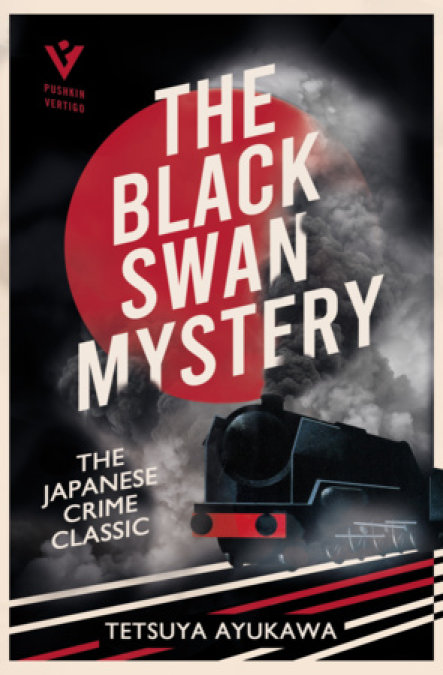
THE JAPANESE CRIME FICTION CLASSIC: A prize-winning railway murder mystery set in 1960s Japan—for fans of Agatha Christie and Seicho Matsumoto!
Full of devious twists and turns, this brilliant puzzle mystery is considered to be one of the greatest alibi deconstruction mysteries ever written
Early one morning, the owner of a local mill is found lying next to the railway tracks just outside of Kuki Station. Suspicion initially falls on the workers' union, with whom the man had been embroiled in a labour dispute, then on a new religious sect that has been gaining followers recently.
Chief Inspector Onitsura and his assistant Tanna are called in to investigate, and soon set off in a journey across Japan, from Tokyo to Kyoto and Osaka, and finally to the island of Kyūshu, in a hunt for the killer.
But as they investigate, the killer strikes again, and again. Will they be able to catch the murderer before even more people are slain?
Fans of Agatha Christie’s 4.50 from Paddington and Seicho Matsumoto’s Tokyo Express will delight in the devious twists and turns of The Black Swan Mystery, as well as in the characterisation and portrait of 1960s Japan.
The author, Tetsuya Ayukawa, is considered to be the master of alibi deconstruction mysteries–a talent that is on full display in this brilliant classic railway murder mystery, which won the prestigious Japanese Detective Writers Club Prize.
Release date:
June 3, 2025
Publisher:
Pushkin Vertigo
Print pages:
352
* BingeBooks earns revenue from qualifying purchases as an Amazon Associate as well as from other retail partners.
ONE A Bad Day 1. Atsuko and Fumie were strolling down an elegant, tree-lined avenue full of shops and boutiques, taking in all the window displays as they made their way towards Shimbashi. It was almost noon, and the late-spring sunlight set off the bright colours of their outfits—one Japanese, the other Western. Since mid-May, the duster coats that had been so popular had vanished entirely, and now, everywhere one looked in the Ginza, women were wearing early-summer dresses. Here, Atsuko’s lace blouse, which might have seemed a little racy in other parts of Tokyo, complemented her surroundings and showed off all the more eye-catchingly her chic, sporty style.
Before long, the two women stopped in front of a jeweller’s window and peered in at the display.
“What a lovely tiepin!”
On the little glass shelf where Fumie was pointing, there was a golden tiepin in the shape of a sabre. Atsuko took the remark as more of a comment than an invitation for her to share the opin- ion. Perhaps it just slipped out as Fumie pictured the accessory on her beloved husband’s chest. About ten days ago, he had gone to England to attend a textile convention in Lancashire, and, on the return journey, he’d be stopping off to inspect textile mills in various countries, so wasn’t expected to land back at Haneda Airport until sometime in September.
“It’s nice, isn’t it? It would really suit somebody slim and with a tan.”
As she said this, Atsuko in fact had no idea whether this slen- der, curving pin, which made her think of the body of a damselfly, would look better on a man with fair or dark skin: instead, she had merely described Fumie’s husband.
“You’ve such a good eye, Atsuko… Say, how about some lunch? My treat.”
As though having seen her friend’s empty stomach with X-ray vision, Fumie laughed giddily, and, as she did, a dimple appeared on her left cheek, while her lips parted to reveal a beautiful set of white teeth.
She glanced at her watch.
“Perfect timing! It’s almost noon. There’s an Italian restaurant just over there, around that corner.”
No sooner had the words passed Fumie’s lips than she took Atsuko by the arm and set off again down the avenue. Atsuko was a little envious of her companion’s decisiveness and her assertive nature, which seemed to manifest itself in even the most trivial of things, like this. And yet, this was only because she had no idea of the true purpose behind Fumie’s invitation to go with her to the Ginza that day. If she had known, Atsuko might have felt very differently indeed.
There was a Japanese curry restaurant on the third corner they came to, and, sure enough, next door to it was an Italian restaurant. Under a garish peach-and-green-striped awning there hung a signboard bearing the name: Posillipo. It was Atsuko’s first time there, but Fumie, with the air of a regular, headed straight upstairs and sat down next to a potted Chinese windmill palm. In contrast to the downstairs section, it was much quieter here, and the table that Fumie had chosen was in a spot far removed from the few other customers who were up there. In hindsight Atsuko realized that Fumie must have chosen it deliberately so that their conversation would not be overheard.
Remarkably enough for a restaurant in this up-market part of town, there was no music playing in Posillipo, and the only accompaniment to the meal was the tinkling of the fountains in two tiled ponds that stood in the middle of the floor. After walking in the early-summer sun, the sound of water was refreshing to hear, just like wiping away perspiration with a cool towel and applying a dash of eau de cologne. And although Fumie had chosen the restaurant partly on account of the delicious food and the cool sensation imparted by these fountains, what she really needed was a quiet place where she could talk freely.
“I’ve never had Italian food before,” Atsuko said, after casting a brief glance at a plump Italian-looking couple seated on the other side of the room.
“They do all kinds of things here,” Fumie said, handing her a menu, which was, incomprehensibly, written entirely in Italian.
“Oh, they’ve got something called macaroni Caruso! I think I’ll try that.”
Atsuko had seen this dish in a magazine somewhere and knew that it had been named after the immortal singer Enrico Caruso. But that was the sum of her Italian knowledge.
“I had that the first time I came here, too.”
Wearing a dazzling smile, Fumie summoned the waiter, who, with his white uniform, jet-black hair and tanned skin, looked every bit the Mediterranean type.
As they ate, the conversation turned to the earrings, necklaces and rings set with artificial gems that they had just been admiring in the shop windows. After all, some women do like to talk about jewellery, even if the price tag is beyond their reach, but, in the case of these two, they were in the fortunate position of being able to get their hands on anything their heart desired. In fact, it may well have been this topic of conversation that made the food in Posillipo taste even better than Atsuko expected, compensating so well for a lack of seasoning.
When a rich Neapolitan coffee was served after their meal, Fumie pressed the napkin to her rounded lips and flashed a mean- ingful smile at her companion.
“Now I don’t mean to pry, but are you seeing anybody at the moment?”
The suddenness of the question caught Atsuko off guard. Trying not to give anything away, she stirred her coffee impassively.
“No,” she replied. “Why do you ask?”
“Well, it’s just that there’s a little matter I’d like to discuss with you…”
“Oh?”
Without her even having to ask the question, Atsuko knew Fumie was trying to broach the subject of a marriage proposal.
“The thing is,” Fumie said, lowering her voice, “I know some- body who’s interested in marrying you…”
The most distinctive feature of Fumie’s face was her big eyes. Not only were they large, but they were deep and limpid. Atsuko was no poet, so she didn’t see, reflected in those eyes, a cold lake found deep in the mountains, but when she peered into their fathomless pupils, searching for a response, she had the uncanny feeling of gazing into Fumie’s soul, which made her unaccountably nervous. Although she tried not to let it show, she could feel her face blushing redder and redder.
“I’m sorry, I didn’t mean to take you by surprise.”
“That’s all right,” Atsuko replied off-handedly. She hadn’t the least interest in the identity of this possible suitor, but if she were to say nothing, there was a risk that Fumie might suspect some- thing. “Who might he be, this ‘somebody’?”
“Mr Haibara! Surely you know him? The director’s private secretary.”
Atsuko immediately pictured the man’s broad shoulders and stocky build. The name had come as a surprise to her, but, after the initial shock had passed, and the more she thought about it, it really wasn’t so peculiar that Haibara should want to marry her. They’d crossed paths several times—at the company’s garden party, at her dancing display, and so on—and, on each occasion, they had chatted to each other.
“Don’t you think you’d make the perfect couple? He’s kind, considerate… I’d have thought that any woman would consider herself lucky to marry a man like that.”
Fumie spoke with such enthusiasm, as though she were recom- mending her own flesh and blood.
In Atsuko’s eyes, however, Haibara did not seem quite so consider- ate. It was true that whenever they met, he was always pleasant and attentive, but she was sure that it was all an act, and that she could see through his motives for sidling up to her. After all, her father was the managing director of the same company. If Haibara were to marry the man’s daughter, his path to the top would certainly look much shorter. Surely, a man as shrewd as he could not have failed to recognize this. But Atsuko was no soft touch, nor was she foolish enough to let herself be made a stepping stone for an ambitious man.
Yet there was no way for Fumie to know what was going on in Atsuko’s mind, as she silently sipped her coffee.
“He’s awfully good at what he does, and the director loves him! He doesn’t really have any relatives to look after, and, as you know, he’s the reliable sort. There aren’t any rumours flying around about his love life, either. It’s hard work, you know, when they’ve got too many relatives; all that running around you’d have to do… You’d be worn out!”
Apparently believing this prospect of marriage to be truly a won- derful thing, Fumie kept trying to convince Atsuko. She was the wife of one of the company’s senior executive directors and, still child- less in her early thirties, seemed to have channelled this loneliness into the love lives of others. Three or four times already, she’d taken it upon herself to play matchmaker, resulting in the marriages of several young people within the company. On this occasion, since the proposal concerned a friend from her university days, it was perhaps only natural that she was being more solicitous than usual. Her good intentions were well known to Atsuko. She’d heard from her father that Haibara was already in the running for one of the top positions at the company, and he’d intimated how impressed he was with this “self-starter” of a man. Even her mother seemed to have a soft spot for him after everything that Atsuko’s father had said.
“I had thought about broaching it with your father, but then I decided it would be better to talk to you directly. There’s no need to make any decisions now, though. Talk it over with your parents and think about it. There’s no rush. After all, nothing can be done until the strike’s over.”
Fumie’s voice trailed off into what sounded like a sigh. They both of them had reasons enough to sigh. The trade union at the Towa Textiles Company was at loggerheads with the owners; a month ago, they’d published a four-point list of demands and called a strike. Since then, the situation had only worsened, with little sign of a breakthrough.
“I know,” said Fumie cheerily, trying brush off her black mood. “How would you like to go and see the roadshow release in Hibiya? If we leave now, we’ll make it just in time. I’ve been wanting to see that thriller for so long.”
With those words, she grabbed her crocodile-skin bag and got up.
We hope you are enjoying the book so far. To continue reading...

 Please log in to recommend or discuss...
