
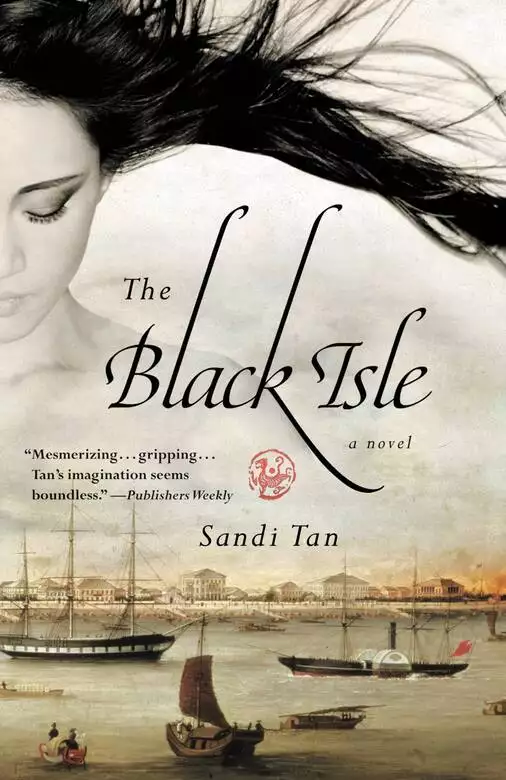
The Black Isle
- eBook
- Paperback
- Audiobook
- Hardcover
- Book info
- Sample
- Media
- Author updates
- Lists
Synopsis
There are ghosts on the Black Isle.
Ghosts that no one can see.
No one...except Cassandra.
Uprooted from Shanghai with her father and twin brother, young Cassandra finds the Black Isle's bustling, immigrant-filled seaport, swampy jungle, and grand rubber plantations a sharp contrast to the city of her childhood. And she soon makes another discovery: the Black Isle is swarming with ghosts.
Haunted and lonely, Cassandra at first tries to ignore her ability to see the restless apparitions that drift down the street and crouch in cold corners at school. Yet despite her struggles with these spirits, Cassandra comes to love her troubled new home. And soon, she attracts the notice of a dangerously charismatic man.
Even as she becomes a fearless young woman, the Isle's dark forces won't let her go. War is looming, and Cassandra wonders if her unique gift might be her beloved island's only chance for salvation . . .
Taking readers from the 1920s, through the Japanese occupation during WWII, to the Isle's radical transformation into a gleaming cosmopolitan city, THE BLACK ISLE is a sweeping epic--a deeply imagined, fiercely original tale from a vibrant new voice in fiction.
Release date: August 7, 2012
Publisher: Grand Central Publishing
Print pages: 480
* BingeBooks earns revenue from qualifying purchases as an Amazon Associate as well as from other retail partners.
Reader buzz
 Please log in to recommend or discuss...
Author updates
The Black Isle
Sandi Tan
Every Saturday, like a faithful grave-tender, I would go to visit a certain book at the Archive of Wartime Affairs. The book was part of my private curriculum—my research, if you will—not that I ever had to worry about secrecy. This being 2010, the Archive, perched atop a crumbling billiards parlor, is little known and even less loved.
This morning, however, my book is gone. It’s not in its usual hiding place, the dankest corner in War Crimes, wedged behind an encyclopedia on genocide that never sees any traffic. Reaching into the empty space, I feel the panic of a mother who arrives at the schoolyard only to find her child missing.
But my breath returns: Two librarians are pulling books from the shelves. Anything that is jaundiced with age or crippled of binding—no matter if it’s the Communist Manifesto or an introduction to hara-kiri—if it looks old, out it goes.
You may ask, Aren’t archives supposed to be forever? Well, forever’s a meaningless concept in Asia. Here, only the present is eternal.
I head over to the wheeled cart by the exit where they’ve quarantined the discards and begin sifting through volume after dusty volume. Miraculously, I spot the red jacket of the book in question, my book, its unwieldy title embossed in faded gilt down its spine: After the Ghost: Good Shepherds in the Post-Colonial World by the Flemish couple Lucas Van Kets and Marijke Jodogne, long out of print and impossible to obtain. I clutch the volume to my chest.
The younger librarian, a fashionable girl with raccoon eye makeup, clops by in her fur-lined boots. She stares at me, smiling. Loony old coot, she must think, haunting this pathetic place all the time.
Yes, it is strange that I should feel such intense attachment to a book that nobody else cares about. When it first came out in 1974, I wanted nothing to do with it. The work purported to be a survey of the so-called Third World following the eviction of the British, French, and Dutch, quick sketches in which the colonial masters came off badly, yet not so horrendously that anyone reading it in the West would feel too queasy. The final chapter included a brief interview with me, flabby with misquotations, alongside an unflattering snapshot of myself picking up bones at a cemetery. It was egregiously miscaptioned, “Native girl practicing witchcraft.”
When the authors perished in a boating accident a few years later, I began to forgive them their errors. For all its blunders, After the Ghost was the closest thing I would ever have to a record of my achievements, my failures, my life’s work.
I flip open the old hardcover and sniff its musty, reassuring scent. Then I race my dust-covered fingers to the closing section on the Black Isle.
But…what’s this?
My pages are missing, stolen—all of them—ripped out along the margins. And the photograph…
Black marker scrawls, a crazed spiderweb of them. Somebody’s given me the face of the devil.
Immediately I lose all bearings. My fingers grow limp and the book plummets to the ground. My head throbs. Things flash black, white, black, white, black, white.
I must have made a desperate sound because Raccoon returns, wearing a nettled frown. I point to the book, now lying on its spine, the amputated pages exposed for all the world to see.
“Who would do a thing like this?” I suck in my rage. “Why…?”
Shrugging like the impatient youth that she is, she plucks the book from the floor and plops it back onto the cart. “It’s falling apart, anyway.”
“Yes,” I say, “I suppose it is.” I give my book one last squeeze and leave.
On the way home, I pick up a few essentials at the mini-mart. When I emerge through its sliding doors, the air is sweet with the scent of blistering chestnuts. Above the squat gray buildings, the sky is perfectly clear—cloudless, nearly two-dimensional in its monotony—just as it was the day I moved here exactly twenty years ago to pursue my private studies.
Happy anniversary.
Cutting through the blue expanse are two dark specks, on opposite ends of the horizon, advancing in straight lines. Both are speeding toward some invisible meeting point. I stand mesmerized. Is this love or is this death? One of them will surely swerve. Surely.
They crash head-on with a muffled smack and plunge to the ground as one. A few feet from me, the shocking, liquid thud arrives almost before their bodies hit the pavement, a mess of black feathers with twin beaks: Crows.
This is not good. Not good at all.
In all my years in this city, I’ve never seen anything quite like this. Crows colliding. It’s hard not to think the missing pages have something to do with it, that they’ve untied some secret knot within the world.
My head’s on fire once more. I have to get home and lie down. My doctor says I…Damn what the doctor says. I take to the shortcut, as fast as my feet can manage. The alley’s never been a problem—it’s well lit and I know every chipped cobblestone and blind corner like the back of my hand.
But out of nowhere, brisk footsteps come running behind me. Before I can turn, something rams into my arm, sending my bags into the air. I look up and see a teenage girl jogging, headphones as swollen as donuts. She hasn’t even noticed.
I gather up my fallen things, the groceries of the insignificant old woman I’ve let myself become: loaf of bread, tub of margarine, ten bars of dark chocolate, two bags of prunes, and a carton of eggs—broken. These I abandon to the rats.
“Are you okay?” someone yells from an open window. At least that’s what I think she’s saying.
“I’m all right,” I lie. “I’m all right.”
Slam, lock, bolt, chain. Home at last.
I strip off my clothes and run the hot water till the bathroom mirror is fogged. This is the only way I can bear to look at myself these days.
These dried mangoes hanging from my chest? They used to be breasts. My legs? Sexless, hobbling candlesticks. As for the gray skin flapping from my arms, it would be generous to call them bat wings. Then again, I can’t complain. I shouldn’t even be alive, technically speaking.
I soak in the bath, replaying the day’s uncanny sights. Were they omens? Or am I turning into a nervous old ninny?
The second I step out of the bath, the telephone rings. A rare occurrence, now that circumstances have robbed me of every friend and acquaintance. So I let it ring. And ring. And ring.
After the tenth ring, my answering machine clicks on. I hear the voice of a woman with an unplaceable accent: South African? Dutch? Or perhaps she taught herself English watching The Sound of Music. She says she’s a professor, surname Maddin, Christian name Mary, then adds, a bit too casually, “I’m an admirer.”
I shudder.
“You don’t need me to tell you that you were a legend in some circles. And when you disappeared…well, that only added to your mystique.” The voice pauses. “I’ve wanted to chat with you for quite a while. But of course I’ve had to track you down, which wasn’t easy, and then find the nerve to call, which was in many ways even more difficult.”
There is something in her approach that makes me uneasy. Too ingratiating. And the timing of the call…I pick up the receiver and tell her to go to hell.
“My, is this really you?” She sounds amused.
“How did you get my number?”
“That’s confidential, I’m afraid.”
Wrong answer. “I’m going to hang up now.”
“Would it be better if I just showed up at your door?”
“Don’t you threaten me!”
She sighs, as if I’m the one who’s making trouble. “All I’m asking is that you talk to me. It concerns your life.”
“My life?”
“Just hear me out, please. I’m writing a book about superstition in twentieth-century Asia, or rather, the impact modernization has had on indigenous belief systems in that part of the world.”
“Biting off more than you can chew.”
“No doubt.” She chuckles vacantly to humor me. “But here’s the thing. When I was starting my research, I occasionally came across mentions of you. Good things and bad, depending on who was doing the writing, but mostly unkind.”
Is she baiting me? “All right, just to be clear, I don’t give interviews. Be sure to relay that to your fellow historians.”
“Actually, madame, most of them think you’re already dead.”
To my astonishment, that wounds me. “Well, maybe I am.”
“But I never once believed that, not for a second. People like you live forever.” A pregnant pause. “And so I tracked you down.”
“How?” I keep an unlisted number and mind my own business. I’d deliberately dropped off the map years ago. Centuries, it feels like.
“Your very presence is defined by your absence.”
“Enough with the riddles.”
“I’ve been doing research on three continents, at all the best libraries. You began appearing in several pretty arcane articles between 1972 and 1999, usually as a footnote, always described as a ‘shadowy, behind-the-scenes figure.’ That got me intrigued—of course I had to know more. Over the next year, I managed to locate a handful of sources pertaining to you, but believe it or not, each time I went to one, all I’d find was a black hole. Literally. Library after library, book after book, line after line. On all three continents. Whenever I turned to any page that mentioned your name, the passage would be completely crossed out—with black ink. And if the section was long, entire pages would be torn out. And I’m talking about rare historical records kept in libraries with the highest levels of clearance.” She takes a breath. “Somebody—and this person or persons must really be obsessed—has been cutting you out of history.”
I swallow. “Cutting me out of history?”
“Everywhere. Even online. As far as the Internet is concerned, you don’t exist.” She lowers her voice. “Every place I looked over the past year, you’d disappeared. So I deduced, if you were actually dead, why would anyone bother with this erasure?”
I have long accepted that no trace of me exists in the official histories of Asia—that’s been my life’s great bargain. But am I really now disappearing from unofficial accounts as well?
“Look, we really should talk. Face-to-face. And we must hurry. The night is closing in.”
A warning, is it? “Who are you? Who sent you?”
“The real question is, who are you?”
“Tell me how you found me, Miss Maddin.”
“Not over the phone…You of all people should understand.” Her voice grows silkier, more conspiratorial. “Please. Let me in. I know I’m the only one who can—”
I hang up.
And instantly regret it. She’s the only one who can what? I wait for the phone to ring again. If she’s as persistent as she says, surely she’ll try again. I wait. And wait. And wait.
I sit by the phone the rest of the evening, keeping Schumann’s “Scenes from Childhood” low on the turntable so I won’t somehow miss her call. It never comes; only a dead knot tightening in my gut.
First the mutilated book, then colliding crows, now this. All in the same day.
Signs. If my life has taught me anything, it is not to disregard signs. And there’s something weird about her use of the phrase the night is closing in. What academic speaks like that? This is no professor.
If my brother were here, he’d tell me this feeling of doom was merely indigestion, paranoia resulting from cognac on an empty stomach, followed by half a bar of chocolate. My doctor would scold me for eating the wrong things, saying I’d only hasten my coronary tsunami. But they would both be wrong. Naïve and wrong. Something black and toxic is moving closer and closer to me. I can almost smell its sour edges, feel its burning miasma reaching for my throat, my heart, my soul. It’s death, then, my brother might say. Well, perhaps. But I’ve stared death in the eye for years, and never once had I felt the kind of nausea now churning through me. No, this is something more destructive than death. I sense evil. A devouring mouth of ill will that isn’t about to let me off with a quick and happy end.
I’ve made many enemies over the years, among both the living and the dead, so reprisals should come as no surprise. Yet they do. Anger, jealousy, regret—I am no freer of these emotions than anyone else, but for the first time in perhaps twenty years, I feel fear. Fear has finally returned to claim me, a woman nearing ninety, a shadow of her former self who, if that strange woman is to be believed, is vanishing even from history itself.
I have worried for decades about this moment—this reckoning—and the time, it seems, is about to come.
The doorbell goes off at 2:37 in the morning. Is it her?
I swipe the cleaver from the side of my bed and hobble to the door. But through the peephole, nobody. At least, no one I can see.
As I back away from the door, the neighbors’ dogs begin baying with a morbid fearfulness that chills me to the marrow. I can’t tell which is worse—the basso woofs of the hound next door or the Pomeranians at the end of the hall squealing like children being strangled in their beds.
I turn off every lamp and light the red candle—a memento from long ago, untouched for years. Whenever it burned fast, I knew something was wrong. It’s racing tonight. The flame chases the wick down to nothingness in five minutes flat. Normally this is the work of four hours. I sprinkle bone ash across the doorway, another rite from another time, and utter a chant I inherited many moons ago from a former friend now long gone.
Finally, I sit in my rocking chair, knife perched across the knee.
Sometime in the night, my eyes close. When they open again, there is a flurry in the air. The distinctive cold, prickly draught I know only too well.
Sure enough, in the dark, my eyes make out an uninvited guest. His hair is white, his shirt and pants headstone gray.
The sight of him, after all these years, in this city, makes me tremble. This is the man I owed everything to. But why here? Why now? I cannot think of what to say, except, “What do you want?”
As he’d done countless times before, he fixes his sunken, rheumy eyes on me. His lips flex to reveal a mouth with small, jagged teeth. Still human, but only barely.
“You’re one of us now,” he hisses, his voice thin, dry, snakelike.
I recognize the presumption of his claim. This is no invitation to join a club.
Before I can curse him, he vanishes, taking with him half the heat in the room and all the air in my lungs. My struggle to breathe only proves he’s wrong. I’m not one of them. I’m still alive.
Nine a.m., I grab the phone before the first ring ends. “Yes?”
The professor jumps in immediately, as if our conversation hadn’t been interrupted. “I want your story. I need it.”
Goose bumps scurry across my arms.
“In exchange, I’ll give you what you’ve been searching for.”
My heart almost stops. “I’m not searching for anything.”
“You’re hunting,” she says. “That’s what you do.”
“Miss Maddin.” I pause to steady myself. “Why are you so interested in my story?”
She thinks for a few seconds. “I’ve always had this need, you know, to dig beneath the surface of things. To uncover and protect the truth, I suppose, in places people never think to look. And to right wrongs.”
To right wrongs? Would she do that for me? “Where are you?” I ask.
“Ah,” she says, with the care of one who knows too well the world’s dangers. “Not far.”
Darkness is closing in. “You better hurry.”
The professor says she’ll give me what I’ve been searching for. Could she? I mean, how could she even know? Unless…And the ghost…
I take a tranquilizer and potter around—Nutella sandwich, undies in the wash, warm milk and prunes, my heart all the while going pit-pat-pit-pat. I try to revive myself with a nap. No luck. Before long, it is night again.
I pull open the bedroom curtains and gaze out. Lights dot the surrounding high-rises. Children, perhaps, talking to strangers on their computers. Confessing their sins. That the young keep vigil while their parents sleep—there’s poetry there, I suppose, although night is never really night here, not in the romantic sense anyway. The sky is an orange luminescence, the by-product of six thousand tower blocks and the metropolis that spreads itself yonder, the glimmering grids of one endless electric paddy field.
Darkness has long been extinguished in this part of the world. Some call it a compromise, others a blessing. There are millions of us, living in exactly the same apartments, under our shared tangerine sky. For years, I felt that this anonymity was the best fortress I could ask for.
But anonymity is not the same as annihilation. One is about the present, the other is about the past, and the two should never be confused.
You’re one of us now.
No! I’m still alive.
It is inevitable that my past should return. I’m an old-fashioned woman with an Old Testament faith in symmetry. What goes up must come down. Every action has an equal and opposite reaction. Life for life, eye for eye, tooth for tooth.
The Professor and the Ghost. One telling me I’m disappearing, the other saying I’m already on the other side. Two faces of the same terrible coin.
The Professor…is it possible she could be my salvation? Will telling her my story save me from becoming one of them?
I must do it. It’s my best hope.
I root in the petticoat drawer for the voice recorder—a present to myself after watching a dreary Canadian film about Alzheimer’s that nevertheless made me quake—and slot in fresh batteries and tape. I trust the permanence of tape. They let words live on long after the air has died. My story shall survive. To prepare, I give my throat an antiseptic gargle: to ward off the rot of mendacity.
In the mirror, my blue teeth smile back at me.
Permit me to cast the first stones.
All my life, people have tried to erase me, in big ways and small, publicly and privately, thoughtlessly and with supreme, awe-inspiring malevolence. All my life.
But I refuse to let them win. They will not wipe me out.
I will not become a ghost.
1
THEY CALLED ME LING. Names don’t come much more forgettable than that. And my story didn’t begin on the day of my birth, August 3, 1922. I was just a wailing blob that day, and thus no different from all other blobs in history that were pulled screaming from their mothers’ loins and then subjected to the universal rigmarole of walking and talking, eating and sleeping. I was told that I mastered those skills more quickly than most, so eager was I to win my parents’ affection as well as some invisible contest against time that only I knew about. But again, this precocity was far from a defining character trait. I was a young child. And babies are in general uninteresting people.
My real story began in the summer of 1929, on my seventh birthday. Or, more correctly, our birthday. I was older than my brother, Li, by four or five minutes, a race I won, I always believed, by being closer to the gate and not by the heartless bullying of my weaker twin as the midwife insisted. (Chinese midwives! Always rooting against girls!) I was undeniably a stronger baby than Li—I cried louder, kicked harder, weighed more—but I plead my case that in the womb, there was no pushing and shoving or malicious piggery. Of course, when Li emerged emaciated, his wail barely a whimper—and a boy, no less!—everyone listened to the midwife. They all blamed me.
As soon as we were born, my parents tried to counter the injustice. What happened in Mother’s belly was out of their purview, but so long as Li and I lived in their house, under their care, they would make it up to him. They always gave him whatever he wanted; he always got the first pick. From the moment the midwife washed the blood off her hands and wobbled down the stairs, it no longer mattered that I was the eldest. The roles were cast: Li was the hero. I was the sidekick.
By the time of our seventh birthday, Li had grown into a vigorous boy, a natural leader, taller than me by two inches. He led and I followed. He became my protector and benefactor. If he was offered a cream puff, he would ask for two so he could give me one. Soon I no longer had to fight or choose or pine. I got used to coming in second and began to prefer being his shadow—there was never any pressure to be original or brave. One should never underestimate the joy of being underestimated.
In looks, Li was nothing special, just your generic little prewar, middle-class Chinese boy in flannel shirts and corduroy shorts, always smiling, always smelling faintly of chalk. I had my hair in two pigtails and wore pinafores made of flannel and corduroy, surplus fabric from the construction of Li’s shirts and shorts. Neither of us had any distinctive features or battle scars; no stranger passing us on the street would stop to cry out in glee or in horror. We might as well have been invisible, as far as the wider world was concerned, two children drowned in an endless sea of black hair and narrow eyes. But to me, Li was the handsomest boy in all of China.
His things filled our house: model cars, dancing bears, books about planes and warships, many ordered from America. “What will I get for my birthday?” he’d ask, months before the actual day. “Anything,” was Mother’s invariable answer. “Anything your heart desires.”
This never became an issue until the day of our seventh birthday. I always took whatever they gave me, be it pencil case, scarf, or slippers, so I was never a problem. And until then, Li’s taste was conventional—our parents held boats, planes, and trains on reserve at the toy shop until he made up his mind—but for our seventh, he kept his request secret until the big day. I saw him go over to Mother and whisper in her ear.
“No,” Mother said definitively, and stormed up the stairs.
There were two ways of looking at Shanghai in those days. It was either the Pearl of the Orient or the Devil’s Den. There was no in-between; you belonged to one camp or the other. Our mother evidently belonged to the latter. She had been raised in a cloistered Suzhou compound by spinster maids who taught her to fear and loathe the outside world. Her fear was so great that it rendered the binding of her feet unnecessary—there was no risk she’d run off anywhere.
Shanghai only heightened her nervousness. None of the hedonistic thrills of big-city living for her. She was happiest in her dark little rooms, where she could pore over opulent catalogs, oversee the help, and fret in peace. Indeed, her unnatural pallor that came from staying indoors was considered quite fashionable. But there was a price to her agoraphobia. The feral love affair Li and I had with sunlight and nature caused her great anguish. It only proved to her that she had been inadequate in her job. What provident mother had children who needed to leave her house to seek fun?
That’s why she felt profoundly wounded when Li, for his seventh birthday, whispered these simple words: “Take us to the park.” She doubtless felt he was attacking her weakness with a son’s malice. Her “no” resounded through the house, the louder for being the only time he’d been denied.
Our home on Rue Bourgeat was everything that a good middle-class town house should look like, at least on the outside. It was in the French Concession, which telegraphed that we belonged in the happy bourgeois world of cosmopolitan Shanghai, and it had the requisite white walls, which proved that we could afford to hire painters to undo the darkening effects of the region’s inclemency. We even had a waist-high wrought-iron gate in the Kensington Gardens style, an ornamental barrier between our front step and the toothless kumquat and lychee vendors who traversed the dusty pavement. We cherished our borders. To the outside world, we were solidly, stolidly middle class. Within our walls, however, we were less complacent, a young family fraying at the edges as our financial situation grew grimmer and grimmer by the week.
In spite of our straitened circumstances, my parents retained domestics—two amahs, Sister Kwan and Sister Choon; a cook; and a part-time errand boy. I should also include the rickshaw coolie duo who served us exclusively on weekdays. Nothing would have gotten done if we hadn’t had help, for Mother wouldn’t leave the house and Father, a dreamy idealist, had so little interest in the physical world that he could barely remember the name of our street, let alone the location of the butcher’s or the spice shop.
As a practical concession, we leased out the servants’ quarters, and this little room was piled from floor to ceiling with low-quality women’s sandals (and their persistent tang of cheap tannin), overstock from Mr. Wang’s footwear emporium on nearby Avenue Joffre. Their space thus usurped, our servants slept anywhere they could come nighttime, on lumpy blankets by the dying embers of the kitchen brazier or crouched under the crook of the stairs, knees tucked beneath their chins to fend off the plague. Mother assured me that to the people of the lower classes, this was still rather luxurious. Most of Shanghai, she said, lived in rat-infested shantytowns on the banks of the muck-filled Suzhou Creek or were packed like sardines inside crowded junks where only the luckiest got to lie on straw mats.
We slept on the second floor. My parents had their own room, large enough to accommodate, aside from their featherbed, a brass chamber pot and a folding screen hand-painted with a hundred cranes in midflight. I know it was meant to be a picture of serenity, but it always filled me with panic to gaze at the screen—the cranes looked as if they were fleeing some sort of catastrophe, perhaps an earthquake or a prodigiously good shot. The elder two children, Li and myself, shared a small, nondescript room adjacent to our parents’, and our infant sisters, Xiaowen and Bao-Bao—strangely enough, also twins—slept in the hallway on a cot that had once belonged to a consumptive great-aunt. Nobody wanted to say that she died in that rickety thing, but the stains on the mattress seemed to me brutal evidence.
Hanging on the wall above the twins’ cot was an oil portrait of our parents on their wedding day, as wide as a broadsheet and nestled in a gilded frame. They were outfitted in the latest Western styles—he in a suit with a cravat, strangely dashing in his quiet way, and she in white lace, looking waxier than usual, as if she had been carved out of a huge candle and then dredged through powders and rouge. Her mind seemed to be elsewhere and her lips were crooked with a kind of half smile. An unhelpful aunt must have told her this was the proper way to pose. This image of Mother I found disturbing. Her eyes followed me whenever I crossed the hall, accusing eyes that seemed to know even before I did that I would someday disappoint.
Unlike her mother, who’d been a celebrated Suzhou beauty in a city famed for its beauties, Mother’s charms weren’t self-evident. There was a bit of the tadpole about her—bulging eyes, weak chin—and to disguise the fact, she spent hours arranging and rearranging her hair and face before every lunch or cocktail invitation. Much to the puzzlement of new friends and the exasperation of old ones, she nearly always decided at the very last minute that she couldn’t leave the house and would forgo the meetings. Friendships suffered, and so did her confidence.
Over the years, her fear and poor self-image had worked so well in tandem, each reinforcing the other’s sinister hold, that they completely crippled her social life. She turned her attentions by sad default to the running of the household, becoming a quarrelsome matron who rose at six and dressed for nonexistent balls, all for the purpose of ordering the help around. From the way she screamed at the amahs and steamed around the house, I sensed that her quirks frustrated her deeply. Her great concern was that our neighbors would never think of her as anything but well put together and of us as anything but angelic and that they’d never suspect the awful truth that we were, alas, a struggling little ragtag troupe headed by a pseudo-intellectual whose station in life as a schoolteacher meant that we’d never in a thousand years be rich.
Father plodded through his role as paterfamilias. I remember him as having a perpetually pursed mouth, his thin lips pressed firmly together lest the fried fish roiling in his gut came leaping out. The idea of family made him queasy in general, the reality of it even more so. He’d wring his hands like a woman whenever the twins started bawling; then he’d either go out for a long walk or put on a record—opera in German usually, a language he didn’t understand and therefore felt unburdened by. Looking back, I don’t think poor Father was ever prepared for the size of our household—not just the aggrieved, high-maintenance wife but also additional headaches in the form of four children and a rotating roster of resentful servants. This was a storklike gent who preferred to be left alone and might have been best suited to the life of a medieval scholar-prince, emerging from his pavilion once in a blue moon to stretch his skinny legs, stroke his beard, and sip Huangshan Mao Fen
We hope you are enjoying the book so far. To continue reading...
