'Fantastic! A must read for fans of Philip Kerr' STEVE CAVANAGH
'An excellent historical series' VASEEM KHAN
THE BRAND NEW NOVEL IN THE AWARD-WINNING OCCUPATION SERIES
In the city of light, some deals are only made in the shadows.
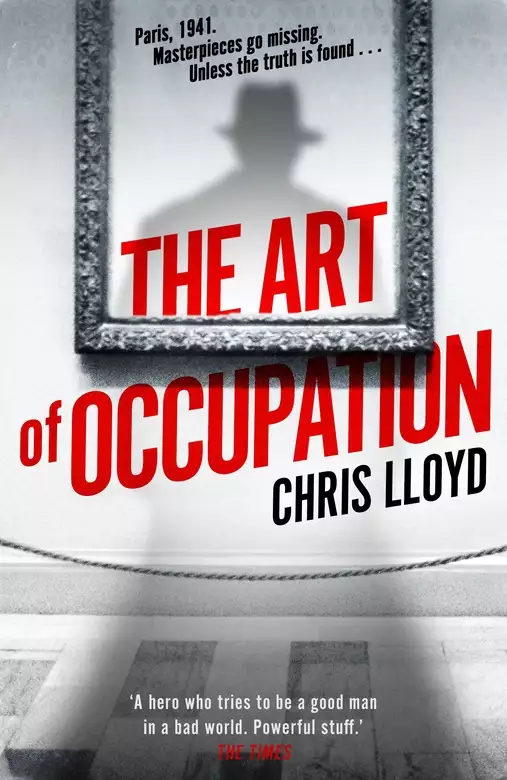
When a corrupt art dealer is killed, Detective Eddie Giral descends into an underground world of stolen paintings, forged identities, and whispered deals with Nazi Occupiers.
As Eddie discovers links to a wealthy Jewish family's missing collection, the trail leads him to Paris's Jeu de Paume, where looted masterpieces have vanished - and where guarded curator Rose Valland gives nothing away.
But in Eddie's efforts to win her trust he forgets - can he trust her?
With Parisians turning against their neighbours to survive, and the different factions of the city's Occupiers entangling Eddie in their power struggles, the answers he needs lie in the museum's most secretive collection...
*****
PRAISE FOR CHRIS LLOYD'S OCCUPATION SERIES:
'Ranks alongside Alan Furst and Philip Kerr ... Powerful stuff' SUNDAY TIMES
'A thoughtful, haunting thriller' MICK HERRON
'Such a powerful and morally nuanced crime novel. Both a gripping murder mystery and a vivid recreation of Paris under German Occupation' ANDREW TAYLOR
'It's up there with luminaries such as Philip Kerr, Sebastian Faulks and Manda Scott - in fact, it's probably better than all of those' DAVID YOUNG
'A haunting and eye-opening portrayal of life under occupation' ADELE PARKS
'Lloyd does a masterly job of conjuring a hungry, defeated Paris. Eddie is a convincing protagonist; a flawed man trying his best to be a good one' THE TIMES
Release date:
May 14, 2026
Publisher:
Orion
Print pages:
368
* BingeBooks earns revenue from qualifying purchases as an Amazon Associate as well as from other retail partners.
‘A tense and gripping mystery which hums with menace and dark humour as well as immersing the reader in the life of occupied Paris.’
HWA Gold Crown Award
‘Terrific … chillingly evokes the horror of living under a brutal occupation.’
Sunday Times, Best Books of the Month
‘A brilliant, breathtaking tour de force … It’s up there with luminaries such as Philip Kerr, Sebastian Faulks and Manda Scott – in fact, it’s probably better than all of those.’
David Young
‘Lloyd’s Second World War Paris is rougher than Alan Furst’s, and Eddie Giral, his French detective, is way edgier than Philip Kerr’s Bernie Gunther … Ranks alongside both for its convincingly cloying atmosphere of a city subjugated to a foreign power, a plot that reaches across war-torn Europe and into the rifts in the Nazi factions, and a hero who tries to be a good man in a bad world. Powerful stuff.’
The Times
‘A thoughtful, haunting thriller.’
Mick Herron
‘A page-turning, morally complex thriller.’
Sunday Times, Best Historical Fiction Books of 2023
‘Excellent … In Eddie Giral, Lloyd has created a character reminiscent of Philip Kerr’s Bernie Gunther, oozing with attitude and a conflicted morality that powers a complex, polished plot. Historical crime at its finest.’
Vaseem Khan
‘Such a powerful and morally nuanced crime novel … Both a gripping murder mystery and a vivid recreation of Paris under German Occupation.’
Andrew Taylor
‘The best kind of crime novel: gripping, thought-provoking and moving. In Detective Eddie Giral, Chris Lloyd has created a flawed hero not just for occupied Paris, but for our own times,too.’
Katherine Stansfield
‘A terrific read – put me in mind of Alan Furst and Philip Kerr … Gripping and well-paced. The period atmosphere is excellent.’
Mark Ellis
‘Monumentally impressive … I’m blown away. A truly wonderful book. If somebody’d given it to me and told me it was the latest Robert Harris, I wouldn’t have been surprised. Eddie Giral is a wonderful creation.’
Alis Hawkins
‘Top quality historical crime fiction’
S.G. Maclean
‘A feast of a book … The portrayal of wartime Paris is unsurpassed’
Douglas Jackson
‘Fantastic! A must read for fans of Philip Kerr’
Steve Cavanagh
It was the ghost of a car. A spectral shimmer of steel and glass on the edge of my vision. One that stirred a memory in me. I turned to find it, but it eluded me. The dust settling in its wake on the dry cobbles of Rue de Rivoli was all that told me it had to be real. Although with all the people shuffling this way and that in silence, I doubted even that.
‘Surprised to see you here, Eddie.’
Unsettled, I barely avoided walking into a couple strolling and turned to look at the speaker. Short as a rationed baguette and twice as thin, he stared intently at me out of glasses so thick and cumbersome, he looked like he’d fashioned them out of two wine bottles and an iron pipe. Either way, they’d be stolen.
‘Not nearly as surprised as I am to see you,’ I told him.
He looked around conspiratorially, squinting through the lenses. ‘Working under cover?’
‘Who’s to say.’
‘Shh.’ The man in the couple I’d just sidestepped turned to glare at me before shushing a second time. Two more couples joined in hissing at me and slithered out of sight of my own viperous look back at them.
I turned but the man who’d spoken to me was gone, caught up in the flow of people walking under the arches and along the stones of what was once one of the city’s busiest roads. Half past three on a Sunday afternoon and you could walk unfettered along the Rue de Rivoli. The only motorised vehicles you had to keep an eye out for were the German military trucks that occasionally drove by, honking their horns and revving their engines to intimidate anyone making their way to Place des Pyramides. Any other vehicles were bikes, their riders rattling their bones along the uneven surface, although there were barely any in sight. Not today. Not between three o’clock and four o’clock.
I passed a poster on a column between the arches, its edges ragged where passers-by had surreptitiously torn and ripped at it. It’d only been there since the first of May, just ten days ago, but it was fading and crumpled. Just like its hero. May the first was Saint Philip’s Day, so Vichy had inevitably turned it into the Marshall’s Day, splashing Pétain’s insignia of seven stars on the poster alongside a blue baton and an anvil. As designs went, it was up there with the swastikas hanging high and low on all our once-elegant buildings. At this rate, they’d be canonising Pétain before supper. I supposed that all depended on how this day turned out.
The eleventh of May 1941, less than a year after the city had come under occupation, and Pétain’s bunch of hangers-on in Vichy had decided to commemorate Joan of Arc Day. The good Marshall had invoked Joan at Verdun, so our puppet government was desperately trying to jump on the bandwagon one more time by declaring her a symbol of national unity, which somehow meant working with the German occupier. She was also a mark of hatred of the English, so they reckoned they had that going for them too.
The one problem from their point of view was that General de Gaulle’s Free French lot in London had had the same idea. Only for them our Joan was a symbol of resistance. The leader of an army that had come together to drive out the invader. De Gaulle himself had put out a broadcast on the BBC calling for us all to take to the streets for this one hour. So here we were.
As I walked, two men in smart suits let their glance linger on me a moment longer than usual. Three women a short distance behind them did the same. I returned the look. Not because I knew them or it was some strange courtship ritual but because that’s what the General had asked us to do. Not to riot or rise up, but to walk gently in silence, exchanging eye contact with everyone we passed. To express shared hopes. I gazed back at my fellow strollers but I saw little optimism in any of the eyes I met. More powerful than any hope was the silence, and even that was broken by a German lorry driving past, forcing pedestrians onto the pavement, its horn blaring. A man in a couple made to shout something, but the woman tugged on his arm to quieten him in time. He consoled himself with a fist shaking impotently at his side. A second German truck went past, keeping up the attempt to break the spell and drive people away.
Despite the apparent randomness of the strolling, we were all headed for Place des Pyramides, where the bronze statue of Joan of Arc sat astride her horse. I was suddenly struck by the curious sight we made. The Occupiers had banned any marches or flags, so we were a theatre of people acting badly at walking naturally, casually marching while pretending we weren’t, towards a statue that meant two different things to two different camps.
I carried on regardless, aware I was about the only person to be walking alone among couples and groups of three or four. I couldn’t decide if that was through choice or circumstance. Unlike me, the French police were out in force, trying to channel people away from the statue and into the Jardin des Tuileries. As usual, the Germans had put our cops at the forefront of controlling the crowd, the visible face of repression. Sadly, some of them were doing it only too willingly. In contrast to the silence of the walkers, the noise from the police had been steadily growing. Shouts and commands, the thump of boots on cobbles, batons hitting gloved hands. Almost imperceptibly, the looks on people’s faces turned from fading hope to growing concern.
I’d tried to hide myself away in the centre of the throng to avoid being seen. Most of the cops were uniformed officers from local stations in the arrondissements on the Right Bank, but I’d seen some I recognised from Thirty-Six, the central station on Quai des Orfèvres, where my office in the criminal investigation department was. I had no idea how they’d react if they saw me, and I didn’t want to find out.
Sensing rather than seeing someone staring at me, I turned slowly, expecting to see another cop, perhaps acting as an agent provocateur or maybe just checking who was taking part. I gasped. Also alone, Dominique had stopped and was looking at me. I couldn’t make out any expression on her face, and then realised that my own must have been as impassive as hers. Lingering a moment longer, she turned away and moved on, lost in the crowd. I looked after her but she was gone.
My steps were leaden after the encounter. I hadn’t seen Dominique since telling her with a break in my voice some four months ago that she should leave my flat. It had been too dangerous for us to be together. I was a cop, she was Senegalese. Who knew what Nazi and Vichy laws we’d been breaking and how the Germans I was forced to work with would have used it against me. And then my ex-wife had threatened to denounce us and I knew there was only one thing I could do. Only I hadn’t told Dominique at the time that that was the reason and now it was too late.
A whisper rode past me on a wave. A voice quietly swelled through the crowd that the cops were several ranks deep around the tomb of the unknown soldier at the Arc de Triomphe. Another German lorry went past, too close to the walkers on the edge of the road. Its side flaps had been raised, and the grey-clad soldiers, their faces emotionless, were there for us all to see. I watched a ripple of anxiety as the recent hushed rumour turned into a slowly breaking white horse of fear.
The cops moved closer, guiding people away from Place des Pyramides with increasing force, first with directions, then with their hands, and finally with their batons, prodding the slowest walkers on the chest and shoulders, shouting at anyone who showed dissent. A man swatted a police arm away and he was surrounded by three cops, who roughly manhandled him out of the relative safety of the marchers into an awaiting paddy wagon. A voice in the crowd shouted ‘Collaborators’ at them. The sting of the insult hung in the air.
Out of the corner of my eye, I saw a baton lash out and a middle-aged man crumpled to the ground, blood seeping through the sparse grey curls of his hair. A neighbouring man threw a punch at a policeman and the crowd opened up, its members scattering as the cops took it as their cue to start dishing out the day’s frustration. Another voice shouted, ‘Vive la France,’ and the cry was taken up by those furthest from the gloved hands and swinging sticks. As the walkers dispersed in panic under the police onslaught, I was suddenly laid bare, with no cover from my fellow protestors surrounding me.
Alarmed, I looked around for an escape. On the corner of every street leading off from the gardens and square, the German lorries had retired to a distance, their engines revving, the soldiers in the rear silently watching. In front of them, the French police who weren’t laying into the crowd were checking the ways in and out of the streets. Thankfully, there were far too many entrances and exits for them to patrol efficiently, and I saw a few of the protestors already running into the various side streets. Many more were running straight into the Tuileries, but I could see from where I was the mistake they were making. All along, the French cops had been trying to channel the walkers into the gardens, and I could see police vans lined up ready to receive anyone arrested. I searched for Dominique in the crowd, but it would have been impossible to find her.
I’d already made it to the statue by now. Instinctively, I turned away from the Tuileries and broke into a run to get quickly past a group of police waiting under the arches at the entrance to Rue des Pyramides. The cops were catching de Gaulle’s protestors like fish in a barrel, but there were too many of us for them to get us all. Taking advantage of the mass of bodies, I dodged behind a couple being pulled to one side by two uniformed officers and weaved between the arches and the cobbled street to get out without being caught. I heard a cop shout what sounded like my name and I put a spurt on.
Zigzagging, I saw a throng frantically diving into the main entrance of St Roch church. Another institution that had rejected me long ago. I returned the favour and took the narrow lane to the side of the building, forgoing religion one more time when I came to the vestry door. Others didn’t. I watched a second panicked crowd scrabbling up the small flight of steps to the narrow double doors and I kept on running. The way I saw it, sanctuary would mean little to the police – and to the German soldiers, some of whom I could see were now joining in the chase – and the protesters would be trapped inside with no escape.
I tried to put as many streets between me and the Rue de Rivoli as I could, but I could still hear the sound of police shouting. Crossing Avenue de l’Opéra, I had to double-back along Rue Thérèse to dodge a German lorry roaring up the road. It was going too fast to bother turning to come after me, but I could hear others in the streets surrounding me.
Pausing for breath, I could feel my forty-odd years catching up with me almost as quickly as the French police and German army seemed to be doing. Hearing more shouting and van doors slamming, I ran up Rue Chabanais, my pace slower now. An odd change in the texture of the noise stopped me in my tracks as I turned to look back. A German lorry had turned into the narrow road, the sound of its engine echoing along the high buildings and seeming to engulf me. I could hear the driver change gear to pick up speed.
Emerging from the street onto the Square Louvois, I saw a police car to my left, slowly cruising in my direction. The engine tone changed as the cops spotted me. I hoped I was too far away for them to recognise me. Pinning my ears back, I cut across the small square, past the fountain of rivers and found myself on the Rue de Richelieu with nowhere to hide.
Gasping for breath, I looked around. The one street that offered a way out would have been a mistake. It was long and narrow, and either the car or the lorry would have caught up with me before I could make it to the end. The two engine noises grew louder, overwhelming the sound of blood pounding in my ears.
An ancient wooden door on Rue de Richelieu opened a fraction.
‘This way, Eddie,’ a voice called to me. ‘Over here.’
Without a backward glance, I raced for the tiny gap and hurled myself through the door. It closed behind me with a quiet click.
‘So you weren’t under cover.’
I held my finger to my lips and listened to the sounds from the street outside. One of the vehicles passed in front of the building, but it didn’t stop. I waited, but no more sounds came. Breathing out, I looked at my rescuer.
‘Jonas,’ I said.
It was the man who’d spoken to me on the Rue de Rivoli what seemed an age ago. His magnified eyes blinked at me through the bull’s-eye glasses like an owl in a fishbowl.
‘Well, under cover or not?’
I shrugged and looked at my surroundings, ignoring his question. Instead, I led him away from the door he’d opened for me and crossed the courtyard into my favourite part of the building. Originally Cardinal Mazarin’s humble abode, it had been turned into the King’s Library in the early eighteenth century, and had been a library ever since. Just not the king’s any more. I breathed in the scent of the Bibliothèque Nationale. The library would normally be open today, but the authorities had decided to keep it closed in case there was any trouble.
He opened another door and I took ten paces inside to let the splendour flood over me. The Salle Ovale. Floor-to-ceiling wonder, from galleys of desks and lamps, up through galleries of shelves to the crowning glory of the glass ceiling, casting a light that was mostly lacking in the world right now. The room had only opened four years earlier and it already seemed an aeon ago.
I recalled the crowd struggling to get into the church, and thought that the library offered greater sanctuary, the books lining the walls greater protection against the outside world. I used to come here fairly often before the Germans had invited themselves over, and I’d forgotten the sense of safety it had always given me. I closed my eyes simply so I could open them again to see the sight anew once more.
I sensed Jonas join me.
‘All these fucking books,’ he commented.
‘Quite.’
I lowered my gaze and watched him disappear through the door we’d come in.
‘You sit there,’ he told me. ‘I’ll find us some refreshment.’
‘Refreshment?’ Ten minutes ago, I was running like a lost cause.
Enjoying the solitude, the first time I’d ever found myself alone in this room, I watched the pattern of sunlight refracted through the ceiling and the shadows cast on the books lining the walls. The scent of books pervaded the room, leaving trails of leather and vanilla swirling in the air. I let the feel of the sides of the oval envelop me. Building blocks of books in limitless hues and sizes towered all around me, upwards to the edges of the glass ceiling, reaching for the light and gently bathed in it. Almost reluctantly, I closed my eyes again to savour their aroma, to imagine the words held in this one magical place.
‘Shift your arse, Eddie.’
Jonas returned before I was ready. I opened my eyes to see him carrying a small tray with two cups on it. Tendrils of steam curled up, leaving a gentle wake behind him as he walked towards a desk. My nose told me the coffee was the real thing.
‘Might be the Bibliothèque Nationale,’ he said, ‘but there’s no need for café national.’
Café national. The false patriotic name that Vichy had given to the coffee substitute using acorns and chicory to try and fool us into thinking we were doing the right thing by drinking the wrong thing.
‘How come you’ve got a key to this place?’ I asked him.
He sat down and rocked his head from side to side.
‘Key is perhaps a strong word,’ he finally said. ‘More like the means of access.’
‘You nicked a key.’
‘I made one. I’m a craftsman, Eddie, you know that.’
‘You’re a forger, Jonas. A very good one, but a forger.’
He squinted at me. The effect through the thick lenses was like being examined by an earnest lemur. ‘Paintings. That’s my art. I’ve got the touch. I couldn’t care less about books.’
‘So why have you made a key for the library? You don’t know your Balzac from your Cocteau.’
‘I know that a first-edition Balzac is worth more than a first-edition Cocteau. Bang in a fake signature and it’ll keep me in whores for a year.’
‘I do love these literary discussions.’ I looked around again. ‘Is it my imagination or are there fewer books on the shelves?’
‘I’m not a common thief, you know. I told you, I’m an artisan, a skilled labourer. You’re right, though. There are fewer books. The library hid a whole heap of them before the Schleuhs got here. They carted them off somewhere to stop the Germans from taking the really valuable stuff.’
I thought of his use of the word ‘Schleuh’. Most people had stopped using Boches to describe the German invader. It had suddenly sounded too innocent for what we were seeing around us. So Schleuh had become one of the favoured alternatives, and even that already seemed dated.
‘They’re all valuable, Jonas. Rich pickings, I’d say.’
‘There you go again. Accusing me. I’m a fucking artisan.’
I couldn’t help a wry smile. ‘So why does your being here make me think you’re up to something?’
‘You’re a cop. You can’t help yourself. I just like coming to the library.’
That earned a full-blown laugh. ‘What is it I need to be keeping an eye out for, Jonas? What aren’t you telling me?’
‘Nothing, Eddie. I’m an open book.’ He seemed to brighten up as a thought occurred to him. ‘Why don’t you take some of these? You love books. No one’s going to know.’
I looked with longing at the books stacked high all around me. Finally I shook my head. ‘That’s not what libraries are for, Jonas. I’d know. And I’ll know if you’ve taken any.’
He snorted. ‘Books are small fry. I’m going where the money is. I’m branching out.’
‘Talking of which, I thought you were supposed to be going to Berlin to work.’
Earlier in the year, some five hundred workers a week were going to Germany to find work because of the mass unemployment at home.
‘The Schleuhs sent me back. They reckoned I couldn’t do the job. They sent a whole load of us back.’
‘So they didn’t need anything nicking then? Or faking?’
Jonas took another look around the shelves. ‘Nah. I reckon they’ve mastered that one for themselves.’
‘I’ve been talking to Jonas Valois. He’s been sent back from Berlin.’
‘Why is this relevant?’
‘Because you asked me what I’d been doing.’
Commissioner Dax stared at me a moment longer. His eyes looked sharp through the horn-rimmed glasses embedded on his thin nose. ‘Why do your explanations always leave me feeling I know less than I already did, Eddie?’
‘Because we live in an age of propaganda and false hope.’
He snorted and sat back heavily in his chair behind his desk. I was seated opposite him. His hand hovered over the drawer he kept his illicit whisky in, but came back empty-handed. No ill-gotten treats for me today. I glanced out of the window at the Monday morning sky. The sun had barely risen over the raggle-taggle skyline of buildings the other side of the river. I still hadn’t got used to the time change the Germans had imposed on us almost a year ago now. One of the first things they’d done when they’d entered the city was put Paris time one hour ahead to be in line with Berlin time, and the murky start to the working day and the later, lighter evenings simply felt like a daily reminder of just how much darkness had engulfed us since.
We were in Dax’s office at Thirty-Six, our name for the police headquarters on the edge of the Île de la Cité in the middle of the Seine. It was another magic-filled moment at the dawn of yet one more day caught between the distrust of the people of the city and the grey souls of the Occupiers, trying to see some sense in being police detectives in a world turned on its head. But that’s just me being optimistic.
‘Anything of importance to tell me?’ Dax asked, his gaze lingering longingly on his whisky drawer. Not as longing as mine.
‘He was in the Bibliothèque Nationale. Jonas Valois. A forger, one of the best we’ve got. But usually of paintings. I can’t help wondering what he’s cooking up. Or got himself involved in.’
‘Sent back from Berlin, you said. Could he be doing something for the Boches?’
The thought had occurred to me, but it didn’t seem right. ‘You never know with Jonas. He said something I found odd. That he was branching out. He has never branched out for as long as I’ve known him.’
‘Keep an eye out. When was this? And what were you doing in the national library?’
‘Yesterday afternoon. I told you. Talking to Jonas Valois.’
He gave me a hard stare, but knew better than to waste his time pursuing it. ‘Did you see anything of the protests by Place des Pyramides?’
It was my turn to stare back, searching for anything hidden in Dax’s eyes. They were blank behind the glass. ‘Caught a glimpse. Heard something of it going on outside the library.’
‘Didn’t occur to you to check it out?’
‘I reckoned the uniforms and our eager friends would have it all sorted out between them.’
‘Forty-two arrests,’ Dax told me. ‘At a silent protest.’
He gestured to a newspaper on his desk. France-Soir, which had steadfastly reminded its readers before yesterday’s event that Joan of Arc had thrown the English out of France. I didn’t dirty my fingers. Despite using the day for Vichy’s ends, much of the press spoke wildly of Pétain and many of the Vichy ministers being dangerously pro-British and secretly working with de Gaulle’s Free French in London.
‘You don’t think the good Marshall is working with de Gaulle, do you?’ I asked Dax.
Oddly optimistic, Dax was one of the few who still used the word ‘Boches’ and thought that Pétain was keeping some master plan to save France up his sleeve.
He snorted, surprising me. ‘Of course not. But I do think he’s working against the Germans, just in a different way from de Gaulle.’ He glanced at his closed door and kept his voice low. I listened rapt to his hopes. ‘He’s doing everything he can behind the scenes to protect us, his people, and to keep the Nazis at bay.’
‘Really?’
‘You mark my words, Eddie. Pétain will be the one to revive France’s fortunes.’
I made to leave, but he signalled I should stay seated. I wished he’d turn to the whisky drawer, not the fantasy one, and revive my fortunes.
‘There’s something else you need to know,’ he told me. A change had come over his voice. We both knew I wasn’t going to like what he had to say. ‘In two days’ time there’s going to be a round-up. Foreign Jews.’
I clenched my fists by my side and unclenched them slowly. ‘Why have the Germans told us?’
‘Because we’re going to be the ones doing the rounding up.’
I exhaled slowly. ‘Our police pushed to the front to take the blame as always.’ My jaw ached with my anger.
‘Just men. Not women or children.’
‘And that makes it all right?’
‘You know it doesn’t, Eddie, but what are we to do?’ He paused a moment. ‘You and Boniface are to be there.’
‘What? No. We’re criminal investigation. If the Germans aren’t going to do their own dirty work, it has to be uniforms doing it.’
‘Who’s pushing our police to the front now? I want you there to keep an eye on what’s happening.’
‘You know this is wrong.’
‘We both know. But there’s something else. Major Hochstetter wants you there.’
I looked in dumbfounded defeat at Dax. ‘Hochstetter?’
‘Hochstetter.’
‘Vichy have already rounded up near on forty thousand foreign Jews in the zone Nono,’ Mayer whispered to me as inconspicuously as he could.
I looked around us as I leaned over his shoulder behind his desk. I’d descended a floor from my office to the second floor, which was a warren of poky rooms filled with cops working on files. The maze of doors and half-glass walls gave us some privacy. Persistent and intelligent, Mayer was a uniformed cop who usually worked in the evidence room. He was appreciably brighter than most of the stars in the detective firmament, but had never shown any desire to move over, despite my wishing he would.
‘Ever since the Schleuhs made us set up a Jewish service for them within the police, they’ve had us compiling lists of French and non-French Jews in the zone O,’ he continued. ‘People and businesses.’
A decree at the end of last year had officially named us the zone occupée, while the unoccupied zone in the southern half of the country was the zone non occupée, replacing the misnamed zone libre. Everyone had immediately called them the zone O and the zone Nono.
I hid a sigh. ‘Who knows what they’re planning on doing with that.’
‘I think the round-up on Wednesday goes some way to answering that.’ We both went silent for a moment when another uniformed cop walked past with a towering pile of folders in his arms. ‘So far, we’ve told them of sixty-five thousand Jewish households in the Paris area and some two hundred thousand people. And three quarters of those aren’t French.’
We stared at each other for a moment, trying to imagine the implications. At the end of a corridor I saw another of our detectives, Lafitte, with someone I didn’t recognise. A fist-happy rampager from one of the tougher parts of Paris, Lafitte was exactly one of the many reasons I wished Mayer was a detective. The other man was one of those people who looked like they always wore boxing gloves to dress themselves in the morning. He was burly and strongly built, but his jacket hung off him like a tattered flag on a windless day. His trousers were crumpled around his boots and baggy where they flooded like a dirty river from underneath his jacket. The only problem was that the clothes he’d struggled to put on that morning was a uniform as grey as a Sunday under Occupation. On his head was an equally grey peaked cap with a thick black band, in the middle of which a skull stared out constantly over the left shoulder of whoever was unlucky enough to be facing it.
‘Who’s the guy with Lafitte?’ I asked Mayer.
He chose his moment to reply. ‘Gestapo. Here to make sure we’re not skimping on the task they’ve set us.’
‘Thoughtful of them. I see Lafitte’s found his milieu.’ I surreptitiously studied the man in the uniform, and Lafitte wagging his tail as he followed too close to his shoulder. ‘Gestapo? In uniform? You sure?’
‘Take a look at his left sleeve. The SD badge has white piping around it. That tells you he’s Gestapo.’
‘Why’s he in uniform? I’ve not seen that before.’
Mayer gave the slightest of shrugs. ‘Who knows why they do anything?’
I watched the German surreptitiously. The Gestapo and the SD. The Sicherheitsdienst. Sibling organisation to the Gestapo within the Reich Security Main Office. Where the self-professed elite SD gathered the information, the o
We hope you are enjoying the book so far. To continue reading...

 Please log in to recommend or discuss...
