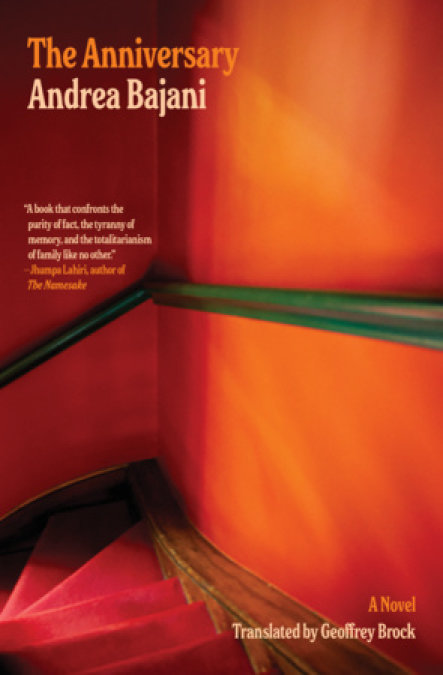
“A book that confronts the purity of fact, the tyranny of memory, and the totalitarianism of family like no other.” —Jhumpa Lahiri
A subtle yet heartrending portrait of an abusive marriage in patriarchal Italy and a son’s liberating decision to cut contact with his parents.
Can you leave your family behind? Can you slam the door, walk down the stairs, and decide never to see them again? Can you ever escape the grip of your origins?
A son asks himself these questions as he celebrates a bittersweet anniversary: a decade since he saw his parents. Now he finally feels able to tell their story. This is his eloquent account of a family devastated by a father’s violence and the woman who silently accepts him; of an airless relationship, unsettled only by the ringing of a telephone, a visiting classmate, or a friend soon pushed away. And it is the story of a son possessed by the irrepressible desire to be free: to be himself, to live his own life, to open up to others without fear of reprisals.
Release date:
August 25, 2026
Publisher:
Other Press
Print pages:
144
* BingeBooks earns revenue from qualifying purchases as an Amazon Associate as well as from other retail partners.
The last time I saw my mother, she walked me to the door to say goodbye. Then, before closing it again, she waited until I disappeared down the funnel of the stairwell. My mother was never one for parting phrases, mainly because she was overwhelmed by a form of timidity that verged on self-erasure. Which, in practice, made any kind of performance impossible for her: considering herself such a marginal figure, she couldn’t take center stage, even briefly. For that same reason, I believe, she didn’t think she had the right to proclaim the beginning or end of anything. Whenever I visited them, she would be standing behind my father both when the door first opened and later, when it closed and swallowed them inside. Yet on that day it was she who said goodbye to me last, alone on her side of the threshold, at the top of the stairs. It was more than a farewell: she somehow followed me. With the perspective of the intervening years, I’m inclined to say she was unable to let me go. In any case, as I made my retreat, covering each step with a smoke screen of words, she advanced at a similar pace. Seen through the lens of writing, the scene resembles a dance: a man takes a step back and a woman a matching step forward, the son takes another step, the mother another, until the exit is gained. The last words I heard my mother utter were not a statement but a question. Which, again, stood in sharp contrast to her usual attitude of acceptance, of submission rather than demand, of being accountable to others rather than asking anything of them. “Will you come see us again?” she asked, advancing toward me as I slipped away. I think she looked me in the eyes, but that’s more a guess than a blurry memory, since I didn’t meet her gaze. Her question was completely out of place; there was no reason to ask it. Every two weeks or so, I drove the seventy kilometers from Turin to spend a few hours with my parents, usually for lunch. After the meal, after the coffee, I’d get back in my car and drive home. I’d been doing this a long time, since leaving home at twenty under the traditional pretext of college. By the time of her question, I was forty-one. Which means that for twenty-one years I had been visiting them with a regularity that could only seem routine. So there was no reason to doubt that, after that day, the routine would repeat again and again, forever. What’s more, I was a son and they were the people who had given me life – a situation that ought to have banished all doubt. I would add that not only was the question patently out of place given the circumstances, it was one I had never before asked myself, one that had never even occurred to me to consider. “Will you visit us again?” she asked. No answer to that question was ever given. The “Of course” that I left behind on the landing was uttered only so that something would happen, so that my mother would release her grip and I could slip away down the stairs. It wasn’t a reply for the simple reason that the question itself, posed by a mother to a son, was one that couldn’t be asked. Yet my mother had asked it, out of instinct. After so many years of receding, of not existing for either herself or her children, of cleaning and serving and obeying her husband at home and in bed, of performing the little or nothing my father expected or demanded of her, she concluded with a motherly act: she sensed what had already taken place within her son, without his knowing it yet. On that day, ten years ago, I saw my parents for the last time. Since then I’ve changed phone numbers, houses, continents, I’ve erected an impregnable wall and put an ocean between us. They’ve been the best ten years of my life.
We hope you are enjoying the book so far. To continue reading...

 Please log in to recommend or discuss...
