
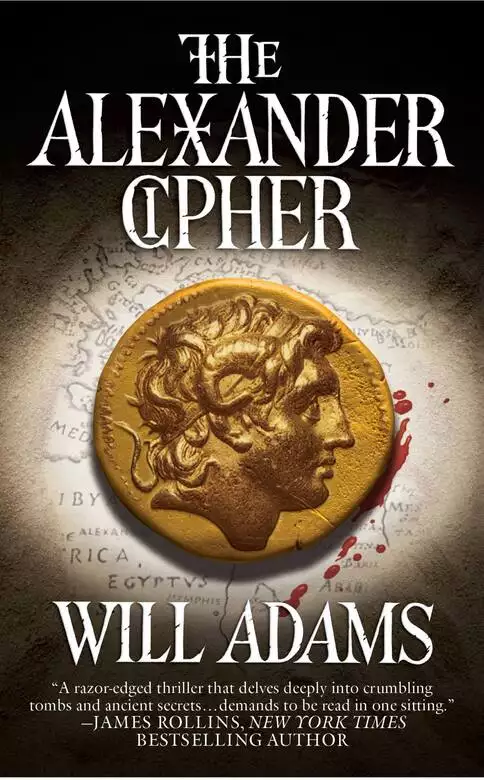
The Alexander Cipher
- eBook
- Audiobook
- Book info
- Sample
- Media
- Author updates
- Lists
Synopsis
Egyptologist Daniel Knox's lifelong fascination with Alexander the Great and his tomb, a fabled wonder of the ancient world, could be the death of him. After construction workers excavating in Alexandria expose a catacomb dating back to ancient times, Knox eagerly sneaks in to scout the cavernous and dusty site. Among the relics he finds clues that may solve one of the world's greatest mysteries: the last resting place of Alexander the Great.
An unconquerable warrior king, Alexander was the single most powerful man on the planet and thought to be a god. Now, nearly 2,500 years later, the discovery of his tomb, seemingly lost forever, is within reach, triggering a deadly hunt for one of the greatest treasures of all time. Knox is not the only seeker; others are after the prize, and they would kill to win it.
In the spirit of the great adventure-thrillers by Douglas Preston and Lincoln Child, Clive Cussler, Raymond Khoury, and Steve Berry, The Alexander Cipher is a rip-roaring ride through history, archaeology, and the great deserts of Egypt.
Release date: March 18, 2009
Publisher: Grand Central Publishing
Print pages: 336
* BingeBooks earns revenue from qualifying purchases as an Amazon Associate as well as from other retail partners.
Reader buzz
 Please log in to recommend or discuss...
Author updates
The Alexander Cipher
Will Adams
THERE WAS A FRESHWATER SPRING at the lowest point of the cave, like a single black nail at the tip of a twisted, charred, and mutilated leg. A thick layer
of lichen and other scum clotted its surface, barely disturbed in centuries except to ripple and shiver at the touch of one
of the insects that lived upon it, or to dimple with bubbles of gas belched from deep beneath the floor of the surrounding
desert.
Suddenly, the skin burst and the head and shoulders of a man erupted from the water. His face was turned upward, and instantly
he gasped huge heaves of air through his flared nostrils and gaping mouth, as though he’d been underwater beyond the limit
of his endurance.
There was no light at all in the cave, not even a phosphorescence of water, and the man’s relief at surviving his underwater
flight quickly turned to distress. Had he merely exchanged one mode of death for another? He felt around the edge of the pool
until he found a low ledge. He heaved himself up, twisted around to sit on it. Almost as an afterthought, he reached beneath
his soaking tunic for his dagger, but in truth, there was little danger of pursuit. He’d had to fight and kick his way through
every inch of that watery escape. He’d like to see that fat, sword-wielding Libyan try to follow; for sure, he’d cork in the
passage, and it wouldn’t spit him out till he’d lost some flesh.
Something whirred past his cheek. He cried out in terror and threw up his hands. The echo was curiously slow and deep for
what he’d imagined to be a small cave. Something else flapped past him. It sounded like a bird, but no bird could navigate
in such darkness. Perhaps a bat. He’d certainly seen colonies of them at dusk, swarming the distant orchards like midges.
His hopes rose; if these were the same bats, there had to be a way out of here. After surveying the rock walls with his hands,
he began to climb the gentlest one.
He wasn’t an athletic man, and the ascent was nightmarish in the dark, but at least the rough walls offered good holds. Each
time he reached a dead end, he simply retreated and found another route. Hours passed, and more hours. He grew hungry and
tired, but he didn’t allow himself to give up, and finally he reached a precarious ledge high above the cavern floor, just
wide enough for him to kneel. He crawled forward and upward, the rock face to his left, nothing at all to his right, only
too aware that a single mistake would plunge him to certain death. The knowledge didn’t impede him but rather sharpened his
concentration.
The ledge closed around him so that it felt as if he were crawling inside the belly of a stone serpent. Soon the darkness
wasn’t so complete as it had been, and then he emerged shockingly into the setting sun, so dazzling after his long blindness
that he had to throw up a forearm to protect his eyes. The setting sun! A day at least had passed since Ptolemy’s ambush.
He inched closer to the lip, looked down at nothing but a sheer cliff face and certain death. He looked up instead—still steep,
but manageable. The sun would soon be gone, so he began to climb at once, looking neither down nor up, contenting himself
with progress rather than haste. The last glow of daylight faded as he reached an overhanging brow. He steeled himself and
committed to it, hauling himself up with his fingernails and palms and elbows, scrabbling frantically with his knees and feet,
scraping his skin raw on the rough sandstone, until finally he made it over and rolled onto his back, staring thankfully up
at the night sky.
Kelonymus had never claimed to be brave. He was a man of healing and learning, not war. Yet he still felt the silent reproach
of his comrades. “Together in life, together in death” had always been their vow. When Ptolemy had finally trapped them, the
others had all taken without qualm the distillation of cherry laurel leaves that Kelonymus had concocted for them, lest torture
loosen their tongues. Yet he himself had balked, swept by the terrible fear of losing the wonderful gift of life—the sight,
the smell, the touch, the taste, the glorious ability of thought. Never again to see the high hills of home, the lush banks
of its rivers, the forests of pine and silver fir! Never again to listen at the feet of the wise men in the marketplace. Never
to have his mother’s arms around him, or tease his sister, or play with his two nephews! So he had only pretended to take
his poison. And then, as the others died around him, he’d fled into the caves.
The hilltop he’d reached was sheer only on one side, and the descent was simple enough with the moon to light his way. But
as he made his way down, he began to realize just how alone he was. His former comrades had been shield bearers in Alexander’s
army, dauntless lords of the earth. No place had felt safer than in their company. But he was no soldier himself; he was here
only because his beloved brother Akylos, the man Kelonymus looked up to above all others in the world, had summoned him from
Macedonia to help with this single task. And now that he had lost his brother and his comrades, he felt weak and fragile,
adrift in a land of strange gods and incomprehensible tongues. He walked down the slope, faster and faster, the fear of Pan
welling in him until he broke into a headlong run, only to stumble in a rut and fall hard onto the compacted sand.
He had a growing sense of dread as he pushed himself up, though at first he wasn’t sure why. But then shapes began to take
form in the darkness around him. When he realized what they were, he began to wail. He came to the first pair of crucifixes,
where he found his comrade Bilip on one, the same Bilip who had carried him when his own strength failed him outside Areg;
and opposite him, Iatrocles, a kindly man with a never-ending supply of wondrous tales of distant lands. Cleomenes and Herakles
were next, their shins and wrists nailed to the crudely cut wood with fat iron spikes, splinters of bone showing through the
bloodied skin. No matter that they had already been dead—crucifixion was the Macedonian punishment for criminals and traitors,
and Ptolemy had evidently wanted it known that that was what he considered these men. Yet it wasn’t these men who had betrayed
Alexander’s dying request regarding his burial. It wasn’t these men who had put personal ambition above the wishes of their
king. No. These men had merely sought to do what Ptolemy himself should have done: build Alexander a tomb in sight of the
place of his father.
He looked down the avenue of crosses ahead. Something about their symmetry caught his eye. They were in pairs. All the way
along, they were in pairs. Yet their party had been himself and thirty-three others. An odd number. How could they all be
in pairs unless someone else had gotten away? Hope fluttered weakly. He began to hurry down the horrific corridor of death.
Old comrades on either side, yes—but not his brother. Twenty-four crosses, and none his brother’s. Twenty-six. He prayed silently
to the gods, his hopes rising all the time. Twenty-eight. Thirty. Thirty-two, and none his brother, and no more crosses! He
felt an exquisite euphoria, but it lasted only a moment. Like a knife plunged between his ribs, he realized the diabolical
plan that Ptolemy had hatched, why he had taken Akylos’s body away with him. He cried out in anguish and rage, and he fell
to his knees on the sand.
When his anger finally cooled, Kelonymus was a different man, a man of purpose. Fixed and certain. He had betrayed his oath
to these men once already, but he wouldn’t betray it again. Together in life, together in death. Yes. He owed them that much, whatever it took.
The Ras Mohammed Reefs, Sinai, Egypt
DANIEL KNOX was dozing happily on the bow of the dive boat when the girl came to stand with deliberate provocation, blocking the afternoon
sun. He opened his eyes and looked up a little warily, because Max had made it clear that she was Hassan al-Assyuti’s for
the day, and Hassan had a proud and thoroughly warranted reputation for violence, especially against anyone who dared tread
on his turf. “Yes?” Knox asked.
“So are you really a Bedouin?” she gushed. “I mean that guy Max said like you were a Bedouin, but I mean you don’t look it.
I mean, don’t get me wrong, you kind of look it, I mean your complexion and your hair and eyebrows, but—”
It was no surprise she’d caught Hassan’s eye, thought Knox, as she rambled on. He was a sucker for young blondes, and this
one had a charming smile and startling turquoise eyes, as well as an attractive complexion, with its smattering of pale freckles
and pinkish hints of acne, and a slender figure perfectly showcased by her lime-green and lemon-yellow bikini. “My father’s
mother was Bedouin,” he said to help her out of her labyrinth. “That’s all.”
“Wow! A Bedouin gran!” She took this as an invitation to sit. “What was she like?”
Knox pushed himself up onto an elbow, squinting from the sunlight. “She died before I was born.”
“Oh, I’m sorry.” A damp blond lock fell onto her cheek. She swept her hair back with both hands, holding it there in a makeshift
ponytail so that her chest jutted out at him. “Were you brought up here, then? In the desert?”
He looked around. They were on the deck of Max Strati’s dive boat, tethered to a fixed mooring way out in the Red Sea. “Desert?”
he asked.
“Tch!” She slapped him playfully on the chest. “You know what I mean!”
“I’m American,” he said.
“I like your tattoo.” She traced a fingertip over the blue-and-gold sixteen-pointed star on his right biceps. “What is it?”
“The Star of Vergina,” answered Knox. “A symbol of the Argeads.”
“The who?”
“The old royal family of Macedonia.”
“What? You mean like Alexander the Great?”
“Very good.”
She wrinkled her nose. “You a fan, then? I always heard he was just a drunken brute.”
“Then you heard wrong.”
She smiled, pleased to be put down. “Go on, then. Tell me.”
Knox frowned. Where did you even start with a man like Alexander? “He was besieging this town called Multan,” he told her.
“This was towards the end of his campaigns. His men were fed up with fighting; they just wanted to go home. But Alexander
wasn’t having that. He was first up the battlements. The defenders pushed away all the assault ladders except his, stranding
him up there alone. Any normal man would have leaped for safety, right? You know what Alexander did?”
“What?”
“He jumped down inside the walls. All on his own. It was the one sure way to make his men come after him. And they did, too. They tore the citadel
apart to save him, and they only just got to him in time. The wounds he took that day probably contributed to his eventual
death, but they added to his legend, too. He used to boast that he carried scars on every part of his body—except his back.”
She laughed. “He sounds like a psycho.”
“Different times,” said Knox. “You know, when he captured the mother of the Persian emperor, he put her under his personal
protection. After he died, she was so upset, she starved herself to death—not when her own son died, mind, but when Alexander
died. You don’t do that for a psychopath.”
“Huh,” she said. It was clear that she’d had enough talk of Alexander. She rose onto her knees, placed her left palm flat
on the deck on the far side of Knox, then reached across him for the red-and-white icebox. She threw off its lid and tested
each of the bottles and cans inside for coldness, taking her time, her breasts swinging free within her dangling bikini-top
as she did so, the nipples pink as rose petals. Knox’s mouth felt a little dry suddenly—knowing you were being worked didn’t
make it ineffective. But it reminded him forcibly of Hassan, too, so he scowled and looked away. She sat back down with a
thump, an open bottle in her hand, a mischievous smile on her lips. “Want some?” she asked.
“No, thanks.”
She shrugged and took a swallow. “So have you known Hassan long?”
“No.”
“But you’re a friend of his, right?”
“I’m on the payroll, love. That’s all.”
“But he’s kosher, right?”
“That’s hardly the smartest way to describe a Muslim.”
“You know what I mean.”
Knox shrugged. It was too late for her to be getting cold feet. Hassan had picked her up in a nightclub, not a Sunday school.
If she didn’t fancy him, she should have said no, simple as that. There was naive and there was stupid. It wasn’t as though
she didn’t know what she was doing with her body.
At that moment, Max Strati appeared around the line of cabins. He walked briskly over. “What happens here, then?” he asked
frostily. He had come to Sharm el-Sheikh on vacation twenty years ago and had never gone home. Egypt had been good to Max,
and he wouldn’t risk that by pissing off Hassan.
“Just talking,” said Knox.
“On your own time, please, not mine,” said Max. “Mr. al-Assyuti wishes his guests to have a final dive.”
Knox pushed himself up. “I’ll get things ready.”
The girl jumped up, too, clapping with false enthusiasm. “Great! I didn’t think we’d be going down again.”
“You will not join us, I think, Fiona,” Max told her flatly. “We have not enough tanks. You’ll stay here with Mr. al-Assyuti.”
“Oh.” She looked suddenly scared, childlike. She put her hand tentatively on Knox’s forearm. He shook her off and walked angrily
toward the stern, where the wet suits, fins, masks, and snorkels were stored in plastic crates next to the steel rack of air
tanks. A swift glance confirmed what Knox already knew: there were plenty of full tanks. He felt a sudden tightness in the
nape of his neck. He could feel Max’s eyes burning into his back, so he forced himself not to look around. The girl wasn’t
his problem, and she was old enough to look after herself. He had no connection to her, no obligation. He had worked his balls
off to establish himself in this town, and he wasn’t going to throw that away just because some brat had misjudged the price
of her lunch. Of course, his self-justifications did little good. He felt sick in the pit of his stomach as he squatted down
by the crates and started checking equipment.
The MAF Nile Delta excavation, Northern Egypt
“HELLO!” CALLED OUT GAILLE BONNARD. “Is there anyone here?”
She listened patiently for an answer, but none came. How odd. Kristos had been clear that Elena, who needed her help translating
an ostracon, would be waiting for her in the magazine, where they stored and documented all their finds. But there was no
sign of her or her truck, and the magazine was closed. Gaille felt a rare flicker of irritation. She didn’t mind making the
fifteen-minute walk from the cemetery site, but she did mind having her time wasted. Then she noticed that the door of the
hut was hanging ajar—something she had never seen before. She knocked, pulled it open and looked within, allowing in a little
sunlight. The interior walls were lined with shelves stacked with battery lamps, hammers, mattocks, baskets, rope, and other
archaeological equipment. There was a dark square hole in the floor, too, from which protruded the top of a wooden ladder.
She crouched, cupped her hands around her mouth, and called down, but there was no answer. She waited a few seconds, then
called down again. Still hearing nothing, she stood with her hands on her hips, brooded. Elena Koloktronis, head of this Macedonian
Archaeological Foundation excavation, was one of those leaders who believed all her team incompetent and who therefore tried
to do everything herself. She was constantly running off in the middle of one task to see to another. Maybe that was what
had happened here. Or maybe there had just been a mix-up with the message. The trouble was, with Elena it was impossible to
do the right thing. If you went looking for her, you should have stayed where you were. If you stayed, she was furious that
you hadn’t come looking.
Gaille crouched again, her hams and calves aching from her long day’s work, and called down a third time, feeling just a tremor
of alarm. What if Elena had fallen? She turned on a battery lamp, but the shaft was deep and the beam was lost in its darkness.
She had a sudden vision of Elena lying unconscious at the foot, her neck twisted, in urgent need of medical attention.
Gaille had little head for heights, so she took a deep breath as she put her hand on the ladder, reached one foot tentatively
onto the top rung, then the other. When she felt secure, she began a cautious descent. The ladder creaked, as did the ropes
that bound it to the wall. The shaft was deeper than she had imagined, perhaps six meters. You couldn’t normally go down so
far in the delta without reaching the water table, but the site was on the crown of a hill, safe from the annual inundation
of the Nile—one reason it had been occupied in ancient times. She called out again. Still silence, except for her own breathing,
magnified by her narrow confines. Displaced earth trickled past. Curiosity began to get a hold of her. She had heard whispers
about this place, of course, though none of her colleagues dared speak openly about it.
She reached the bottom at last, her feet crunching on shards of basalt, granite, and quartzite, as though old monuments and
statues had been smashed into smithereens and dumped. There was no sign of Elena, but a narrow passage led away to the left.
She called out again, more quietly this time, half hoping there would be no answer, so that she would have the opportunity
to explore a little. Her lamp started flickering and stuttering, then went out altogether, so she tapped it against the wall
and it sprang back on. The stone chips under her feet crackled as she advanced. There was a painting on the left wall, its
colors remarkably bright. It had evidently been cleaned, perhaps even retouched. A profiled humanoid figure dressed as a soldier
but with the head and mane of a gray wolf was holding a mace in his left hand and, in his right, a military standard, its
base planted between his feet, a scarlet flag unfurling beside his right shoulder in front of a turquoise sky.
Ancient Egyptian gods weren’t Gaille’s specialty, but she knew enough to recognize Wepwawet, a wolf god who had eventually
merged with others into Anubis, the jackal. He had been seen primarily as an army scout and had often been depicted on shedsheds—Egyptian military standards such as the one he was holding here. His name had meant “Opener of the Ways,” which was why the
miniaturized robot designed to explore the mysterious air shafts of the Great Pyramids had been christened with a version
of his name, Upuaut. He had gone out of fashion during the Middle Kingdom, around 1600 BC, so this painting should be over
three and a half thousand years old. Yet the shedshed that Wepwawet was holding told a different story. For a handsome young
man was depicted on it, his face tilted up like that of some renaissance Madonna. It was hard to know for sure when you were
looking at a portrait of Alexander the Great, since his impact on iconography had been so profound that for centuries afterward
people had aspired to look like him. But if this wasn’t Alexander himself, it was unquestionably influenced by him, which
meant it couldn’t possibly date to earlier than 332 BC. And that begged an obvious question: What on earth was he doing on
a standard held by Wepwawet, over a millennium after Wepwawet had faded from view?
She set this conundrum aside and continued on her way, still murmuring Elena’s name, though only as an excuse should she suddenly
encounter anyone. Her battery lamp went out again, plunging the place into complete blackness, and again she tapped it on
the wall until it sprang on once more. She passed another painting—identical to the first, as far as she could tell, though
it was not yet fully cleaned. The walls began to show signs of charring, as though a great fire had once raged here. She glimpsed
a flash of white marble ahead, and two stone wolves lying prone yet alert. More wolves. She frowned. When the Macedonians
had taken Egypt, they gave many of the towns Greek names for administrative purposes, often basing the names on local cult
gods. If Wepwawet was the cult god of this place, then surely this must be—
“Gaille! Gaille!” From far behind her, Elena was shouting. “Are you down there? Gaille!”
Gaille hurried back along the passage. “Elena?” she called up. “Is that you?”
“What the hell do you think you’re doing down there?”
“I thought you’d fallen. I thought you might be in trouble.”
“Get out!” ordered Elena furiously. “Get out now.”
Gaille started to climb. She saved her breath until she reached the top, then she said hurriedly, “Kristos told me you wanted
to—”
Elena thrust her face in Gaille’s. “How many times have I told you this is a restricted area?” she yelled. “How many times?”
“I’m sorry, Ms. Koloktronis, but—”
“Who the hell do you think you are?” Her face was red; tendons stood out on her neck, reminding Gaille of a straining racehorse.
“How dare you go down there? How dare you?”
“I thought you’d fallen,” Gaille repeated helplessly. “I thought you might need help.”
“Don’t you dare interrupt me when I’m talking.”
“I wasn’t—”
“Don’t you dare!”
Gaille stiffened. For a moment she considered snapping back. It had barely been three weeks ago, after all, that Elena had
called her out of the blue and begged her—begged her—to take a month out from the Sorbonne’s Demotic Dictionary project to fill in for a languages assistant who had fallen
ill. But Gaille knew instinctively how well she matched up against other people, and she didn’t stand a chance against Elena,
not when she lost her temper like this. The first time Elena exploded, it had left Gaille shell-shocked. Her new colleagues
always shrugged it off, telling her that Elena had been that way ever since her husband died. Full of internal rage, she boiled
like a young planet, erupting unpredictably in gushes of indiscriminate, molten, and sometimes spectacular violence. It had
become almost routine now, something to be feared and placated, like the wrath of ancient gods. So Gaille stood there and
took on the chin all Elena’s scathing remarks about the poverty of her abilities, her ingratitude, and the damage this incident
would doubtless do her career when it got out, though she herself of course would do her best to protect Gaille.
“I’m sorry, Ms. Koloktronis,” she said when the tirade finally began to slacken. “Kristos said you wanted to see me.”
“I told him to tell you I was coming over.”
“That’s not what he told me. I just wanted to make sure you hadn’t fallen.”
“Where did you go?”
“Nowhere. I just checked at the bottom.”
“Very well,” said Elena grudgingly. “Then we’ll say no more about it. But don’t mention it to Qasim, or I won’t be able to
protect you.”
“No, Ms. Koloktronis,” said Gaille. Qasim, the on-site representative of the Supreme Council, was every bit as secretive about
this place as Elena herself. No doubt it would be embarrassing for Elena to have to admit to him that she’d left the door
unlocked and unguarded.
“Come with me,” said Elena, locking the steel door then leading her across to the magazine. “There’s an ostracon I’d like
your opinion on. I’m ninety-nine point nine nine percent sure of its translation. You can perhaps help me with the other naught
point naught one percent.”
“Yes, Ms. Koloktronis,” said Gaille meekly. “Thank you.”
“ARE YOU AN IDIOT?” GROWLED MAX, having followed Knox to the stern of the dive boat. “Do you have a death wish or something? Didn’t I tell you to leave Hassan’s
woman alone?”
“She came to talk to me,” answered Knox. “Did you want me to be rude?”
“You were flirting with her.”
“She was flirting with me.”
“That’s even worse. Christ!” He looked around, his face suffused with fear. Working for Hassan would do that to people.
“I’m sorry,” said Knox. “I’ll stay away from her.”
“You’d better. Trust me, you get on Hassan’s wrong side, you and your mate Rick can forget about your little project, whatever
the fuck it is.”
“Keep your voice down.”
“I’m just warning you.” He wagged a finger as if he had more to say, but then he turned and walked away.
Knox watched him go. He didn’t like Max; Max didn’t like him. But they had a valuable relationship. Max ran a dive school,
and Knox was a good, reliable dive instructor who knew how to charm tourists into recommending him to others they met on their
travels—and he worked for peanuts, too. In return, Max let him use his boat and side-scan sonar for what he disparagingly
referred to as their “little project.” Knox smiled wryly. If Max ever found out what he and Rick were after, he wouldn’t be
so dismissive.
Knox had arrived in Sharm nearly three years ago, needing a place to lie low for a while. While he was sitting by the seafront
one evening enjoying a beer, a powerfully built Australian man had come up to him. “Mind if I join you?” he had asked.
“Help yourself.”
“I’m Rick.”
“Daniel, but everyone calls me Knox.”
“Yeah, so I’ve been told.”
Knox squinted at him. “You’ve been asking?”
“They say you’re an archaeologist.”
“Used to be.”
“You gave it up to become a dive instructor?” Rick sounded skeptical.
“It gave me up,” explained Knox. “A bust-up with the establishment.”
“Ah.” He nodded at Knox’s arm. “Interesting tattoo you’ve got there.”
“You think?”
Rick nodded. “If I show you something, you’ll keep it to yourself, right?”
“Sure,” said Knox.
Reaching into his pocket, he pulled out a matchbox. Inside, embedded in cotton wool, was a fat golden teardrop about an inch
long, with an eyelet at the narrow end for a clasp or a chain. Specks of pink were accreted from where it had apparently been
chiseled out of coral, and on its base a sixteen-pointed star had been faintly inscribed. “I found it a couple of years back,”
said Rick. “I thought you might be able to tell me more about it. I mean, it’s Alexander’s symbol, right?”
“Yes. Where’d you find it?”
“Sure!” snorted Rick. “Like I’m going to tell you that.” He took it back and replaced it jealously in its matchbox, which
he returned to his pocket. “Well? Any idea?”
“It could be anything,” said Knox. “A tassel for a robe, a drinking cup, something like that. An earring.”
“What?” frowned Rick. “Alexander wore earrings?”
“The star doesn’t mean it belonged to him personally. Just to his household.”
“Oh.” He looked disappointed.
Knox frowned. “And you found it in these reefs, yes?”
“Yeah. Why?”
“It’s odd, that’s all. Alexander never came near here. Nor did his men.”
Rick snorted. “And I thought you said you were an archaeologist! Even I know he came to Egypt. He went to visit that place out in the desert.”
“The Oracle of Ammon in Siwa Oasis. Yes. But he didn’t travel via Sharm, believe me. He cut across the north coast of Sinai.”
“Oh. And that was his only visit, was it?”
“Yes, except for . . .” And Knox’s heart suddenly skipped as a wild idea occurred to him. “Jesus Christ!” he muttered.
“What?” asked Rick, excitedly.
“No, no, it couldn’t be.”
“What? Tell me.”
Knox shook his head decisively. “No. I’m
We hope you are enjoying the book so far. To continue reading...
