
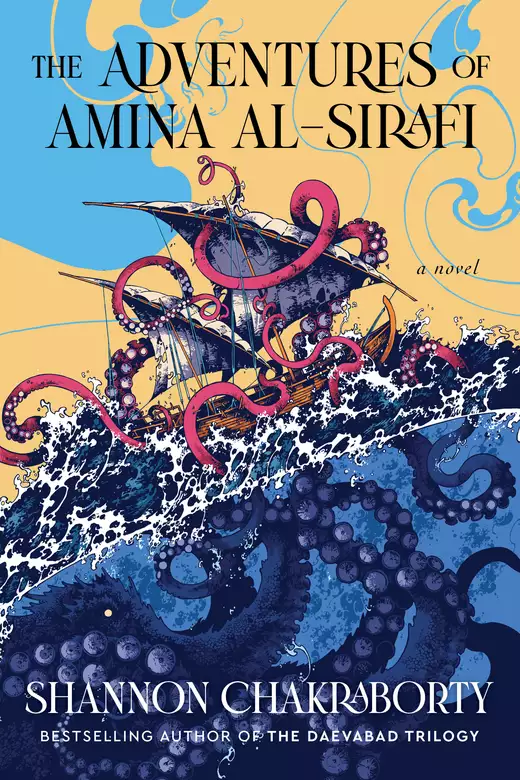
The Adventures of Amina al-Sirafi
- eBook
- Audiobook
- Book info
- Sample
- Media
- Author updates
- Lists
Synopsis
Shannon Chakraborty, the bestselling author of The City of Brass, spins a new trilogy of magic and mayhem on the high seas in this tale of pirates and sorcerers, forbidden artifacts and ancient mysteries, in one woman’s determined quest to seize a final chance at glory—and write her own legend.
Amina al-Sirafi should be content. After a storied and scandalous career as one of the Indian Ocean’s most notorious pirates, she’s survived backstabbing rogues, vengeful merchant princes, several husbands, and one actual demon to retire peacefully with her family to a life of piety, motherhood, and absolutely nothing that hints of the supernatural.
But when she’s tracked down by the obscenely wealthy mother of a former crewman, she’s offered a job no bandit could refuse: retrieve her comrade’s kidnapped daughter for a kingly sum. The chance to have one last adventure with her crew, do right by an old friend, and win a fortune that will secure her family’s future forever? It seems like such an obvious choice that it must be God’s will.
Yet the deeper Amina dives, the more it becomes alarmingly clear there’s more to this job, and the girl’s disappearance, than she was led to believe. For there’s always risk in wanting to become a legend, to seize one last chance at glory, to savor just a bit more power…and the price might be your very soul.
Supplemental enhancement PDF accompanies the audiobook.
Release date: February 28, 2023
Publisher: HarperCollins
Print pages: 496
* BingeBooks earns revenue from qualifying purchases as an Amazon Associate as well as from other retail partners.
Reader buzz
 Please log in to recommend or discuss...
Author updates
The Adventures of Amina al-Sirafi
Shannon Chakraborty
God as my witness, none of this would have ever happened if it were not for those two fools back in Salalah. Them and their map.
—What? What do you mean, that is “not how you start a story”? A biography? You wish for a biography? Who do you think you are chronicling, the Grand Mufti of Mecca? My people do not wax poetic about lineage like yours do. We are not even true Sirafis. My father’s father—an orphan turned pirate from Oman—simply found the name romantic.
—Don’t you think so?
As I was saying. The idiots and their map. Now, I understand the appeal of treasure-hunting, I do. After all, we build our homes upon the ruins of lost cities and sail our ships over the drowned palaces of forgotten kings. Everyone has heard a tale of how so-and-so dug up a jar of Sasanian coins while sowing his fields or met a pearl diver who glimpsed hordes of emeralds glittering on the seabed. It was related to me that in Egypt, treasure-hunting is so popular its participants have organized into professional guilds, each holding their particular tricks close . . . though for the right price, someone might be willing to give you some advice. They may even offer to sell you a map! A guide to such fortunes you could scarcely imagine.
The maps are—and I cannot emphasize this enough—remarkably easy to forge. I can even tell you how it is done: You merely need a scrap of parchment and a bit of time. Tonics are applied to darken and yellow the paper, though regrettably, the majority require urine and the best derive from the bile of a bat. The map itself should be drawn with care, with enough details that some geographic locations will be recognizable (ideally directing the mark in the opposite direction of which the mapmaker intends to flee). Symbols can be lifted from any number of alphabets. Many forgers prefer Hebrew for its mystical connotations, but in my opinion, the text off an old Sabaean tomb makes for more mysterious letters. Wrinkle the whole thing up; fray the edges, burn a few holes, apply a thin layer of sandarac to fade the script—and that is that. Your “treasure” map is ready to be sold to the highest bidder.
The map my clients possessed that night did not look like it had been sold to the highest bidder. Though they had been
trying to conceal the document along with their purpose—as though midnight excursions to ancient ruins were a common request—a glimpse had been enough to reveal the map was of middling work, perhaps the practice manuscript of an earnest criminal youngster.
But I kept such opinions to myself. That they had hired me to row them out here was a blessing, a chance job I had snagged while fishing. I must have seemed a prime candidate for their mission: a lone local woman a bit long in the tooth and almost certainly too dim to care what they were doing. I made the appropriate noises, warning them that the ruins were said to be haunted by ghouls and the surrounding lagoon cursed by djinn, but the young men assured me they could handle themselves. And as I had spent many a night fishing in the area without encountering even a whiff of the supernatural, I was not truly concerned.
—Excuse me? That “seems sort of naïve”? Do you not recall how we met, hypocrite? Stop talking and eat your stew. The saltah is excellent here and you are barely thicker than that pen you are holding. Another interruption, Jamal, and you can find some other nakhudha to harass for stories.
Anyway. Back to that night. It was an otherwise enchanting evening. The stars were out, a rare sight during the khareef, the summer monsoon that typically mires us in fog. The moon shone brightly upon the ruined fort across the lagoon, its crumbling bricks all that remained of a long-abandoned city locals said had once been a bustling trading port. This part of the world has always been rich; the Romans once called us Arabia Felix, “Blessed Arabia,” for our access to the sea, reliable trade routes, and lucrative frankincense groves. Locals also say that the lost city’s treasury—still bursting with gold—lays hidden beneath the ruins, buried during an earthquake. It was that story I assumed had lured out the youths until one of them loudly clucked their tongue at me in the manner of a man calling a mule to halt while we were still in the lagoon.
“Stop here,” the boy ordered.
I gave the black water surrounding us, the beach still some distance away, a dubious glance. During the day, this was a lovely place that attracted flamingos and dolphins. When the wind and tide were just right, water would burst from the rocks in geysers to the delight of children and picnicking families. But during low tide on a calm night such as this, the breakers against the surf were mild, a steady soothing crash and glittering white spray that did little to differentiate between sea and shore. If my clients thought they could swim all the way to the barely visible beach, they were even more foolish than I thought. And I think I’ve been clear how foolish I considered them.
“We are not yet at the ruins,” I pointed out.
“This is far enough.” The pair were huddled together at the other end of my small boat, the map spread across their knees. One boy held an oil lamp for illumination, the other a burning bunch of dried jasmine.
“I do not understand,” one of the youths muttered. They had been arguing in hushed whispers all night. Though their accents sounded Adeni to my ear, I did not know their names. They had rather dramatically declared that in lieu of offering their names, they would pay me an additional dirham for my discretion, and since I did not actually care, the extra payment was a delightful surprise. “The map says this is the spot . . .” He gestured to the heavens above, and my heart went out to him, for what was written on that map had nothing to do with any star chart I have ever seen.
“You said you wished to go to the old city.” I gestured toward the hill—or at least I tried to. But a thick bank of fog had rolled down from the wadi, the monsoon-swollen stream that fed the lagoon, to surround us, and neither the ruins nor the hill were visible. Instead, as I watched, the shore entirely vanished so that we appeared to be floating on an endless, mist-shrouded plain.
The youths ignored me. “We have said the words,” the one holding the oil lamp argued. “We have her payment. She should appear.”
“And yet she has not,” the other boy argued. “I am telling you, we were supposed to . . .”
But whatever they were supposed to do stopped concerning me. In the space of a breath, the breeze that had been blowing in from the sea all night abruptly halted, the air turning dead and flat. I stilled, a bead of sweat chasing down my spine. I am a sailor, and there is little I watch more closely than the weather. I lifted a fraying strand from my cloak, but no wind stirred the thread. The fog drew closer, accompanied by a smothering quiet that made thunderous every knock of water against the boat’s hull.
There are places in the world where such signs might herald a vicious, dangerous storm, but the typhoons that occasionally struck here typically did not manifest so unexpectedly. The water remained gentle, the tide and current unchanged, but even so . . . there was an ill feeling in my belly.
I reached for my oars. “I think we should leave.”
“Wait!” One of the young men stood, waving excitedly at the fog. “Do you see that shadow above the sea-foam?”
It was sea-foam, I realized, squinting in the dark. Years of the sun’s glare upon the ocean had begun to take their toll on my vision, and I struggled to see clearly at night. But the boy was correct. It wasn’t only fog drifting closer. It was sea-foam piled high enough to swallow my boat. As it approached, one could see a reddish-yellow hue to the substance and smell the awful aroma of rotting flesh and gutted fish.
“Give over her payment,” Oil-Lamp Boy urged. “Quickly!”
“Forget my payment and sit back down,” I ordered as the second youth reached into his robe. “We are—”
The boy pulled free his hand, revealing a large chunk of red carnelian, and two things happened very quickly:
One, I realized that was not my payment.
Two, the thing whose payment it was dragged us into the fog.
The boy holding the carnelian barely had time to cry out before the froth rushed to consume him, licking down his neck and chest and winding around his hips like an eager lover. A howl ripped from his throat, but it was not a scream any mortal mouth should have been able to let loose. Rather, it was more the roar of a tidal wave and the death cries of gulls.
“Khalid!” The other boy dropped the lamp in shock, extinguishing our only light.
But fortunately—fortunately?—the seemingly alive and possibly malevolent sea-foam was glowing. Its light was faint, but enough to illuminate Khalid as he bared his teeth like a wolf and threw himself on his companion.
“You shall not have me,” he hissed, groping for the other boy’s neck. “We will curse you! We will devour you! We will cast you into the flames!”
The other boy struggled to free himself. “Khalid, please!” he choked as more sea-foam—now the crimson of blood—spread over them both. Fanged suckers were blossoming across its surface like the tentacles of a monstrous squid.
I would like to say I did not hesitate. That at the sight of two youths in mortal peril, I flew into action and did not briefly wonder if the malevolent sea-foam might be sated with eating them and leave me and my boat alone. That would be a lie. I did hesitate. But then I cursed them profusely, rose to my feet, and went for my knife.
Now, I am fond of blades. The khanjar that was my grandfather’s and the wickedly beautiful Damascene scimitar I stole off an undeserving noble. The small straight knife that hides in an ankle holster and a truly excellent bladed disc from my second husband, who learned to regret teaching me to throw it.
But there’s only one weapon for situations like this, one I commissioned myself and never leaves my presence. Made of pure iron, it isn’t my sharpest blade and its weight can make it unwieldly. Spots of rust from the sacred Zamzam water I sprinkle over it in nightly blessings pepper the metal, the red flakes making it difficult to discern the knife’s inscribed holy verses. But I didn’t need the knife to be pretty.
I needed it to be effective when more earthly weapons failed.
I seized Khalid by the collar and ripped him off the other boy. Before he could make a grab for my throat, I put my blessed blade to his. “Be gone,” I demanded.
He wriggled wildly, sea-foam flying. “You shall not have me. You shall not have me!”
“I do not want you! Now, in the name of God, be gone!”
I pressed the knife harder as the bismillah left my lips. His flesh sizzled in response, and then he crumpled. The sea-foam that had wrapped his body hovered in the air a
moment then hurled itself at me. I fell as though struck by a battering ram, my head slamming into the boat’s bottom.
Icy fingers with bone-sharp tips were digging into my ears, a great weight pinning me in place. But by the grace of God, I was still holding my blessed blade. I struck out madly, and the knife stuck in the air. There was a shriek—an evil, unnatural sound like claws scraping over seashells—and then the scaled monstrosity squatting on my chest rippled into sight. Its glittering eyes were the color of bilgewater, its filthy straw-like hair matted with barnacles.
It screamed again, revealing four needlelike teeth. Its bony hands scrabbled on my own as it tried to wrest away the dagger sunk into its wine-dark breast. Silver blood bubbled and dripped from the wound, drenching us both.
The youths were sobbing and begging God for mercy. The demon was shrieking and wailing in an unknown tongue. I shoved the blade deeper, thundering to be heard over all of them.
“God!” I shouted. “There is no god worthy of worship except Him, the Ever-Living, All-Sustaining!” Holding the dagger tight, I launched into ayat al-kursi, the passage from the Quran I had been taught all my life would protect me.
The demon on my chest howled and writhed in pain, its skeletal hands flying to cover scaled ears.
“Neither drowsiness nor sleep overtakes Him! To Him belongs whatever is in the heavens and whatever is on the earth—will you get off of me?” I elbowed the creature hard, and it spit in my face. “Who could possibly intercede with Him without His permission? He knows what is ahead of them and what is behind them, but no one can grasp any of His knowledge—except what He wills!”
Its skin smoking, the demon must have decided it had had enough. A pair of bat-like wings sprouted from its back, and with a gusty flap, it pulled itself off the blade and was gone, vanished into the night.
Gasping, I sat up. The mists were already receding, the youths still clutching each other on the other side of the boat. I held the dagger tight, searching the retreating fog for anything else. Fear coursed through me, thick and choking, as I waited for that familiar laugh. For fiery black eyes and a too-silky voice.
But there was nothing. Nothing but the star-splashed lagoon and the gentle murmur of the tide.
I spun on the youths. “You said you were after treasure.”
Oil-Lamp Boy flushed, spots of color appearing in his chalky skin. “Treasure is a concept open to—no, wait!” he cried as I snatched their map and lump of carnelian, thrusting them over the water. “Do not do that!”
I tossed and caught the glittering red gem in one hand. “Do not pretend with me, boy,” I warned. “Lie again and I will throw you both overboard. You mentioned payment and a name. What were you trying to summon?”
“We were not trying—Bidukh!” he confessed when I dipped the map into the sea. “My cousin told me about her.
She is . . .” He swallowed loudly. “She is one of the daughters of Iblis.”
I gaped. “You were trying to summon a daughter of the lord of hell? On my boat?”
“We did not mean any harm!” The moonlight had returned, and I could see him cowering. “It is said that if you please her, she will whisper the secrets of love into your ear.”
Khalid swayed in his friend’s arms. “I am going to be sick.”
“Throw up in my boat, and you swim back to shore. A daughter of Iblis . . . may you both be cursed.” I hurled the map and carnelian into the lagoon. They vanished with loud splashes amidst the protest of my passengers.
“Hey!” the boy cried. “We paid a lot of money for that!”
“You should be thanking God you did not pay with your lives.” I thrust an extra oar in his arms. “Row. Perhaps some labor will knock a bit of sense into you.”
He nearly dropped the oar, his eyes going wide as I shifted positions, the movement revealing the other weapons concealed beneath my cloak. I wiped the iron knife clean, placing it back into its sheath before taking up my own set of oars.
Both boys were staring at me with expressions of shock. I could not blame them. I’d fought off a demon, given up the slouch I’d been affecting to reveal my true height, and now rowed with my full strength—a far cry from the quiet, hunched-over old fisherwoman who’d reluctantly agreed to take them out here.
“Who are you?” Khalid asked hoarsely.
The other one gawked. “What are you?”
The lagoon was receding, but I would swear I still felt a heaviness in the air. For a moment the water splashing at the rocky beach looked like the yellow-hued crimson of the now-vanished sea-foam, the shadows dancing on the cliffs like tentacles.
“Someone who knows too well the price of magic.”
I said nothing else, and they did not ask. But they did not need to. For stories carry, and even if the youths were ashamed to confess their own schemes, the tale of an unassuming fisherwoman who fought a demon like a warrior of God? Who threw off her tattered cloak to reveal an armory at her waist and a form like an Amazon?
Exaggerations, but the truth scarcely matters when it comes to a good tale. The kind of story that spreads in taverns and shipyards. To wealthy women’s harems and the kitchens of their servants.
To the ear of a very desperate grandmother in Aden.
As you might imagine, witnessing a youth being taken over by malevolent sea-foam in hopes of summoning Iblis’s daughter was not an experience easily forgotten. If we had awakened some sort of vengeful spirit in the lagoon, however, I did not return to find out. Instead, I fell back into the routines of family and harvest, which meant on the day I returned to a life of misadventure, I was locked in battle with the constant enemy of my retirement: my roof.
Had I held fast to the payment the young men and I had agreed upon weeks ago, I might have been able to purchase a few good boards from a carpenter in Salalah, the town a half day’s journey away. Instead, I had taken the boys back to shore for free, moved by their fear and hoping my benevolence would buy their silence in return. A decision I cursed as I laid down a mat of rushes across the latest leak and sat back to assess my work.
It was not an inspiring sight. For nearly a decade, my family had called this decomposing stone house in the seaside mountains home. With commanding views of both ocean and countryside, walls thick enough to block arrows, and a crude escape tunnel hacked into the storage room floor (complete with claw marks and bloodstains on the cramped walls), the place had likely once been the fort of a petty, paranoid warlord. During the khareef, the jungle grew so thick that a screen of greenery hid the house completely, and strange hisses emanated from the surrounding thickets of banana trees. A nearby coconut grove was always cold, too cold, and the crashing waves on the narrow beach sounded like the shrieks of lost souls.
Add the horned stone idol my brother had uncovered while cleaning out the courtyard and you would be correct in assuming locals avoided the place. Which made it perfect for my chief purpose in those years, which was to hide. Less perfect were the endless repairs. Repairs I was required do myself, as I could not bribe workmen from any of the neighboring villages to visit such a haunted abode. The holes in the roof were the worst of them. It was not enough that I had spent my career trying to keep a ship watertight; no, I had to have a house that wanted to be one with the rain and the sea air, a particular curse in the wet season.
“Do you need more rushes, Mama?” my daughter, Marjana, chirped from where she was spinning wool.
“No, little love.” I wiped the sweat from my brow, my eyes stinging. “But would you get me some water?”
“Of course!” Marjana dropped her spindle to skip-run away, and I returned to my knots, trying not to despair at the roof’s appearance. Between my sailor’s stitches and the rushes, it looked less like a roof and more like a reed boat that a shark had devoured and vomited up.
Ever a blessing, Marjana returned with not only a pitcher of water, but a bowl of sliced mango.
“God reward you, my light.” I straightened up with care, pinching my brow to keep black spots from dancing before my eyes. House repairs and farming had kept me strong, but my body did not like swiftly moving positions during afternoons so humid it felt as though you could have wrung out the air. I collapsed into a damp hammock strung in the corner and drank directly from the pitcher.
Marjana settled between my feet. “When do you think Grandma and Uncle Mustafa will be back?”
“By sunset, God willing.”
“Do you think Auntie Hala will come with them?”
“If she is feeling well enough.” Unable to afford a place big enough to host his workshop and his family, my little brother, Mustafa, and his wife, Hala, split their time between her parents’ home in Salalah and ours in the hills. But the trip could be an arduous one, and at six months pregnant, with another toddler in tow, Hala was returning less and less.
Marjana wiggled her toes. “If we moved to Salalah, we would get to see her all the time. And I could go to school at the masjid.”
The hope in her small face broke my heart. Marjana had been asking about school more often. Though I tried to minimize her ventures to Salalah, my mother was not above spiriting her out for day trips to the market and gossip circles of elderly ladies. “It is cruel to isolate her so, Amina,” she would chide. “Marjana blossoms when she is out and about. You cannot let your fears rule her life.”
If only my mother knew the depths of my fears. “It is not safe, Jana,” I said gently. “Maybe in a few more years.”
My daughter stared at me now, a hundred questions in her dark eyes. When she was younger, she would ask them with the relentless curiosity of a child. Why do we not leave the cliffs? Are there bad people after us? Will they hurt you? I knew my stammered, evasive answers were never enough, and yet it only made me feel guiltier when she stopped asking them. She seemed too young to have surrendered to fate.
“Why don’t we play a game?” I suggested to lift her spirits. Marjana loves her games, inventing her own complicated versions and designing boards and pawns with anything she can get her hands on. “Go find your mancala board.”
“Okay!” She beamed, thoughts of school forgotten, and was gone in a flash, her braids bouncing as she raced away.
I pulled off the cloth holding back my hair and mopped my face. A breeze had kicked up, bringing the smell of the sea and rich wet earth more strongly. The khareef was in full swing, patches of light fog cloaking the emerald hilltops. If you have never witnessed the khareef in this part of the world, ah, but it is a wonder. The mountains and valleys undergo an astonishing transformation, rocky cliffs and bone-dry wadis giving way to lush forests and roaring waterfalls. The swiftness of the change and the vivid, ever-present green—a divine hue unlike any other I’ve witnessed—seems very nearly magical, evidence of God’s splendor.
And yet for me, the khareef signified more. The passing of all the seasons did. For if the sea was the heart of our world, the winds were its lifeblood. And when the khareef lifted, so would those winds shift, heralding the beginning of the northeast monsoon. While I labored on this roof, sailors from Kilwa to Zeila were loading the last of the ships to head to Arabia and India with ivory and gold, mangrove poles, and all manner of trinkets; savoring last moments with wives and children. The accountants and overzealous market inspectors of Aden would be absorbed in their tax scrolls, harassing new arrivals if they had anything to declare while the pirate fleets hunkered in Socotra lifted their sails, heading for the unwary and ill protected. On the other side of the ocean, mariners in places such as Cambay and Calicut would be waiting to depart westward, painting the hulls of their sewn ships with fresh layers of pitch and shark oil and checking their sails.
Sailor or clerk, smuggler or trader—this steady calendar has ruled our lives and those of our ancestors since ancient times. They say you can find goods from all over the sea in the ruins of pagan temples and forgotten kingdoms; Indian seal stamps in Bahrain and Chinese glass in Mombasa. Our stories speak of trading cities built and lost before the time of the Prophet, may peace be upon him, and the chants we sing to make ship work pass memorialize the losses of countless perished crossings. My ancestors had attuned their lives to the sea for far too long for me to forget its rhythms.
At least that’s what I told myself when it hurt. When watching the winds come and go and not follow them filled my soul with a blazing grief that made me take to my bed. Take to stalking the hills and working the land until my hands bled and sweat poured down my limbs. Until I was too weary to wallow in my memories and despair of never seeing the land recede into watery blue again.
And then Marjana reappeared. And if the grief did not disappear, it did fade. But though her beloved mancala board was in her hands, her gaze was not upon me. She had stopped on the stairs and was looking beyond the edge of the roof.
“Mama . . .” She frowned. “There are people coming up the path.”
“People?”
“Strangers.”
The word had me on my feet and at her side in the next moment. We did not get strangers. Our location was too remote and removed from the routes connecting Salalah and the coastal villages to attract lost travelers. But Marjana was correct. On the narrow, zigzagging path that cut through the verdant scrubland was a small palanquin being carried by four men. Armed men—they bore swords at their waists. Such precaution was the norm, of course. Bandits and the occasional leopard abound. But these were big men, with a military bearing I did not trust. There were no other cargo animals or people accompanying the palanquin, suggesting the traveler inside intended a short trip.
But a short trip here? Why?
I glanced across the roof. Carefully hidden in a watertight chest was my bow—a gift from a Sohari admirer whose tokens were more appealing than his personality—and a quiver I kept supplied with fresh arrows. The bow is not my weapon of choice, but I am fast with it. Fast enough that I could likely take out two of the men before the others hid. Maybe three.
“Mama?”
Marjana’s voice jolted me back to the present. I was not in the world where I shot people first and asked questions later.
I carefully pulled her out of sight. “Stay here and set up the mancala board. I will see what they want.”
Her expression was worried. “Should I—”
“You will stay on this roof and not come down until I call you, understand?”
She nodded, still looking a little scared, a sight that made me again contemplate my bow. But I left the weapon where it was, instead picking up the hammer I’d been using to repair the roof. The house was silent as I crept through, the stone walls so thick it was nigh impossible to hear anything beyond them. Despite the hammer in my hand, I briefly considered the blessed iron blade at my waist as I re-covered my hair.
He is gone, I told myself. Gone. You buried him with your own hands. Trying to ignore the dread curdling in my gut, I pressed an ear to the barred wooden door.
Whoever was on the other side chose that moment to knock so loud I jumped. But it wasn’t the pounding of soldiers preparing to break through. A small band of travelers had simply knocked at my door, a perfectly normal thing to do. I was the one being paranoid.
Keeping the hammer concealed behind my back, I opened the door. “Yes?”
Two men stood there, one with his hand raised as if to knock a second time. Slowly his eyes trailed up to meet mine and his mouth opened in a small o of surprise. Whether it was my height or my rudeness that took him
aback, I did not know. Hopefully one or the other would convince him to leave.
“I . . . peace be upon you,” he stammered. “Is this the home of Fatima the Perfumer?”
It was indeed, “the Perfumer” being one of my mother’s many attributes. When my family resettled in this land, my mother and brother were anonymous enough to keep their identities. I could not, though it didn’t matter. Few people wanted to speak to Umm Marjana, the giant, eccentric widow who rarely left home and prowled the hills like a caged lion.
“My mistress is not in.” I was covered in twigs and sweat; perhaps the guise of a gruff, unhelpful servant would make them leave. “I can take a message.”
Before the man could reply, the palanquin’s curtain was pulled open to reveal its sole inhabitant: a woman swathed in a purple silk jilbab embroidered with delicate opal beads I could tell from a single glance would pay for a new roof. Enough gold bangles to buy another roof and likely all the land I was squatting on ringed her wrists. Though she remained partially hidden in the shadow of the palanquin, she appeared elderly. Her face was veiled, but the hair between her temple and pearled headband was white, her eyes wrinkled with crow’s-feet.
Her gaze went from my feet to my head before settling on my face with what looked like satisfaction, as though she had been considering options at the butcher and found a choice sheep. It was a profoundly irritating look and followed up by worse—she began to disembark from the palanquin.
“A message will not do,” she announced. Her bearers helped her to her feet.
I moved to block the way. “You should stay in your carriage. The damp air—”
“I find it refreshing.” She cocked her head, staring up at me. “My, you are tall.”
“I—yes,” I stammered, uncharacteristically lost for words. The old woman took advantage of my uncertainty to sweep past me and through the door as though she were a sultana entering her own salon. Were it one of her men, I would have slammed their head into the wall and put my blade to their throat for such audacity, but before a frail old woman, I was powerless.
“Sayyida,” I tried again. “My lady, please. There has been a mis—”
“You may call me Salima,” she called over her shoulder. “And I would be much obliged if you could fetch me a cup of water. Do you mind if my bearers rest in your courtyard?”
I did mind. I minded quite a bit. And yet I could not fathom kicking them out in a way that did not make the situation more suspicious. Guest right was sacred in our land. The moment I saw an old woman stuffed in a cramped palanquin, I should have urged her to come into my home and take respite. Her men were visibly exhausted, with
sweat pouring down their faces. An innocent person—a servant, no less—would be falling over themselves to offer relief.
There was also the possibility they would be more vulnerable to attack while resting. I plastered a gracious smile on my face. “Of course not. Please make yourselves comfortable.”
It took time to get them settled. I showed the men our well and left them to the shade of the overgrown trees in the courtyard before escorting Salima to our small, sad excuse for a reception room. As we actively avoided entertaining guests, it was not a welcoming place. A steady drip from the leaking roof pinged loudly in a metal tin, and the only light came from a single dusty window. I cleared away sacks of rice and lentils, making a stack of cushions for her to sit upon, and then left to retrieve water and refreshments.
When I returned, Salima had removed her face veil and set aside her jilbab. She appeared about my mother’s age, her silvery hair untouched by henna. Though her delicate features were now well lined and flush with exertion, there was no hiding that she must have been a beauty in her youth. She wore a deep blue gown patterned with copper birds and yellow trousers whose ankle hems were so thick with needlework it must have taken a seamstress a year to complete. More gold jewelry, beautifully worked, hung around her neck with ruby ornaments dangling from her ears. From the cut of her clothes to the way she commanded the small room with her presence, everything about this woman spoke of wealth and power far beyond anything I knew.
And far beyond anything that should lead her to seeking out my mother. Granted, in our years here, my mother had cultivated a circle of friends—she always did. She was a survivor, accustomed to her life being hastily uprooted, and she could mend your clothes, paint your hands, and brew up fragrance with a skill that had kept food in my belly since I was small. But we were not remotely in the class of this Salima, who, if she had been inquiring after my mother’s skills, would have sent a servant. I set down fruit and water with a lowered head, resisting the urge to study her further.
Salima took the cup, murmuring thanks to God. “When do you expect your mistress back?” she asked after she had slaked her thirst.
“I do not know, Sayyida. It may be very late.”
“Is there anyone else in the home?”
My skin prickled. “No. As I said, I am happy to convey a message.”
Salima shrugged. “Perhaps later. For now, I prefer your company.”
It was not a request I could deny if I wanted to keep up my servile front. “You honor me,” I said demurely, cursing internally as I sank to the floor. Even upon her stack of cushions, Salima was still dwarfed by me. I had slipped the
hammer into my waistband, the metal head poking reassuringly into the small of my back.
She pulled a small fan from her sleeve and waved it in front of her face. “Muggy day. I was promised that this part of the coast looked like a mirror of Paradise during the khareef, but the humidity.”
“Where are you coming from?” I asked.
“Aden.”
Aden. The most prominent—and notoriously law-abiding—port in the region. “I have heard that Aden puts even our worst heat to shame. Has your family been there long?”
“Nearly thirty years. We are from Iraq originally, but there was more opportunity here.” She sighed. “I fear with politics as they are, soon enough my homeland’s splendor will live on only in the storytellers of Baghdad.”
I clucked my tongue in sympathy. Though I did not intend to confide such a thing to Salima, I suspected my family’s maritime history sprouted from similar glory days. My father used to rhapsodize about the splendor of early Baghdad and its Abbasid rulers, when sailors like us would journey from Basrah all the way to China to bring back the silks, books, and spices of a new world, of unknown lands our faith had just started to explore.
But that was long ago. Baghdad was no longer the heart of our world, the city of legend that drew traders and travelers from every distant corner of the ummah. Or perhaps it never had been; the land of my birth had always looked to the sea first, and that sea was vast. So vast that it had become uncommon for Arab and Persian sailors to journey beyond India—we did not need to. There were merchants already there, many now Muslim as well, who knew the waters and lands better than us.
Salima motioned to hand her cup back but stumbled. I reached forward to help, and she grabbed my wrist.
“Take care.” I gestured to the platter of fruit. “Why don’t you eat something?”
“I suppose the journey affected me more than I realized.” Salima was still holding my wrist. “Oh my. That must have been a nasty injury.”
I followed her gaze. My sleeve had ridden up, revealing the mottled scar that covered much of my right forearm.
“Cooking accident,” I lied.
We returned to our seats. But Salima was still staring at me. I could hardly blame her, I present quite a sight. Like many of my class, I have the blood of nearly all who have sailed upon the Indian Ocean. My father’s father was an Arab, an orphan who traded pearl-diving for piracy when he stole his first ship, and my father’s mother a Gujarati poet-singer who stole his heart, then his purse. My mother’s family, though not as scandalous, was no less global, her island of Pemba known for welcoming lost travelers including a number of Chinese mariners, among them her grandfather, who decided taking the shahada and starting a family in a gentle land was better than risking the journey home.
I have a mix of their features and speak enough of their languages that I should have been able to blend in a great many lands. Except I do not blend. Anywhere. I have traveled to more countries than I can remember, yet have never met another woman approaching my height and only a bare handful of men who can best my strength. I may have been retired, but I did what I could to maintain a formidable form—trading sparring and rowing for beating the land into orchards and swimming against the waves every morning.
Salima popped a slice of coconut into her mouth. “Your father must have been a giant. I suspect you could likely bear my palanquin all on your own.”
What a compliment to note my worth as it compares to carting her rich ass around. “I was taller than my father,” I deadpanned. “But should it become necessary, I would be more than happy to remove you from the house.”
Her mouth quirked with what looked like triumph, as if she had enjoyed finally pulling a rude retort from me. It was unsettling—because for the first time, I noticed that there was something a bit familiar about Salima. The way her large brown eyes glinted with amusement and the set of her thin lips. Why did it feel as though I had seen her face before?
She leaned back on her cushion. “This is a very . . .
i
nteresting home. But in such a secluded location. Does your mistress not get lonely?”
The roof chose that moment to begin leaking again, water pinging loudly into the pan. “I believe she enjoys the solitude,” I said with as much grace as I could muster.
There was a timid knock on the door, and Marjana peered in. “Mama?”
Oh, for the love of God . . . the one time this girl decides to disobey. “Jana, I told you to stay upstairs,” I reminded her swiftly, making a shooing motion.
“I know, but I brought food.” She lifted a tray with a pitcher of juice and fresh banana fritters. “It sounded like we had guests.”
And just like that, my lie began to crumble.
We had guests. The ownership in that phrase and this well-dressed little girl calling me Mama.
Sure enough, Salima turned her shrewd gaze to Marjana, still standing in the doorway. “Is this your daughter?” she asked.
“Yes.” I could scarcely deny it; the resemblance between us was obvious. ...
We hope you are enjoying the book so far. To continue reading...
