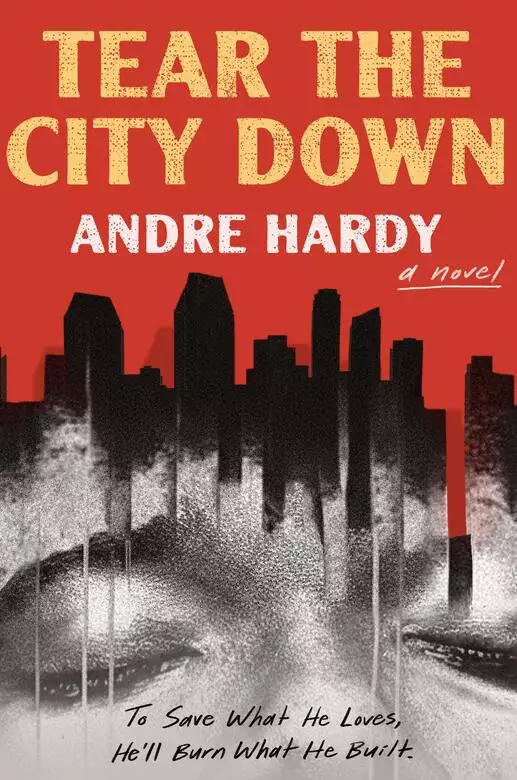
For fans of S.A. Cosby and Walter Mosley, debut novelist and former NFL player Andre Hardy’s TEAR THE CITY DOWN is a hard-hitting, heart wrenching crime novel that brilliantly blends elements of jazz, football, and a gritty portrait of a city divided.
Coltrane Davis is at once a knight and a hustler. He has risen to wealth and success, graduating from San Diego's back alleys to the halls of power through his partnership with Saul Sollman, a crooked kingmaker among the city's elite. Running multimillion dollar scams with Saul, he has been Saul's fixer, but now he wants out of the hustle so that he can focus on his teenage daughter's burgeoning tennis career and finally be the dad he has always wanted to be.
But when the Los Angeles Chargers' star running back vanishes one evening before a big game, Coltrane is drawn into an investigation of what happened by Saul and his protégé, the player's agent; the stakes escalate with a gut-punch when the trail leads into San Diego’s underworld of drugs and prostitution and reveals clues to the disappearance of his daughter's best friend, whose loss has haunted him. Torn by the unreconcilable demands of the life he can't seem to quit and the fierce desire he has to protect his own, Coltrane brings himself and his loved ones to the brink of destruction in his quest to free himself once and for all of Saul's control – and focus on what really matters: family.
Release date:
September 1, 2026
Publisher:
Grand Central Publishing
Print pages:
1
* BingeBooks earns revenue from qualifying purchases as an Amazon Associate as well as from other retail partners.
Upward mobility needs a surgeon general’s warning label. Something to the effect of “Brothas, best beware: Social climbing is dangerous. Known to infect us with greed, leading to the adoption of the lifted class’s behaviors and prejudices, resulting in delusion, moral dilemmas, neglect, identity crises, self-hatred, and, in extreme cases, death.”
Reposed in Saul’s oxblood leather chair, I wasn’t thinking anything that eloquent. I’d fallen into a hustler’s lament. Running the tape back in my mind’s eye. Searching for the moment I should’ve recognized sooner—the signal I’d missed, buried under the sound of the cash register ringing.
I’d known better.
Hustlers supposed to get in. Stack some bread. Get ghost before it goes bad. Because it always does.
The library held its familiar golden hue, a brass lamp on Saul’s mahogany desk casting our shadows like ghouls on the floor-to-ceiling bookcases filled with Plato, Homer, Machiavelli, and Sun Tzu. I sipped my WhistlePig rye, then puffed an Arturo Fuente cigar, blowing smoke toward the artisan ceiling tiles. Turning my eyes toward the view out the tall arched windows whose red velvet drapes were tied to iron hooks, I gazed vacantly at the brewing storm.
Somewhere on the horizon, there was trouble with my name on it. Exactly what kind of trouble, I wasn’t sure. But I’d been feeling a sort of paranoid disenchantment as of late. There were a number of contributing factors, but all of them were tributaries of the same river: moral bankruptcy amplified by cognitive dissonance.
All I’d ever known was hustle. I’d graduated from nickel-and-dime plays on the concrete blocks of San Diego (hustlers say Daygo) to Churchill chairs in Saul’s La Jolla Farms estate. And while I might have seemed out of place in his underworld of hedge-fund maneuvering, bribery, kickbacks, and good ol’ fashioned usury, Saul understood something: White men don’t see brothas. And that’s not some metaphorical aside. Unless I get close, like in an elevator, or I catch the eye of one of their women, white men don’t see me. And I’m built like a reason to cross the street: cast-iron black, six foot three, 235 pounds of mostly muscle. Their miss goes back to colonization, African adventure stories, Jim Crow, and shit I’ll leave right here. The point is, I’d hustled my way out the mud. But now there were strong reasons to change.
My daughter played in her first International Tennis Federation tournament in Boca Raton three months ago. She didn’t win, but goddamn, she hit some incredible shots. I grinned as the crowd side-eyed each other in amazement. There is pride, which I know well, but this thing in Florida hit different. Something warm swelled in my chest—and suddenly I saw my daughter in a new way. If my feet touched the ground after that, I don’t remember.
We spent three extra days in Florida, touring tennis academies and boarding schools, meeting with private coaches. As I walked the grounds of IMG Academy, it landed profoundly: Naima is a pro. This tennis thing is real.
Putting my hustle down went from someday to now. It felt right. And I’d been thinking about it for a while.
Which was why I wasn’t keen on being here.
The ritual of jazz, cigars, and fingers of high-end whiskey, which I took neat, was foreplay. Lubrication before Saul and I drew up new plays, reviewed those in progress, and graded those that had borne fruit. Occasionally, like now, the ritual was about finesse. Saul easing into an ask I wasn’t gonna like.
“Your bankruptcy attorney better be good,” Saul said. He was on the phone bullying my mark, Alexander Bradshaw. “Because if you don’t execute, the bid numbers are going to NASSCO,” he said, referencing the navy’s shipbuilding contractor. “I’m playing golf with their CEO on Tuesday.”
Man, I wished he would shut up so I could enjoy the music. I would have said something if he had not been on the verge of a mood.
Saul was a psychopath. I mean, honest-to-god, dropped-on-his-head-when-he-was-a-baby disturbed. When I first got on, I noticed his team of Ivy Leaguers—which I renamed The Weenies—tiptoeing around him, trying not to break the eggshell of Saul’s soul. Then came his over-the-top tantrums when deals didn’t go as planned. I’d look at him, thinking, Bro, relax. Let me do what I do. His behavior was a head-scratcher—until I plugged his superficial charm, grandiose sense of self-worth, con man fast-talk, and zero remorse into a Google questionnaire. There it was: He was fuckin’ crazy.
My hood was rife with brown-skinned people with damaged psyches. So his crazy wasn’t nothin’ to me. I was there for the money. It was coming fast in large chunks. And he reminded me of my Day One homeboy, Bobby.
Not physically, of course. Saul Sollman was pudgy, balding, five seven, tops, with skin a shade of white you get from living inside. Bobby was a classic ectomorph. And, I should add, was sort of like King Solomon, as street niggas go. Kind, benevolent, a deep thinker who would blow your candle out if the scales tip that way. Saul and Bobby’s match came in their brown eyes, which never stopped probing for leverage. It was the first thing I noticed about Saul. So it wasn’t unreasonable to expect he’d handle stress as well as Bobby.
But handling stress wasn’t happening that late Saturday night. Or early Sunday morning, if we’re being exact. Which was irritating because I craved silence. Coltrane was now playing “Naima.” My daughter’s name. And like her smile, the ballad’s dulcet melody had the power to chase my troubles away. If only he would shut up and let me listen.
Saul would finish his threats, then put between thirty and fifty racks of cash on the table for me to fix this emergency with Bradshaw. I don’t travel for less than thirty. The extra twenty thousand would be for getting me out of bed on date night.
Perhaps it’s better said: I’d left my woman in bed on date night because I can’t stop picking pennies off the ground.
No matter that I’d hustled more dough than I could ever spend; memories of hunger, cold, and mattress springs kept me answering Saul’s calls. It felt sacrilegious to turn down the bag. But that’s what I planned to do—which would be a first.
I closed my eyes as Wynton Kelly finished his piano solo, an ethereal meditation on its own. Now my namesake, Coltrane, was blowing those five declarative notes, which made me feel weightless as they climbed the scales into a crepuscular sky.
“I don’t give a shit what Coltrane said. He works for me!” Saul shouted. “If I were in your shoes, I’d be in Chicago tomorrow.”
Now it was clear why he’d insisted I leave my beautiful, naked woman. He wanted me in Chicago for the meeting. I shook my head with a tinge of sorrow. Saul was aware the coming days would be especially hard for Naima and me. To ask me to travel? It felt like, I don’t know, inhumane.
I wasn’t going anywhere but home.
Ten minutes later, I returned from taking a piss and was surprised to find Dylan Banks alone in the library. Hands shoved deep in his pockets, he stood, swaying slightly, at the giant window, gazing at the best view in town. Was he fascinated by the ocean like I was? How on starry moonlit nights, it shimmers like black glass while, simultaneously, great white sharks shed blood underneath. Whatever the case, Dylan didn’t hear me, and with a quick sweep, I clocked his camel-hair blazer, burnt-orange turtleneck, ankle-high tan slacks, persimmon socks, and double monk strap shoes in football brown. His blond hair was longer than I recalled, a rebellious length that curled at the base of his neck.
Glancing at the grandfather clock, I saw it was 1:45 in the morning. A hundred miles away from home, he hadn’t just shown up. When his shoulders rose and fell with a sigh loud enough to catch, head dropped with a faint shake—the kind a man gives when he’s in trouble—I got it.
He was the reason I was here.
“Dylan Banks,” I said warmly, extending my hand.
He startled. Slight, but I marked it before he turned and flashed a sparkling smile. The kind that makes people feel good. And, for a tick, I forgot I didn’t like him all that much. Had he called me “Old Sport,” I might have blushed.
“The beard is sweet,” he said, taking my hand, wrapping me in a half hug—like one of the homies—before I realized it was happening. “Good to see you again, brother.”
“Likewise,” I lied. That gut-level dislike was back like it had forgotten something.
It was bigger than him calling me “brother,” which is code for Here, take these Bibles and blankets with smallpox. He was one of those super-white boys, the cool ones who used my culture’s accoutrements as tools, then escaped behind their wall of privilege with the booty.
“The last time I saw you”—he paused—“let’s see—”
“Noah’s bar mitzvah in Brooklyn. Bubbeh was in his cups.”
“Oh, that’s right. He was!”
We shared a laugh as Saul returned with a tray of cheeses, olives, hard salami, and crackers.
“Look at you two.” He put the tray down, pausing to smile with arms akimbo. Brushing past my shoulder—he couldn’t get there fast enough—he embraced Dylan and held on. Then, looking up into his eyes, he said with unmistakable affection, “Always happy to see you, kid.”
Dylan was to Saul the son he’d longed for.
When banks wouldn’t touch him, Saul had loaned Dylan’s pops ten million to develop fifty acres in Temecula. And, like many of Saul’s plays, it was a handshake deal. He often told me, “I built my empire on trust. The key is vetting. I’ve found most men are loyal. Those who aren’t? I break them by taking the thing they love most.”
Saul met his pseudo-son during the due-diligence phase of vetting Dylan’s dad. In no time flat, twelve-year-old Dylan was riding shotgun in the Cessna, fly-fishing in Idaho, playing chess—bonding in a way that old school, patriarchal, misogynistic Saul never approached with Leah and Hannah, the daughters he nonetheless adored. The cement, however, was Saul’s love of the Chargers. He took Dylan to his first game at Jack Murphy Stadium. And if you believe Saul, he’s why Dylan swings the biggest dick in the sports agent game.
Their surrogate moment complete, Saul brushed by me again like I was Cinderfella. I shook my head, side-eyeing him as he landed at the bar. Oblivious.
“How is it we’ve never spent any real time together?” Dylan asked.
I shrugged. “I’m interested in why we’re spending it now,” I said, side-eyeing Saul like, what the fuck is going on?
“Yeah, brother, I hear you. I would have preferred different circumstances, but hey, once we get past this”—he sipped—“we’ll fish Los Barriles. My treat. We’ll catch tuna while we figure out how to take over the world.” He grinned. “You fish?”
Agitated by the number of times he’d said we, I manufactured a smile. “Fishing ain’t my thing. San José del Cabo is, though.”
“That’s it then,” he declared. “We’ll do Flora Farms. The art walk. Snorkel Pelican Rock and—”
“What do you want, Dylan?” I cut off the grooming while behind me, inside a sudden abrupt silence, a glass clinked, whiskey gurgled.
“Anthony Riddell—” he started but didn’t get very far.
“You’ve got to be kidding me,” I snapped, the eruption causing him to flinch.
Anthony Riddell was the Chargers’ All-Pro running back. A legit National Football League superstar. Dylan was his agent. And I was completely out of fucks to give.
“Please, Saul.” I shook my head, seething. “Tell me you didn’t get me out of bed because of some knucklehead football player?”
I eyed him for answers. As if nothing was wrong, he futzed with the drinks, gathered them up, and came from behind the bar with two glasses pinched between the fingers of his right hand. The third he carried in his left. He set all three on his desk.
Then, matter-of-factly, he looked up in my eyes with a softness that almost seemed real. “If I had told you Anthony Riddell was being extorted, would you have come?”
“You know that answer.” I scoffed.
“So what was I supposed to do? A good kid is in trouble and needs your help.”
“I don’t like being played with.”
“You think I don’t know that?”
I didn’t say anything. Just glared.
“Six years together you think I don’t know who you are? Let’s have a drink. You hear Dylan out. You don’t like what he says, you leave.”
He picked up the tulip-shaped glasses and passed the first one to Dylan—of course—offered me mine next, and we formed a semicircle.
“To good fortune.” Saul held his glass high, we clinked in the middle. Dylan tossed the ultrarare whiskey down his throat like a frat boy with cheap tequila. Reckless.
I shook my head.
Eyeing my half-smoked Cuban, I thought to sit and finish it off before I politely said no and excused myself. Except Dylan strolled to my oxblood chair and colonized it.
Whatever. He expedited my departure.
Repositioning myself in front of Saul’s desk, I leaned my hip against it. Twisting to rid myself of the glass, I noticed a manila folder atop the blotter. Dead center, but somehow I’d missed it when I first walked into the room. I knew it was meant for me.
Dextering off, Dylan was fumbling inside his blazer’s breast pocket when I turned around. “Once we get through this conundrum”—he retrieved a snakeskin business card holder—“you call me.” He took out a card. “Adidas, Nike, Under Armour, Puma—everybody’s hunting for the beautiful young it girl”—he made air quotes—“with brown skin. I’ll get her an apparel deal for starters. We’ll take it from there.” Between his index and middle fingers, he stretched, offering the card to me.
It hung in the air, a fuse sizzling toward detonation as I breathed, dousing my anger. Otherwise, I might have punched him in the goddamn mouth. He’d licked his lips for sure while saying the words. And I caught something dreamy in his eyes when he’d said, Beautiful young it girl.
And what the hell was wrong with Saul?
I’d shared, in confidence, that Naima wanted to turn pro. Now here my words were, being used as leverage. Reluctantly, I took the card, which I planned to toss on Saul’s landscaped lawn on my way out. It was black metal. DB etched on one side, a phone number on the other.
“That’s my personal line. You have a green light, brother. Twenty-four seven.” He tipped his glass, crossed his right leg over left, sipped.
I did not like Dylan Banks. “What’s up with Riddell?” I asked.
“Where would you like me to start?” he replied.
“CliffsNotes.”
“Well, that’s easy. As Saul said, Anthony has been targeted for extortion.”
“How much?”
Dylan’s mouth formed an answer, but for some reason, he paused. A simple question had knocked him off-balance.
“What’s the number?” Noticing Dylan’s confusion, I glared at Saul with a clear message: Your man is sauced. “Riddell? Extortion? What’s the number?”
“Don’t you want to know what happened?” Dylan asked.
“Doesn’t matter.”
“Of course it does.”
Glancing at Saul for support, I guffawed. He knew where I was going. The dollar amount revealed the nature of the problem. Amateurs ask too little. Crazies too much. Pros seem to know what’s in the account and want all of it.
“I’m trying to do you a solid here, Old Sport. You tell me how much,” I said as if talking to a child, “I tell you how big your problem is and how to solve it. Or shall I go home?”
Dylan looked at Saul. “What the hell is wrong with this guy? Jesus, calm down.”
I smiled inside. When a white man tells a brotha, who is calm, to calm down, it’s a tell.
“Let me apologize for him, Dylan,” Saul cut in. “It’s date night.” His singsong tone mocked me. Set my teeth on edge. “But I’m sure he’ll hear you out,” Saul continued. “He still works for me.”
“You want me to listen? Okay, fine. The answer is still going to be no. The last thing I’m doing is carrying a bag to fix some knucklehead football player’s mischief.”
The room ignited in a silent tug-of-war between my agency and whatever was in that folder.
“Forgive me, Your Highness,” Saul said. “After all I’ve done for you, isn’t there a tiny bit”—he held up his index finger and thumb, cheeks flushing with red-hot anger—“of this thing called gratitude?”
I snickered at the irony. He’d given me a chance to make him millions of dollars while destroying my well-being.
“How can you say no when you haven’t heard the ask?” Dylan whined. “Jesus, man, come on. You’re supposed to be a pro.”
“Here’s what I do know. It involves time I don’t have. Saul knows it’s a tough time of year for my family and me, and… why are we even having this conversation? I’m retired. Saul, you’ve got ten guys—”
“That I’d have to call in from out of town!” he hollered. “And their first ask will be to meet with you for a briefing. There’s no time for that.”
Call in from out of town? I damn near laughed in his face at the exaggeration.
Yes, it was about to get ugly.
“Now, get your head out your ass, and let’s get to work.”
I shook my head, muttering, “Fuck this. I’m out.”
Dylan leaped out of the chair, my chair, and stood in my path. He put his hands on my shoulders. Though I wasn’t partial to being touched, he was so ardent, his blue eyes pleading, I let it slide.
“Coltrane, listen, man.” His breath, whew! He’d been on a binge. “Anthony Riddell is a damn good kid. I mean, damn good. He needs you. I’m negotiating his extension. It’s contentious. They want him to play for a discount. After all he’s done? Hell no. Not on my watch. And the money is about more than him. Did you know he’s paid full college tuition for thirty-seven kids and counting?” Now Dylan removed his hands, using them for emphasis. “He’s broken ground on a sanctuary for teen boys and girls outside of Greenville.…”
I must have reacted to girls because he paused, sensing fertile ground. He started fast-talking. Selling.
“That’s right, teen girls on a big, beautiful farm with lots of grass and horses. They get ninety days free. There’s dorms, individual, group, and family counseling for victims of domestic violence. Tutors, vocational training. Job placement. It’s God’s work, man. Please, brother, hear me out. Anthony needs you. Those kids need you, brother.”
I shoved past him.
“Aw, come on, man,” Dylan pleaded to my back as I burned out the door up a long hallway lined with photos of Saul’s daughters when they were little girls. My intention was to keep marching to my car. But Dylan’s plea for Riddell, especially the girls, had touched me. Instead of walking out the door like I should have, I switched on the espresso machine. Pressed go on the bean grinder, then walked back to the library.
“I’ll listen,” I said. “Hang tight. I’m making coffee.”
Holding a double shot of Jamaican Blue in a demitasse cup, I wandered out of the kitchen, through the dining room, past a long oak farm table, and stood at the massive French doors. Taking in the infinity pool’s bluish glow—the surface a symphony of raindrops—I sighed. As clusters of queen palms slow danced in the breeze, my eyes followed a football field of grass downhill toward a breathtaking stop at the cliff’s edge, into a memory of Naima’s best friend, Erykah.
They’d been thick since double Dutch and Miss Mary Mack. Her birthday was next week, Christmas Eve, marking the one-year anniversary of so many broken hearts. The night she’d snuck out her window to meet a boy, and vanished.
She’d lived next door with her grandmother, Ms. González, and had been heavy on my mind as I watched Naima plan a candlelight birthday vigil.
I’d promised to find her. Looked my daughter right in the eye and sold myself as her hero. “I will tear the city down to find her,” I’d said. As time trudged on and I climbed a mountain of despair, I was forced to accept this was a thing my money could not fix, and the sweetness Naima and I once shared turned rancid.
Now the vigil loomed like an army of angry boots, marching, drawing nigh, and I’d secretly begun to think of Erykah in the past tense.
But if I fixed Riddell’s trouble, whatever it was, and he saved those girls in Greenville, maybe I wouldn’t feel so bad?
I could be his H-back, knocking his trouble down so he could score. I smiled, wary. There were hints of ill will in the library’s air. This could be Saul’s play, the trouble I’d been expecting.
Shortly after Erykah vanished, love and the dharma found me. Mona was the messenger. And over time, as she introduced me to the teachings, I began to change. It was as if the law of causality—violence breeds violence, love makes more love—was water dripping on my hustler’s persona of stone. Then one day as I sat in meditation, silent, chasing my breath, naming thoughts as they passed through my mind like clouds on a windy day, I began to weep. I’d realized I’d rather chase love than bags. I didn’t know the cost. It wasn’t long before Saul called me into a meeting, asking about my dwindling pipeline. I assuaged his concerns with half-truths of burnout, working smarter, assured him it was recalibration and there was nothing to worry about. He bought it. Even suggested I take an extended break.
But when I came home from Boca Raton and told him my hustling days were done, and that Alexander Bradshaw would be my last client, he showed himself to be the kind of white man my granddaddy warned me about: one who believes the world and everything in it belong to him.
The conflict appeared to greenlight a kind of extrajudicial killing of Coltrane. Even his Ivy League Weenies, who’d despised the sight of me but wouldn’t dare step up, were circling, looking for a Black body souvenir.
Downing the espresso, I headed back to the kitchen, a sleek, stainless-steel situation of Miele appliances designed by Saul’s chef. After setting the cup on a lava stone countertop, I strolled back into the library.
The room had a low hum to it now. A buzz of double-cross treason, something along those lines. I marked it, returned to my position. Hip on Saul’s desk, I said, “Okay, Dylan, let’s hear it.”
He sipped his drink, picked up his phone. “Here I am minding my business and get sucker punched with this.” He reads slowly, “‘It sure was nice having this big Black cock in my mouth. More soon.’”
I laughed. “And?” Anthony Riddell, first of all, was single. He was also famous, rich, and good-looking. “You’re making it sound like a blowjob is going to ruin the man’s career.” I shook my head as if they were snotty-nosed neophytes. “Look, guys,” I lectured, “here’s why the amount matters. This is below my pay grade, but here’s the solution free of charge. Prepare an NDA and drop a bag on her ASAP. I mean now. Before her girlfriends get in her ear, start with twenty-five in a Birkin. By seventy-five, you’ll have a deal—”
“Here!” Dylan shoved his phone in my face.
I gave him a sharp eye, like watch yourself, bro. I took my time taking the phone from his hand.
Reading the note, in which each S was a dollar sign, I saw it was as I’d assumed. The age-old play I’d rebranded Whitemail, as white men hold the patent on financial arm-twisting.
The image, though, its motif thrilled me. Not excitement, a strange quickening in my blood.
It had been snapped in what I assumed was a VIP room. The walls were bloodred and mounted with gargoyle sconces. I pinched, zoomed in on the animals: some kind of tormented, antediluvian mix of man and winged dragon. They were holding spheres that shone like moonlight. I dragged the image left, zooming in some more, then paused.
A charcoal drawing dominated the wall. Based on scale, it had to be fourteen feet tall, perhaps ten feet wide. A figure with breasts, a goat’s head, and wings: Baphomet, the occult symbol of androgyny, sitting in lotus position on a throne. Below was Anthony Riddell, sprawled on a milk-white couch with his pants down around his ankles. Someone had captured him in the kind of climactic moment photojournalists dream of. Head thrown back, he wore that expression of intense pleasure that looks like intense pain.
On his knees, administering the pleasure, was an old, silver-haired white man.
“Damn,” I muttered. “When did you get this?”
“Three hours ago,” Dylan said.
The photo was a goddamn shocker, though maybe it shouldn’t have been. There were, what, 1,700 players in the NFL? Odds said a handful, if not two, had sugar in their shoes. The idea that Anthony Riddell was in the closet made sense. What was with the old white dude, though? Sugar daddy? Nah, Riddell was a millionaire. Instead of chasing possibilities, I settled on a truth: Unpredictability is fundamental to human nature.
Passing Dylan his phone, I wondered who was behind the text. It had come from a short code number used by corporations, government entities, and digital hustlers in social engineering schemes.
“So, Riddell is queer?” I asked.
“Honestly, I’m shocked.”
“You didn’t know?”
“I mean, anything’s possible when he’s blackout drunk, right?”
I went for my cigar. Puffed. It was dead. Fetching the lighter, I asked as I revived it, “Okay, so he has a drinking problem. Explain that to me.” I indicated the phone.
“The team—” Dylan started.
“It’s a setup,” Saul cut in as if I’d asked his opinion.
I glared, eyes saying stay out of my way.
“You know that for a fact?”
“I do.”
“How?” I pressed.
“What do you mean, how?” Dylan frowned, offended. “I know because it’s my job. And I’m good at what I do.”
He picked up his drink, seemed surprised to find it was empty. Then he was up, teetering toward a refill. I thought, Better pump your brakes, Old Sport.
“The market for running backs is depressed.” He sloshed a sloppy pour. “That shit”—nodding at his phone as he fell back in my chair, spilling liquor on his nice blazer—“narrows his options and reduces market value. What’s left, unless he retires, is to take their lowball offer.”
He was suggesting extortion, which wasn’t far-fetched. I’d read the findings of fact between the NFL Players Association and the NFL Management Council. If NFL owners colluded, they’d extort.
“Something’s off,” I said.
“How?” Saul asked. He was talking too much. Steering.
Wiggling my fingers, I said, “Let me see the phone.” Dylan gave it to me, and as I studied the picture, the room fell quiet. I recalled images of Riddell smiling over bowls of Campbell’s Chunky Soup, wheeling Ford tough trucks, holding In-N-Out Double-Doubles, and hawking cell phones for Verizon. In this right-leaning political climate, his brand image was cooked.
“It’s Jaxon,” Dylan slurred.
“The GM?” I questioned.
He nodded. “I’m telling you, it’s him.”
“What’s his beef with Riddell?”
“They declined his fifth-year option, refused to negotiate a market value deal, then franchise tagged him. Anthony felt betrayed and rightfully so. The man accounted for fifty-three percent of the offense, played hurt, and was nominated for the Man of the Year Award for his work in South LA. So he skipped most of training camp and asked for a trade. That garbage about his health, domestic violence, so-called Mississippi gang ties? It’s Jaxon leaking stories to the press.”
Here was a familiar narrative of oppression:
“It’s devolved into an all-out war.”
“With you or Riddell?” I asked.
It took a beat for the implication to register before he said, annoyed, “My other guys’ deals got done. In fact, raises.”
“So what is it then?”
“Anthony might have called him a cracker motherfucker and threatened to choke him with both hands.” He tussled with a smile. “In a team meeting.”
“Yeah, well, that’ll do it,” I said.
Looking at Saul, I asked, “So what’s the play?”
“Behind you on the desk.” He nodded.
As I’d suspected, the folder was meant for me. Inside there were twenty-five-ish pages. Bound with a black binder clip as if it were light work.
Depending on the complexity, this kind of work takes at least an hour per page. Dylan had said the photo dropped three hours ago. It struck me that this was theater. A La Jolla Playhouse production intended to shape my opinion. I would have asked about the equation of twenty hours of work on three-hour-old trouble if the first page had not been an all-out blindside blitz that knocked the question right out of my mouth.
It was a 2014 press release from the United States Attorney’s Office, Southern District of California: Fifty-Five Charged in Massive Crackdown on West Coast Crips Street Gang. Some Defendants Charged in RICO Case That Includes Allegations of Execution-Style Murders.
As my curiosity burned, wondering what a decades-old operation had to do with Anthony Riddell, I felt a jolt of absolute silence, the kind of moment given to remembrance of fallen soldiers.
In all of America’s big cities, none has a lower percentage of brothas than Daygo. Most of us are concentrated in roughly six square miles, from Encanto through Lincoln Park and Valencia Park, stretching west to Logan Heights and north into City Heights. Growing up, I’d crossed paths with most of the
We hope you are enjoying the book so far. To continue reading...

 Please log in to recommend or discuss...
