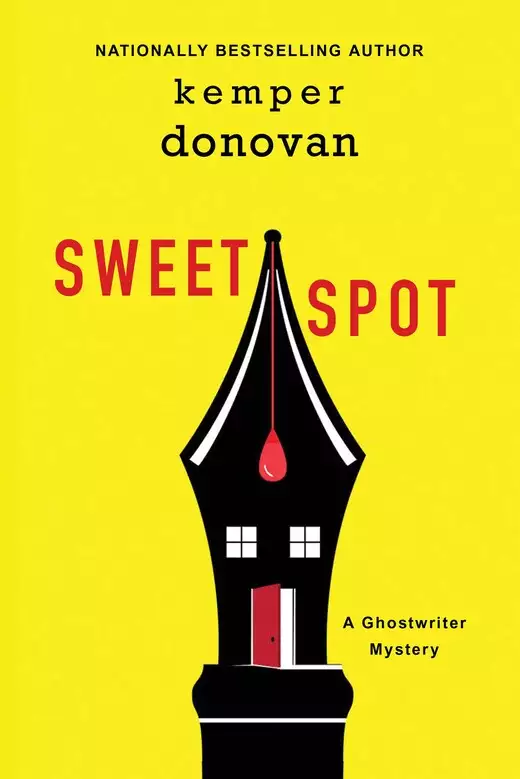
The USA Today bestselling host of the “All About Agatha” podcast injects the spark and fizz of a Golden Age Murder Mystery into the present day, as a ghostwriter-turned-sleuth must find a devious killer who’s transforming her new assignment into a real-life thriller…
Ghostwriters, just like ghosts, shouldn’t exist. Knowing that the latest juicy memoir was penned by a stranger for a paycheck tends to ruin the illusion of intimacy. But not every ghostwriter is in it for the money alone.
For Belle Currer—as the ghostwriter extraordinaire prefers to be known—Genevieve Caraway’s memoir is an irresistible project, a tale of tragedy overcome. At 14, Genevieve was abducted from her bedroom by a couple and held hostage for three months. She’s now a happily married mother with a flourishing career, a poster child for thriving after trauma. Still, the scars haven’t entirely faded.
Genevieve’s lavish Utah home, “Sweet Spot,” is a guarded compound impregnable to outsiders—theoretically, at least. But Belle’s arrival coincides with the parole of Deirdre Gregory, one of Genevieve’s kidnappers. When Deirdre shows up at Sweet Spot begging to see Genevieve, she is refused. The next day, Deirdre’s dead body is found on the grounds.
How did Deirdre get in? More importantly, who killed her? Belle soon joins Detective Kay Adams, the pregnant Mormon detective assigned to the case, in sifting through the suspects. The compound is filled with family and friends—and also with secrets, including one the ghostwriter has been carrying for far too long. She knows how guilt, remorse, and love can drive people to do unthinkable things. And that no matter how much you try to keep the world at bay, the best and worst of it may find a way to get in . . .
Release date:
June 30, 2026
Publisher:
Kensington Books
Print pages:
368
* BingeBooks earns revenue from qualifying purchases as an Amazon Associate as well as from other retail partners.
I find this dichotomy to be a false one. There are a million reasons to go on a trip, and nothing to stop a person from engaging in work and recreation in equal measure—or simultaneously. It’s not as though “business” and “pleasure” have to be mutually exclusive. They certainly aren’t for me.
“Business,” I replied to my seatmate. We were going to be on a plane together for five hours. I wasn’t about to give him a real answer and thereby entrap myself in a conversation with no natural end point. A modicum of friendliness was required, however, so I added, “And you?”
“Me? Pleazh all the way.”
This is my best attempt to recreate in written form the way he’d lopped off the second syllable of “pleasure.” See also: “natch” for “naturally,” and other such abominations of abbreviation.
“Yeah, me ’n’ a few college buddies’re going up to Jackson Hole, gonna do some hiking, a few rounds of golf, unwind ’n’ unplug, y’know?” he drawled. “Me, I live in New York, work in finance. ’Sa grind, no joke. Guess that’s why I make the big bucks ha ha ha. How ’bout you? You live in New York? Look like you do.”
Oh, no.
It’s curious how often such “dude-bros” are characterized as wooden or withholding, when so many of them turn out to be as chatty as this man. And he was a golfer too. The “golf widow” is a familiar character, the woman who loses the man in her life to this time-suck of a pursuit. I like to think of myself as a “golf spinster”: a woman who would prefer to remain single, rather than risk inviting this dread pastime into her life. Not that my seatmate was making any overtures. There was nothing flirtatious in his manner. And yet the ease with which he’d invoked my appearance set off a flicker of a warning.
I nodded, hoping he’d take my lack of a verbal response as a hint to shut his piehole.
“Yeah, I know a fellow New Yorker when I see one. You gotta be observant when you live in the city, right? Gotta stay on your toes ha ha ha. So whaddaya do?”
“I’m a freelance writer.”
“Yeah?”
I could practically see this information bump against his shiny head and crash onto the armrest between us, failing to penetrate his psyche. If I had told him I was a ghostwriter who specializes in writing the memoirs of the rich and famous, and that lately I’d taken to writing murder mysteries on the side—mysteries drawn from real life—I could have kissed goodbye to the next five hours of my life. Sigh. What a burden it is to lead a secretly fabulous and fascinating existence.
“I’m on my way to workshop some optimization strategies with a colleague.” I gestured to the laptop sitting on my tray. “I’ve got to organize my notes, so I’m probably not going to be the greatest company. Unless—”
I drew in my breath sharply, widening my eyes as though an idea had just occurred to me. This was a bluff; but when you gamble, you’ve got to go for it. Already I could sense a shifting in his posture, an infinitesimal backing away.
“You—you wouldn’t want to help me, would you?” I laid a hand on our shared armrest, beside the elbow he’d already shoved there. “If I could read out what’s been swirling in my head, I think it’d go a long way to detangling what I’m trying to express. I mean it might sound like a lot of jargon, but it would help me to actualize—”
“Nah, nah, just gonna watch a movie,” he mumbled, relinquishing the armrest and ripping open the complimentary headphones a flight attendant had just passed out to us. He couldn’t jam them in his ears fast enough.
I returned to my laptop, hiding a smile. None of what I’d said to him was a lie, other than my trip being solely for business. Beyond the satisfaction I derive from my writing, already I’d laid the groundwork for a significant source of pleasure in the days to follow—pleasure that would come to pass precisely as I hoped it would.
And yet, in the end, the joke was on me. Because all this pleasure came at a price, and an unusually steep one. I was no stranger to murder by this point in my life.
But out West, at Sweet Spot, murder and I would reach a whole new level of intimacy.
I should backtrack a little. My flight was on Friday. Two days earlier, on Wednesday, I was at home in New York and I had no travel plans while I sat alone at one of my favorite restaurants downtown, waiting for my lunch date to appear.
Tea & Sympathy is both a tea shop and a restaurant, with a little bit of a grocery store thrown in. I enjoy the blurring of these lines, which is common in eating establishments where the food on offer is foreign or niche in some way, its customers seeking to optimize their visit by eating on the premises and buying more for later. Not that the British fare at Tea & Sympathy is foreign or niche to me. It’s an Anglophile’s paradise: the sort of comfort food I dreamed of as a child, because it’s what my fictional friends were eating whenever I hung out with them—Cornish pasties, Welsh rarebit, bangers and mash, etc. Though such savory delicacies are merely a prelude to the main course, i.e., dessert.
Reader: There is nothing like British confections. Their pastries and cakes are heavier than ours in the States, hence capable of greater flavor; their chocolate has more cocoa and less sugar, for a smoother, superior taste; their creams have more fat, making them—well, creamier. Have you ever seen a British person try to eat a Hershey’s Bar? Impossible. To them it tastes like vomit, and even though I grew up on the stuff and eat it regularly, I know exactly what they mean.
I made a habit of going to Tea & Sympathy whenever I finished a manuscript, and not at any other time, the denial making the reward that much sweeter. And since I had just finished my second mystery manuscript, I didn’t hesitate when called upon by my lunch date to pick a location. I suppose by choosing it, I was trying to manifest the happiest meal possible.
I’d arrived at a quarter to noon, though we weren’t set to meet till twelve thirty. I chose a table outside in one of those narrow, tented structures that are the only positive vestiges of the recent pandemic—other than the death of the default hug. (I spit on your grave, default hug.) I like to sit in these outdoor “dining sheds” not because I’m worried about COVID anymore, but because I’m usually eating alone, and they allow me to avoid the peculiar awkwardness of entering a restaurant’s dining room and trumpeting my solo status by sitting down without a companion. There is no such trumpeting in an alfresco situation.
Today, however, I would not be eating alone. My companion was a man named Denny Peters. I got to know him a few years ago, up in Maine. Back then, he’d been a bodyguard to a politician whose memoir I was ghostwriting, though I’d abandoned the project—abandoned everything in Maine, including him. We’d gotten to know each other extremely well, and yes, that is a euphemism for sex. Good sex. Great sex. It happened just the once, but I thought about it a lot. I thought about him a lot. So much so that I’d gone through the hell of calling him a few days earlier, and asking if I could see him again.
This was the first time in my life I had done such a thing.
The call had been short. Not because it was unfriendly; to the contrary, he’d been amiability itself.
“It’s such a coincidence you called!” he shouted down the line before I’d even gotten a chance to explain myself. He didn’t seem to need an explanation. “I had it on my to-do list to call you!”
When we’d parted in Maine, he’d said I could get in touch with him whenever I wanted. Since then, I’ve engaged in enough introspection under the guidance of a licensed psychotherapist to acknowledge that my failure to get in touch had nothing to do with a lack of interest. It had to do with fear: the fear that came from an abundance, a cornucopia of interest. And while it’s more helpful to figure out such limitations in one’s twenties or thirties rather than one’s forties, I was grateful to have made this progress at all, and to be acting on it now.
“Do you mind if we continue our conversation in person?” I’d asked him. And then he’d asked me to name the time and place, which was how we ended up making a date for twelve thirty at Tea & Sympathy, and how I ended up arriving at eleven forty-five and forcing myself to scarf down two pieces of sardine-laden toast I didn’t much want for purposes of securing my seat.
By twelve fifteen, not only the toast but the plate that held it was gone, and I had settled my bill for lunch number one so that Denny would be none the wiser about my early arrival. This had required giving a lengthy explanation to my waitress, who I had decided to take into my confidence about my hot date. This too was not the sort of thing I did, but apparently I was all about new beginnings.
I wondered—not for the first time—what exactly I was going to say to him. The truth was that by getting off the phone, I’d given in to the impulse to procrastinate: the same impulse that kept me from looking at my grade whenever a test was handed back to me in school. Instead I’d stuff the paper in my bag, where it would torture me for hours till I couldn’t bear it any longer. (It was almost always an A or an A+, just saying.) Procrastinators are cast as hedonists, but I find there’s more than a tinge of masochism to the practice—at least the way I practice it. More grist for my therapist.
So what was I going to say to him? That I wanted to date him? That I’d like to be a part of his life? That I regretted my offhand rejection and thought about him every single day? That there was as good a chance as any I’d come across in my life that I could fall in love with him?
I drummed my fingers on the tablecloth, unbearably humiliated by these thoughts. How could I ever let any of this nonsense escape the fetid confines of my brain? This lunch was going to be a disaster, and my beloved Tea & Sympathy, my happy place, would be ruined.
Maybe it will all go well, a voice offered timidly—a voice I was trying to nurture. She’d been stifled for so long. Maybe I was setting the bar too high. Why the need for such elaborate declarations on our first meetup? Maybe we’d simply have a nice chat. Maybe we could see each other again, chat some more. Have sex a few times? See how it all went? Isn’t that what adults did who liked each other? It could happen. If only I wasn’t too late.
If only he weren’t too late. I checked my phone: twelve thirty-two. Time flies when you’re being whipsawed by doubt and hope in equal measure à la Faye Dunaway in Chinatown. He still had eight minutes before he was officially late. (Everyone gets a ten-minute grace period.) No need to panic.
Four minutes passed.
I panicked.
He wasn’t going to show. This was all a trick, some middle school–level cruelty being visited on me, a figurative bucket of pig’s blood at the prom. (I’d been on a seventies movie kick of late.) How idiotic was I? How could I have bought into his friendly demeanor? He hated me, and I deserved his hatred.
I in fact deserved nothing.
And then he appeared.
I’d been bracing myself for his attractiveness. I’d even stooped to Google Imaging him beforehand in an attempt to sap my libido ahead of time—an attempt I should have known would fail. I was an eternal sink of lust where Denny Peters was concerned, and there was no amount of preparation that could have weakened the pull I felt as he appeared on the edge of the dining shed, his eyes alighting on mine.
That’s what attractive people do, after all: They attract, pulling you toward them. It wasn’t as though any part of me moved, but I experienced a herky-jerky sensation in that middle-ish, gastro-cardiac space where all feelings register themselves, my vital organs protesting my refusal to run to him. You could say I had butterflies in my stomach if you wanted to be clichéd about it. You could also say it was a miracle nothing erupted from the orifices at either end of my digestive tract.
A part of me had been hoping when I saw him that I would feel nothing. That I would realize my regard for him belonged to the past. I’d imagined a mixture of relief and disappointment washing over me like a cleansing shower. But instead, all my passion for him returned, a deluge rather than a shower, and nothing cleansing about it. As I gripped the table’s edge with one hand and waved at him with the other, I may as well have been a drowning victim signaling the hot lifeguard to come to my rescue.
He waved back uncertainly, as though he didn’t recognize me. Had I changed that much? It was possible. I’d encountered three corpses since the last time I’d seen him. That sort of thing ages a girl.
He looked exactly the same, which is to say, like a fitness model. I could tell you about his fireman’s chin, square and dimpled, his concave cheeks and convex chest, the big brown eyes that wouldn’t have looked out of place on a Beanie Baby. He was wearing a suit with no tie, which seems to be the dress code for businessmen these days, and I wondered if he’d had them specially tailored to encase his glorious thighs. (I’m a legs woman. Denny taught me that.) His brand of handsome was so sunnily obvious, I’d come to realize that beyond the vulnerability I experienced whenever I was confronted by my attraction to him, what made me so uncomfortable was that my regard proved I wanted the same things everyone does.
Beauty. Vitality. Joy.
Denny ordered a full English breakfast and I got another order of toast, plain this time. Before she left, the waitress made a sign of approval behind his back—thumb and forefinger in a circle, lips pursed appreciatively. So this was what it felt like to be outgoing—a person who went on dates at cute restaurants and involved incidental strangers in her life. I could do this; I was doing this.
“You know”—he smiled nervously; he was nervous too!—“I’m not sure what I should call you.”
The situation with my name is admittedly complicated. Twenty-five years ago, when I was still a teenager, I lost my sister to suicide. She was my one sibling, and this tragedy and its aftermath estranged me from my parents. When I turned eighteen I made the estrangement official by legally changing my name. In this way, ghostwriting came more naturally to me than to most writers. I welcomed the idea of hiding behind a more famous person, of yoking my words to their high-profile plow. When I started writing my own mysteries, I published them under yet another fake name: “Belle Currer.”
Denny had alluded to the fact that he knew all this, up in Maine. But I hadn’t been ready to talk about it then.
I was ready now.
“These days I go by Belle.”
“I think I prefer your real name.”
“Which one?” I asked grimly.
“Whichever one you prefer.”
The irony is that I vastly prefer my original name, my true name. The one my parents gave me.
“I’m not sure I have the courage to do that,” I said candidly.
“You will,” he assured me. “Just give it time.”
This was what I needed: a man who had faith in me, who had faith in general. I hesitated, but only for a moment because I knew if I lingered on the edge of the precipice too long, I’d lose heart and surrender to my fear. I had to jump. Now.
“I’m going to be honest,” I began. “I regret the way I ended things between us, and I wanted to—”
His eyebrows sprang up in alarm, his smooth forehead acquiring three perfect, parallel lines. He put up his hand, but I waved him off.
“Let me finish,” I begged him.
“I’m engaged,” he blurted out.
“Oh wow! That’s amazing, congratulations!”
This response spilled out of me in a kneejerk attempt to take back what I had begun to say. I smiled like a maniac, desperate to play off the series of explosions detonating inside me, the flames fed by rivulets of regret coursing through my body, my self-arsonist’s secret stash of gasoline. Already, in the very milliseconds after he spoke, the regret was everywhere because I am just as much a sink for this impulse as I am for lust. In an effort to deflect from what was happening, I lifted my cup to my face, even though I had no intention of drinking from it. Maybe this is why I spilled half its contents in my lap. There wasn’t much tea in there anyway, plus it had been sitting out for nearly an hour at that point, so it was lukewarm at most.
I wished it had been scalding.
“Do you want this?” He was holding up a cloth napkin, his genuine concern making his eyes bigger than usual.
He was the source of my humiliation and so I hated him, even though I well knew, dabbing at the dark spots on my already dark pants, the person I hated was myself.
“I’m fine!” I assured him. “Truly,” I added, imbuing this word with a significance meant to convey I knew he knew what I’d been about to say to him, and it was okay that these words were forever abandoned, never to be spoken or alluded to again. Ever.
I saw the understanding register in his eyes—and the relief.
I was not fine, reader. I’d made the error of a lifetime, and knew with a religious conviction there were no other fish in the sea because the sea was a toxic waste dump. It was a miracle that Denny Peters existed. And what had I done? I’d rejected him and then waited to come to my senses till it was too late. Too late.
My chance at happiness was over.
Wow, it was a good thing Tea & Sympathy didn’t have a fainting couch in its dining shed, or I would have collapsed onto it now with the back of my hand pressed against my forehead. It was a shame I couldn’t crawl my way inside a Tennessee Williams play and wail in proper melodramatic fashion, handkerchief in hand. Regret-fueled lamentation is very much my jam. But also my jam? Jam. I got four tiny pots of it now—apricot, black currant, plum, and marmalade—delivered to me in a wooden board with grooves for each pot, an honest-to-goodness flight of jam. It came to me like a life preserver: not for its flavor or sustenance, but for the respite it provided from the necessity to talk while our waitress was present.
“Food’s coming soon,” she said. “Anything else you need?”
A time machine? I thought. A lobotomy?
Before she left, she tried catching my eye again, to check in on how the date was going. If I had to choose a low point for the lunch overall, I think this would be it. But then she was gone, and I had to say something or else humiliate myself further.
“So who’s the lucky girl?” I asked brightly.
We both knew my brightness was false, but what I hoped he didn’t realize was what a miracle it was that I was capable of falsity, of continuing to play the game we play with each other every goddamn day. I was learning the lesson we’re all forced to learn, and relearn, and learn yet again during moments of personal crisis. That the world goes on, and we go on with it.
“Her name is Abigail Brooke.”
Abigail. What a dumb name, right?
“She goes by Abi.”
She would.
“She’s from Utah, actually.”
Gross.
“And grew up Mormon.”
Grosser.
“But she doesn’t practice now. The rest of her family does, so she’s kind of a black sheep in that way. Especially considering she went to the land of sin.”
“Vegas?” I pictured a tragic show girl with a sweaty face and a single, drooping feather sticking out of her bedazzled headgear.
He smiled, and I had to look down. His chin dimple I could handle, because it was always there and I had no choice. But I could not abide his cheek dimples. Not on this day.
“Nah, Hollywood. She’s a studio executive. On the TV side,” he said proudly. “It’s where all the action is these days,” he added, obviously parroting what she’d told him.
“TV, wow!” Normally I’d make a better show of pretense, but my façade was of such hasty construction, it was in danger of crumbling. I was lucky I hadn’t said “Wowie!” or “Gee whiz!”
“Yeah, you know I moved to L.A. recently? I forget if I mentioned it on the phone.”
He hadn’t, but I’ll stop pretending it was only yesterday that I’d googled him. I looked up Denny regularly, and knew precisely when he had stopped being one of the bodyguards for Dorothy Gibson, the politician who had employed us both. I also knew that he had opened a private security firm in L.A. Denny had no personal presence on the Internet, but his professional activities were there for anyone to see. (LinkedIn was my friend here—though I hope you all know the default privacy setting on LinkedIn allows other users to see you when you visit their profiles? You have to make yourself anonymous while browsing, and then, let the good times roll.)
“I started my own private security firm out there.”
“Oh really?” I dissembled.
He nodded. “Abi and I met last year.”
“Online?” I asked, hoping for as bland a story as possible.
He shook his head. “At a charity event. You won’t believe this, but she lost her shoe and was looking all over for it. I—I was the one who found it.” His cheeks reddened. I’d forgotten how easily he blushed. “I know it’s cheesy, but it was like a real-life Cinderella moment.”
If I broke the teapot over my head with enough force, would I be able to lose consciousness?
“No need to get into all that,” he continued, “it’s not very interesting. She’s the one with the interesting story.”
I believed she was infinitely interesting to him. He was in the first flush of love: that giddy phase wherein speaking about the object of one’s desire is a pleasure in and of itself.
Listen to me going on about love. As if I have any idea what the fuck I’m talking about.
“That’s actually why I wanted to see you.” He took a giant swig from his coffee mug. “She has a proposition for you.”
“Your fiancée has a proposition for me?”
You’d think that “proposition” was the dirtiest word in that sentence, but the way I’d said “fiancée,” I may as well have said “pimp.”
“I know! It’s wild. Okay, so I already mentioned how she’s from Utah, right? Well, growing up, her best friend was Genevieve Caraway.”
“Genevieve Spruce,” I corrected him automatically. “That’s her—”
I was about to say “maiden name,” an antiquated term I try to avoid. But in Genevieve’s case, this phrase was extra awkward. Also, the import of what he’d said was beginning to dawn on me.
“So you know who she is?” he asked excitedly.
“I do,” I replied, not indicating—at least not yet—how familiar I was with this woman’s story. “But wait, how long has your”—I paused, tamping down my swollen gorge—“fiancée known her?”
“Since kindergarten. Abi was supposed to be sleeping over at her place, the night it happened. She said it changed her life, the whole thing. How could it not?”
Goddamn it. This “Abi” (I wasn’t ready to abandon the air quotes) would be a great perspective to have in the memoir I was already ghostwriting in my head.
I’d heard through the grapevine (a WhatsApp group of neurotic ghostwriters who mainly complained about how little they made, and which editors to avoid) that Genevieve Caraway was looking to break out of the self-help genre. Her last book had bombed, and many on the chain wondered whether there was even an audience for a memoir—whether Genevieve Caraway was old news at this point.
“I had heard she was looking to do a memoir.”
He nodded. “That’s why I wanted to talk to you. Abi’s a big fan of yours. Like, really big.”
I wished I could say the feeling was mutual.
That’s a lie. I didn’t wish I could say it at all.
“And not just your ghostwriting. She said she likes the idea of a mystery writer telling Genevieve’s story, since it has a true crime angle. Someone who can marry the mystery and the memoir.”
Well, well. This Abi was all about marriage, wasn’t she? But I saw immediately what she meant. Genevieve’s life story was the stuff of Dateline, or those tawdry three-part documentaries we all stream guiltily on Netflix late at night. It began twenty years ago, when she was woken up in her childhood bed in her suburban home outside Salt Lake City, Utah. She was fourteen years old and a man was holding a knife to her throat. He told her that if she didn’t go quietly, he would kill her parents. She went quietly.
Genevieve’s ordeal lasted three months, but miraculously, she survived it, sending her tormentors to prison for life and making a career out of transcending the victim role that had been thrust upon her. In the wrong hands, a recounting of her story would victimize the woman all over again. But in the right hands, i.e., my hands, something better was possible. My biggest criticism of Capote’s In Cold Blood was his fascination with the perpetrators at the expense of the family they murdered. But of course Capote had never been able to interview the victims in that case. Whereas I would have unlimited access to Genevieve.
Our waitress returned at this moment, laden with a wire toast-holder containing at least half a dozen triangular toast “points,” and an enormous plate steaming with the various entrails of a full English breakfast. “I’m definitely interested,” I said, once she had departed. Taking my time to apply a thick layer of apricot jam to my first piece of pre-buttered toast, I hoped my hands weren’t visibly shaking. Even though we were a safe distance now from the part of the conversation where I’d all but admitted my feelings for him, the pain and humiliation of this near-disclosure engulfed me at intervals, like a throbbing wound.
“That’s great!” he exclaimed. “The job is yours if you want it.”
This was music to my ears—the most beautiful music. J. S. Bach and Billie Holiday.
“And it’s all thanks to Abi.”
Make that Kenny G and Nickelback.
“She told Genevieve she had to hire you. She said she’d be crazy to go with anyone else. Abi told me all this the exact day you called. Can you believe that?!”
I could. The world worked in mysterious ways. Mysterious, and extremely crappy, ways.
“So you’re available?” he asked.
I almost choked on my toast. I was available all right. I nodded.
“That’s great, because it’s a time-sensitive situation.”
“Tell me,” I demanded, determined not to let this opportunity slip through my fingers.
“There’s a gathering this weekend at Genevieve’s place in the desert. In Utah.”
“Sweet Spot,” I said, casually invoking the name of her estate in southern Utah. Here in New York, it was a bright and sunny afternoon in the middle of May—one of the first days to feel like May as opposed to March, which is how May often goes on the East Coast. And yet, with the advantage of hindsight, I can’t help feeling as though a bank of clouds should have materialized from within that innocent blue sky, or something similarly foreboding.
“It comes up every now and then in her books,” I explained. “I’m a fan. I admire her.”
This was true—unlike ninety-nine percent of the time when I say I admire someone. Genevieve Caraway had published at least half a dozen self-help titles over the years, building for herself if not an empire, at least a fiefdom. Also, she’d written these books herself, without the help of a ghostwriter. According to my WhatsApp group, the heft of a proper memoir as opposed to the memoiristic self-help she was used to producing had been the reason her agent put out feelers for a collaboration.
“Her mom passed away at the end of last year,” he went on. “They’re scattering her ashes, and her whole family is going to be there. Close friends, too. You’ll get a good sense of everyone all at once, jump right into things. Strike while the iron’s hot. That’s what Abi said.”
Oh she did, did she? How trite of her.
“I’m in.”
Of course I was in. There was no need to beat around the bush. I’m much crueler to bushes in my adulthood, but I like to think they respect me for it.
“Will you be there?” I asked.
“No, I have business keeping me here for the next two days at least.”
Boo. But what was the difference? Did I think I was going to entice Denny away from his fiancée? Was this something I would even want to do if I could pull it off? The fact that I couldn’t answer this question immediately in the negative opened up a wellspring of shame in me that I knew I would absorb readily, just as I’d done with the lust and regret before it. (What can I say? I’m a triple threat.)
“I’ll try to come out sometime on the weekend,” he said. “Sunday probably. They’re spreading the ashes on Friday night.”
As a reminder: It was Wednesday. This meant I had less than two days to close a deal with Genevieve and get out to Utah if I was going to be there in time for the memorial, which would be crucial for purposes of the boo. . .
We hope you are enjoying the book so far. To continue reading...

 Please log in to recommend or discuss...
