
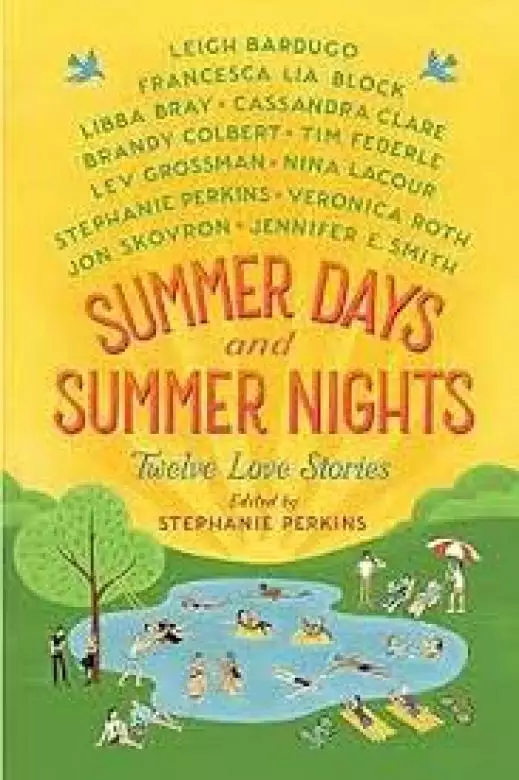
Summer Days and Summer Nights: Twelve Love Stories
- eBook
- Paperback
- Audiobook
- Hardcover
- Book info
- Sample
- Media
- Author updates
- Lists
Synopsis
Maybe it's the long, lazy days, or maybe it's the heat making everyone a little bit crazy. Whatever the reason, summer is the perfect time for love to bloom. Summer Days and Summer Nights: Twelve Love Stories, written by 12 best-selling young adult writers and edited by international best-selling author Stephanie Perkins, will have you dreaming of sunset strolls by the lake. So set out your beach chair, and grab your sunglasses. You have 12 reasons this summer to soak up the sun and fall in love.
Full list of authors includes: Tim Federle, Veronica Roth, Jon Skovron, Brady Colbert, Cassandra E. Clare, Jennifer Smith, and Lev Grossman.
Release date: September 23, 2025
Print pages: 401
* BingeBooks earns revenue from qualifying purchases as an Amazon Associate as well as from other retail partners.
Reader buzz
 Please log in to recommend or discuss...
Author updates
Summer Days and Summer Nights: Twelve Love Stories
Stephanie Perkins
Leigh Bardugo
HEAD
There were a lot of stories about Annalee Saperstein and why she came to Little Spindle, but Gracie’s favorite was the heat wave.
In 1986, New York endured a summer so miserable that anyone who could afford to leave the city did. The pavement went soft with the heat, a man was found dead in his bathtub with an electric fan half-submerged in the water next to his hairy knees, and the power grid flickered on and off like a bug light rattling with moths. On the Upper West Side, above the bakeries and delicatessens, the Woolworth’s and the Red Apple market, people slept on top of their sheets, sucked on handkerchiefs full of crushed ice, and opened their windows wide, praying for a breeze. That was why, when the Hudson leaped its banks and went looking for trouble on a hot July night, the river found Ruth Blonksy’s window wedged open with a dented Candie’s shoe box.
Earlier that day, Ruth had been in Riverside Park with her friends, eating lemon pucker ices and wearing a persimmon-colored shift that was really a vintage nightgown she’d dyed with two boxes of Rit and mixed success. Rain had been promised for days, but the sky hung heavy over the city, a distended gray belly of cloud that refused to split. Sweat beading over her skin, Ruth had leaned against the park railing to look down at the swaying surface of the river, opaque and nearly black beneath the overcast sky, and had the eerie sense that the water was looking back at her.
Then a drop of lemon ice trickled from the little pink spoon in her hand, startling as a cold tongue lapping at her pulse point, and Marva Allsburg shouted, “We’re going to Jaybee’s to look at records.”
Ruth licked the lemon ice from her wrist and thought no more of the river.
But later that night, when she woke—her sheets soaked through with sweat, a tangle of reeds at the foot of her bed—that sticky trail of sugar was what came first to mind. She’d fallen asleep in her clothes, and her persimmon shift clung wetly to her stomach. Beneath it, her body burned feverish with half-remembered dreams of the river god, a muscular shape that moved through the deep current of sleep, his gray skin speckled blue and green. Her lips felt just kissed, and her head was clouded as if she’d risen too fast from some great depth. It took a long moment for her ears to clear, for her to recognize the moss-and-metal smell of wet concrete, and then to make
predawn streets below. The heat had broken at last.
Nine months later, Ruth gave birth to a baby with kelp-green eyes and ropes of seaweed hair. When Ruth’s father kicked her out of their walk-up, calling her names in Polish and English and making angry noises about the Puerto Rican boy who had taken Ruth to her junior prom, Annalee Saperstein took her in, ignoring the neighborhood whispers and clucking. Annalee worked at the twenty-four-hour coin laundry on West Seventy-Ninth. No one was sure when she slept, because whenever you walked past, she always seemed to be sitting at the counter doing her crossword beneath the fluorescent lights, the machines humming and rattling, no matter the hour. Joey Pastan had mouthed off to her once when he ran out of quarters, and he swore the dryers had actually growled at him, so nobody was entirely surprised that Annalee believed Ruth Blonksy. And when, waiting in line at Gitlitz Delicatessen, Annalee smacked Ruth’s father in the chest with the half pound of thinly sliced corned beef she’d just purchased and snapped that river spirits were not to be trusted, no one dared to argue.
Ruth’s daughter refused milk. She would only drink salt water and eat pound after pound of oysters, clams, and tiny crayfish, which had to be delivered in crates to Annalee’s cramped apartment. But the diet must have agreed with her, because the green-eyed baby grew into a beautiful girl who was spotted by a talent scout while crossing Amsterdam Avenue. She became a famous model, renowned for her full lips and liquid walk, and bought her mother a penthouse on Park Avenue that they decorated with paintings of desert flowers and dry creek beds. They gave Annalee Saperstein a tidy sum that allowed her to quit her job at the coin laundry and move out of the city to Little Spindle, where she opened her Dairy Queen franchise.
At least, that was one of the stories about how Annalee Saperstein came to Little Spindle, and Gracie liked it because she felt it made a kind of sense. Why else would Annalee get copies of French and Italian Vogue when all she ever wore were polyester housedresses and Birkenstock sandals with socks?
People said Annalee knew things. It was why Donna Bakewell came to see her the summer her terrier got hit by a car and she couldn’t seem to stop crying—not even to sleep, or to buy a can of green beans at the Price Chopper, or to answer the phone. People would call her up and just hear her sobbing and hiccupping on the other end. But somehow a chat with Annalee managed what no doctor or pill could and dried Donna’s tears right up. It was why, when Jason Mylo couldn’t shake the idea that his ex-wife had put a curse on his new Chevy truck, he paid a late-night visit to the DQ to see Annalee. And it was also why, when Gracie Michaux saw something that looked very much like a sea monster breach the waters of Little Spindle Lake, she went looking for Annalee Saperstein.
Gracie had been sitting on the bank of what she considered her cove, a rocky crescent on the south side of the lake that no one else seemed to know or care about. It was too shady for sunbathers and devoid of the picnic tables and rope swings that drew vacationers like beacons during the tourist season. She’d been skipping stones, telling herself not to pick the scab on her knee, because she wanted to look good in the jean shorts she’d cut even shorter on her fourteenth birthday, and then doing it anyway, when she heard a splash. One, two, three humps breached the blue surface of the water, a glittering little mountain range, there and then gone, followed by the slap of—Gracie’s mind refused to accept it, and at the same time clamored—a tail.
Gracie scrabbled backward up the banks to the pines and dragged herself to her feet, heart jackrabbiting in her chest, waiting for the water to part again or for something huge and scaly to haul itself onto the sand, but nothing happened. Her mouth was salty with the taste of blood. She’d bitten her tongue. She spat once, leaped onto her bicycle, and pedaled as hard as she could down the bumpy dirt path to the smooth pavement of the main road, thighs burning as she hurtled through town.
It wasn’t much of a hurtle, because Little Spindle wasn’t much of a town. There was a mini-mart, a gas station with the town’s lone ATM, a veterinary clinic, a string of souvenir shops, and the old Rotary hall, which had become the public library after the library in Greater Spindle flooded ten years before. Little Spindle had never
gotten the traffic or the clusters of condos and fancy homes that crowded around Greater Spindle, just a smattering of rental cottages and the Spindrift Inn. Despite the fact that the lake was nearly as big as Greater Spindle and surrounded by perfectly good land, there was something about Little Spindle Lake that put people off.
The lake looked pleasant enough from a distance, glimpsed through the pines in vibrant blue flashes, sunlight spiking off its surface in jewel-bright shards. But as you got closer you started to feel your spirits sink, and by the time you were at its shore, you felt positively mournful. You’d convince yourself to walk down to the beach anyway, maybe swing out on the old tire, but as you let go of the rope, you’d hang for the briefest second above the water and you’d know with absolute certainty that you’d made a horrible mistake, that once you vanished beneath the surface, you would never be seen again, that the lake was not a lake but a mouth—hungry, blue, and sullen. Some people seemed impervious to the effects of Little Spindle, but others refused to even put a toe in the water.
The only place that did real business year round was the Dairy Queen, despite the Stewart’s only a few miles away. But why Annalee had chosen to set up shop in Little Spindle instead of Greater Spindle was a mystery to everyone but her.
Gracie didn’t head straight for the DQ that day—not at first. In fact, she got all the way home, tossed her bike down in the yard, and had her hand on the screen door before she caught herself. Eric and her mom liked to spend Saturdays in the backyard, just lying next to each other on plastic lounge chairs, snoozing, hands clasped like a couple of otters. They both worked long hours at the hospital in Greater Spindle and hoarded sleep like it was a hobby.
Gracie hovered there at the door, hand outstretched. What could she really say to her mother? Her weary mother who never stopped looking worried, even in sleep? For a moment, at the edge of the lake, Gracie had been a kid again, but she was fourteen. She should know better.
She got back on her bike and pedaled slowly, meditatively, in no direction at all, belief seeping away as if the sun was sweating it out of her. What had she actually seen? A fish maybe? A few fish? But some deeper sense must have been guiding her, because when she got to the Dairy Queen she turned into the half-full parking lot.
Peanut Buster Parfait melting in front of her. Gracie mostly knew Annalee because she liked listening to the stories about her, and because her mom was always sending Gracie to ask Annalee over for dinner.
“She’s old and alone,” Gracie’s mother would say.
“She seems to like it.”
Her mom would wave her finger in the air like she was conducting an invisible orchestra. “No one likes being alone.”
Gracie tried not to roll her eyes. She tried.
Now she slid into the hard red seat across from Annalee and said, “Do you know anything about Idgy Pidgy?”
“Good afternoon to you, too,” Annalee grumped, without looking up from her crossword.
“Sorry,” Gracie said. She thought of explaining that she’d had a strange start to her day, but instead opted for “How are you?”
“Not dead yet. It would kill you to use a comb?”
“No point.” Gracie tried to rope her slick black hair back into its ponytail. “My hair doesn’t take well to instruction.” She waited then said, “So … the monster in the lake?”
She knew she wasn’t the first person to claim she’d seen something in the waters of Little Spindle. There had been a bunch of sightings in the sixties and seventies, though Gracie’s mom claimed that was because everyone was on drugs. The town council had even tried to turn it into a tourist draw by dubbing it the Idgy Pidgy—“Little Spindle’s Little Monster”—and painting the image of a friendly-looking sea serpent with googly eyes on the WELCOME TO LITTLE SPINDLE sign. It hadn’t caught on, but you could still see its outline on the sign, and a few winters back someone had spray painted a huge phallus onto it. For the three days it took the town council to notice and get someone to paint over it, the sign looked like the Idgy Pidgy was trying to have sex with the E at the end of LITTLE SPINDLE.
“You mean like Loch Ness?” Annalee asked, glancing up through her thick glasses. “You got a sunburn.”
Gracie shrugged. She was always getting a sunburn, getting over a sunburn, or about to get a sunburn. “I mean like our lake monster.” It hadn’t been like Loch Ness. The shape had been completely different. Kind of like the goofy serpent on the town sign, actually.
“Ask that kid.”
“Which kid?”
“I don’t know his name. Summer kid. Comes in here every day at four for a cherry dip.”
Gracie gagged. “Cherry dip is vile.”
Annalee jabbed her pen at Gracie. “Cherry dip sells cones.”
“What does he look like?”
“Skinny. Big purple backpack. White hair.”
Gracie slid down in the booth, body going limp with disappointment. “Eli?”
Gracie knew most of the summer kids who had been coming to Little Spindle for a while. They pretty much kept to themselves. Their parents invited each other to barbecues, and they moved in rowdy cliques on their dirt bikes, taking over the lakes, making lines at Rottie’s Red Hot and the DQ, coming into Youvenirs right before Labor Day to buy a hat or a key chain. But Eli was always on his own. His family’s rental had to be somewhere near the north side of the lake, because every May he’d show up walking south on the main road, wearing too-big madras shorts and lugging a purple backpack. He’d slap his way to the library in a pair of faded Vans and spend the entire afternoon there by himself, then pick up his big backpack and trundle back home like some kind of weird blond pill bug, but not before he stopped at the DQ—apparently to order a cherry dip.
“What’s wrong with him?” asked Annalee.
It was too hard to explain. Gracie shrugged. “He’s a little bit the worst.”
“The cherry dip of humans?”
frames and said, “Because you’re the town sweetheart? You could use some more friends.”
Gracie tugged at the frayed end of her newly cut shorts. She had friends. Mosey Allen was all right. And Lila Brightman. She had people to eat lunch with, people who waited for her before first bell. But they lived in Greater Spindle, with most of the kids from her school.
“What would Eli Cuddy know about Idgy Pidgy, anyway?” Gracie asked.
“Spends all his time in the library, doesn’t he?”
Annalee had a point. Gracie tapped her fingers on the table, scraped more of the chipped lilac polish from her thumbnail. She thought of the story of the green-eyed baby and the river god. “So you’ve never seen anything like Idgy Pidgy?”
“I can barely see the pen in my hand,” Annalee said sourly.
“But if a person saw a monster, a real one, not like … not a metaphor, that person’s probably crazy, right?”
Annalee pushed her glasses up her nose with one gnarled finger. Behind them, her brown eyes had a soft, rheumy sheen. “There are monsters everywhere, tsigele,” she said. “It’s always good to know their names.” She took a bite of the puddle that was left of her sundae and smacked her lips. “Your friend is here.”
Eli Cuddy was standing at the counter, backpack weighting his shoulders, placing his order. The problem with Eli wasn’t just that he liked to be indoors more than outdoors. Gracie was okay with that. It was that he never talked to anyone. And he always looked a little—damp. Like his clothes were clinging to his skinny chest. Like if you touched his skin, he might be moist.
Eli planted himself in a two-seater booth and propped a book open on the slope of his backpack so he could read while he ate.
Who eats an ice cream cone like that? Gracie wondered as she watched him take weird, tidy little bites. Then she remembered those shapes moving in the lake. Sunlight on the water, her mind protested. Scales, her heart insisted.
“What’s tsigele mean?” she asked Annalee.
“‘Little goat,’” said Annalee. “Bleat bleat, little goat. Go on with you.”
Why not? Gracie wiped her palms on her shorts and ambled up to the booth. She felt bolder than usual. Maybe because nothing she said to Eli Cuddy mattered. It wasn’t like, if she made a fool of herself, he’d have anyone to tell.
“Hey,” she said. He blinked up at her. She had no idea what to do with her hands, so she planted them on her hips, then worried she looked like she was about to start a pep routine and dropped them. “You’re Eli, right?”
“Yeah.”
“I’m Gracie.”
“I know. You work at Youvenirs.”
“Oh,” she said. “Right.” Gracie worked summer mornings there, mostly because Henny had taken pity on her and let her show up to dust things for a few dollars an hour. Had Eli come in before?
He was waiting. Gracie wished she’d planned this out better. Saying she believed in monsters felt sort of like showing someone the collection of stuffed animals she kept on her bed, like she was announcing, I’m still a little kid. I’m still afraid of things that can curl around your leg and drag you under.
“You know the Loch Ness monster?” she blurted.
Eli’s brow creased. “Not personally.”
Gracie plunged ahead. “You think it could be real?”
Eli closed his book carefully and studied her with very serious, very blue eyes, the furrow between his eyebrows deepening. His lashes were so blond they were almost silver. “Did you look through my library record?” he asked. “Because that’s a federal crime.”
“What?” It was Gracie’s turn to scrutinize Eli. “No, I didn’t spy on you. I just asked you a question.”
“Oh. Well. Good. Because I’m not totally sure it’s a crime anyway.”
“What are you looking at that you’re so worried people
will see? Porn?”
“Volumes of it,” he said, in that same serious voice. “As much porn as I can get. The Little Spindle Library’s collection is small but thoughtfully curated.”
Gracie snorted, and Eli’s mouth tugged up a little.
“Okay, perv. Annalee said you might know something about Idgy Pidgy and that kind of stuff.”
“Annalee?”
Gracie bobbed her chin over to the booth by the window, where a nervous-looking man in a Hawaiian shirt had seated himself across from Annalee and was whispering something to her as he tore up a napkin. “This is her place.”
“I like cryptozoology,” Eli said. Off her blank look, he continued, “Bigfoot. The Loch Ness Monster. Ogopogo.”
Gracie hesitated. “You think all of those are real?”
“Not all of them. Statistically. But no one was sure the giant squid was real until they started washing up on beaches in New Zealand.”
“Really?”
Eli gave her a businesslike nod. “There’s a specimen at the Natural History Museum in London that’s twenty-eight feet long. They think that’s a small one.”
“No shit,” Gracie breathed.
Another precise nod. “No. Shit.”
This time Gracie laughed outright. “Hold up,” she said, “I want a Blizzard. Don’t go anywhere.”
He didn’t.
* * *
That summer took on a wavy, loopy, lazing shape for Gracie. Mornings she “worked” at Youvenirs, rearranging knickknacks in the windows
and pointing the rare customer toward the register. At noon she’d meet up with Eli and they’d go to the library or ride bikes to her cove, though Eli thought another sighting there was unlikely.
“Why would it come back here?” he asked as they stared out at the sun-dappled water.
“It was here before. Maybe it likes the shade.”
“Or maybe it was just passing through.”
Most of the time they talked about Idgy Pidgy. Or at least that was where their conversations always started.
“You could have just seen fish,” Eli said as they flipped through a book on North American myths, beneath an umbrella at Rottie’s Red Hot.
“That would have to be some really big fish.”
“Carp can grow to be over forty pounds.”
She shook her head. “No. The scales were different.” Like jewels. Like a fan of abalone shells. Like clouds moving over water.
“You know, every culture has its own set of megafauna. A giant blue crow has been spotted in Brazil.”
“This wasn’t a blue crow. And ‘megafauna’ sounds like a band.”
“Not a good band.”
“I’d go see them.” Then Gracie shook her head. “Why do you eat that way?”
Eli paused. “What way?”
“Like you’re going to write an essay about every bite. You’re eating a cheeseburger, not defusing a bomb.”
But Eli did everything that way—slowly, thoughtfully. He rode his bike that way. He wrote things down in his blue spiral notebook that way. He took what seemed like an hour to pick out something to eat at Rottie’s Red Hot when there were only five things on the menu, which never changed. It was weird, no doubt, and Gracie was glad her friends from school spent most of their summers around Greater Spindle so she didn’t have to try
to explain any of it. But there was also something kind of nice about the way Eli took things so seriously, like he really gave everything his full attention.
They compiled lists of Idgy Pidgy sightings. There had been less than twenty in the town’s history, dating back to the 1920s.
“We should cross reference them with Loch Ness and Ogopogo sightings,” said Eli. “See if there’s a pattern. Then we can figure out when we should surveil the lake.”
“Surveil,” Gracie said, doodling a sea serpent in the margin of Eli’s list. “Like police. We can set up a perimeter.”
“Why would we do that?”
“It’s what they do on cop shows. Set up a perimeter. Lock down the perp.”
“No TV, remember?” Eli’s parents had a “no screens” policy. He used the computers at the library, but at home it was no Internet, no cell phone, no television. Apparently, they were vegetarians, too, and Eli liked to eat all the meat he could when they left him to his own devices. The closest he got to vegetables was french fries. Gracie sometimes wondered if he was poor in a way that she wasn’t. He never seemed short of money for the arcade or hot pretzels, but he always wore the same clothes and always seemed hungry. People with money didn’t summer in Little Spindle. But people without money didn’t summer at all. Gracie wasn’t really sure she wanted to know. She liked that they didn’t talk about their parents or school.
Now she picked up Eli’s notebook and asked, “How can we surveil if you don’t know proper police procedure?”
“All the good detectives are in books.”
“Sherlock Holmes?”
“Conan Doyle is too dry. I like Raymond Carver, Ross Macdonald, Walter Mosley. I read every paperback they have here, during my noir phase.”
Gracie drew bubbles coming out of Idgy Pidgy’s nose. “Eli,” she said, without looking at him, “do you actually think I saw something in the lake?”
“Possibly.”
came out meaner than she’d meant it to, maybe because the answer mattered.
Eli cocked his head to one side, thinking, seeking an honest answer, like he was solving for x. “Maybe a little,” he said at last.
Gracie nodded. She liked that he hadn’t pretended something different. “I’m okay with that.” She hopped down off the table. “You can be the stodgy veteran with a drinking problem, and I’m the loose cannon.”
“Can I wear a cheap suit?”
“Do you have a cheap suit?”
“No.”
“Then you can wear the same dumb madras shorts you always do.”
* * *
They rode their bicycles to every place there had ever been an Idgy Pidgy sighting, all the way up to Greater Spindle. Some spots were sunny, some shady, some off beaches, others off narrow spits of rock and sand. There was no pattern. When they got sick of Idgy Pidgy, they’d head over to the Fun Spot to play skee ball or mini golf. Eli was terrible at both, but he seemed perfectly happy to lose to Gracie regularly and to tidily record his miserable scores.
On the Friday before Labor Day, they ate lunch in front of the library—tomato sandwiches and cold corn on the cob that Gracie’s mother had made earlier that week. A map of the US and Canada was spread out on the picnic table before them. The sun was heavy on their shoulders and Gracie felt sweaty and dull. She wanted to go to the lake, just to swim, not to look for Idgy Pidgy, but Eli claimed it was too hot to move.
“There’s probably a barbecue somewhere,” she said, lying on the bench, toes digging in the dead grass beneath the table. “You really want to waste your last school-free Friday just looking at maps in the middle of town?”
“Yeah,” he said. “I really do.”
Gracie felt herself smiling. Her mother seemed to want to spend all of her time with Eric. Mosey and Lila lived practically next door to each other and had been best friends since they were five. It was nice to have someone prefer her company, even if it was Eli Cuddy.
She covered her eyes with her arm to block the sun. “Do we have anything to read?”
“I returned all my books.”
“Read me town names off the map.”
“Why?”
“You won’t go swimming, and I like being read to.”
Eli cleared his throat. “Burgheim. Furdale. Saskatoon…”
Strung together, they sounded almost like a story.
* * *
Gracie thought about inviting Eli when she went to see the end-of-season fireworks up at Ohneka Beach the next night, with Lila and Mosey, but she wasn’t quite sure how to explain all the time she’d been spending with him, and she thought she should sleep over at Mosey’s place. She didn’t want to feel completely left out when classes started. It was an investment in the school year. But when Monday came and there was no Eli walking the main road or at the DQ, she felt a little hollow.
“That kid gone?” Annalee asked as Gracie poked at the upended cone in her dish. She’d decided to try a cherry dip. It was just as disgusting as she remembered.
“Eli? Yeah. He went back to the city.”
“He seems all right,” said Annalee, taking the cup of ice cream from Gracie and tossing it in the trash.
“Mom wants you to come for dinner on Friday night,” Gracie said.
But she could admit that maybe Eli Cuddy was better than all right.
* * *
been, plenty of times, over the school year. She’d done her homework there until the air turned too cold for sitting still, then watched ice form on the edges of the water as winter set in. She’d nearly jumped out of her skin when a black birch snapped beneath the weight of the frost on its branches and fell into the shallows with a resigned groan. And on that last Friday in May, she made sure she was on the shore, skipping stones, just in case there was magic in the date or the Idgy Pidgy had a clock keeping time in its heart. Nothing happened.
She went by Youvenirs, but she’d been in the previous day to help Henny get ready for summer, so there was nothing left to do, and eventually she ended up at the Dairy Queen with an order of curly fries she didn’t really want.
“Waiting for your friend?” Annalee asked, as she sifted through her newspaper for the crossword.
“I’m just eating my fries.”
When she saw Eli, Gracie felt an embarrassing rush of relief. He was taller, a lot taller, but just as skinny, and damp, and serious looking as ever. Gracie didn’t budge, her insides knotted up. Maybe he wouldn’t want to hang out again. That’s fine, she told herself. But he scanned the seats even before he went to the counter, and when he saw her, his pale face lit up like silver sparklers.
Annalee’s laugh sounded suspiciously like a cackle.
“Hey!” he said, striding over. His legs seemed to reach all the way to his chin now. “I found something amazing. You want a Blizzard?”
And just like that, it was summer all over again.
SCALES
The something amazing was a dusty room in the basement of the library, packed with old vinyl record albums, a turntable, and a pile of headphones tucked into a nest of curly black cords.
“I’m so glad it’s still here,” Eli said. “I found it right before Labor Day, and I was afraid someone would finally get around to clearing it out over the winter.”
Gracie felt a pang of guilt over not spending that last weekend with Eli, but she was also pleased he’d been waiting to show her this. “Does that thing work?” she asked, pointing to the column of stereo gear.
Eli flipped a couple of switches and red lights blinked on. “We are go.”
Gracie slid a record from the shelves and read the title: Jackie Gleason: Music, Martinis, and Memories. “What if I only want the music?”
“We could just listen to a third of it.”
They made a stack of records, competing to find the one with the weirdest cover—flying toasters, men on fire, barbarian princesses in metal bikinis—and listened to all of them, lying on the floor, big black headphones hugging their ears. Most of the music was awful, but a few albums were really good. Bella Donna had Stevie Nicks on the cover dressed like an angel tree-topper and holding a cockatoo, but they listened to it all the way through, twice, and when “Edge of Seventeen” came on, Gracie imagined herself rising out of the lake in a long white dress, flying through the woods, hair like a black banner behind her.
It wasn’t until she was pedaling home, stomach growling for dinner, singing Ooh baby ooh baby ooh, that Gracie realized she and Eli hadn’t talked about Idgy Pidgy once.
* * *
Though Gracie hadn’t exactly been keeping Eli a secret from Mosey and Lila, she hadn’t mentioned him, either. She just wasn’t sure they’d get him. But one afternoon, when she and Eli were eating at Rottie’s Red Hot, a horn blared from the lot, and when Gracie looked around, there was Mosey in her dad’s Corolla, with Lila in the passenger seat.
“Don’t you only have a learner’s permit?” she asked, as Mosey and Lila squeezed in on the round benches.
have to drive me. Where have you been, anyway?” Mosey glanced pointedly at Eli.
“Nowhere. Youvenirs. The usual.”
Eli said nothing, just carefully parceled out ketchup into a lopsided steeple by his fries.
They ate. They talked about taking the train into the city to see a concert.
“How come your family doesn’t stay at Greater Spindle?” Mosey asked.
Eli cocked his head to one side, giving the question his full consideration. “We’ve just always come here. I think they like the quiet.”
“I like it, too,” said Lila. “Not the lake so much, but it’s nice in the summer, when Greater Spindle gets so crazy.”
Mosey popped a fry in her mouth. “The lake is haunted.”
“By what?” asked Eli, leaning forward.
“Some lady drowned her kids there.”
Lila rolled her eyes. “That’s a complete lie.”
“La Llorona,” said Eli. “The weeping woman. There’s legends like that all over the place.”
Great, thought Gracie. We can all start hunting ghosts together.
She tried to ignore the squirmy feeling in her gut. She’d told herself that she hadn’t wanted to introduce Eli to Mosey and Lila because he was so odd, but now she wasn’t sure. She loved Mosey and Lila, but she always felt a little alone around them, even when they were sitting together at a bonfire or huddled in the back row of the Spotlight watching a matinee. She didn’t want to feel that way around Eli.
When Mosey and Lila headed back to Greater Spindle, Eli gathered up their plastic baskets on a tray and said, “That was fun.”
“Yeah,” Gracie agreed, a bit too enthusiastically.
“Let’s take bikes to Robin Ridge tomorrow.”
“Everyone?”
The furrow between Eli’s brows appeared. “Well, yeah,” he said. “You and me.”
Everyone.
TEETH
Gracie couldn’t pinpoint the moment Eli dried out, only the moment she noticed. They were lying on the floor of Mosey’s bedroom, rain lashing at the windows.
She’d gotten her driver’s license that summer, and her mom’s boyfriend didn’t mind loaning Gracie his truck once in a while so she could drive up to Greater Spindle. Gas money was harder to come by. There were better jobs in Greater Spindle, but none that were guaranteed to correspond with Gracie’s mother’s shifts, so Gracie was still working at Youvenirs, since she could get there on her bike.
It felt like Little Spindle was closing in on her, like she was standing on a shore that got narrower and narrower as the tide came in. People were talking about SATs and college applications and summer internships. Everything seemed to be speeding up, and everyone seemed to be gathering momentum, ready to go shooting off into the future on carefully plotted trajectories, while Gracie was still struggling to get her bearings.
When Gracie started to get that panicked feeling, she’d find Eli at the Dairy Queen or the library, and they’d go down to the “Hall of Records” and line up all of the Bowie albums, so they could look at his fragile, mysterious face, or they’d listen to Emmett Otter’s Jug-Band Christmas while they tried to decipher all the clues on the cover of Sgt. Pepper’s. She didn’t know what she was going to do when the school year started.
They’d driven up to Greater Spindle in Eric’s truck without much of a plan, radio up, windows down to save gas on air-conditioning, sweating against the plastic seats, but when the storm had rolled in they’d holed up at Mosey’s to watch movies.
Lila and Mosey were up on the bed painting their toes and picking songs to play for each other, and Gracie was sprawled out on the carpet
with Eli, listening to him read from some boring book about waterways. Gracie wasn’t paying much attention. She was on her stomach, head on her arms, listening to the rain on the roof and the murmur of Eli’s voice, and feeling okay for the first time in a while, as if someone had taken the hot knot of tension she always seemed to be carrying beneath her ribs and dunked it in cool water.
The thunder had been a near continuous rumble, and the air felt thick and electrical outside. Inside, the air-conditioning had raised goose bumps on Gracie’s arms, but she was too lazy to get up to turn it down, or to ask for a sweater.
“Gracie,” Eli said, nudging her shoulder with his bare foot.
“Mmm?”
“Gracie.” She heard him move around, and when he spoke again, he had his head near hers and was whispering. “That cove you like doesn’t have a name.”
“So?”
“All the little beaches and inlets have names, but not your cove.”
“So let’s name it,” she mumbled.
“Stone … Crescent?”
She flopped on her back and looked up at the smattering of yellow stars stuck to Mosey’s ceiling. ...
We hope you are enjoying the book so far. To continue reading...
