
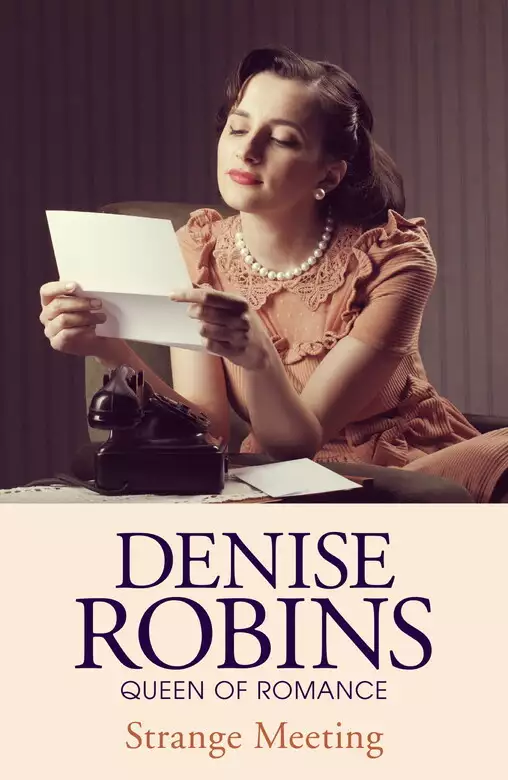
Strange Meeting
- eBook
- Paperback
- Book info
- Sample
- Media
- Author updates
- Lists
Synopsis
When Clare Farramond goes to the historic home of Sir Stephen Finch-Boyes, there to act as a tutor to his young daughter, Isabel, it is with sadness in her heart. For still alive within her is the memory of Michael - the man who had been her whole world - the man who had sworn her his undying love. The man who had betrayed her. A captivating love story from the 100-million-copy bestselling Queen of Romance, first published in 1952, and available now for the first time in eBook.
Release date: August 14, 2014
Publisher: Hodder & Stoughton
Print pages: 192
* BingeBooks earns revenue from qualifying purchases as an Amazon Associate as well as from other retail partners.
Reader buzz
 Please log in to recommend or discuss...
Author updates
Strange Meeting
Denise Robins
And when, instead, Grief met me by the way
Most strange and bitter words I found to say.’
PHILIP B. MARSTON.
THE first person to see the notice about Doria in the newspapers was Uncle Phipps.
Clare was cooking breakfast in the kitchen of the shabby villa in Seaford where she had lived since she was a child. She had just taken poor Auntie Vi, who was bedridden, her cup of tea and been told she was late. She had burnt the toast and the milkman had not come. Everything seemed to be going wrong and she was in a special hurry because she wanted to get things straight, then catch her train to London. She was meeting Michael for lunch.
Then Uncle Phipps with his glasses on the end of his nose and looking quite excited, thrust the paper in front of her nose.
‘Look at that, my dear—just imagine!’
Clare snatched another slice of bread from burning. Uncle Phipps pointed to a paragraph marked:
Covent Garden Ballet.
When Clare read the rest of it, her cheeks burned red and her heart missed a beat. It said:
Doria’s triumph in The Sleeping Beauty.
There followed the usual criticism of decor and choreography. But most of it was about Doria.
A new and great ballerina has come into our midst. The audience was spell-bound by the perfection of Doria’s dancing, especially in Act II. Small and delicately built and yet with incredible strength and buoyancy of limb, she moved with a poetry and fire that remind us of Karsavina at her best. Last night Covent Garden was marked by a touch of pre-war brilliance. Her Majesty the Queen, the Duke of Edinburgh and Princess Margaret, were in the Royal Box. Afterwards Doria was presented to them. …
Clare read every word with deep pride. Doria was her sister. Her own sister. What a wonderful thing! What a reward for all the years of hard work which Doria had put in since she was a tiny child.
‘Oh, Uncle Phipps!’ broke out Clare, ‘I just can’t get over it!’
The old man who was a retired schoolmaster—vague and gentle—devoted to this young niece who had done so much for him since his wife’s illness, smiled and patted Clare’s shoulder. He had known that she would be pleased, and it was so typical of her not to be jealous.
He and Vi had never been able to give her much. She had been with them since she was a child of four. His brother and sister-in-law had died together in an air-disaster. Phipps and Violet Farramond had taken the two little orphaned daughters, Dorothy and Clare.
But it was only Clare who remained with them. Dorothy—older by a couple of years—had played only a brief part in this small house where so much rigid economy was practised, and where there was more work than play.
Dorothy had always been as beautiful as an angel. At the age of six she had attracted the attention of a famous ex-ballerina, married to a peer of the realm and enormously rich, who had gone down to Seaford to open a local fête. There Lady Carradine had seen Dorothy dancing.
Lady Carradine, who was childless, had offered to adopt the child and train her. And after that Dorothy virtually vanished from Clare’s life. At first the sisters used to meet occasionally, but the opportunities gradually grew less because Dorothy (who had taken the stage name of Doria) was more often than not in France where her adoptive mother owned a villa; and much of her training took place in Paris. Finally Clare and Dorothy saw nothing of each other at all.
In Uncle Phipps’s estimation, young Dorothy had not shown up too well—so completely neglecting her own sister. But Clare even as a small child had always loved the other girl with the passionate sort of admiration that the plainer and less spectacular member of the family so often gives to the glamorous one.
She excused Doria—a great artiste has no life of her own. Doria belonged to the Carradines—and to ballet. It was enough that sometimes she sent Clare wonderful parcels from France or America. And in latter years she had taken the trouble to come down to Seaford in her magnificent Cadillac to take Clare out. She usually sent her home with armfuls of lovely, expensive presents. Doria could be generous.
During the last two years, the sisters had not been able to meet because the young ballerina had been touring the Colonies. Clare had known that she was back now and due to dance at Covent Garden. She had sent Clare a telegram announcing her arrival. Doria never had time to write letters.
Clare exclaimed:
‘Oh, I’m so glad for her! I shall ring her up as soon as I get to town, I must congratulate her!’
Then Clare caught sight of herself in the spotted mirror which hung on the kitchen wall. Her young slender body which, for a moment, had pulsated with life and taken on a grace of its own, stiffened. Her eyes lost their sparkle. She became once more the rather plain ordinary girl whom few men would look at twice.
Playing a piano—that was all she was good for, she told herself with a wry smile. Well, she had at least succeeded there. She had always been the ‘ugly duckling’. Shy and retiring and unobtrusive. But if Doria had dancing in her blood, Clare was genuinely musical, and her aunt and uncle had encouraged her to study the piano. Only a week ago she had taken a degree. Now, at the age of twenty-one she was all set for a career as a teacher of music. She wanted a career; until Michael could afford to marry her.
Doria did not know about the degree. And Doria did not know about Michael.
Clare cheered up again at the thought of her engagement. These last six months as Michael Gorringe’s fiancée had done much to cure her inferiority complex. He was a young doctor who had only recently qualified. She had met him through his sister, Pamela, who was studying music at Trinity College at the same time as Clare.
Brother and sister shared a flat in South Kensington. Clare used to go to little parties there (when she could get away from her duties at Seaford). Michael loved music and liked to hear her play. At first she had been shy and awkward with him; he was so good-looking and had enough charm to make any girl—even the most glamorous one—look at him twice. Clare had no illusions about herself. She was much too thin. She had straight long fair hair which she never knew how to do, a pale little face with sharp bones and grey serious eyes. She could not afford to be chic, and she was more interested in books and music than make-up. But Michael took her out several times and seemed to enjoy her company. They queued happily together for seats at the ballet, or for the opera. Clare, who was a good listener, listened very earnestly to Michael’s plans for his future. She rarely talked about herself. Which—to her surprise—seemed to make her more acceptable as a girl-friend to the handsome Michael than the prettier ones who demanded a fellow’s constant attention.
Then one night Michael asked her to marry him.
Then it seemed to Clare that a miracle had taken place in her life.
It was a transformed Clare who took Dr. Michael Gorringe down to Seaford as her fiancé, to meet Uncle Phipps and Auntie Vi.
All this would be news to Doria, thought Clare this morning as she caught her train to London. She had only been engaged for the last six months. And now, with all the papers which she could afford to buy, full of Doria’s triumph in The Sleeping Beauty, Clare decided that it was high time that she told Michael about their relationship. She had never said much about the other girl. He only knew vaguely that Clare had a sister called ‘Dorothy’, who had been adopted when she was six and taken abroad, and who these days was virtually a stranger to Clare.
She must show him these marvellous reviews tonight. It would be a thrill for him to learn that he had such a distinguished future sister-in-law.
In a call-box at the station, Clare spoke to Doria. Phoning her was something Clare rarely did. A secretary answered. Then came Doria’s voice on the phone, dulcet as a flute, full of lazy sweetness.
‘Well, well, hallo, my little sister Clare. What an unexpected pleasure! Tell me all about yourself.’
‘Oh, Doria, first of all I must say how proud we all are of you. We have seen the papers. Oh, Doria, what does it feel like to be such a success?’
‘It feels quite good,’ Doria answered with a laugh, ‘the critics have been kind to me—haven’t they?’
‘Your dancing must be wonderful!’
‘The same generous little Clare! You always were so sweet about me, and I have always felt so sorry that your life has been so drab compared with mine. I was lucky——’
‘Oh, but I’m lucky, too,’ broke in Clare, ‘I have wonderful news for you, Doria, about myself. I am going to be married—later on, when my fiancé has made his way. I’m starting my career, too, as a music-teacher—I’ve got my degree, and——’
‘Darling, congratulations,’ broke in Doria, ‘I’m particularly glad about your engagement. A love affair was just what you needed to bring you out of your shell.’
‘Oh, but it’s more than an affair. I love Michael!’ exclaimed Clare.
‘Darling, you always were much too romantic and serious.’ Doria’s laugh tinkled again, then she added: ‘I can’t stop now, sweet. You must come and see me and tell me all about things. My secretary says that there are six reporters waiting for an interview. I simply must get up.’
‘Where can I see you?’ asked Clare.
‘I’ll leave two seats for tonight at the Box Office for you. You can treat your fiancé and afterwards bring him round to my dressing-room. Till then, good-bye, darling.’
‘I can’t——’ began Clare.
But Doria had rung off. Clare came out of the call-box flushed and dazzled. How like Doria—a queen who gives orders and expects them to be obeyed! She did not anticipate a refusal. Clare would just have to stay up in town and go to the ballet tonight. Of course, it would be a terrific thrill … to see Doria in The Sleeping Beauty; to take Michael and point out the new star and tell him that it was her sister.
The Gorringes would put her up. She had snatched a night on their sofa before now. Fortunately Pam took the same size in shoes, and had the same sort of figure. She could borrow a dinner-dress from Pam. And she would wire Uncle Phipps and explain why she couldn’t get back home tonight.
This morning Clare felt on top of the world. She also made an important decision. She wouldn’t tell Michael that Doria was her sister until the ballet was over. She would say
‘Now you must come and meet Doria. I’m going to take you round to see her.’
And then she would tell him why. It would be an enormous surprise. She could imagine how impressed he would be.
Her whole being became concentrated on the thought of the glorious evening in front of her, and the big thrill she had in store for Michael.
CLARE and Michael were sitting in the front row of the Grand Circle.
Covent Garden was packed. Despite the times, the greater part of the audience was in evening dress. The ballet was just about to begin. The orchestra was tuning up. There was that breathless hush in the house which is the very essence of excitement; for a new great ballerina was about to dance.
Michael Gorringe kept whispering to his fiancée:
‘I don’t know how you got such marvellous seats. I can’t understand it.’
And Clare laughed and whispered back:
‘Wait and see. I’ll tell you later.’
She wanted tonight to be absolutely perfect. But it had not started too well. Michael had not reacted as she had anticipated, to her excited announcement that she had been given these tickets.
‘Yes, I know Doria is dancing but I am not at all sure that I want to go,’ he had said.
She had been so upset that afterwards he relented and said that he would take her. First they had supper together in a restaurant in Soho. But even there, he was not in festive mood.
She had been puzzled by his silence, his restless air. At times he had seemed quite distrait—he had not listened to a word she said. It had made her realize then that he had not really been himself for some time; and although she had tried not to admit it, she had been forced to the conclusion that his attitude towards her, personally, was abnormal. He had made hard work at hospital the excuse for not seeing as much of her as usual, and when they did meet she had fancied that his kisses lacked some of their old fervour; that it was difficult to drag a smile out of him.
She had not dared let herself be seriously affected by all this. Michael was a hard-worked doctor. No doubt he was tired, as well as worried over some of his patients. With tenderness and discretion she had refrained from questioning him about these new black moods.
But she had hoped that he would enjoy this evening. And here he was, sitting beside her with folded arms—staring grimly in front of him as though he were witnessing a funeral instead of one of the most dazzling ballets ever produced.
Clare made no remarks but it was difficult not to feel disappointed. He had not even told her how nice she looked, although Pam’s white chiffon evening blouse and long black skirt suited her. She had a fine, milk-white skin and had put on more make-up than usual. It suited her—that touch of colour. The hairdresser had set her hair in soft waves, drawn back into a classic knot. She had never looked more attractive and had hoped that Michael would notice it.
‘He’ll soon be so thrilled with Doria’s dancing that he’ll snap out of this mood,’ Clare told herself, trying to be optimistic.
But he did not snap out of it, even when the lights were lowered and Tchaikovsky’s beautiful music began to stir the Opera House.
Clare gazed rapturously at her sister when she first came floating on to the stage. The whole audience seemed electrified by the pure radiance and ethereal grace of this new Aurora. Those amazing insteps of Doria’s were already famous. She moved with a breathtaking balance. It seemed to Clare that this could not possibly be her own sister—this moonbeam creature with her golden hair, long doe-like eyes, blue-lidded, heavily lashed—that languorous red mouth—the matchless arms and tapering fingers. Every gesture, every movement was significant. One of the great male ballet-dancers of the day partnered her. Clare, while she watched and listened to the noble and emotional music, had a fleeting and tender memory of this same Doria—dancing at the fête in Seaford, seventeen years ago; when the tiny embryo-ballerina had been singled out by the former ‘star’ who marked her down as a genius. How, when they had got home, Doria—then Dorothy—had pirouetted in front of the mirror in Uncle Phipps’s house and cried: ‘Look at how I dance. I am the best dancer in the world!’
They had all laughed at this childish display of vanity from a six-year-old—intoxicated by her first success. But her words had come true. She would take her place now with Fonteyn—with Markova—and with the others. Even with the great Russian ballerinas of the past.
Clare stole a glance at Michael. He was staring at the stage. His face looked drawn and expressionless. And every time she looked at him, some of Clare’s own happiness evaporated. Michael must be ill. He must be.
At the end of the pas de deux when—in her bridal gown of shimmering satin—Doria had danced as though she was inspired—the whole house broke into long-sustained applause.
Michael, too, clapped his hands. But it seemed to Clare that he did so mechanically—without enthusiasm.
‘Don’t you think she is glorious?’ Clare asked Michael. His answer seemed almost grudging.
‘Y-yes!’
Clare was bewildered. But she shrugged her shoulders, turned to the stage and lost herself again in the glamorous beauty of that final act. So lovely was the music and so moving and breathtaking the manner in which the young ballerina interpreted her part, Clare was reduced to tears. She gripped her fiancé’s hand.
‘Oh, Michael …’ she whispered. ‘Michael, darling.’
He squeezed her hand in sympathetic response, but his own face was white and curiously bitter. It was as well that the young girl who loved him in her quiet and uncomplicated fashion could not know what was in his mind. When the last bouquet had been handed up to Doria, and the final curtain had fallen; when the house buzzed and hummed with life and laughter and voices again, Clare smiled at her fiancé.
‘Now for the big surprise.’
‘What’s that?’ He gave her a faint smile in return.
‘We’re going round to see Doria.’
He changed colour.
‘We can’t possibly.’
‘But why not?’
‘It’s too late. We’ve got to get home.’
‘Nonsense, darling. It isn’t late. And we’re not in any particular hurry. You have your key. Pam said that she wouldn’t wait up for us.’
‘Doria won’t see us, anyhow,’ he added brusquely.
‘But she will. I’ve been specially invited.’
They had moved with the crowd into the foyer. Michael, who was carrying a light waterproof, tore his programme in half.
He said, ‘Must I be forced to go round to the stage door? You’ve already dragged me here, when I didn’t want to come.’
Clare’s eyes opened wide. Her heart sank. Never before had Michael spoken to her like this.
‘Oh, Mike—but I thought you adored The Sleeping Beauty, and would love to meet Doria.’
‘I’d rather go home.’
‘Oh, Michael—you’re spoiling everything. You’re spoiling my big surprise,’ she exclaimed, and felt the childish tears rush to her eyes.
He set his teeth.
‘Why must we go round to see Doria? If it’s just to get her autograph surely you can get it some other time—when I am not with you.’
Clare took a grip on herself. He had indeed spoilt the evening. She felt crushed. Then she made the announcement which she had intended to be so thrilling and exciting for them both.
‘You don’t, of course, realize … how I got these tickets … why I want so much to take you to see Doria. Mike—she is my sister.’
The young doctor stood still. Most of the audience had vanished—to their waiting cars or taxis, or into the Tube. The theatre lights were being turned out one by one. Michael looked so astounded and he had grown so pale that Clare felt a thrill of fear.
‘Michael, are you ill?’ she asked.
He did not answer her. Then with apparent difficulty he said:
‘Doria—your sister? Are you mad? Is this your idea of a joke?’
‘Not at all. She is my sister. I told you I had a sister who had been adopted when she was tiny and whom I rarely ever saw, and who had become a ballet-dancer.’
He made a gesture of bewilderment.
‘But you never said that she was Doria. I can’t remember now—because you haven’t spoken much about her—but I seem to think you said that your sister’s name was Dorothy.’
‘So it used to be. She took the name “Doria” for her career. I’ve never boasted about her to anybody. I don’t boast—and she’s been away in Canada and Australia ever since you and I got to know each other. That’s why I’ve hardly mentioned her.’
The young doctor shook his head and drew a hand across his eyes. He looked like a man in a trance.
Clare, watching him anxiously, shivered although it was a warm night in June. She took his arm and walked with him out on to the pavement. She was beginning to see how completely her lovely plans for a ‘surprise’ had failed. Something was terribly wrong with Michael. He did not even seem pleased to hear that Doria was related to her.
‘Please come round to Doria’s dressing-room with me,’ she begged him, ‘surely you want to meet my wonderful sister.’
Then the red blood crept up under Michael’s skin. He drew a deep breath, took hold of one of Clare’s hands and looked with a tragic expression down at her worried young face. He noticed for the first time how unusually pretty she looked in Pam’s clothes and how well that new hair-style suited her. She wasn’t beautiful but she had distinct charm and he had always found a strong appeal in her fragile build; her long fair hair and the delicacy of her wrists and ankles. She had something which made a man feel that she needed to be protected and looked after. Yet, as Michael knew, her physical slenderness was a paradox, Clare was quite strong really; spiritually a rock. She had a fine loyal nature. If only Doria had not been related to her, all might have been well. He might have got through this crisis and put things right between them.
Suddenly he decided he was making a spectacle of himself and of Clare, arguing here in the street. The neon lights which spelt out the words The Sleeping Beauty and Doria suddenly went out. The young doctor, with a fatalistic look, surrendered himself to the inevitable.
‘Very well, take me to see your sister,’ he said in a low voice.
Clare was silent as they followed the stage doorkeeper to the ballerina’s dressing-room. But for Michael’s peculiar attitude, Clare would have been thrilled by the atmosphere behind the scenes. The sight of various members of the corps de ballet, with their heavily painted faces and short classic tulle skirts. But she could not begin to understand what was the matter with her fiancé.
Now they were in Doria’s brilliantly lighted dressing-room. It was crowded with people. Clare’s spirits rose again as she saw her sister seated in her chair, receiving homage like a queen with a dazzling smile, talking, laughing, gesticulating while she wiped the grease paint from her face. Then Doria saw her and exclaimed:
‘Why, it’s my very own little sister! Clare, my pet!’
Clare forgot everything else and rushed forward into her arms. Doria looked her up and down, laughed and patte. . .
We hope you are enjoying the book so far. To continue reading...
