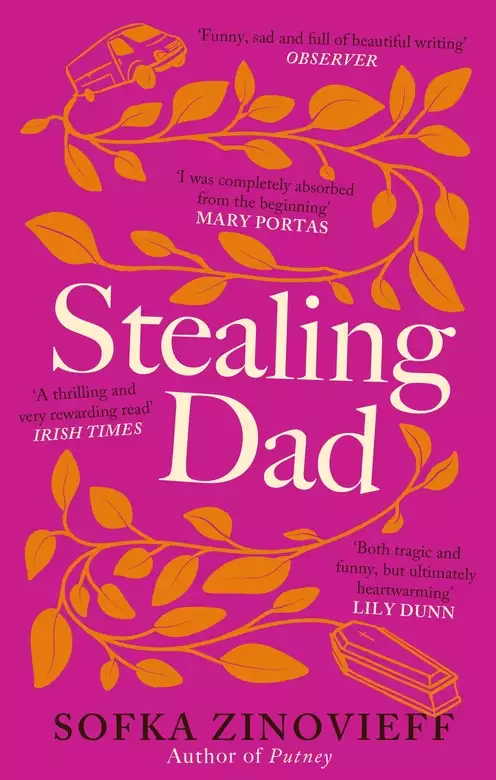
'Funny, sad and beautifully written' Telegraph 'I was completely absorbed from the beginning' Mary Portas 'A brilliant depiction of a complex sprawling family with a charismatic lovable rogue at its centre. It is both tragic and funny, but ultimately heartwarming' Lily Dunn
What do you do when you're not allowed to attend your father's funeral?
This is the question facing Alekos's far-flung children from many marriages when the successful, if controversial, Greek sculptor dies in London. His last wife and now widow is determined that they stay away, but for the first time, all the sisters and brothers meet up and plan to take matters into their own hands.
Wonderfully written and sharply funny, Stealing Dad tells the unlikely story of a dysfunctional family coming together in tragic yet hilarious ways, from acclaimed author of Putney, Sofka Zinovieff.
Release date:
May 8, 2025
Publisher:
Little, Brown Book Group
Print pages:
80000
* BingeBooks earns revenue from qualifying purchases as an Amazon Associate as well as from other retail partners.
It was Indigo who rang Iris in Athens to let her know. He didn’t prepare the ground. No, ‘I’ve got bad news,’ or, ‘I need to tell you something.’ Just a simple, ‘Dad’s dead!’ Her brother had surely made a mistake, though he continued with details. Walking. Collapsed. The canal. Early morning. A passing dog-walker. Possible heart attack.
‘That can’t be right,’ she said. Alekos isn’t someone who subsides on a towpath. He would go down in a fireball or be torn limb from limb. Suicide? Possibly. Drowning could have worked, though not in the filthy chill of a London waterway. It would be swimming the Hellespont or shredded by sharks. He was that sort of man.
‘What was he doing there by the canal in the morning?’ She wanted explanations, as if they would crack a larger enigma.
‘They don’t know. Apparently he was wearing work clothes – that French blue kit. And his old black cap. Taking a stroll, maybe?’ Indigo sounded dubious. Their father was usually in pursuit – searching, struggling, creating. Either that or swallowed up by drink and losing all direction. He didn’t stroll. Her brother said that Heather, their latest stepmother, had gone to identify him at the hospital: next of kin.
Iris’s body turned to stone or maybe salt, the heavy solidity precarious, liable to dissolve in water. She grasped the doorway onto the kitchen balcony facing the rear of other apartment blocks, their elevated backyards packed with mops and tired plants. It was the spot where she once felt a small earthquake and the experience was comparable. What is fixed moves. Concrete could wobble like jelly. Alekos could die. Indigo waited while she wept and a neighbour’s caged cockatoo squealed its grievances in counterpoint.
‘How is Heather?’
‘As you’d expect.’ Indigo’s words were like a trick answer; what could you expect? In the beginning, Iris hadn’t expected Heather to last. How could Alekos the Terrible marry a woman with a tidy bob and velour tracksuits, a physiotherapist in her early forties who baked ornamental cakes? It didn’t make sense. True, she was younger than him but not in an outrageous way – now in her early fifties. And at least this one was some years older than Dora. As his sixth wife, Heather wasn’t going to start cooking Christmas lunches for swarms of stepchildren, but then the family had never done much gathering up the motley clan. At ten years, this was his longest marriage. And now Heather was his widow. Finally, after all the transformations, Alekos had achieved a guaranteed forever.
‘Do any of the others know?’ Iris assumed Indigo would understand even if, as sisters and brothers, they were hardly a group. He said that Esme had rung him with the news.
‘Did you already speak to Dora?’ she persisted. People often told her older sister things first, keeping Dora a few steps ahead and Iris the perpetual runner-up, filled since childhood with pure love for her and smouldering fury.
‘No.’ Indigo hesitated then admitted, ‘I tried, but her phone was engaged.’
‘I’ll tell her.’ Even at that moment of devastation Iris sensed a small adjustment in the sisterly power balance. ‘The twins?’
‘Still too early in America, isn’t it?’
‘I’ll call them later.’
Indigo thanked her. ‘I’ll let you know when there’s any news. And of course, there’s Willow.’
‘Oh god!’ Who would forget they had a new sister? True, their only encounters had been a couple of video calls, but still … Iris remembered the teenager blinking into her screen, facing the reality that as the only child of a single mother, she had suddenly acquired not only a father, but a tangle of six, much older half-brothers and sisters scattered around the world. ‘Can you tell her?’ Iris didn’t envy Indigo that task.
Iris messaged Dora immediately, saying she needed to see her urgently and was coming over. Always better to bear bad news in person, her mother had once declared, and Iris agreed. Out on the street, the heat was like a giant oven door left open, the scent of freshly baked flat bread from the Georgian bakery only adding to the illusion. Hussein stood in the doorway of his mini-market opposite and Iris looked away to avoid greeting him – she wasn’t sure she could handle it. Victoria Square throbbed with people and music and she kept her head down, her legs nearly buckling as she made her way along Patission and across the choked traffic on Alexandra Avenue. ‘Count the breaths,’ she said to herself aloud. The advantage of her familiarity with panic attacks was knowing how to breathe through crushing emotions. She zigzagged through quieter streets towards Dora’s place, keeping to the shady sides, past walls graffitied with layers of slogans and symbols. Someone had scrawled: ‘Utopia is here under the cement.’
Before she arrived, Dora rang. ‘I need to go out soon. What’s so important?’
Iris told her, subsiding on the marble doorstep of an abandoned house. Both sisters sobbed. An elderly woman plodded up and parked her shopping trolley. ‘What’s the matter, paidáki mou?’ she asked, unperturbed but curious.
‘My dad died.’
‘May God forgive him.’ She patted Iris on the shoulder and from the trolley came the aroma of fresh dill. On top was a bag of apricots. ‘Here, have one. Have several.’ Her fingers papery, she thrust some into Iris’s hands. ‘Everything will be all right,’ she said and tottered away.
‘What was that?’ Dora asked, still on the line. Iris had stopped crying, like a child distracted by sweeties. ‘Nothing. Just a yiayia. I’ll be there in five minutes.’
She arrived with the warm soft fruits in her hand like sleeping dormice, and when the sisters hugged, they squashed against Dora’s white shirt. Dora didn’t react, though she would normally have made a fuss with a damp cloth.
They sat in the kitchen, stunned. Eventually, Dora made coffee, adding sugar to offset the shock.
‘Shall we call Heather? You probably should,’ said Iris, suspecting her fifth stepmother might not pick up for her. As First Daughter, Dora was a more solid presence, whereas Iris was seen as the capricious one. Both sisters understood that Heather had married Alekos and not his family and initially, it hadn’t mattered. They all had their own lives, Alekos was free to see his children, and in the early days, the bets were already on for how long this latest cohabitation would last.
Heather answered and Iris leant in, desperate not to miss anything.
‘There’ll be an autopsy.’ Their stepmother’s voice was dull with disbelief. ‘They need to establish that it was a heart attack. He fell into the canal.’
‘So it’s possible he drowned?’ Dora rubbed the kitchen table as though consoling Heather and Iris pictured the surgical blade on her father’s skin, a saw grinding through the sternum, his heart blasted to bits. Dora asked if there was anything they could help with and Heather said she was too upset to talk. There was no point in coming to London. ‘There’s nothing you can do. He’s dead.’
‘What shall we do?’ Iris asked after Dora said goodbye. ‘I want to go.’
‘I can’t believe I spoke to him on the phone only a few days ago.’
Iris didn’t respond. It was weeks since she’d been in touch with Alekos. Perhaps it had been Dora’s turn to be the favoured daughter. Their father’s affections fluctuated.
‘I asked Babbas if he and Heather would come out to Athens,’ continued Dora. ‘In time for his name day, and then stay a bit in September, take a trip. I said the kids should see him or they’ll forget they have a grandfather.’ She moaned as she saw this was also a bereavement for her children. ‘He sent me a selfie for them. Making a ridiculous expression.’ Dora managed a smile and found the photo on her phone. Their father’s eyes popped, his tongue stretched out and one hand was splayed by an ear. More grotesque than funny.
‘Did they like it?’
‘Went crazy. And we sent one back of all three making their worst faces for him, which he loved. But he couldn’t come to Athens. Too busy.’ Dora’s eyes leaked tears.
‘Do you have any better pictures of Alekos?’ asked Iris. Even with Dora, Iris usually referred to their father by his first name and with other people the habit helped her feel she wasn’t half-drowned in the scandals and legends that swirled in the stewpot of his achievements, his art and his women.
‘Yes,’ said Dora. ‘But we don’t have much time. Antonis said he’ll leave work early and the kids will be back soon with Yiayia, and then it’ll be mayhem. Also, we have to tell Mama.’ Dora grimaced. She always had so much to do. Even in the summer holidays when the Fig Tree Nursery was closed, her orderly life was a delicate construction. This death was like an explosion. ‘You call her, Iris,’ she said with force, and Iris batted straight back, ‘But she likes you better.’
‘Don’t be silly. Mothers love all their children. It’s nature.’
‘Let’s sit quietly just a bit longer.’ Iris tried to keep a begging tone from her voice.
‘Come on then,’ Dora relented. ‘I’ll dig out the old photos.’ They closed the windows, switched on the air conditioning and slumped on the sofa while a calming chill infiltrated the room. The first photograph was Alekos as a young man with long hair and a messy beard. He was dressed in a corduroy jacket and Chelsea boots and must have recently left Greece where the Junta was making his life precarious with arrests and beatings. Still, his expression was jaunty, even challenging, his shoulder set against a grimy wall of London bricks ready to push it over.
‘Regent’s Park, 1975,’ said Dora, reading the biro scrawl on the back of another black-and-white snap. Their parents looked joyful: Niki, girlish in a short skirt and long boots holding baby Iris in her arms; and Alekos, one arm around his wife, with fashionable sideburns and a scarf knotted at the neck. Their father held Dora’s hand and she gazed up at him, whereas his fiery eyes were focused on the camera. ‘A crazy Greek taking London by storm,’ the Evening Standard had written at this time about his success as a sculptor. Conveniently if inaccurately, he was depicted in the press as a Zorba-like figure – a man of lusty, Mediterranean appetites who could show the Brits how to loosen up, dance on the beach and have more fun. Perhaps there was never a period when this variety of seduction was timelier than the early ’70s. The perfect family, thought Iris. With our dark hair and Greek faces, standing in an English rose garden. There we were, bound by blood and love. Evidence. You’d never guess that he’d soon leave. Or that he already had another secret daughter in Paris whom they didn’t learn about for years.
Iris had no memories of that time and it was hard to imagine her parents as a couple. They’d met in London in the late ’60s as runaways from the dictatorship and, though it was baffling that two such different people became involved, the facts were there: the rented basement flat in Bayswater; the wedding (Alekos’s first) in St Sophia’s up the road. Apparently, they had wild parties and didn’t mind when the police were called because in England you didn’t get locked up for long hair, miniskirts or singing songs by Theodorakis.
Dora was named in the traditional way, after her paternal grandmother, Theodora. ‘God’s Gift!’ Iris mocked. When the second child came, the couple gave up honouring mothers and called her after the fleet-footed, golden-winged messenger of the Olympian gods. ‘The iris of the eye and iris the flower,’ Niki their mother repeated, explaining the English word, ‘iridescence’, until her younger daughter grasped it. Iris connected gods with humans, appearing as a rainbow, which her mother pointed out when she spotted one edging from grubby London clouds. Niki loved etymology and the girls rarely saw her happier than when she was teaching them something. For a treat, she’d take them to the British Museum to see the stolen Parthenon sculptures, among them a rendering of the gods’ go-between, though this stone Iris was now a decapitated quadruple amputee with an Amazon-breasted, muscular torso beneath her wisp of windblown frock.
‘How do you even begin to make sense of him?’ Iris asked and Dora didn’t reply. How do you ever make sense of a parent, let alone one who was so elusive and changeable? The picture told the truth and it lied. Hard to understand which was which. So much of our parents’ past is unknowable, with only the rocky outcrops discernible above the sea of secrets, deceits and loves. No wonder many of us steer our boats away from them.
Dora left the room and returned in an uncreased dress of black bias-cut linen. She observed traditions that neither of their emigrant parents would have dreamt of and now, while Iris teetered on the edge of panic, Dora knew what to do. ‘A born-again Greek,’ Iris sometimes teased, though she occasionally envied her sister’s singlemindedness in acquiring an Athenian husband, three solidly Greek children, a full-time mother-in-law doubling as babysitter-cook, and the arts-based, bilingual nursery school she’d founded soon after arriving. The Fig Tree was now so successful that Dora had opened a second site in the northern suburbs and there was a jostling waiting list.
Antonis arrived home and held Dora in a long wordless embrace before giving a shorter version to Iris. He moved gingerly, sensing that anything loud or sudden would jar.
‘We don’t know when the funeral will be,’ Dora explained. ‘And it’s never the next day in England. But we’ve decided to go to London tomorrow.’
‘We want to be closer,’ added Iris. What else could they do?
‘Of course,’ said Antonis. ‘And I’ll come over for the funeral. We can leave the kids with Yiayia.’
‘Or bring them,’ said Dora.
The apartment door opened and Dora’s daughter and two younger sons skittered into the living room ahead of Yiayia. They’d evidently been told something and eyed the adults warily, but when Dora smiled they relaxed.
‘Give your auntie a hug!’ said Iris, kneeling and grasping as many limbs as possible while Dora was kissed on each cheek by her mother-in-law.
‘May God forgive him. May you remember him.’ There was a system, which was repeated with Iris. Yiayia had brought Dora a ‘death package’ containing incense resin, a burner, beeswax tapers, a reproduction icon and a wooden cross of the sort sold outside popular monasteries. ‘Where in England would you find these?’ she asked, pushing a little oil lamp towards Dora. ‘Don’t worry about anything. I’ll take the kids to my place or move in here for a few days. Stay as long you need.’
‘I should get home,’ said Iris after a few minutes. Her mouth had a bitter taste, the kids were screaming above the shrill baying of television cartoons, and Yiayia was up to something boisterous in the kitchen.
‘I’ll drive you,’ her brother-in-law offered. ‘It’s too hot to walk.’
‘I’m fine. I like walking.’ Though nobody likes walking on a stifling July afternoon when it’s 35 degrees, the city is baked into submission and anyone rational is sleeping in a darkened room with a fan.
Back home, Iris stood in the shower letting cool water run over her, then floundered naked and dripping, opening windows. Not for the first time, she regretted her resistance to air conditioning. Dora thought she was mad. ‘Why not throw away the fridge and buy an old wooden icebox at Monastiraki?’ she’d said. ‘And while you’re at the flea market, buy a mangle and hand-wash your clothes. Get a donkey!’
Iris dreaded the task of informing people about the death but forced herself to start by ringing her mother. There was no answer. Not surprising as members of her commune in New Mexico ‘that is not a cult’ were discouraged from frequent contact with their families. Iris left a hesitant message asking Niki to call, wondering how she would take the news. She suspected her mother wouldn’t fancy joining a funeral line-up with Alekos’s subsequent wives. Or were they all widows now? Dora and she had once chuckled, imagining the number of unaccounted females who might turn up at their father’s funeral, but they’d pictured him being ninety-five and not a vibrant seventy-eight-year-old, who was working again and had once more found success.
Niki had become increasingly thick-skinned with age and now poured all the energy she previously gave to her journalism into her community. She organised their courses and retreats and had worked her way up the hierarchy into the inner circle. According to her, she didn’t need anything else. By moving to America, Niki had rejected any trace of Alekos, but she had also ditched her daughters. True, they’d been officially adult when she left, but only just – she’d gone before Iris’s second year of university. The relocation was a shock for them all but appeared to liberate Niki, whose parents had recently been killed in a car crash. Anything she inherited was handed over to her new community and that was that. She didn’t explain her motivations.
‘Gone to a nunnery,’ jeered Alekos. And it felt as drastic as that to Iris. Left to themselves in England with Alekos hovering around the notorious ‘rock bottom’, it was inevitable that Iris and Dora sought other sources of security and support. Before long they found these in Greece.
The prospect of preparing for a trip to England filled Iris with dread.
‘Remember it’s English summer,’ Dora had said. ‘Bring socks and jumpers.’ She pictured them swathed in wool as they buried their father in cold London clay, but instead of choosing funeral clothes, she wandered through the apartment examining it anew. This had been her home for twenty years and layers of previous influences remained like a palimpsest of Athenian life through the decades. The high ceilings, parquet floors and generous balconies had been the epitome of modern living when the block was built before the war.
Alekos was born there in 1940 and it was vertigo-inducing to imagine his birth on the day he had died. His mother had come from Icaria and was taken in by her godmother. She trained as a teacher and when she was married, the elderly childless widow was happy to house the family. Eventually, Alekos inherited the place, which was now the most settled home Iris had ever known. It was off Victoria Square, an elegant example of nineteenth-century town-planning that was strained by poverty, transient populations and commercial hubbub. But Iris’s fourth-floor apartment was peaceful, airy and filled with light.
She wandered into the workroom that had once been the main bedroom. The ornate brass bed in which Alekos was born was long gone, as were the icons. Sometimes, though, she lay on the floor, remembering these objects as if they too had been alive. They had witnessed so much: the dramas of birth and death; the cycles of sleep and sex playing out in hand-sewn sheets. Now, one side of the room was dominated by her worktable and tools, and packed against the opposite wall were crates crammed with wood – rescued doors and shutters from demolition sites, and driftwood, washed pale by the sea. Stripes of shuttered sunlight smouldered in through the French windows illuminating dust on some finished work that needed waxing. She was late with an order and would never achieve it before her morning flight. Grit your teeth. Call Apollo Art. Explain that they won’t get their stock.
Iris rang Mykonos Man (as she’d nicknamed him) and his condolences were perfunctory. ‘Syllypitíria. But send the stuff in a couple of days, OK? After the funeral.’ She remained silent. ‘Iris? Mykonos is bursting. The season ends in just over a month. I need it yesterday.’ She pictured him slouching in his showy shop near the port – imitation ancient bronzes, life-sized ceramic leopards and impressionistic fishing boats snapped up by tipsy foreigners who wandered in after dinner. Mykonos Man paid under two hundred euros for her driftwood mirrors and sold them for at least six hundred in August. One of her pallet ‘thrones’ (for which she’d got four hundred) went to an American for five thousand, though Iris wasn’t supposed to have discovered that. He usually took as many of her staples as she could make, especially her mobiles, with their twisting cascades of wood, held in place by twine and wire. And while they were also the hardest to pack, she didn’t receive enough big artistic commissions to stop producing these pieces.
‘I’ll be gone at least a week. Probably more.’
‘Iris, please. Ju. . .
We hope you are enjoying the book so far. To continue reading...

 Please log in to recommend or discuss...
