An uncompromising and sensually charged collection from one of the great practitioners of the short story.
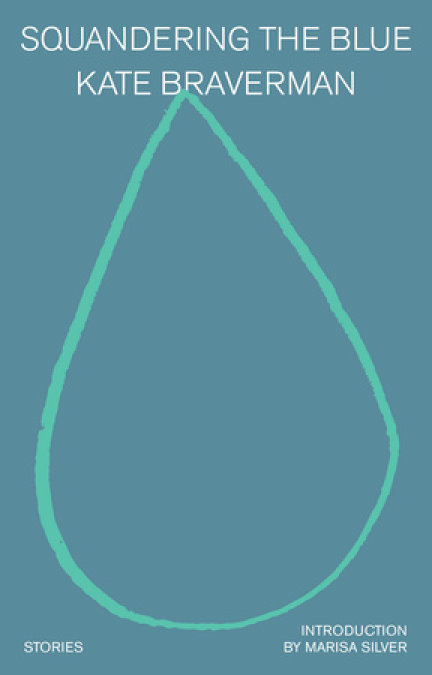
Squandering the Blue is Kate Braverman’s debut story collection, a fierce, hallucinatory vision of Southern California and the women who move through its heat, glamour, and wreckage. Set among artists, addicts, lovers, and drifters, these interconnected stories form a vivid patchwork of lives caught between longing and self-destruction, where affection and addiction are often inseparably entwined.
Across brief, haunting snapshots, Braverman captures women at moments of fracture and transformation: an art-world satire that becomes a feminist post-nuclear parable in “Falling in October”; a woman struggling to break free from an abusive relationship in “Points of Decision”; and, in the widely anthologized “Tall Tales from the Mekong Delta,” a recovering alcoholic navigating motherhood, sobriety, and a dangerously seductive stranger.
At once raw, lyrical, and unsparing, Squandering the Blue explores how people shape—or bury—their own experiences while living in the long shadow of a better life just out of reach.
“If, as they say, beauty is in the eye of the beholder, it stands to reason that horror, too, lurks deep within the optic nerve. How else to explain the lushly menacing imagery in the poet and novelist Kate Braverman’s latest book?” —The New York Times
Release date:
July 14, 2026
Publisher:
Outsider Editions
Print pages:
240
* BingeBooks earns revenue from qualifying purchases as an Amazon Associate as well as from other retail partners.
CAUTION: This email originated from outside of Penguin Random House. Please be extra cautious when opening file attachments or clicking on links.
Squandering the Blue
It was in my sixth year, shortly before my birthday, that my mother took us to live with her mother, Dominique, in Beverly Hills. In my perception, we were one moment walking along the beach in Maui, the sky an intoxication above us, and the next, we were beside my grandmother’s swimming pool, the calm water blue and alluring. I did not recognize that we had crossed a border between worlds. It seemed we were merely located in a somewhat different region of a perpetually warm and luminescent continuum.
I was immediately enrolled at Westford Academy. I welcomed the sense of ritual, the order, the uniforms and schedule. When I climbed the steps of the school bus on my first day, I had the sensation that my life, at last, was beginning. I was not frightened. I did not look back.
My mother was a poet. She had educated me in an eccentric mode of her own design. In Mexico, where I was born and lived until I was three, I had a local girl as a nanny. I have seen pictures of this house perched on a cliff above an ocean implausibly blue. It was in this house that my mother finished her fourth book of poetry, Squandering the Blue, a manuscript ultimately published by a now long-bankrupt small press. Not a single copy still exists.
The house itself survives in photographs. It was in this small white villa washed by a constant salt wind that my mother stared at the sea below, finding a vast and remote blue space within herself, some intimation of a profound necessity that she forced into stanzas while I learned to speak Spanish. What I learned at three I would forget immediately, though I suspect there is somewhere within me a certain capacity for a kind of blue, a sea rhythm, perhaps, salt air or waves.
After Mexico, my mother took us to Kyoto where she taught for one year at the university, studied Zen, and wrote the poems that would later be published by a small press in Oregon as Green Tea at Dawn. I have found one review of this book which called the poems too still and private, too meditative, lacking the flamboyant sense of the dramatic that her earlier work had possessed.
“When my ship comes in, I’ll be too weak to meet it,” I remember my mother saying, lighting a cigarette and laughing.
The sound of typewriter keys informs my recollection of Japan. The sound of the typewriter and falling rain and a sense of cold in the air. In Kyoto, I was four and educated solely by my mother. She read poetry to me in the garden.
It was after Japan, when her trust fund was almost entirely exhausted, that we lived in the jungle of Maui. I cannot find a line between my actual memories and the reconstructions I have been able to make, reinventions based largely on my mother’s Maui poems. It has become part of my personal history, those disputable facts and their shifting resonances that we all carry and somehow both believe and doubt, to think my schooling consisted of walking with my mother from our shack beside a river to a similar dwelling where children were communally taught the alphabet and counting every other morning, weather permitting.
I am certain of nothing before Beverly Hills. Still, an image asserts itself aggressively at the periphery. I seem to want to remember my mother at night, opening a suitcase and packing, agitated. She would have done this by flashlight and lantern. We had no electricity in the jungle. There would have been the smoky shadows I took as the unquestionable face of the night. My mother finds an old pair of high heels that she has not worn in years. She puts them on and walks with effort through the one room of our wood and chicken-wire shack on a river of red ginger in the jungle. My mother, stumbling and laughing and not alone. Night with the smell of kerosene and what I later learn is marijuana. My night is fragmentary, seen through mosquito netting. But I must be imagining this. If she was packing anything in this partial memory, it would be notebooks and pages of manuscripts. I have heard Dominique say, at a cocktail party or over the telephone, that we crawled out of the jungle with only the clothes on our back.
Then the green arms of Beverly Hills, a crisp and ordered green after the dense excess of the jungle pulled us in. There was the sense of something assured and dependable, like the cradle I already suspected I did not adequately have. I am talking with my grandmother on the brick terrace near the green tile swimming pool. The gardener is cutting and mowing. I am swimming with Dominique. I do not see my mother. She does not like to swim, she does not like the sun. Dominique and I are tanned, glistening with chlorine like beads on our skin. My mother chooses to be remote, on the edge of the yard, in shade. She is staring at the bird of paradise poking orange and purple between bougainvillea. She is erased of expression. There is a notebook on her lap, a pen in her hand, but she writes nothing. The pages are blank. I sense there is a disturbance in this abundance of white. I am somehow afraid I will be blamed for this, but I am not.
It occurs to me that I am half expecting punishment for my mother’s inability to write because I have somehow willed this for her, this severing from her source, this exile and erasure. I do not like her relentless chicken scratches and her refusal to swim and sunbathe, to laugh and tan as we do. My mother embraces the periphery and I will her to fade completely.
This is a land of magic. She complies. She becomes part of the background, like the water sprinklers, the gardener, the maid. I barely think of her. My world is now dense with fences and anchors, the routine and predictable. I like this. Somehow I sense that there will be no more nights lit by candles and the sound of long-haired men playing guitars. My mother will not laugh anymore in a night smoky from cigarettes and kerosene, in a night punctuated by rain. All of this has been banished.
I wear gray-and-white uniforms to school. This does not vary. The school bus arrives precisely at eight, without fail. Even the climate has been revised. It is always warm and rainless. And what my grandmother says to my mother never alters. It is a perpetual quiet litany of how my mother has failed. My mother should do something with her education, like teach English. My mother should get married. Her hair is a scandal. She drinks too much. Dominique and I share glances. We know how to float on rafts in the pool in the hot afternoon. We know how to make the sun love our skin. We are agile and strong. Dominique and I are conspirators, nodding in perfect agreement.
One day, I realize with absolute clarity that I am different. It is at a school festival, the May fair or the Halloween party. I suddenly recognize that, simultaneously, I have no father and my mother has no husband. Everywhere, my classmates are clustered in groups of three or four or five. My mother and I are glaringly, flagrantly it seems to me, the exception. We are only two. I am breathless with rage. My mother has burdened me with her defects, her terrible flaws. I am conscious of this then, at that moment, and later, when I must say that my parents are divorced. I feel humiliation and shame.
There is a further level in this first intimation: my mother and I are only two. I recognize that this, like the blank pages in my mother’s notebooks, is an unacceptable absence. I am afraid that this lack is being noticed and remarked upon by others. I suspect that I am also to blame. I am not blamed. Somehow, I believe that Dominique will not permit this.
I cannot determine years with any certainty. There are images that seem identical in their dimension and intent, though surely I am older now. I am at the house of a classmate. I am adroit with people, always. I am surrounded by friends. I am standing in a child’s playhouse set in a backyard beyond the swimming pool and tennis court, in a part of the yard where the ground refuses the insistent demand of order and swells with the unruly and the tropical. A part of the backyard that asserts the premise of the indigenous, a place where the ground refuses to be manicured. There is a bird’s nest, perhaps, and vines with mice, hedges of red-and-yellow hibiscus thrashed by latania.
I am playing tea party with Ashley or Courtney or Chelsea. It is my idea. It is always my idea. I get to be the mother. I am placing teacups with pink roses painted on their sides in matching saucers. I am arranging plates on a flowered cloth and I sense my mother approaching. I do not hear her. It is rather that I become aware of her nearness as one might sense the ocean or a storm before you see it. There is an alteration in my personal climate. I look out the miniature window of the playhouse, the window with small white lace curtains, and she is approaching.
Invariably, my mother is navigating the green expanse of the grounds, the irregular green path between lawn and grass as if she were walking on a ship, unsteady, with enormous effort. Her chin is set, tense. She is walking as if her life depended on it.
I am on a tennis court, and certainly I am older. Suddenly I am completely blinded by sun. It is not the sunlight which is, without warning, disorienting me but rather the subliminal agitation I experience when my mother is near. I am shading my eyes and still I am unable to return a simple shot. She is coming toward me, walking unbalanced, as if the gravity of this world took her by surprise. Her hair is too long. She has stopped dyeing it. Her hair is partially gray. It looks dirty. And she is wearing blue jeans and sandals. I can’t stand her. The other mothers wear nylons and skirts and high heels, even when they have been in skiing accidents and have limbs which are bandaged. I think my mother is the perpetual victim of an accident without a name; her damage is permanent. I am without fail embarrassed. I avoid contact with her eyes. Always, her eyes register with something I am later to identify as wonder, contempt, and terror but misread, as a child, as merely something deeply startled.
It is that startled quality, the wide and too full eyes that informs my childhood. It is her startled eyes and how she stumbled as she walked, as if the ground were somehow denser and more complicated than she had expected. I do not remember when my discomfort hardened and I became bitterly ashamed of her. Perhaps it was shortly after my eighth birthday, my second birthday in Beverly Hills, when my mother began attending meetings.
I did not feel relief when my mother joined Alcoholics Anonymous. Rather, I felt a kind of scorn. The beast which had no name now had a history, a morphology. There was a category for my mother, after all. It seemed to make her smaller. AA seemed to me the stuttering beginning of an alphabet I did not expect her to master. How could she? She could barely comb her hair and walk. She sat in the shade. She couldn’t even soil pages with the words no one wanted.
In the distance, I am aware of my mother suddenly animated and often absent in the evenings. She is going to meetings. Dominique and I exchange glances which say this will not last. She has no grace. She is a creature of the rudiments. She cannot even find a decent hairdresser. She cannot recover.
We hope you are enjoying the book so far. To continue reading...

 Please log in to recommend or discuss...
