
 Please log in to recommend or discuss...
Mmm, springtime! It is truly a time of flourishment and joy. We move out of the frosty, frigid snow and ice into a season of hope and renewal. We shake the bitter wind out of our hair, allow the marrow of our bones to thaw, and turn our faces toward the gentle sun.
Springtime reminds us of tulips and newborn lambs. It is childhood incarnate. Spring was when we gathered together with our friends to fly kites amid laughter. The season is made up of tall, swishing grasses, picnics under trees, and rooftop gardening. No matter how jaded you are, spring still comes with a feeling of hope. Are there new possibilities? Is there a new future? How can I make it thus? And yet, hope is never easy. Sometimes it comes with a price.
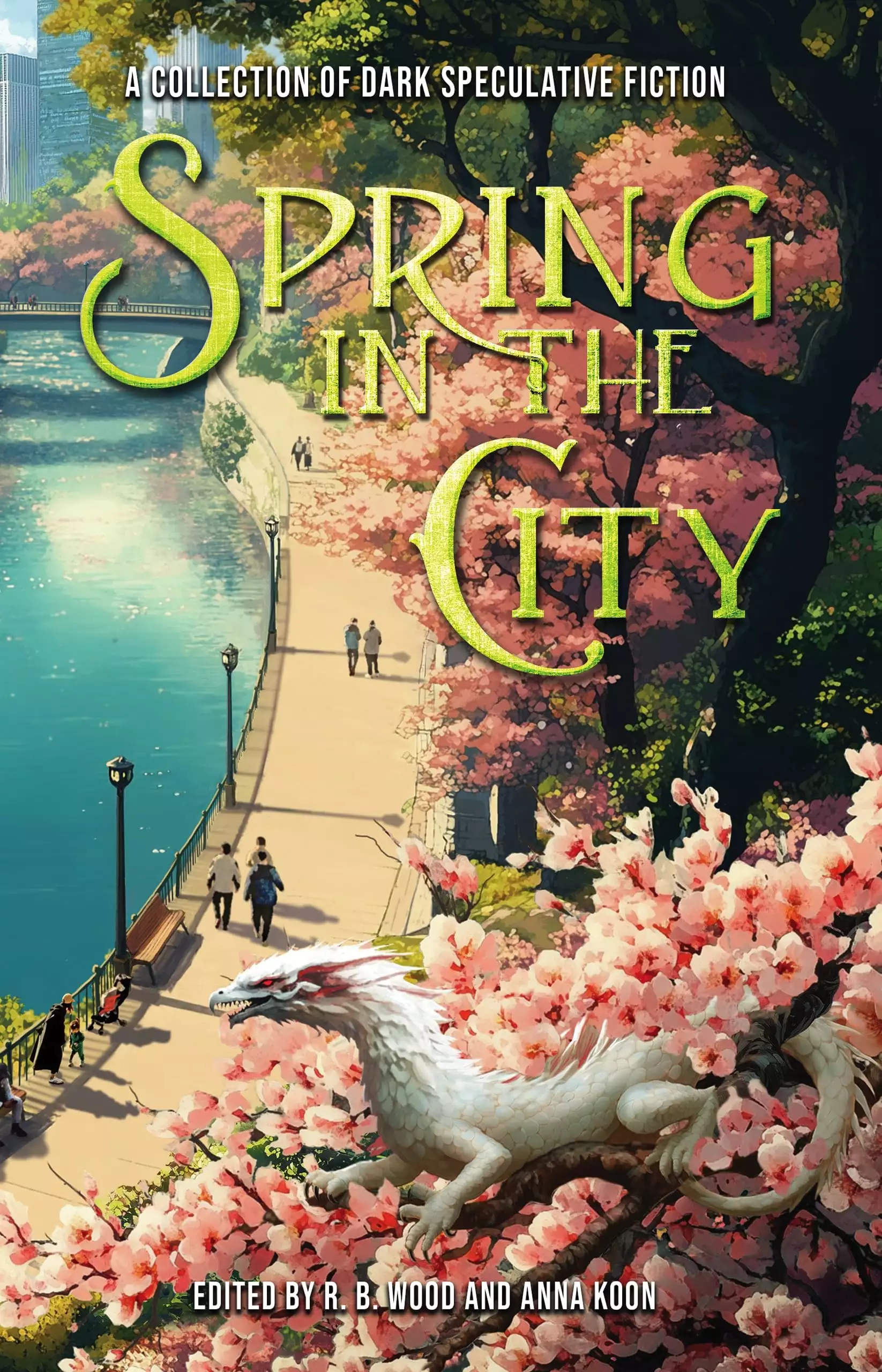
It is my pleasure to introduce you to Spring in the City, the new anthology of dark speculative fiction released by Ruadán Books. R.B. Wood and Anna Koon have done it again, putting together this worthy sophomore book in their series. They made certain to choose stories that both excite and enchant. This beautiful tome contains sixteen unique stories, all taking place in different cities across the world during the lovely springtime.
Roam with turkeys across Brisbane. Flee for your life in Chicago. Explore the legend of Mr. Splitfoot in Detroit.
Oslo. Montreal. Chester. Each setting is perfectly captured and integral to the story. The authors describe their chosen place aptly, breathing life into their worlds. They are no longer words on a page, but a feeling. An experience. You’ll be swept away to several destinations, each one fully formed and brimming with activity. Feel the heartbeat of the city and smell the blood on pavement. Their rich descriptions will make your breath catch while you immerse yourself in each and every tale. You’ll find a varied tone in voice and subject matter, assuring there is something for everyone. It truly is a book of dreams.
You will discover practitioners in Manchester and stroll through purple flowers in New York. Prowl with Jack the Ripper in London Town and be haunted in Taipei. Meet the Witch in Los Angeles and turn away from the strangeness in Cape Town.
But oh, there really is so much strangeness everywhere, really. This book is rife with it. I hope it surprises and delights you.
This is an anthology full of goddess, drowned women, and so much glitter, dread, horror, and magic that your heart will nearly burst. Please settle yourself in, my darling, to enjoy some truly stunning paranormal stories that celebrate both the beauty and pain of life in the city.
Yours in bittersweet hope,
Mercedes M. Yardley
Las Vegas, June 2025
Iðunn wakes to blood and fire. Veins split, feathers singed—offerings from the downtrodden and deceived.
Across the sacrificial stone, they write their stories. Careful fingers turn red, spill into sigil calligraphy. Runes beseeching, pleading–revenge a sweet rejuvenation.
Darkness thickens before the dawn as frost crackles a waning defiance, but—inexorably—the season shifts.
Iðunn lingers beneath the mantle of winter dreams, ensconced in the nightmare memories of her own mistreatment. She breathes in the ash and salt of sacrifice, rage roiling in her empty belly. How she hungers for the retribution she was denied.
Awake, Iðunn shakes out the humus-knotted tangles of her hair and rubs her wrists, then presses her fingers into the divots on her ribs, remembering… the trickster’s treachery, the giant eagle who snatched her in his talons—gouging, marring, scarring. How she was taken and how no one came for her. No one even lamented her disappearance until the gods began to wither in her absence. Then came the grudging, fear-fueled rescue, and how she resents it, that to be saved she was made small and insignificant, folded into an acorn, stolen once, twice, all for the benefit of others. No justice, no righteous vengeance, only a return to the husband who sighed in relief when his longevity was restored.
The sky ruptures, light herniating through the cloud as Iðunn stretches, her delicate fingers curling into fists.
I’d hoped to abandon my inner demons, to shed them like old scabs, but my demons are needy co-dependents, snarled up in my double helix, an epigenetic stain.
Somewhere above the wadi-sculpted expanse of empty sand, I morph from emigrant to immigrant, trade autumn for spring, depression for hope, and still these varmints of the mind remain. I’d hoped they’d be shredded by the x-ray soaking at the airport, had hoped border control would revoke their visas, prayed Customs might recognize them as contraband, but the voices in my head remained as I passed from red to green.
Välkommen till Sverige, parasites and all.
Stockholm is a city divided, its parts sheared and scattered across an archipelago, its heart fractured, its runnels filled with the snow-rimed waters of the Baltic. I’d imagined picnics on emerging lawns dotted with precocious flowers. Instead, pavements are slushed with melt during too short days, turned slick and treacherous by freezing nights.
I slip and skid and fall, each tumble smearing bruises over scars like lumpy frosting on a lopsided cake, about to topple. Coming here was a mistake, my demons cackle a relentless tinnitus. Did you think a change of address would undo the damage?
My new home lies well north of the postcard—perfect center in a neighborhood hugging the edges of a preserve littered with history.
Kista—the name means box. Or coffin.
As I navigate the meandering roads too narrow for a firetruck, I inhale. Onions and garlic, tamarind and cumin, cinnamon and coriander. My neighbors are Jordanian and Iranian, Eritrean and Somali, Russian, Romanian, Japanese, Finnish—near or far from home, we are all outsiders here.
a burial mound.” She points into the forest hemming my winter-rotten garden.
Something twitches deep inside my alleles, a chemical jolt within my mitochondria. Perhaps my Viking ancestors are moldering in that dirt. I hope the ghosts here haunt me. Maybe then I’ll feel like I belong.
“Tack,” I say when my landlady leaves.
“Afwan,” she responds. “It’ll get easier.” She squeezes my hand and my eyes burn when she lets go. The door closes, and I am alone with the voices in my head whispering admonishment.
My new home, a corpse cradle.
Iðunn hunts.
She sashays down narrow alleys, cobbled and quaint in Gamla Stan. She struts along broad avenues in Östermalm where trees stand sentinel in cultivated rows. In shadow form, she slips under cracked panes in crumbling apartments or through ornate keyholes on antique doors. Late at night on the tunnelbana platforms, she wafts past stumbling bodies sour with piss and cards her fingers through their hair, their souls, sampling their apathy or despair. In the morning, she stretches in the guise of timid sunbeams across brunch tables, lapping at the laughter spilling from the beautiful and bejewelled. Sometimes she dresses in breath and bone to mingle at a bar–smokey-eyed and demure–or flirt at the gym–perspiring but mindful–peering behind entitled smiles to see the darkness festering beneath the perfect veneers.
Quarry found, she stalks them home before pouncing with nails like scalpels to open their chests. Her prey, all so alike, thinking they can take without consideration for those they leave bereft, without consequence for their greed.
With deft fingers she excavates the cavity, chews on gristle, savors the gore, all the while imagining the trickster who betrayed her and the jötunn who confined her, used her, almost broke her.
The hearts, picked clean, she keeps. In their stead, she leaves cursed apples, golden flesh concealing a putrid core, before snapping ribs back in place with a gobbet of saliva to seal the wound.
Finally, she will have her vengeance.
The fruit will glow, gentle and repentant, before it withers. Her gift, not immortality, but a lifespan just long enough to make amends.
EINMÁNUÐUR
With spike-studded boots, I brave the slick trails. Joggers, dog-walkers, and the elderly armed with ski poles all leave me penguin-hobbling in their wake. I smile even though the cold makes my teeth hurt. I manage a greeting but mangle syllables when I attempt small talk. The steely eyed locals regard me like the interloper I am.
“Learn our language,” they rebuke.
I’m trying, but the words—although similar to my native tongue—clog in my throat and glom my teeth, as I butcher the ancient prosody. There is no invisible umbilical connecting me to this land of my forebears, and the homesickness inside me metastasizes with every botched pronunciation.
At least the sun teases with the promise of a thaw. If I close my eyes and lean closer to the light, I swear I feel a little warmth.
I will myself not to miss the sunshine of that other life, to remember all the reasons I left, to forget… but the voices in my head taunt me, leaving me as raw and tender as my carpet-burned knees, and my shame unfurls in a welwitschia spread.
The rotary thrum of a chopper slices through the cacophony in my head as it whizzes across the brown ribbon river separating the municipalities. Neighborhood to the east, ghetto to the west.
protest, the resentment and fear, bemoaning radicalization while signing petitions to keep reception centers out of the good zip codes where they live. They spit out ‘refugee’ as if the word might leave blisters on their tongue, like it might stick between their teeth and force them to taste the loss in it, the devastation, the fury, the hope.
Is there a form I can fill in to seek asylum from the voices in my head?
At night, I wander, ignoring warnings to avoid certain train stations after dark where gangs of surly teens flash knives at rival crews. I nod in solidarity as I pass the flotsam youths, our roots similarly twined and tethering us to the same ‘dark’ continent. I don’t join my colleagues for coffee at fika or shots after work. I don’t trust their polite and perfect smiles that never touch ice blue eyes; I know I’ll never belong in their cliques. Instead I drink alone, knocking back bränvinn and akvavit, muttering skål as I try to silence the demon-sung dirges inside my skull.
Iðunn prowls the crowded and colorful old town, greeting the ghosts seeping from the history-soaked stones, eroded by transient tourist throngs.
What has become an urban sprawl and motley collection of architecture was once a lonely logging settlement, a gateway between the Baltic sea and Mälaren lake. The city owes its origins to merchants, its foundations built on trade. In several hundred years, little has changed. Only now there is more falafel and kebab than meatballs and herring.
She inhales burnt sugar and fried meat, and the rich, buttery aroma of a hundred foreign stories. Fleetingly, her thoughts return to the skaldic husband she once had, who noticed her abduction only when Time laced grey through his hair and creased his pristine face. He loved poetry and music; he tolerated Iðunn only for her powers of rejuvenation.
With the bitterness tucked beneath her lip like a pouch of snus, she plucks at the mesh of threads, unpicking the tapestry of shame and anguish, elation and remorse, joy and corruption—so many tantalizing tales—but one unravels fresh and heady, a teasing suppuration.
As the sun battles against the ax-fall of night, Iðunn tracks the lure to a tea house tucked between buildings leaning conspiratorially close as if they might trade the secrets of their tenants in moldy speckles across grazing shingles.
With light and dark evenly matched now, Iðunn grows stronger, bolder, assuming human form as she steps into the steaming humidity of oolong and chai.
There, snug in a back corner, where the shadows congeal like fat left in a cooling pan, there is her quarry.
“Is this seat taken?” She stands limned in gold, her hair a wild halo, burnished and shimmering. I am dazzled, my heart slamming a fist against my ribs as I shake my head and sweep my feeble attempts at verb conjugation off the table. Class starts in thirty minutes, and the dread of my ineptitude knots across my shoulders. Assimilation–the word a sibilant hiss, the unspoken expectation.
I’ve been chatting with my neighbors, more confident among others in the acquisition phase. What I acquire is ‘dirty,’ my teacher says. My sentences peppered with immigrant slang. It is impure and brands me an interloper, a self-imposed othering for which I only have myself to blame.
But thoughts of integration incinerate in the incandescence of the woman still standing beside my table.
“What are you drinking?” she asks as she sits. She smells like apple blossoms and sunshine. I inhale and nearly gag at the rancid aftertaste catching in my throat. Coppery like old blood; like the scabs I used to pick from the lines carved into my arms and chew into dust, as if I could bite back at the pain gnawing on my insides, or silence the voices in my head.
You are not worthy, they growl.
“Rooibos,” I say, despite the snarling insecurities, and she orders the same.
I don’t know what to say, cannot fathom the protocol. I cradle my mug, leaning toward the heat radiating from her body. For the first
time since I arrived, I feel truly warm again. Perhaps this place will one day feel like home. But the word is a blade, reminding me I’m unwanted everywhere. Although my pale skin provides comforting camouflage here, my heritage is still a mosaic of jagged pieces, never quite the right fit.
Iðunn has never been in love. Her body has been given and stolen and bound, but never her heart. She’d thought it atrophied, yet it spasms now in revolt against desolation as she explores the city in the company of quarry-turned-companion, seeing the familiar through new eyes.
At first glance, Stockholm is beautiful. Candy-colored cladding and neat flowerbeds, sparkling waterways and buildings restored, even the utilitarian made decorative, but Iðunn sees the puckers in the paint, prods gently at the ripples marring the surface, and senses the simmering dis-ease twitching at her touch.
She glances at the human beside her, mortal eyes reflecting the sun setting over the Baltic in shades of violence and delight, and her heart convulses. She traces the spiral of the human’s ear, the strong line of the jaw, the delicate hollow where the artery throbs, capillaries like poetry unspooling through flesh.
Together they watch the moon rise over Södermalm, the effulgence as bright as Iðunn’s waxing joy as the fragile human quotes Södergran and Boye, analysing metaphor and analogy, words as mesmerising as the emergent stars.
Together they lie in brittle grass entranced by cavorting streamers of green, the norrsken dancing across the night, and Iðunn’s pulse frolics in response as the discussion turns to sources of light in life, in art, mimetic, a subsurface scattering setting them both aglow.
Together, together, together they fend off the lingering touch of darkness and cold, believing the promise of brighter days.
Iðunn has never been in love, but she is falling…
