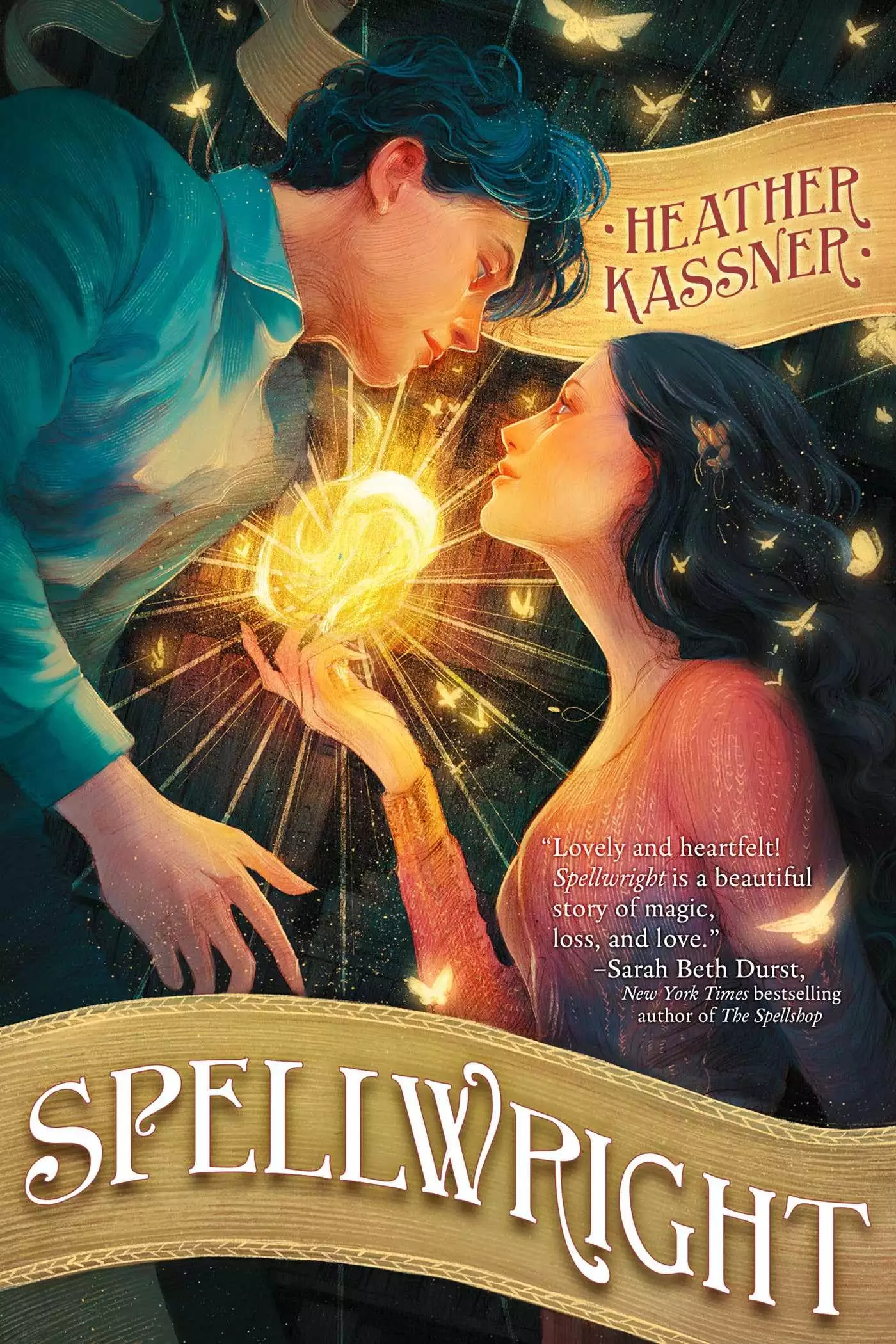
A plucky writer of spells must team up with a frustratingly charming magician to uncover the secrets of a dangerous grimoire—and maybe open her heart in the process—in this light academia young adult romantasy perfect for fans of Margaret Rogerson.
No one is allowed past the gargoyles guarding the doors of Thistledown Library. Spellwright Fia Ives should know—for months she’s hoped to be admitted inside to find a magic powerful enough to locate her late mother’s spellbook. One midnight, she finally breaks in, only to discover three mysterious figures already searching the forbidden stacks.
When the library announces the theft of a dangerous grimoire, suspicion falls on Fia. The only way to clear her name is to root out the thieves she spied that night. However, solving a magical theft isn’t easy while running her inherited spellshop alone. So Fia hires the first person who applies to help—the insufferably charming Penbrook Madbury, who is as sleepy as a cat and just as stubborn. Fia isn’t sure she can trust him with her reckless plan (let alone her beloved shop), but there’s something about the secretive magician that tempts her to try.
As a strange magic curls through town, Fia must risk her own heart to unravel a string of curses before they claim both her and Penbrook. And if some of those curses require kisses to break them, well, that’s just the whimsy of magic.
Release date:
October 27, 2026
Publisher:
Atheneum Books for Young Readers
Print pages:
320
* BingeBooks earns revenue from qualifying purchases as an Amazon Associate as well as from other retail partners.
Chapter 1 CHAPTER 1 The letter arrived by way of a rook. A soft tapping, beak to glass, fell against the moon-glared window of the spellshop on Carrow Lane, but Fia Ives didn’t hear it over the creaking of the old, scuffed floors beneath her feet and the clapping of the cabinets as she opened and closed them—rather forcefully.
Although she’d rooted through all the drawers and cupboards in Sable Spells countless times over the last long months since she’d lost her mother, Fia couldn’t keep from doing it again in search of a very particular spellbook. One with a black velvet cover, the thread unraveling a bit at the corner, and ink-scrawled ivory pages that had never been far from her mother’s hands.
In her heart Fia knew the book wasn’t here. Not in the shop, and not in the apartment, neither upstairs nor down. But she refused to believe it was gone.
“It’s just misplaced,” she murmured, ignoring the fact that none of the spells she’d cast—some simple, some more complicated—had revealed its location either. Many late nights Fia had sat by candlelight, endeavoring to write her own finding spell, and that was the worst thing of all—that she herself was a spellwright, but for this one spell she failed again and again with its construction.
All of her attempts worked well enough on other items. Even with her rather fickle magic, she could locate a mislaid key, a runaway spool of thread, or the little bell Finnick sometimes batted behind the oven, but none of her spells had unearthed the one thing she wanted to find above all else. So here she was banging cabinets late at night with the marmalade cat at her heels, as if the book might somehow appear right under her nose.
Even knowing it was hopeless, she grasped for the threads of the last finding spell she’d so carefully written, centered it in her head and heart, and held it there, letting it bloom inside her before casting it out with a gold-dusted swish of her hand. The magic leapt into the air, humming and wild for the span of one held breath—and then it fizzled without giving even a whisper of direction. The same as all the ones before, the spell brought her nothing.
Her mood only darkened.
Edging around the wooden counter that ran along the back wall of the shop, she scanned the shelves that hung above it, as if the spellbook might be playing hide-and-seek. Among the bottles and jars of potion and powder, a collection of inkpots gathering dust, and an assortment of clutter she didn’t have the heart to part with, sat a disordered array of books in dire need of organization. She squinted at the spines, determining for the millionth time that the spellbook wasn’t here.
Another tap, louder and more impatient than the first, drummed against the front window. Startled and not at all wanting to open the door to a customer at this late hour, Fia dropped down behind the high counter, her skirt pooling on the floor. Disapprovingly, Finnick tilted his fluffy head, and only then did she realize how ridiculous she must have looked, all crouched and frowning.
She winced. Against the darkness of the autumn night, the interior of the shop gleamed with golden light from the fireplace, and whoever had come knocking would surely have seen her try to hide. Even for her, this elusive behavior seemed a tad much. Yet there she stubbornly remained.
“We’re closed,” she called, hoping they would leave. Her mother would have ushered them in—not necessarily from the goodness of her heart but for the payment that would come. Fia, however, couldn’t bring herself to move toward the door, even knowing that she should. That it was her responsibility. She felt completely overwhelmed by the spellshop now that she was (pathetically and forlornly) caring for it.
All alone.
Before she allowed those thoughts to sink her heart any further, she cried, “Come back tomorrow!”
She tensed in anticipation of an unwanted reply. But all was quiet—no one desperate and pleading for Fia to write them a fanciful spell to call their one true love or a sleeping sonnet to ease their darkest nightmares or an impossible enchantment for a happily ever after. She sighed in relief.
Then a terrible crack split the night.
Fia scrambled upright, only to go absolutely still, caught by the storm of motion beyond the front window—a pair of wings beating wildly, two glossy eyes glinting like onyx marbles. Not a customer but a rook, agitated and quick. A flash of white in the clutch of its claw.
Could it be a reply at last?
The rook dove against the window, beak striking harshly. Fia jumped as a jagged line split along the glass, and then she was flying across the room, fumbling with the lock, and throwing the door open. The inky creature swooped toward her, and instead of backing away, she stepped onto the stoop to receive the letter it dropped into her waiting hands.
The small envelope bore the golden wax seal of Thistledown Library. Heart thumping, she tore it open.
Sable Spells
16 Carrow Lane
Wakesend District, Trivoris
Dear Miss Ives,
Concerning your numerous letters seeking admittance into Thistledown’s private archives, the collection of which contains irreplaceable (and sometimes volatile) volumes of magic that must be protected from misuse, misdeeds, and mishandling, it is with regret that your request, though stirring, has been denied—on this day and in perpetuity. Thusly, there is no need to write again.
You are, of course, invited to browse the shelves open to the general public, as are all good citizens of Trivoris.
Mr. Jasper Tremaine
Assistant Archival Librarian
Fia read the letter three times before the news sank in fully, and when it did, she crumpled the paper in her fist, glaring after the rook—but it was already gone. Back to Thistledown. Back to the archives. Back to its master.
Jasper Tremaine.
That narrow-faced librarian with a slick of pale hair who’d dismissed her, weeks ago, even more quickly than the others had when she’d approached them. He’d seemed more reserved than rude, or so she’d thought at the time, like he spent all his hours with books instead of people, and she could hardly fault him for that when she so often did the same. Still.
“Excuse me. I was hoping you could help me.” She’d kept her voice low, respectful of the library’s hushed atmosphere, and he’d blinked at her, like he hadn’t seen her coming until she’d spoken.
“Perhaps…” His eyes had skittered to the side, as if there might have been another librarian nearby that he could have foisted her upon.
She’d rushed on before he could slip away. “You see, I’d like”—her gaze had lifted to the ceiling, to secret rooms she’d never seen—“a moment in the archives, and—”
“There are procedures in place. Any requests for archival material should come in writing,” he’d said, already looking past her down the long hallway. The rook on his shoulder had watched her much more closely.
“I’ve written,” she’d told him, unused to confrontation but needing so much for him to listen.
“Have you.” More an acknowledgment than a question. “There now, Waxworth,” he’d said when the rook rustled his wings.
“Several times.” For months she’d petitioned for admittance into the archives, politely, desperately, to no avail. Yet she’d been certain her persistence would pay off in the end.
“Well.” He had almost sounded apologetic. “Then I’m sure it will be processed…”
“If you would—”
“… in due time.” He’d excused himself after that, striding briskly away.
Only now did she realize he’d never had any intention of helping her.
Fia fumed, imagining him sitting in some stuffy broom closet of an office, a mountain of books and unanswered letters stacked to the ceiling on his desk, and him crouched among them, cramped and cranky, writing her this note with such finality. Not caring what it meant to her.
She shoved the letter into the pocket of her skirt, staring blankly down Carrow Lane as lamplight spilled across the cobblestone roads onto all the little shop fronts: Sugarplum Sweets, Inkblots Stationerium, and the nameless café on the corner that served the most delicious cocoa this time of year, heaped with fat pumpkin marshmallows. But even if she drank a whole mug of the creamy hot chocolate now, she knew it wouldn’t warm her.
Fia scowled at the jagged crack in the window made by the rook. It split through the curlicued script for Sable Spells with all its swirling flourishes, designed and painted beautifully on the glass by her mother—who would never hold a paintbrush again.
Looking at the familiar letters left a terrible ache in Fia’s center, reminding her all over again of her mother’s missing spellbook with all those handwritten, heart-bled enchantments. She’d shared this loss in her letters requesting admittance to the archives, but Jasper Tremaine hadn’t been swayed.
Fia’s last hope had been dashed.
Blinking back tears before they could fall, her eye caught on a black feather that must have drifted down when the rook made its unruly delivery, and she bent, swiping the quill from the leaf-strewn stoop. Frustration quivered through her at the idea that the bird had access to a place she did not. The idea that she’d never walk through the archive’s gargoyle-guarded doors.
At least—she twirled the feather between her pale fingers, an idea forming—not by invitation.
Overnight, Fia tossed and turned, repeatedly feeling for the feather she’d tucked under her pillow and wondering if it might be her key into the archives—if, that is, she could first find a way past the librarians. It was all she thought about the next morning too; there was little else to do, as the spellshop remained dishearteningly quiet.
Her mother would have been so enormously disappointed in Fia for letting things fall apart. In appearance the shop looked no different, with its high-beamed ceiling and the worn fireplace and the myriad bottles and jars in their proper places, unchanged all these months since her mother’s sudden death. It smelled no different either, of books and warm fires and something sweet, the woodwork suffused with the scent of vanilla from all the candles they’d burned over the years.
The notable difference was the quiet.
Spellwriting was one thing; running the whole shop was something else entirely. Fia didn’t know how to stand in for Sable. To be someone people would trust. And how could she expect them to when she kept to herself so much? It didn’t help that she’d closed the shop for over a month, too sick with grief to open the doors and converse with anyone, let alone craft spells. Fia had thought, quite foolishly, that customers would return when she was ready. Not that she really felt ready even now.
As quick as she’d been to duck out of sight when she’d thought a customer had come after hours, Fia wished for one today. Even if it was the sings-to-herself Skye Blackwood, who stopped in frequently, usually without making a purchase or saying more than hello, or old Dermot Stone, who always said plenty, grumbling as he handed over his coins for payment.
Luck was with her—or it was laughing at her—because later that afternoon they both came by. Though they were the only ones.
Dermot Stone, an arborist who’d once lived in the wooded province of Silten, never seemed quite content with his place here in Trivoris, missing what he’d left behind. “There’s not enough green. Hasn’t anyone ever heard of trees?” he was known to complain, and if anyone pointed out the pretty oaks lining the streets of Wakesend or the maples in Lorelei Park or the Highdear apple orchard in Bramble, he’d only lift his lip disdainfully. Fia had never been to the Silten Woods, but apparently those majestic pines, centuries old, their highest branches lost in the clouds, were beyond compare.
And Dermot would argue the point with anyone who might say otherwise.
As contrary as he sometimes was, Fia’s mother had seemed almost fond of Dermot.
“He’s honest,” Sable had said of him more than once, sure in her assessment. “And I’d rather have the blunt truth from someone than false words. Wouldn’t you?”
“Of course,” Fia had replied, because more than anything, she’d wanted her mother to share her secrets.
Certainly not because she wanted the truth from the grumpy arborist.
As he made his way into the spellshop today, he glared up at the bell ringing above the door as if it were as loud as those in a clock tower, and before he even reached the counter, he apparently felt the need to point out the obvious. “You’ve got a huge crack in the front window.”
“It happened last night,” Fia said, almost telling him about the appearance of the rook and the delivery of that awful letter, but Dermot hadn’t come to listen to her sob story—that chore would later fall to her good friend, Grace—and so she left it at that. The last thing she needed to do was chase away her only customer.
“You should fix that up,” he said with a frown, knowing nothing of her ever-unreliable magic and the terrible secret that she didn’t trust herself to mend the crack. “It looks a sight.”
A quiet “I know” was all Fia could manage in response to Dermot’s blunt truth, because every time she looked at the glass, she thought again of her mother. Could picture her outside, arm raised, streaking a paintbrush across the window with a confident hand. She wasn’t the sort who’d unknowingly rub a spot of paint on her cheek as she worked. That was more something Fia would absently do, and so, even though she’d offered to help her mother with the touch-up, Sable had done it all herself. Just as she’d always kept the books, and talked to the customers, and written the majority of the spells.
No wonder Fia was having so much trouble with the shop now—and it didn’t help that in letting her thoughts wander, she’d missed hearing Dermot’s next words.
“I’m sorry, I didn’t catch that?”
“I need a spell,” he repeated, prickly as ever. “I’ve got a song stuck in my head, going on and on, and I want it out. It’s an awful annoyance.”
Fia nodded, her mind already whirring. “Let’s see. A spell to erase, or maybe to banish… No, nothing permanent.” She considered, then decided. “A spell to lure a song from your thoughts.”
“That’s what I said, isn’t it?” Irritably, he scratched his stubbly chin.
“Um, yes.” Fia didn’t bother explaining how much the words themselves mattered. That the way they were strung together made all the difference, and that was why she had a job—however tenuous—at all. Yes, anyone might write a spell, just like anyone might design a dress or bake a cake. But just as no one would want to eat one of Fia’s burnt confections, she suspected no one would want to use a clumsy spell written by and infused with the gardener’s ever-impatient and sure-to-be-grouchy magic.
“Don’t suppose it will take too long, will it, with nobody else here?” Again, Dermot unnecessarily pointed out the obvious.
“I’ll get started right now,” she said, smile tight as she drew a thick sheet of paper from a drawer in the counter and lifted the pen from the inkpot. Fia hardly ever wore shoes in the shop—a habit carried over from when she was small—and she tapped her stockinged foot as she considered.
A spell to lure a song from your thoughts.
It was far from the most exciting enchantment she’d ever written, but still, there was nothing she enjoyed more than finding the right words to call forth magic. Despite her habit of rambling when she spoke or going overly quiet once she’d said too much, she wrote the most careful of spells. At least in this she didn’t feel like a disappointment.
Twirling the pen between her fingers, she watched golden dust whisper up from the tips as she ruminated. Spells were delicate things. Like moth wings. Or transient breezes. All the makings of a spell hovered at the periphery, and she had to be quick enough, and gentle enough, to capture their pieces.
At least, that was what spellwriting felt like to Fia. Her mother had always described it much differently, though no less thoughtfully. “It’s like diving into the sea and stealing a pearl.” And she’d smile so wide and victoriously.
Wearing a grin that looked much like Sable’s, Fia spun the spell, her mind a jumble of ideas that slowly twined and intertwined. She ignored the passing of time, marked by Dermot’s persistent sighing, until a familiar dizzy feeling swept through her—a sign she’d caught hold of the right bits of magic. Her hand scribbled faster, letters slanting across the page in her pointy script, ink smearing on the tips of her fingers—though she didn’t fret over the mess. The lines of the spell dazzled inside her, a gentle threading of intention that spilled out into words. She couldn’t write them down fast enough as another dizzy wave washed through her.
“Done yet?” Dermot asked.
Startled, Fia lifted her head, hair flying, then falling, the end of one long curl plunking into the inkpot. Frowning, she lifted the strand from the pot and looked at it hopelessly, then tossed the lock over her shoulder rather than fuss with it. Her hair was nearly as dark as the ink anyway.
“Almost,” she promised, dashing off the final line with a flourish. Then, after silently reading the whole thing through and feeling satisfied with its composition, she said, “It’s done.”
She passed the paper to Dermot, who—always one to ensure he got what he paid for—immediately began casting the spell.
Fia didn’t mind. She liked the sound of her words spoken aloud and the way they clicked so perfectly together. The way she could feel the magic responding even if it wasn’t her own.
“Come,” he began in his gravelly voice, “my sweet song.” Dermot’s mouth puckered on the word sweet, as if he wanted to reject the sentiment.
“Go on,” Fia encouraged, too pleased with the spell to take offense.
With a huff, he started again.
Come, my sweet song,
to where you better belong.
Dancing among the honeybee swarms,
spinning with the thunderstorms,
making good company
with the crickets’ nightly symphony.
Depart your skulled prison for the air,
joining the wide world on a dare.
When Dermot reached the last section, his breath exhaled white and cold, swirling up toward the ceiling, and the air filled with the notes of some pretty song, lured right from his mouth. The melody sounded entirely more romantic than anything Fia would have imagined Dermot listening to.
She smothered a smile as the music continued to breeze about the shop, playing itself through from start to finish as if performed by the smallest orchestra.
Dermot shook his head, rattling out any lingering notes, and with a final curl of misty breath, he grudgingly acknowledged, “It’s good and gone now.”
“I’ve always loved the ‘Ballad of Rivelyn,’ ” came a soft voice, and both Fia and Dermot turned to find Skye Blackwood, a barmaid who worked at Poet’s Theory a few streets away, standing in the shadows of the bookshelves. Framed there, she might have been a painting, carefully rendered so her brown eyes glinted gold—like mirrors to her gentle soul (or so Sable had once said with a shake of her head).
“Oh, I didn’t even hear you come in.” Fia had been too busy spellwriting to notice, or else Skye just had that light a step. She probably could sneak past the Thistledown librarians without any trouble at all.
“Well, you were busy—and drawn inward more than I ever saw your mother,” Skye said with the hint of a smile. She wore her dark hair up in braids, but one had come loose, and she fiddled with it as she began to hum.
“Are you trying to get that song stuck in my head again?” Dermot grouched before tapping the counter twice and striding away. “I’ve got to go.”
“Have a good day!” Fia rose up on her toes, leaning over the counter, as if her words wouldn’t otherwise reach him. And then he was gone.
She sank back on her heels, glancing again at Skye, who’d moved deeper between the shelves, apparently not in the mood to talk.
But really, neither was Fia.
As she usually did, Fia let Skye be, liking the older woman’s presence, the sound of her soft humming and the turning of the pages as she looked through a book. It was a comfort, not being alone.
And it also gave Fia time for more thinking. About quiet footsteps and a rook’s feather. About ink on the tip of her hair that no one would notice.
About spells that might let her slip into the Thistledown archives unseen.
We hope you are enjoying the book so far. To continue reading...

 Please log in to recommend or discuss...
