We always listen out for the train when we're down in the cutting because sometimes they come quicker than you expect. There aren't as many trains as there used to be. Mostly just the freight ones, like the one that nearly killed us on the bus . . . The best train is the Southern Aurora. It goes all the way from Melbourne to Sydney, and from Sydney to Melbourne. It stops in Mittigunda because we're pretty much exactly halfway between.'
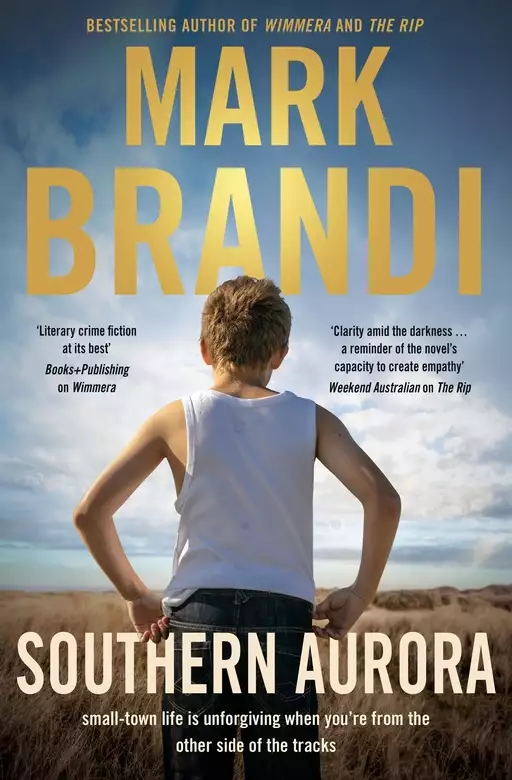
Jimmy is a kid growing up fast on the poorest street in town. He tries to do everything right and look out for his mum and his younger brother. His older brother is in jail, so it's up to Jimmy to hold things together. But small-town life is unforgiving if you're from the other side of the tracks.
If only his mum didn't drink so much. If only he could win the school billycart race. If only his best friend understood. If only he could stop his mum's boyfriend from getting angry. If only he was there.
Jimmy soon learns that even when you get things right, everything can still go wrong.
'If you only read one Australian fiction book this year, let it be this one' Samuel Johnson
'Evocative and authentic, Brandi has created a world filled with equal parts hope and dread. Southern Aurora is a special book' Sarah Bailey
'Another quietly riveting, emotionally potent novel from Mark Brandi' The Age
'The master of small-town dread' Canberra Times
'Heart-wrenching' The Australian Women's Weekly
'Another page-turner'Who Weekly
'Mark Brandi has delivered a protagonist that could well become one of Australia's classic characters. There's a Mark Twain innocence and inner wisdom to Jimmy, one far beyond most adults' Weekend Australian
'Brandi's poignant and deceptively uncomplicated tale pulses with foreboding - but also hope' Courier Mail
'Unforgettable and unsurpassable . . . Brandi's observations are breathtakingly original and his insights are astute. Southern Aurora tackles issues with a purity that's as rare as it is precious' Better Reading
'A beautiful and deeply affecting book . . . Mark Brandi proves himself a master raconteur, in a work characterised by gentle humour, perceptiveness and kindness' Living Arts Canberra
Release date:
June 28, 2023
Publisher:
Hachette Australia
Print pages:
384
* BingeBooks earns revenue from qualifying purchases as an Amazon Associate as well as from other retail partners.
February is the hottest month of the year, so I reckon it’s a pretty cruel time to send kids back to school. I like summer, mostly. I just don’t like school that much.
There’s hardly any shade at our school, just one big pepper-corn tree that makes your hands sticky if you touch the leaves. Most of the yard is boiling hot asphalt. On the really hot days, the asphalt goes soft under your feet.
In summer, us boys play cricket out on the oval, and the girls do their own thing. Me and Danny aren’t that good at cricket, not like the sporty kids, but we still join in when they need the numbers. We hardly ever get to bat or bowl, though. We usually just field, and mostly at fine leg or third man. It’s pretty boring.
In winter the sporty kids play footy, which I like even less than cricket. At least in cricket, when you’re fielding, you can keep quiet and stay out of the way. You can look like you’re part of something even when you’re not.
One of the main things I don’t like about school in summer is the swimming carnival. I hate the swimming training before it too, but we don’t do that every year.
The athletics carnival is heaps better, but that’s in winter. Tunnel ball is probably my favourite, or long jump. One of those two.
The swimming carnival happens at the Mittigunda Leisure Complex. Leisure Complex is just a fancy name for a pool, two squash courts and an indoor cricket pitch.
The pool is especially crap. Its walls are cracked and it stinks like chemicals. They’ve been talking about building a new pool for years. There’s a fundraising sign out the front, with a big thermometer showing how much money they’ve raised. They need a hundred thousand dollars and they’ve only got about twenty thousand, so I don’t think it’ll ever happen.
I don’t mind being in the water, but I can’t swim. Not properly. That’s the main problem. And pretty much everyone else at school can, even some of the grade ones and preps. It’s embarrassing.
Charlie told Mum that he’s gonna teach me. Charlie is sort of like Mum’s boyfriend, but he doesn’t live with us. For a few weeks he stayed at our place, but then he moved out again. His place is a cabin out at the caravan park. It looks like a tin shed, but with a little timber deck out front.
Charlie’s tall and skinny, with black hair slicked over to one side. He has sideburns down his cheeks, and green tattoos on his forearms. He told me and Sam once that he used to be in the army in Vietnam, and that’s why he got the tattoos.
There’s no pictures of girls or animals on his arms, just words and numbers. It’s hard to read them properly because he has his sleeves rolled down most of the time. The biggest tattoo says ‘5RAR’. I’m not sure what it means. He said he got the tattoos after the war, because you weren’t allowed to have them while you were serving.
‘Only in the navy,’ he said. ‘And I was never up for that.’
Charlie doesn’t say much, but he’s all right to me. He’s mostly nice to Sam too, which I think is the main reason Mum likes him. I’ve heard her saying it on the phone to Aunty Pam.
But she doesn’t tell Aunty Pam everything.
She doesn’t tell her about the times Charlie gets angry, or about the time he pushed her.
When Charlie pushed Mum, me and Sam saw the whole thing. Sam got scared and ran out of the house and down the street, but I caught up with him pretty quick. I don’t know where he was headed, but he was really upset.
Charlie’s promised Mum that won’t ever happen again, that he won’t push her, but she still made him move back to his cabin at the caravan park.
I think Mum doesn’t tell Aunty Pam about any of that because she doesn’t want her to worry.
Most times Charlie talks to Sam like he’s normal, which is good. He’s especially nice to Sam in front of Mum, but different when she’s not around. Even so, he’s better than some people. Some people talk to Sam like he’s a baby, which annoys me a bit. Other people just ignore him, or look away, which is even worse.
Mum thinks it’ll be good if Charlie teaches me how to swim, but I’m worried it’ll be embarrassing. Not as embarrassing as the swimming carnival, but almost. I can’t really imagine Charlie going to the pool. I can’t really imagine him swimming either. Mostly he’s off shearing somewhere, or working on his car, or drinking cans of Carlton Light.
Charlie’s car is a maroon Kingswood, and it’s nice when it’s going. But it has a lot of problems. Not as many as his old ute, but almost. It’s nowhere near as nice as Mick’s Pacer, but I’d never say that to Charlie.
•
Charlie reckons we’ll go on Sunday, after he gets back from helping some farmer with a fencing job. We’re not going to the pool, though. And Mum says she can’t come.
‘I have to go see Nan,’ she says.
We all used to go see Nan on Sundays at the nursing home before she died. Mick used to come too, before he went to jail. I would have much preferred to go with Mum to see Nan at the cemetery than go for a swim, but I couldn’t say so.
It was last year when she died, but it still seems really recent. I liked Nan a lot. She was skinny as a stick and lived at the nursing home for almost as long as I can remember. She was married once, but I never knew my pop because he was dead before I was born.
Like I said, me and Mum and Sam used to go see Nan every Sunday. Mick would come too, but not as often. We’d always get dressed up nicer when we went. I had to wear my good shoes, which were way too tight and incredibly uncomfortable.
The nursing home was called The Oakview, but I’m not sure why. The carpet was dark blue and everything smelled a bit like perfume, but with something else underneath. Some of the people who worked there wore white gumboots.
Nan’s memory wasn’t very good, and sometimes she’d tell the same stories over and over. Sometimes she’d start the same story right after she’d just finished it, so you’d have to listen all over again and pretend it was new. It was okay, once you got used to it.
Mum was always cross when we were there. She’d always complain to the nursing home people about something, but mostly about the food. The food did look pretty terrible, to be honest. It was nearly always mashed potato, pumpkin, or savs with tomato sauce.
‘You wouldn’t serve it to a dog,’ she said.
It made me embarrassed when she said things like that, and I could tell the nursing home people didn’t like it. I don’t think the food was their fault.
One time, after we left, I asked Mum why she got so cross.
‘I don’t like how they look after her,’ she said. ‘She deserves better.’
Sometimes, I wonder why Mum and Aunty Pam didn’t take Nan out of there. If they took her home, she would’ve been looked after better, and we would have seen her more often. And she might have lived for longer.
But I’ve never said anything about it. And after she died, it was too late.
•
Me and Sam sit in the back of the Kingswood, which is where we normally sit. Me on the right side, him on the left. Sam doesn’t like it if I sit on the left. But without Mum in the car, it feels different. She usually does most of the talking.
Charlie turns the corner into Macpherson Street. Because I’m the oldest, I feel like I should say something.
‘How many cars have you had?’
Charlie eyes me in the rear-view mirror.
‘A few.’
He reaches into the console beside him, takes out a pack of smokes. Charlie only smokes Craven A Filters. I know the brand because he gives me money sometimes to buy them from the milk bar. They cost one dollar seventy, but he gives me two dollars and lets me keep the change. I usually spend it on mixed lollies for me and Sam.
He dangles the cigarette between his lips but doesn’t light it.
‘Is this the nicest car you’ve had?’
He nods. ‘She’s all right. When she’s running.’
I’m not sure what to say after that. The quiet in the car gets louder, and I wonder if Charlie can hear it too.
After a bit he says, ‘How’s your mum been?’
‘Good,’ I say.
He eyes me again in the rear-view.
‘She had any fellas over?’
It’s not the first time Charlie has asked me, so I know what to say.
‘Nah.’
‘You sure?’
‘Yep.’
Once we turn onto the highway, he pushes the lighter button in and waits till it pops back out. He lights his smoke and winds down the window. The warm air rushes inside, the car speeds up, and everything feels more relaxed after that.
When we’re out of town, he puts on the radio. It’s country and western, and the static is pretty bad. Someone is singing about being lonesome, which is what they’re nearly always singing about. Charlie tries to tune the radio better, but it doesn’t work. He starts tapping the steering wheel anyway, like he knows the song. I don’t like country and western that much, but I’m happy we don’t have to talk. I think he is too.
Soon, we’re out in the middle of the farms where the cows and sheep live. The paddocks look all yellow and dry. Eventually, Charlie turns off the highway and drives up a dirt road. It’s corrugated and dusty. He makes me wind up my window, but the dust still gets inside from somewhere. The radio is out of range, so he switches it off. After a bit, he slows the car down and pulls over to the side of the road.
‘Here we are,’ he says.
I look out and there’s nothing but empty paddocks. We get out of the car and it feels hotter than it was in town. The air smells like dry grass and dust, and flies come in from everywhere. On the other side of the road, there’s a paddock with a couple of tall gum trees a little way from the fence. I can see there’s a dam underneath the trees. It looks muddy and brown and pretty crap. My heart sinks a bit.
Charlie shields his eyes from the sun, looks all around. There’s no houses or sheds or anything for miles, just endless paddocks of dry grass and fences. He goes to the back of the car and pops the boot. He takes out a long coil of rope, then slings it over his shoulder.
‘This is Bluey’s farm,’ he says.
‘Who’s Bluey?’
‘An old mate.’
We follow Charlie to the fence. He spreads the wires apart and lets me and Sam climb through. Sam goes first. The grass is long and yellow, almost up to my waist. Sam runs off ahead.
‘Wait,’ I say. ‘There might be snakes.’
He stops and looks at me. I smile like I didn’t really mean it. He waits till we catch up, takes hold of my hand.
As we walk toward the dam, Sam starts humming. Mum calls it singing, and she reckons he might be famous one day. I think she’s just being nice.
When we get to the dam, Charlie tells me to take off my t-shirt. I do what he says. Sam crouches down near the dam’s edge and starts drawing in the mud with a stick.
‘Be careful, mate,’ Charlie says. ‘Don’t get your shoes wet.’
Sam can’t swim either, but no one has ever tried to teach him. Maybe they have at the Special School, but I doubt it.
Charlie unwinds the coil of rope, loops it under my arms, and ties it around my chest. It’s rough on my skin and smells like oil. His hands work quick, like he’s used the rope heaps of times before. Sam starts humming again.
‘What’s the rope for?’ I say.
‘Just a back-up. In case you get into trouble.’
Charlie takes the loose end, then sits down on the bank next to Sam. He reaches into his top pocket and takes out his smokes. He lights one with a match, and Sam watches him closely. Sam loves matches, so Mum always keeps them hidden at home.
I look into the water and wonder how deep it is. I wonder if there’s fish and yabbies in there, and if the yabbies might bite me. I don’t want to go in, but I know I don’t have much choice. Charlie has gone to the trouble to bring us out here, and I don’t want him to get cross.
The mud is thick and sticky, and it squelches up between my toes. The water is unbelievably cold.
‘You’ll be right,’ Charlie says. ‘And I’ve got the rope, remember? In case you get into strife.’
Sam starts clapping.
I go further out, up to my knees, with my feet sinking deeper into the mud, up to my ankles. Once I’m up to my waist, I can feel the bank slipping sharply into deeper water.
Charlie stands up and walks around the bank to the other side of the dam, still holding the end of the rope. Sam follows. When he gets to the other side, Charlie flicks his smoke in the water. The butt floats like a dead insect, and I cross my arms to try to keep warm.
‘Go on then,’ he says. ‘Swim toward me.’
I start shivering.
‘I can’t.’
‘Just have a crack. It’s a confidence thing.’
Maybe he’s right. I just need to try and eventually it’ll happen. I could start swimming like the other kids, like people in the Olympics.
I take a deep breath and dive forward into the water. The cold makes the air stop in my chest. I pull at the water, but quickly start sinking. I open my mouth for air, but only water rushes in. It’s dark and I’m sinking deeper and deeper. There’s nothing under my feet. I feel the rope slide up under my armpits, and I grab hold and try to pull myself up. My head comes out of the water for a second, and I hear Charlie yelling, but the rope slides from my hands and I sink back down. Everything is dark and cold and endless.
For the first time ever, I’m scared I might die.
The rope pulls hard under my arms, and I reach and grab hold again. I can feel Charlie pulling. It feels like forever, but my shoulder finally hits the muddy bank on the other side. I crawl up out of the water on my hands and knees. I co. . .
We hope you are enjoying the book so far. To continue reading...

 Please log in to recommend or discuss...
