
 Please log in to recommend or discuss...
PRESENT DAY
Leighton Hawthorne’s second visit to Ashfeld Manor would be her last. Her only regret in life was not forcing her brother to turn the car around before they arrived the first time. Everything that came after that was a vicious downward spiral. If only they had left it alone. But her brother dreamed of sourwood, and for once, his dreams would cost her. It was only fair, she supposed.
Decades after their first arrival, she’d decided to pay the house one last visit. When she stepped out of the car, she had the urge to spit on the ground, but her mouth was too dry to conjure the disrespect. So instead, she walked on the grass and dug the heel of her boot into the earth. She had broken one of the promises she’d made to her brother, but she knew he would forgive her for it.
Against the fog-obscured evergreens of the distant forest stood the sourwood trees like wounds in the aged flesh of the earth. As the scars and seasons faded, so did their towering flanks—their leaves feathery, their sap delicious, and their diseased roots molding in the damp autumn. Even the worms stayed away.
Just as Leighton hoped.
If it were spring, the bees would be stealing nectar to make their goldenrod honey. And if, by some cruel twist of time, it were possible to awaken the former inhabitants of Ashfeld Manor, then Leighton imagined her grandmother would be stealing the fruit of the bees’ labor.
That was the guarantee of the place. Whoever lived among the brick and under the beams of the house would become a thief. The Ashfelds believed the world was theirs to take. Money, time, land, love, life. All of it was up for grabs. Thievery wasn’t just rewarded here—it was expected, praised. An inheritance built upon the sticky fingers of liars and abusers, among other things.
Ashfeld Manor. The most dangerous place to be.
She was glad she’d destroyed the boxes that kept the hive. Even bees should be free.
Leighton had inherited the once-magnificent house. She’d tried to punish it for stealing from her, but she could never get back what was taken. So she left it to rot, and rot it had. She strolled the property, but strolling was too kind, so she trampled down the half-withered blades of grass and stomped on the muddied brick driveway.
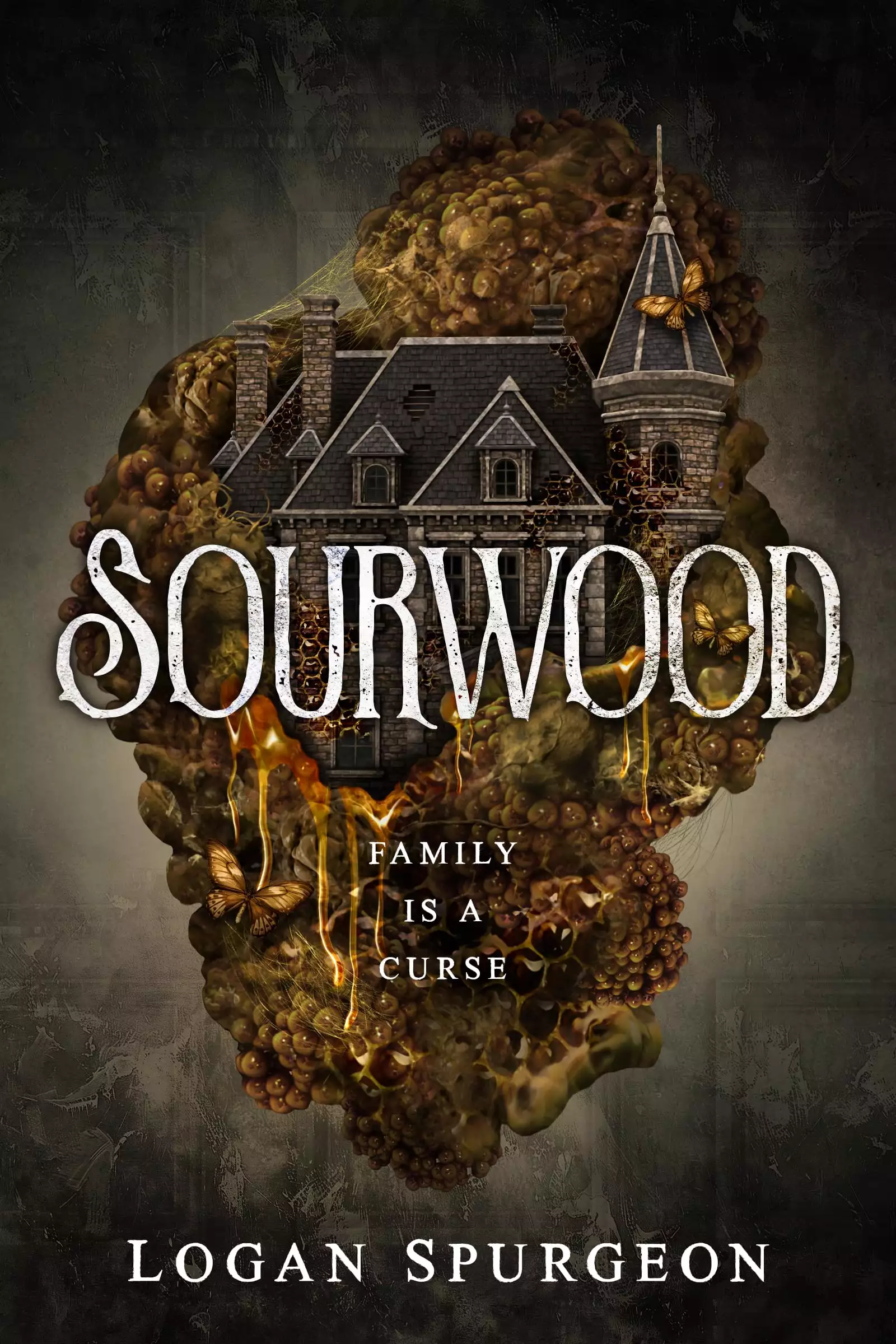
The tower stood as it always had, though cracks climbed up and chipped away at the bricks, and ivy climbed the ruined structure. The land beneath had shifted the piercing obstruction, as if to try to pull it down and ease its affront to the sky. One window was broken, and the others were coated with a film of pollen and
dust. Leighton wondered what sort of creatures now took residence in the structure, if any. She figured it would fall soon—a relief in some ways.
The front porch light flickered with bursts of amber rays of heaven or the firelight of hell. She couldn’t decide which, but she knew it wasn’t a warning. It was him. There were no rationalities to offer her aged but curious mind, not anymore. She cut the power years ago after her visit. No current flowed through the bones of Ashfeld Manor. Yet the house gave off a welcoming glow.
Like an insect lured to the light, she approached.
Joy filled her when she saw the front door having fallen off its hinges, the stone façade dirt-pocked with age, and the windows cracked, likely by hail and wind. She could already smell the rotten wood inside. She hoped the foundation had broken with the shifting land and that termites had taken up residence within the decaying walls.
If the house was her inheritance, then desolation was the house’s.
Unfortunately, her joy was short-lived. Satisfaction would never be hers, not fully. It wasn’t the house that ruined her life and cursed her. It was her own blood. The very thing she could never escape. Leeches couldn’t suck it from her, and transfusions couldn’t replace her family tree. When her cells died, new ones emerged—forever the offspring of her ancestry.
Though there was one thing Leighton made sure of: there would never be another Ashfeld on the face of the earth. The cycle ended with her, and now that end was near. She felt the long fingers of the reaper’s hand wrap around her.
Would death steal her away, too?
Leighton climbed the six stone steps up to the portico. A crack cut through the center stone arch, eager to bring down the two arches beside it. Ivy coated the two columns and burrowed their roots into the structure. She wondered if that was
what roots do—burrow and destroy and self-preserve at all cost.
When she thought about it, she smiled. Any day, the house’s stability could fail, turning it into nothing more than an abandoned landmark. A palace of ghosts. She wished it would be today. She wanted to witness its downfall.
Leighton.
When she turned around, she half expected him to be standing behind her, but all she could see was the fog that rolled across the property, moving like a whisper as it engulfed her rusting car and made the grounds feel as hollow as a cemetery. She remembered the faces printed on the flyers and in the photo books, and she held memories of the lost close to her chest.
“I won’t become you,” Leighton said, though whether to convince herself or the house, she wasn’t sure.
The wind hit her in the face, twisting around her as though in response to her defiance, and whipped through the branches of the crimson trees. Goosebumps bloomed along her skin like someone had been breathing down her neck. It forced her to remember—how long she had pleaded to forget all of this. This house, her family, her—
She was thirsty, but she would not drink. She’d finished off the last of her thermos on the drive to the manor and had no more. The sourwood trees beckoned her to suckle, to lap up their sweet sap and satisfy her curse. The well demanded she look inside, but she refused. It had been sealed up decades ago. No water could be found in Ashfeld Manor. Even the pipes were shut off and the water line disconnected.
Just in case.
Though her mouth felt dry, Leighton would not drink, or it would all be for nothing. Wasted like the one thing she loved in this life, wasted like the years she spent hiding away far from this place, wasted like her dreams of having a
family. She had no regrets.
If she were not in her eighties, she would get on her knees and offer up a name. She didn’t pray—she never had—but this moment felt like the right time to speak to the dead. To apologize, to ask forgiveness, to promise them that her homecoming was not a rebirth but an end.
“Hello, old bitch,” she said as she slapped the wooden frame of the front door. The rotten boards were as soft and wet as she dreamed they would be. The door had fallen off the rusty hinges, and the smell of rot greeted her. She inhaled greedily and smiled. The tomb had been unearthed and left to the elements.
Leighton stepped carefully over the threshold and the haphazard door to see an overturned portrait of her family resting on the floor. She picked it up and saw through the smeared paint all the people who had once been captured on the canvas. Four long-gone faces. Blurs in the stream of time. And soon, all would be wiped away into the oblivion of history.
She thought of the rumors in town. How long would they remember? How eager were they to forget? She assumed the story would never go away. It would be retold generation after generation—a cautionary tale to keep children within the boundary lines and away from the woods.
“Don’t go near Ashfeld Manor!” someone had once told her. Leighton couldn’t quite remember who it was. Her memory wasn’t as sharp as it used to be, but the warning had come too late. She’d been foolish not to heed it then. Ashfeld Manor was cursed. Had she known better, had she not lost her parents or her aunt, had her brother listened to her warning…had they been honest with each other, things might have turned out differently.
Leighton walked farther into the dank house. The grandfather clock in the foyer was silent. The house was finally quiet. No songs or humming, no screeching or pleading. Quiet as a mouse. In the sitting room to the right, gray light trickled
in. Not through the windows, for they were still draped in thick maroon curtains, but through a hole in the ceiling.
A shadow shifted in the distance. Leighton didn’t move. She didn’t take a breath—she watched and waited. The sound of wings echoed through the bones of the house, and her heartbeat raced as something flew towards her. She stepped back—the air felt thin, too thin to breathe. From the darkness, an owl screeched as it flew from some hidden place up and out through a hole in the roof.
Leighton released her breath. It wasn’t him.
The roof had been ripped open, likely by a heavy storm, and had welcomed in the elements that plagued the steps of the mountains. As if it was setting a trap, it had filled a vase of dry-wilted flowers with rainwater. A pool of rotten petals and dead flies, a concoction of the house’s making, offered a tempting promise of relief from her thirst.
“Nice try,” Leighton admitted. She walked to the table the vase was sitting on, watched each step as she went, and picked up the vase. The glass had yellowed, but she held it tenderly. She emptied the murky water on the spot where she’d once posed so long ago. She knew the rainwater wasn’t dangerous, but she wouldn’t be tempted to satisfy her thirst, not in this place. If she did, it would only want more. Even rainwater wasn’t worth the risk.
The bust of her own face stared at her from underneath a broken table, its eyes an empty gray. The clay hadn’t been molded properly—it never set right—and it lacked refinement. Either a product of her stirring fear on that night or her grandmother’s faulty hand. She wanted to shatter what remained of it.
She saw the broken spiral staircase to the tower over in the corner of the room, undone as if to signal the demise of her family. The iron bars jutted from the top of the landing, the bricks cracked from where the bolts were ripped out.
A pile of metal and stone sat in the workroom. No one could ascend or descend anymore. The staircase was aged, rusted by the years, broken forever. The end of the line.
Leighton turned to face the upstairs balcony and hallway. Bits of ceiling were caved in, and the stained-glass windows reflected twisted light in bloodied reds, drab greens, sickly yellows, and weathered blues. It was there that she’d first seen him upon the balcony of horror.
She traced her way back across the room to the foyer, past the silent clock, and up the staircase. She no longer cared if it was safe to walk the halls. It was never safe to walk here anyway.
She walked down the upstairs hall, the stained-glass windows a kaleidoscope of past atrocities, the colors of memories, and into the room of collected “things with wings,” as her grandmother used to say. She covered her nose at the scent of moldy books permeating his office.
Part of the mildew-drenched wall had fallen, and with it, the boxes in which precious things were trapped. The glass of a couple dozen shadowboxes had shattered as though in protest. Still others remained clinging to the wallpaper in a desperate attempt to keep things as they were.
“Why are you still here?” Leighton asked them. They did not respond. While they no longer had a master watching over them, they were still pinned in their boxes, pricked by the shame of death, and preserved by someone else’s desire. Even if the seal had been broken.
She understood.
Leighton’s heart fluttered like she was a moth escaping the cage that was Ashfeld Manor, but all she did was hit against the glass. Again and again. The dream came back to her, and the smells of flesh and bile and honey wrapped
around her, memories of the hard shell and the secrets that came to light. She touched the place where her necklace once hung, but only felt her aged skin.
She took a step forward, and a creak filled her heart with dread. Did the door to his room just open? Leighton knew it wasn’t possible. He was long dead. There was no one else at Ashfeld, and this was the end of the line.
There was nowhere else to go anymore.
She had come back to roost.
AUGUST 1976
“Maybe we should’ve stayed home,” Leighton said.
Reed focused on the road ahead as it curved, burrowed through the walls of stone, submerged in darkness, and emerged in dying light. Each mile was a surprise, a chance, a risk. Reed hated anything unscheduled and unexpected. It had been that way since his parents died and left him to care for his sister.
“Why are we doing this?” she asked.
“She’s our grandmother,” Reed said, shrugging as he drove through the tunnel. Driving wasn’t enjoyable for him either. He often told others that the threat of breaking down or being stuck in endless traffic made him avoid getting behind the wheel. Reed drove enough for his job, and his car wasn’t as reliable as it used to be. He wasn’t lying, but offering a half-truth. Everyone could understand those excuses.
“We don’t know her,” Leighton pressed, interrupting his thoughts.
“That’s not her fault. She said she’s been trying to find us for some time.”
“What’s her name again? Viola?”
“Violet and Royce.”
“What was their last name?” Leighton asked, looking over at him.
“Ashfeld. Same as the name of the house.”
If he were honest with himself, he hated driving because of his parents’ car accident and his driver’s license. Not the license itself, but what it reminded him of. The unflattering picture reminded him too much of his father. The false surname etched into shiny, colorful plastic held a hundred secrets his parents never revealed before their untimely demise.
“Why did our parents change their last name to Hawthorne?”
“I don’t know, Lei.”
Driving was supposed to mean freedom. The open road and soft blue sky above, music shaking the glass panes, windows down and wind rolling through wild hair, speeding fast to get to nowhere, someone you loved beside you, parking where no one could see the two of you in the backseat.
Reed never got to do any of that. He never got to fly, to drive away, to break free from his life. Especially after his parents’ car crash. ...
