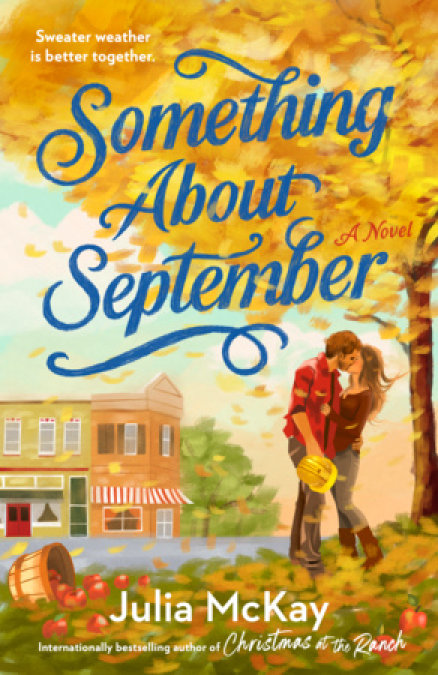
Cozy up with your pumpkin spiced latte and a slice of apple pie, because it's time to fall in love in Bramley Hollow...
A fall-inspired second-chance romance about a woman who returns home after inheriting her grandmother’s diner, only to discover the contractor she must hire was her high school crush.
Sweater weather is better together.
Rebecca Macintosh has always felt that there’s just something about September—nostalgia, crisp mornings, and possibility. But not this year. Rebecca has thirty days to return home to fix up her late grandmother’s diner or face the consequences. And the only contractor in town? Cort Adams. The man who rejected her one year ago. He’s somehow even better looking as a single dad than when he was the high school football star she once tutored. She’d been hoping to avoid him forever.
As the golden leaves start to fall, Rebecca may find that there’s more to her hometown—and to Cort—than she’d realized, and that the dreams she’s been chasing might have been the wrong ones. Could a spark kindle hot enough in the cool autumn air to call Rebecca home for good?
Release date:
August 18, 2026
Publisher:
G.P. Putnam's Sons
Print pages:
320
* BingeBooks earns revenue from qualifying purchases as an Amazon Associate as well as from other retail partners.
It’s only a week into my final year of high school, and I already wish I could time travel to next fall. When I’ll be in Toronto, at university, far away from here, and my whole life will finally be different.
Don’t get me wrong, I like Bramley Hollow. Most of the time. It’s my home, after all. The sign when you drive in says, Population 9,973. . . Unless someone moved! Tourists think that’s adorable—but then, we don’t get all that many tourists here, considering our one claim to fame is our yearly Autumn Fair & Gala, which consists of a tiny midway, and some contests to do with baking or who can grow the biggest vegetable. Thrilling stuff. The fair’s tagline: Fall for autumn in Bramley Hollow, the place that invented it!
We didn’t actually invent autumn. I guess that’s obvious.
Anyway, today’s disaster happened after English class. Mrs. Albemarle asked if I’d tutor Cort Adams. Apparently he’s in danger of getting kicked off the football team if he doesn’t raise his grades, and English is his worst subject because he “hates reading.”
Mrs. Albemarle usually looks like she’s just bitten into a crab apple, but she actually smiled when she talked about Cort. She went on about how he’s our “only chance” at keeping the town’s football pennant dynasty alive, how he’s a “legendary quarterback, just like his father.” I may have pointed out that “legendary” was a stretch. Cue the crab apple frown. But I said yes. Because even though Grannie Lenore says she’s been squirreling tuition money away for years, I know the diner isn’t exactly lucrative. I want to help as much as I can. If tutoring Cort means extra credit, and extra credit means keeping my English average above 95 so I can get the best scholarship, then I’ll do it.
And, I can admit: Cort might not be entirely awful, even with the whole jock swagger thing he has going. The other day, when the rest of the football team were shooting spitballs at poor Crispin Klune in the cafeteria, Cort told them to knock it off and actually helped Crispin clean himself up. And okay, it’s hard not to notice the whole broad-shoulders, crooked-smile thing. Or the way he looks at you like you’re the only person in the world. I know this because after school today, he caught up with me in the hall. His hair was all floppy and he tossed it out of his eyes in this ridiculous way and said, “I can’t believe the smartest girl in class is going to tutor me—I hope I don’t embarrass myself.” My heart started racing, my palms went all sweaty, and I turned bright red. Which is bad, because I’m not in some 1980’s rom-com movie where I suddenly take off my glasses, realize how beautiful I am, and get to be Prom Queen. That is not what I want! I just want a scholarship, not to become a complete cliché if I fall for the quarterback while tutoring him. In English. I mean, c’mon.
Of course, when I told Sabrina, she practically fainted. “Who cares if he’ll never get the difference between a metaphor and a simile? He’s so cute!” she squealed. The most accurate simile for Sabrina is that she’s like a walking, talking ray of sunshine, which is usually nice, but today just made me crankier. Because she’s not wrong. Cort is cute. So cute that when he said that thing about me being the smartest girl, I literally couldn’t form words.
Send help, Rebecca
Twelve Years Later Chapter 1 [Sunday]
Rebecca McIntosh stood in the middle of her Toronto apartment, questioning all her life choices. Meanwhile, her subletter surveyed the surroundings with bewilderment. “There are so many … books. On like, all the shelves.”
Chrysanthemum was a twenty-year-old communications student at University of Toronto with jelly-textured nails and hair in a shiny ponytail. Rebecca’s dark brown curls were falling out of a top knot and her nails were chewed to the quick.
“I teach literature at the university,” Rebecca offered by way of explanation, while Chrysanthemum’s expression reflected what Rebecca was quite certain was sympathy. Then she turned and clomped across the room in white platform sneakers before stopping in front of a sagging shelf of Brontë, Hardy, and dog-eared Norton anthologies.
“Do you read these?”
“Well, I did. And my students do, I hope,” Rebecca said, but her wry humor was lost on Chrysanthemum. And suddenly, Rebecca could see her point. Why would anyone be so interested in the same old stories about drafty mansions, angry men disguised as passionate lovers, women with no autonomy? Why had she allowed herself to decide in high school, when she didn’t know any better, the books that were going to define her career? She tucked an errant lock of hair behind her ear and straightened her shoulders. “Anyway, I’m on a short leave right now. Which is why I’m subletting to you for the month, while I go back to my hometown to take care of some business.” Rebecca checked her watch. “There are some boxes in the spare room closet, she added. If you want to put the books away to make room for your stuff, feel free. I’d love to help, but I have to get going.”
If she was going to make it to Bramley Hollow in time for dinner with her best friend Sabrina, she needed to leave now. But she heard Chrysanthemum gasp from another room and went running.
“Are those real? Those can’t be here!” She pointed a trembling hand at Rebecca’s admittedly large collection of succulent plants and let out a delicate cough. “You did not say anything about being a collector of dusty old books and succulents.”
“I’m not a collector of—well, I can see that it looks that way.” There were at least a dozen of them; Rebecca had lost count at some point. “My ex-boyfriend—he thought I loved succulents.”
“How long has he been an ex-boyfriend?” Chrysanthemum asked, eyebrow raised.
“Oh, ages,” Rebecca said. “We’re just friends now. He’s a professor here. We …” She trailed off, thought of Tom, with his tall, gangly frame and kind smile, and how hard it had been to tell him she wasn’t in love with him. But he had moved on, was engaged to a fellow professor in his department. “Tom and I are still friends,” she concluded weakly. “And I really have to go.” At this point, Rebecca could practically hear her watch ticking a warning. Because she knew every second counted, and not just because of traffic. A few weeks earlier, Crispin Klune, Rebecca’s former classmate, now the chair of Bramley Hollow’s Business Improvement Association, had called her in a flap. He had told her if she did not return to town as soon as possible to deal with her family’s long-closed diner and apartment above that were, as he put it, “falling to rack and ruin”, there would be a town hall meeting about the matter, and action might need to be taken. Rebecca had tried to tell Crispin that since her Grannie Lenore had passed away the year before she just hadn’t had the chance to come back to town and deal with the building—but she had been paying a landscaping company to keep the grass around the building tidy, and wasn’t that enough? Apparently not. Crispin had given her a thirty day timeline and Rebecca had wondered where the sweet, bespectacled boy she had known in high school had gone.
Rebecca realized Chrysanthemum was watching her with alarm. “Rebecca, are you okay? Did you know mold exposure can cause cognitive impairment?”
“I’m fine, honestly.”
But now, she looked even more worried. “Did the man who gave you these break your heart? Are you still in love? Are you going to miss him so much when you’re gone?
Rebecca opened her mouth, then closed it. She suddenly wondered what it might be like to be the sort of person who had a different answer. Who could say that yes, she had once had a relationship so passionate, so intense, that it had ruined her – but, that it had been worth it, to have experienced a love so deep. This wasn’t the case with Tom, though. Passion had never really entered into things. If she was being honest, what she was going to miss most during her leave of absence was the faculty book club she was a member of. They had read a coming-of-age novel called All That Life Can Afford this month, and she had really been looking forward to discussing it. “He really didn’t,” Rebecca said, and hoped she sounded firm.
But Chrysanthemum still clutched her phone to her chest as if it were a medical device, then sneezed. “Tiny spores,” she said through a stuffy sounding nose. “You said you had boxes in the spare room? Let’s put the plants in one of those. You can take them with you.”
“All done,” Rebecca said brightly, after she had piled the succulents into the box she procured, watching as half of them tilted over and spilled out dirt. She said goodbye to Chrysanthemum and left the apartment. But when she got to the row of garbage bins outside the Victorian house she rented the top floor of, she found herself unable to throw the succulents away. She peered into the box, and suddenly thought that maybe cavalierly tossing all that was left of her one relationship was a bad idea. Weren’t people supposed to hang onto things like this, sentimental artifacts from their romantic pasts—like Marian Halcombe, in The Woman in White, with her letters.
She turned and headed toward her hatchback, where she put the box of succulents in the almost-empty trunk, then slammed it shut. Rebecca then took in the early September afternoon, marveling, despite her bleak mood, at the way the sky in September always seemed to be a brighter shade of blue than the rest of the year, perhaps because of the way it contrasted with the golds, oranges and reds of the turning leaves. Spadina Avenue was lined with large Victorian and Edwardian mansions like the one she’d rented the top floor of ever since finishing her PhD and landing the lecturer position at the university. It was steady enough work to afford a small apartment in a beautiful old house, but it was not quite the life she’d imagined, not yet. Tall, leafy maples stood in front of most of the houses. The U of T campus could be seen in the distance: the gothic spire of Hart House, the buildings with their bricks like stacked pats of butter, richly patinaed with age, where her colleagues were already preparing syllabi she should have been revising herself. A red and white TTC streetcar clanged past, crowded with university students and commuters.
Normally at this time of year, Rebecca would get caught up in that back-to-school feeling that had drawn her to academia in the first place: the smell of new books, the promise of sharpened pencils, clean slates. There was just something about September. It had always felt like possibility, like the beginning of the life she’d worked for.
Rebecca had studied literature at the University of Toronto on scholarship, all the while convincing herself that the quiet precision of Victorian novels, their great passions,, their moral feuds and secret rebellions, could sustain her always. She had raced through her PhD, finishing it a year early, and stayed on as a lecturer. The plan had been clear: work hard, publish, earn tenure, become the sort of scholar whose name appeared in footnotes. Only, she had run out of things to say about the books she had been reading all her life. Now, at twenty-nine, she couldn’t shake the sense that the path ahead of her led only to more of the same. Committee meetings, conference papers, essays no one read. She had expected to feel something by now, but she couldn’t remember anymore what that was.
Maybe passion.
A cyclist whizzed by, dangerously close, startling her out of her reverie with his jangling bell. She stepped away from the curb and opened her car door. She knew it was time to go home, to Bramley Hollow. She couldn’t avoid it any longer. She slid into the driver’s seat, and told herself she was ready.
Chapter 2 [Sunday]
As Rebecca exited the highway and the country roads began to unspool like parade ticker tape toward Bramley Hollow, she finally started to relax. The maples and oaks on either side of the car blazed with gold and crimson. She opened the car windows and the sunroof, and there it was again: that trademark sense of September possibility, brought to her as a scent on the wind by the smoke of a distant leaf burn.
She rounded a corner on the gravel road and passed the familiar sign telling her she had arrived in her hometown. Welcome to Bramley Hollow! Population 10, 104 . . . Unless someone moved! She wondered with a dull ache if they had updated the sign after Lenore had slipped away in her sleep, early in the pervious summer. Her grandmother had been eighty-nine years old when she died, had led a full and rewarding life. She had still been living independently in the apartment above the closed diner she had insisted to Rebecca she would decide what to do with in her own time. Regular phone check-ins and monthly visits had been enough for her. Rebecca’s best friend, Sabrina, would stop by the apartment whenever she was in town, but told Rebecca that half the time when she popped in, Lenore was out, playing bridge with her ladies’ group, volunteering at Bramley Hollow’s rummage charity shop, meeting with her book club. Lenore had been happy with the way things were. These were the truths Rebecca comforted herself with when the twinges over her grandmother’s death threatened to overtake her.
But she still missed her. Rebecca let out a long sigh as her car’s tires crunched over fallen leaves. The winding road toward town dipped past fields edged with stone walls, and the trees alongside them glowed with color so bright it was almost neon. As she crested the final hill, she caught her first glimpse of the town square: a slate grey stone gazebo with a white roof standing proud at the center, decorated for fall with wreaths made of russet leaves and dried corn husks. A large wooden sign advertising the Bramley Hollow Autumn Festival in painted script hung on the south side of the gazebo, a smaller sign with details about the Autumn Gala, a dance during the festival everyone in town attended, on the other. She turned onto Main Street and felt like she was slipping into a postcard she always kept tucked in her back pocket, forgotten until she needed it. Home. It had been a long time since she’d been back here. More than a year. And yet somehow, and like always, it felt like she had never been away. Bramley Hollow had a way of never changing, and making Rebecca feel like she hadn’t changed either—like she was still awkward and teenaged, not an adult with another life somewhere else.
She drove slowly, taking in the brick storefronts that had been there since her childhood: Jonagold Hardware, Bramley Breads, Ida's Market, The Tipsy Apple, the post office, with its Canadian flag fluttering gently in the apple-scented air of the early autumn evening. Maple, oak and gingko trees grew out of beds in interlocking stone beside the wide sidewalk. Old-fashioned lampposts stood by; they would all flicker to life at once when the sun dipped lower, as if a witch had cast a hallows eve spell on them. Every establishment was decorated for autumn in some way: urns filled with gourds and mini pumpkins, stacks of haybales in window displays, more russet and corn husk wreaths than Rebecca could count.
Bramley Hollow always dressed well for autumn—but Rebecca knew there was also a certain amount of tyranny behind it, these days. Her best friend Sabrina had been telling her for months about Crispin Klune’s ever-increasing decoration rules and regulations for the businesses lining Bramley Hollow’s main street. Two pumpkins per doorway, three if one was white. Burlap bows. No plastic leaves, ever. Rebecca had laughed it off as yet another Bramley Hollow quirk—until she had received that recent call from Crispin himself, his tone more than vaguely threatening, telling her that according to some obscure regulation she was in breach of, there was sudden urgency. As Crispin had put it, she needed to either “resurrect McIntosh’s Diner, or sell it and put it out of its misery”. Or else, apparently.
“Can he really do that?” Rebecca had asked Sabrina, who was the first person she had called after hanging up with Crispin the month before.
“No one is sure what Crispin can and can’t do,” Sabrina had replied, her tone uncharacteristically grave. “His regime is equal parts bylaws and burlap bows.”
“You make it sound so cute, but it isn’t, is it?”
Sabrina had sighed, and her voice had lowered. “He has definitely created a culture of fear, all covered in a seemingly adorable layer of harvest-themed decorations.”
Rebecca had to admit, Main Street did look great, though. Crispin had promised to boost tourism, and judging from the number of cars lining Main Street, the gaggles of people wandering the sidewalks carrying steaming mugs of apple cider, browsing in and out of the well-decorated shops, or tottering out of the Tipsy Apple wearing ‘I got sauced in Bramley Hollow’ t-shirts, it was working.
When a man with sandy blonde hair stepped out of a store, her heart skipped a beat. But, when the man turned, she saw a different face. It wasn’t him, not yet. She couldn’t figure out if she was disappointed or relieved as speaker signalled that a phone call was incoming, and Sabrina’s name and number popped up on her car’s dashboard screen. “Just checking in on you! Almost here?”
“I’m two minutes away. Sorry I’m late. Want to just meet at Mooney’s?” Mooney’s was the town’s Italian restaurant—although no one knew why it was called Mooney’s. The owner, Vlad, was also not Italian, but apparently had an Italian ex-wife. Still, the restaurant’s pizza and pasta remained some of the best Rebecca had ever had.
“Just come straight to the diner,” Sabrina said—and something in her voice made Rebecca slow down her car.
“Are you up to something?”
“Who, me?” Sabrina’s voice was full of mock innocence. “Just get here!”
“Please tell me the entire town is not going to be waiting in the parking lot when I pull in. Also, the place is a mess. I don’t even know the level of mess yet. I really”—
“I have been your best friend for more than twenty years. I obviously know you well enough not to spring a surprise party on you. Stop overthinking. I’ll see you soon.”
Rebecca drove past the firehall, the church, then a strip of shops, and finally, she was in front of the now-closed McIntosh’s Table. Its time-softened red and white striped awning was as familiar as the color of her own eyes. The diner marked the spot where Bramley Hollow’s storefronts ended and the main road turned to gravel, leading off toward farmhouses and orchards. This road then meandered up and down hillsides as it stretched toward Evergreen, a town twenty minutes north that had a lake with deep, cool water for swimming in summer—or, diving into, feverish with summer nostalgia, on those days when warm temperatures made it possible to believe autumn would stay golden forever, and winter didn’t exist.
The diner building had a soft orange brick exterior and walnut brown shutters dressing the windows above. When Rebecca had lived there with Lenore, her grandmother always used to leave a Tiffany lamp, its red and gold shade decorated with apple blossoms, lit by the middle window. When Rebecca moved away, the warm light of the lamp still always welcomed her home. Now, Rebecca could see its shadow upstairs in the darkness, and the ache she had felt earlier as she drove into town intensified. Until, suddenly, the lamp flicked on. She felt confused hope for a moment, half-expected to see the familiar silhouette of her grandmother, waving from the window. It wasn’t Lenore: it was Sabrina. The loneliness dispersed like dried leaves on a strong breeze, and Rebecca waved before turning off the car.
Rebecca pulled down her sun visor, coaxed her hair out of its messy bun, attempted to tame it. She examined herself in the mirror for a moment. One of the many things she hadn’t heard in the year she’d stayed away from her home town was anyone telling her, You look like your mother. It was a constant refrain, here in Bramley Hollow. Rebecca had never known her mother, Evie McIntosh, who had died when Rebecca was an infant. She knew from photographs that she had her mother’s aquiline nose, wide mouth, thick-lashed, dark brown eyes—but had once heard Mrs. Bell, town gossip and a diner patron, whisper, "There was a light in Evie McIntosh’s eyes that that daughter of hers just does not have. That poor child, though, with a mother like that. Imagine having no idea who the father—”
And here, Grannie Lenore would step in. She'd cluck her tongue loudly, sometimes might even snatch a plate away, no matter that it contained a few more bites of one of the diner’s delicious dishes. A quick glance at Rebecca – who would likely have had her head bent over a book, wanting to hear about the mother and father she had never known and being afraid of the truth at the same time – and the moment would be over. Always, there would come the soothing and warm reassurance of her grandmother's hand on her shoulder, a quick squeeze that said, I'm here. I love you. Don't listen to them. It doesn’t matter what they think.
Rebecca flipped the visor shut and popped open the trunk. She left the box of succulents where they were and hoisted her duffel bag, and a canvas shopping bag heavy with gifts for Sabrina, over her shoulder. The hinges of the diner's side kitchen door creaked as Rebecca pushed it open. Familiar smells – coffee grounds, cinnamon and sugar, leftover from decades of brewing endless pots and baking countless pies – greeted her, but mingled with dust and disuse. She took in the low stainless steel counters, the shelves still stacked with plates and platters. There was the Viking gas range and the industrial-sized fridge, propped open and defrosted. Dust motes danced in the dim light. It was always strange to see the diner, a place once so full of vibrance and life, empty and closed, no matter how much time passed.
“Hello?”
The word echoed through the dark kitchen, and for a heartbeat there was no reply. Then her friend’s voice rang out from the apartment – “I’m up here! Come on!” – and Rebecca followed the familiar sound.
We hope you are enjoying the book so far. To continue reading...

 Please log in to recommend or discuss...
