A gripping, twist-filled story of secrets, deception and suspicion from the bestselling author of Somebody Knows and There's Something I Have to Tell You.
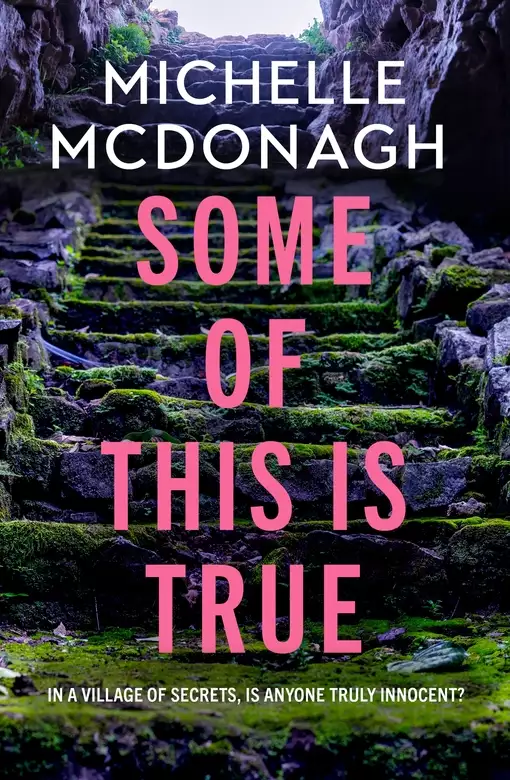
On an icy morning in January, a body is discovered at the bottom of the Wishing Steps at Blarney Castle, seemingly the tragic death by falling of a young tourist.
Jessie DeMarco had travelled to the Cork village in search of the father she'd never known, bringing only a name and general location of his whereabouts. When her bereft mother Dani arrives from America to identify Jessie's body, she brings with her a story of this man's past that will soon lead to shocking accusations - and fervent denials.
Convinced that her daughter's death was not accidental, Dani sets about uncovering evidence, as the local community begins to take sides. But who to believe - the highly respected man they have known all their lives, or a devastated mother with nothing to lose?
What people are saying about Michelle's novels:
'Gripping' Jeanine Cummins, author of American Dirt
'Hard to put down' Liz Nugent, author of Strange Sally Diamond
'An absolute triumph' Andrea Mara, author of Someone in the Attic
'Extremely addictive' Business Post
'A gripping page turner' Reader review
'Kept me constantly guessing' Reader review
'I was hooked from the opening pages' Reader review
Release date:
June 5, 2025
Publisher:
Hachette Books Ireland
Print pages:
352
* BingeBooks earns revenue from qualifying purchases as an Amazon Associate as well as from other retail partners.
It wasn’t until the following morning that her body was found. The ground had frozen overnight, an Arctic mass having moved south and extended over Ireland, bringing with it a widespread, severe frost. A status yellow ice warning had been issued for the day, with further warnings likely for the coming days. One of the gardeners had been crossing the wooden footbridge straddling the pond on his way to the Water Garden when something at the bottom of the Wishing Steps snagged the corner of his eye. Something pale. Something that didn’t belong there and made him pause in his tracks to stare across the pool to the base of the stone steps. But his view was blocked by the mop of climbing creepers that clung to the boulder from which the steps were hewn, spilling over the top like a knotty overgrown fringe. Grumbling under his breath, the gardener continued along the boardwalk, ice crunching beneath his boots. When he reached the willow tunnel, he bent his lanky frame under its interwoven branches.
Keeping the sixty-acre castle grounds looking as impressive as they did was a full-time job for the team of gardeners. In peak season, thousands of tourists came through the gates every day and extra staff were drafted in. Things were much quieter at this time of year, when the vast majority of the visitors were locals making the most of the peace and quiet, who tended for the most part to respect the place and not to leave their rubbish behind. This was his favourite time of the day here, the serenity of the place completely unspoilt. He and the rest of the team had it to themselves for another hour and a half or so before the gates opened.
The gardener made his way around the boardwalk now, passing the miniature willow tunnel for children on his right, before he came to the viewing area at the base of the Wishing Steps. He huffed at the sight of an abandoned, crumpled sleeping bag of what seemed a highly impractical colour, but as he got closer, the condensed plume of his pique still suspended in the air, he realised it was a coat he was looking at: a white, padded, Puffa-style jacket. And then he saw the hand, delicate and white as a snowdrop (Galanthus nivalis) and attached to a slender stalk that disappeared into the sleeve of the jacket.
He took a step back.
How very curious.
She, for it was a she – an older girl or very young woman – lay on her back, her feet and lower body resting on the lower steps, arms spread out like a snow angel on the frozen boards. A halo of thick, dark hair puddled her head, ice crystals glinting like sequins in the weak morning sunshine. Her face a washed blue beneath intricate lacework, as if Jack Frost’s spider had been up all night weaving her a spangled veil.
The gardener had been fascinated as a child to learn that spiders had silk spinning organs called spinnerets on their abdomens, a collection of spigots that looked a bit like icing nozzles protruding from the ends. The silk was stored in liquid form in internal silk glands, but as it passed through to its spinnerets, it gradually hardened, pulled out by gravity or the arachnid’s hind leg to be used as a building material, hunting tool or even a courtship platform.
Even now, after nearly a decade working in this incredible place, the natural world taught him something new every day. He would never run out of things to learn, even if he lived to be a hundred.
Deep in their roots, all flowers keep the light.
Sadly, the same couldn’t be said for humans in his experience. He had been a lonely youth, outcast by his oddness, when he had first discovered Roethke’s work, and it had been as if the dead poet had reached into his soul and opened up to him an entire new world of possibility.
Around the gardener and the girl, the world shimmered and sparkled and shone, birds squabbled and sang and water rushed recklessly over the ancient rock, splashing ecstatically into the pond. Above them, the flight of damp, mossy steps led to the Rock Close. Shaded by a leafy canopy of primeval yew trees and home to a collection of large rocks that had been in place for over 2,000 years, it was the oldest part of the vast estate, thought to have been the site of an ancient druidic settlement. Acutely sensitive to the frequency of the natural world, he had picked up on a darker energy there, particularly at dusk or early in the morning.
He looked at the girl lying on the ground in her battered grey Converse. There was no blood that he could see. Maybe some discolouring on her face, hard to tell beneath her frosty veil. Her eyes were closed. She might have been sleeping, although it was clear this was one sleep she wouldn’t be waking from.
He took out his phone and called 999. He told the operator he had found a dead girl and gave her the location and the postcode. He told her she wasn’t breathing.
Yes, he was quite sure.
She was Dead. As. A. Dodo.
The ensuing silence on the other end indicated that he was after doing it again, being ‘inappropriate’. It didn’t bother him, though: those things didn’t anymore, and at least he had managed to refrain from peppering her with some of the multitudinous facts about dodos that lived in his brain. Dodo (Raphus cucullatus), extinct species of bird, once lived on the island Mauritius. Flightless, slow to reproduce, females only produced one egg a year. Paradox in behaviour and—
The ambulance people would see for themselves when they got here anyway. The 999 lady told him to stay with the girl, and to send somebody else down to the main gate to open it for the emergency services. He did as he was told.
As he stood there, keeping the young woman company, shivering now in the biting chill despite his fleece-lined waterproof and his sturdy boots, he wondered where she had come from. This frozen angel. And how she had come to fall down here and wind up dead. The castle didn’t open to the public until nine and, consulting his watch, he saw it was just gone half eight now. The gates were closed to admission at four o’clock at this time of year, and shut fully at five. He wondered if she had lain here all night, if her death had been instant and merciful or long and terrifying and painful. If it was the fall that had killed her, or the cold. Or something else.
He leaned forward and peered closer. From beneath her death mask, an ethereal beauty lingered.
Not for this snowdrop a new beginning. Not in this world in any case. Her rebirth, if there was to be one, would have to take place on another plane. There could be a poem in that. He could title it ‘Dead as a Dodo’ and maybe replant the girl’s spirit in the kinder, safer place where he imagined the souls of the dodos to have been reborn.
He cocked his head, heard the sirens in the distance. He’d have to work on it later.
Maria
Blarney
From her bedroom window at the back of her house on the hill, Maria had a crow’s-nest view of the village laid out below her and the landscape beyond. It was a view she would never tire of: that patchwork of paint-chart greens stitched together with stone and fence and hedgerow, tumbling down to the village.
It was a lovely morning. Clean and clear and crisp. Her favourite kind of weather. There was little she loved more than wrapping up for a bracing walk under a bright sky, returning ruddy-cheeked and revived to the comfort of a crackling fire and a cosy home. From her elevated vantage point, Maria could see right down over the roofs of the Woollen Mills with the bell tower of the Catholic church poking up through the trees and the old graveyard at the front of the Protestant church.
Today though, it wasn’t the picture-postcard view she was interested in but the activity going on down there. The village was generally quiet enough at night – not much crime, apart from a recent spate of cars being broken into and some lowish-level drug dealing – but last night with all the sirens wailing and whooping past it had been like downtown New York.
It had been all over the news this morning. An arson attack on the Blarney Lodge Hotel up the old Kerry Road, which had been earmarked to house asylum seekers. The photos online were shocking. Angry red tongues of flame and dense black smoke belched up into the night sky as the hotel was eaten alive. And this morning, a ruined smoking shell all that was left. No good to anybody now. All that destruction carried out on the basis of a rumour spread by far-right rabble-rousers.
And now there was something going on over at the castle as well. An ambulance and a squad car parked on the avenue, according to the North Cork News Facebook page. It had been the second item on the eight o’clock news on 96 FM, sandwiched between the arson story and another status yellow warning for ice. Emergency services attending the scene of an incident at Blarney Castle … gardaí releasing no further information at this point.
She hoped nobody they knew was involved. At this time of year, there were very few visitors around, unlike the summer months when the place was thronged with tourists come to kiss the famous Blarney stone that promised to endow them with the ‘gift of the gab’. Most of the staff over at the estate were local and in a small village like this, everybody knew each other or knew somebody connected to them.
It was a beautiful place for a walk. Otherworldly in parts. The stunning gardens, botanical woodlands, lake and waterways had been transformed in recent years, and Maria loved to lose herself in the sprawling estate, to escape the outside world for a while.
From her perch, she could see the top of the castle, its familiar grey stone battlement rising proudly towards the sky. A few years back, an American man had to be airlifted from the top after he’d had a heart attack. Maria and the kids had watched the rescue from the window where she was now standing, the helicopter hovering in the sky like a rackety metal dragonfly. The man had come back again afterwards to kiss the stone and to thank the staff and rescue team who had helped save his life. She hoped whatever was going on over there now would have such a happy outcome.
She couldn’t see the back gate of the castle from where she stood, or the long avenue inside that wound up towards the Rock Close. That was where all the activity was taking place, according to the comments on North Cork News. She swung her gaze away from the castle, back to the neat village square, where a woman was throwing a ball for her dogs, two of those yappy little fluffy yokes.
If they were to get another dog, she’d like another golden retriever or better still, a rescue. She missed the excited skittering of Rupert’s claws along the floorboards, his little ‘All You Need Is Dog’ tag jiggling, his big soft eyes. She missed everything about him really. Tadhg and the kids insisted the best way to get over him would be to get a new puppy, but she wasn’t ready yet and as she was the one who would end up looking after him, she held the golden vote. She needed more time to mourn Rupert before she could open her heart again.
The square, where the woman was now trying to wrestle the ball from the mouth of one of her dogs, was bordered on one side by a pretty row of cottages that had originally been built to house mill workers, and on the far side by a row that included the bank, the garda station and the Castle Hotel. The village centre was also home to a chipper, a charity shop, a Centra supermarket, the Muskerry Arms and the Gab pubs, a butcher’s, a bookie’s, a few restaurants and a handful of gift shops. And around the corner, the Blarney Woollen Mills complex with its hotel, restaurant and huge shop.
There was a knot of people outside the bank, mouths moving urgently, heads nodding in the direction of the castle. A man in a red baseball cap stood outside the bookie’s, smoking. She could tell it was Billy Walsh, hanging around waiting for the pub to open at twelve. She often wondered where he got the money for betting and booze when he’d never worked a day in as long as she knew him. Surely his dole couldn’t stretch that far.
She looked beyond him to the hotel, where a squat man coming out the main door stopped to talk to another man in a black jacket who was passing. They were joined by a couple who came around the corner, the woman gesturing back in the direction they had come from, no doubt sharing whatever scrap of news they had picked up along their way. Everybody would be wondering what was going on over there, dying to find out more.
‘We’re off, Mom.’ Eva’s voice called from the bottom of the stairs.
Crap. She’d totally lost track of time. She glanced at her watch. Eight sixteen.
‘Bye, love, see you later.’ Tadhg.
A muffled grunt. Ben.
She rushed out to the top of the stairs to say goodbye, but the front door banged behind them. She winced. Why did they have to nearly pull the bloody thing off its hinges every time?
She hoped Tadhg was careful driving down the hill. The roads would be lethal this morning and her husband had never lost the invincibility complex of his youth, unlike Maria, who had never really had it in the first place. It was one of the things she’d always loved about him, along with his energy and drive and that innate sense of self-assurance she wished their son had got a bit of.
She went back into her bedroom and sat on the end of the bed that she had made as soon as she got out of it, as she did every morning. She had heard a man on the radio once, a retired navy admiral, talking about how that set you up for success for the day. How beginning your morning with a small success encouraged many more successes throughout the day. There was definitely something in that, she felt.
The house was still around her now, silent. She loved this house, the home where Tadhg had been reared and which they had moved into after his father’s death. It was an arrangement that suited everybody, including Tadhg’s brother, Gavin, who was settled in New York with his partner Craig, happy in the knowledge that their mother was cosily ensconced in her ‘granny flat’. He loved to call it that when he knew Essie was in earshot, she always sure to respond with the threat of a ‘clip across the ear’.
She breathed in the calmness before she left to head down the hill to Holy Faith Primary School, where she taught fifth class. It was a tough group this year. She had a couple of very challenging kids who took up a lot of her attention, the ones to whom discipline was a foreign concept. It made her job so much harder and unfortunately meant that the other kids in her class lost out, but it had been the same since she started teaching more than twenty years ago and it would always be thus.
In the hall, she pulled on her quilted navy coat, with a candy pink hat and matching striped scarf. She was rooting in the under-stairs press trying to find a matching pair of gloves when her phone rang.
Noelle.
Unusual for her friend to call at this time of day when she knew Maria would be getting ready to leave for work. She hoped nothing was wrong.
Grabbing two mismatched gloves, she threw her bag over her shoulder and answered the call, closing the door gently behind her.
‘Hiya. All o—?’
‘It’s the American girl, Maria. I’m really worried about her. She never came back last night.’
Noelle
She was probably over-reacting. Wasn’t she? The girl, Jessie, was more than likely shacked up with some local lad. She was young, free and single, after all. And far away from home.
‘Did you check Liam’s bed?’ Maria had asked. She was only ball hopping, but Noelle didn’t find it funny. A bit too close to the bone.
Her son was spoken for now, even if Noelle hadn’t initially approved of his choice. In fairness, there weren’t too many mothers who’d have chosen one of the Mad Macks from Millview as a partner for their son, even less so as the mother of their first grandchild. Molly McMahon came from a big family of notoriously wild uncles and aunts, most of whom lived on the estate. Fond of their drink and their drugs. Kids with so many different partners it was impossible to keep track of whose were whose. One of the younger lads had been done for dealing drugs and robbing a car last year and it was well known he wasn’t the only one of them involved in that sort of thing.
Noelle had hoped Liam would see sense, that the relationship would eventually run its course and that her only son, her baby, would settle down with a nice girl. She nearly died the day he came home to tell her he was going to be a father. She’d been distraught. And furious. With Liam for being stupid enough to get caught, and with Molly Mack for trapping him. She could never have imagined as she sat sobbing into her hands at the kitchen table that day how things were going to turn out. How wrong she had been.
Molly had turned out to be a marvellous mother, a complete natural who doted on her baby, and Noelle had really bonded with the girl over the five months since the birth of her beloved grandson. She had drummed into Liam how important it was that he respected and looked after the mother of his child. Unlike his own sorry excuse for a father.
She stuck her head into her son’s room. Just in case.
He wasn’t there; he started work at eight and was usually gone by half seven at the latest. She had barely seen him yesterday. He’d popped home for a quick shower and change after work and headed straight back out in the van, no time even for dinner, saying he was going to Dean’s house and would get a takeaway. She hadn’t heard him come in last night, but he never stayed over in the cramped terrace where Molly lived with her mother and stone-mad younger half-brothers, and where she only had a box room with a single bed and now Leon’s cot squashed in. He must have been late. Not good enough on a work night, really, especially when he had responsibilities now. He was a good lad, though, in fairness to him, a great support to her over the past number of tough years.
She pushed the window open as far as it would go, the freezing air rushing in as if it had been hanging around outside waiting, and turned to make his bed.
Oh!
It didn’t appear to have been slept in since she had made it yesterday morning.
Noelle checked Liam’s laundry basket. The tracksuit bottoms and hoodie he had changed into after work were in there, so he must have been back at some stage. At twenty-four, her son was big and well able enough to do his own laundry and make his own bed, but she didn’t mind doing it; he worked hard and she wanted the linen to be fresh for the nights Molly stayed over. The B&B was quiet at the moment anyway, so she didn’t have any other beds to do. Apart from Jessie’s, of course.
Which reminded her.
She went back around the landing to the room where the American girl was staying. Jessie had booked and paid for a single, but Noelle had given her the biggest of the three empty double guest rooms. She’d be pretty much booked out from St Patrick’s weekend in March right through until the end of September, so she appreciated the quiet winter months when she could relax a bit.
Herself and Kevin used to go to the Costa de Sol for a week in October every year, the heat and the cost much more bearable at that time of the year. That had all ended six years ago, along with her marriage, after she found out he was messing around behind her back with one of the girls from the deli in Centra. He had moved in with his deli girl after Noelle kicked him out, had promptly got her pregnant and then left her for an even younger model when the child was still in nappies. Liam and Holly had cut their father off – although her daughter had been in contact with him before she left for Australia – and he had never met his gorgeous grandson. Noelle had gone on a week’s holiday to Lanzarote with a newly separated friend a few years back and they’d had a lovely time, but then her friend had met a new man and that was the end of that. All of her closest friends were still married, happily or otherwise, and still in the thick of parenting kids through school and college. Noelle had started her family younger than the rest of them, and had found herself in a very lonely place before Leon came along, bringing a renewed sense of purpose into her life.
Now, what am I supposed to be doing again?
She stood in the middle of the room where her only guest was staying, her brain completely blank, before turning on her heel and wandering back out to the landing. She knew she had gone in there for a reason. It was so bloody frustrating.
Her older sister Grainne, on one of her rare visits back from Dublin, had told her it was time for her to start HRT. The brain fog was only going to get worse, Grainne warned, and her mood was already up and down like a yo-yo, but Noelle wasn’t ready to start taking it yet. She was forty-eight but still getting her periods like clockwork every month. Grainne had heard on a podcast that baby girls were born with between one and two million eggs, but more than 10,000 died each month so by the time girls reached puberty, they had between 300,000 and 400,000 eggs. ‘Which means that by fifty-one, the average age of menopause, you’ll have fewer than a hundred fairly crappy eggs left,’ Grainne had informed her sister. Noelle had visualised her remaining eggs shrivelling inside her, her ovaries getting ready to pack up their stalls, good for nothing now her child-bearing years were over. As if her desirability was preparing itself to curl up and wither away along with her fertility. It was all so bloody depressing.
Now, where was she again? Oh yes, Jessie.
She went back into the guest room and surveyed it. The curtains were open in here too. Noelle had listened out for Jessie last night, but she’d fallen asleep around midnight. She wasn’t usually this protective of her guests, of course not, but Jessie was different. Only twenty-two and on her own in Ireland, searching for a father she had only just found out about: a Michael Murphy from some place in north Cork with a castle.
Michael Murphy! She might as well try and pull every haystack around the place apart looking for a fine needle. And castles were two a penny in Cork, although Blarney was undoubtedly the most famous.
Young people these days, though. For all the giving out everybody did about them spending too much time online, they were cute out when it came to technology. Much smarter than Noelle’s generation in a lot of ways. Jessie had explained that she was documenting her search, appealing for people to help her find her father through the videos she posted on YouTube and TikTok. And it seemed to be working too. She might not have found him yet, but her appeal had grown arms and legs. Cathal Cronin in the North Cork News had run a full page on her search with a big photo of her: those huge brown eyes and that mop of curls, that gorgeous smile. The story had been picked up by the Examiner and 96 FM and was all over social media.
Jessie had been here ten days now and was talking about moving to Blarney for good, to get bar work and maybe go to college at night. ‘I know the grass is always greener, but it literally is greener over here,’ she had said to Noelle, laughing, before she left the B&B yesterday morning, full of plans for the day. She didn’t seem too worried about getting a work visa, was optimistic that she’d track her father down and would then be entitled to an Irish passport. Noelle had advised her not to make any rash decisions, to maybe talk to her family at home first, although there seemed to have been a bit of a fallout there – Jessie had told Liam she wasn’t talking to her mother. Well, as Noelle had pointed out to Liam, it was all very new and exciting at the moment and Jessie was enjoying being the centre of attention, a sort of mini-celeb around the place, but the gloss wouldn’t be long wearing off once her savings ran out and she had to work for a living and try to find a place to rent in Cork in the middle of the worst housing crisis the country had ever seen.
Noelle had been surprised and a bit put out when Jessie hadn’t turned up for dinner yesterday. She didn’t usually provide an evening meal for her guests; it was a bed and breakfast she w. . .
We hope you are enjoying the book so far. To continue reading...

 Please log in to recommend or discuss...
