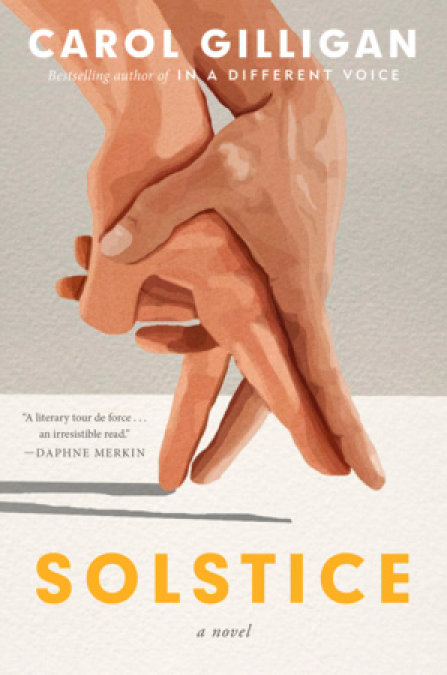
A brilliant but restless dancer discovers the true meaning of love and intimacy through the ebbs and flows of her marriage in this exquisitely written novel—from the bestselling author and psychologist whose feminist classic, In a Different Voice, revolutionized our understanding of women’s lives.
“A literary tour de force . . . an irresistible read.”—Daphne Merkin “A remarkable work by a remarkable writer.”—Gish Jen “A deeply felt narrative of a couple’s push-pull dynamic over decades.”—Publishers Weekly (starred review)
Boston, 1969. Eve, a dancer whose feelings are expressed through the body and movement, senses an inexplicable distance growing between herself and her husband, Gabe, a journalist and father of her two children. Feeling lost and alone, she begins an affair; Gabe detects it immediately and begins one himself. Yet somehow they find their way back to each other, and when Eve gives birth to a daughter, their marriage becomes vital again.
Years later, when Gabe returns from a reporting trip to the Middle East and Berlin, Eve again perceives something is wrong in her marriage. He has always had a darkness she could not fathom—deep psychological scars from his childhood, when Gabe escaped Nazi Germany on the Kindertransport.
Amsterdam, 1991. Newly separated from Gabe, Eve has accepted a fellowship to choreograph a dance inspired by the story of Adam and Eve. When a colleague introduces her to a new translation of the ancient text, Eve begins to redefine the way she thinks about women, men, and relationships—and, perhaps, to see another path back to her marriage.
In this emotionally riveting novel, Carol Gilligan draws on her unsurpassed psychological understanding of women's lives to explore a new vision of love and intimacy. Sweeping across decades and continents, Solstice is a provocative and profound portrait of what it takes to truly love another.
Release date:
August 4, 2026
Publisher:
Random House
Print pages:
336
* BingeBooks earns revenue from qualifying purchases as an Amazon Associate as well as from other retail partners.
Eve inched the empty stroller down the street. Daniel had insisted on walking. At the corner, she waited for him to catch up, his red corduroy overalls and blue Keds bright against the gray October day.
In front of the missile launcher at the Museum of Science and Industry, the sign said Aerospace Power for Peace. Black and yellow metal squares sprouted on public buildings, saying Fallout Shelter, with a number specifying the occupancy.
Beside her, on the large blue post office mailbox, the sign was handwritten: Fallout Shelter: Occupancy 1. She laughed. He’d done it, her husband. At a late-night gathering in their kitchen with friends from the committee for a sane nuclear policy, Gabe was the one who came up with the idea. It’s how to say it, he said, because it’s absurd. And this way, everyone will see it.
Yellow leaves lined the street.
In autumn, when the grapes made sharp air sharper by their smell . . .
“Daniel,” she called.
He scooped an armful of leaves and flung them into the air. A swirl of yellow.
She reached out her arms as he ran to her, hair flopping.
She lifted him and held him close.
The scent of his body. The swell of her breasts.
•
She was pregnant again. She’d known instantly. A shift in chemistry, a subtle vibration. She didn’t need to say anything. One morning Gabe put his arm around her, touched her belly, and smiled: “I’ll need to set the table for four.” She was dancing with a company at the local performing arts center—its Swahili name meant “joyful meeting.” It’s how they felt about the baby.
Shortly after Caleb was born, a minister was run over by a bulldozer in a civil rights demonstration. The city had broken ground in a Black neighborhood for a school that would resegregate the recently integrated Black children, and activists went to the site. Some of the protestors lay in front of the bulldozer. The minister lay behind it. The driver said he didn’t see him. He said he didn’t hear the warnings people shouted to him because of the noise of the machine. Nursing Caleb, his eyes latching onto hers as his mouth circled her nipple, she was haunted by the specter: the minister trusting the driver, trusting him to know he was there.
Caleb had croup. In the bathroom, she held him while Gabe turned the shower on hot. The room filled with steam and Caleb’s breathing eased. A shudder ran through his small body and he nestled his head on her shoulder. Water dripped from the ceiling; light filtered through the mist.
Gabe quit his job at the Associated Press. They’d killed the series he had written exposing the lies in the government’s fallout shelter program. Instead they ran a technical piece: how many people, how many cubic meters of air. “Screw it,” he said. He’d set out on his own to tell the story. The idea that you could survive a nuclear war by sheltering in a basement with a can of soup? People deserved to know the truth.
The Times Magazine ran one of his pieces. People were starting to pay attention.
On the night Nixon was elected, they’d stayed up till four in the morning with Hank, their Jesuit friend. When they first knew him, Hank wore the Roman collar. He believed in the promise of the Gospels—a world without war, a society without poverty. He’d worked on Eugene McCarthy’s campaign. True, the campaign had brought down Lyndon Johnson, but Johnson’s decision not to run for president again had set up a showdown between Gene McCarthy and Bobby Kennedy—the two antiwar candidates. After Kennedy was assassinated and McCarthy was defeated by Hubert Humphrey in the Democratic primary, Hank took off his collar and left the Jesuits.
For a moment it had seemed possible: a great society. Yet Johnson couldn’t bring himself to admit that America was losing a war. Not under his presidency. And for that, Hank said—she remembered his look: incredulous—for that shard of manhood, Johnson had sacrificed all he could have accomplished.
Maybe Marx was right, Gabe said. Things have to get worse before they get better.
Gabe never aspired to work in an office. “I’m not your high-rise kind of guy,” he’d say. For one thing, he was too restless. Also, to write about people whose lives were caught up in the conflicts between nations, people outside the usual circles of power, he had to be out there. Plus, he liked to walk around. Their two boys now shared his readiness for adventure. “Let’s go,” he’d say, undeterred by the weather, the three of them trooping out in boots and yellow slickers.
Yet when The Baltimore Sun offered him an editorial job, he couldn’t see how not to take it. He had ideas about how a newspaper should be run, and as op-ed editor, he might wake people up. With two kids now, they needed the money. It would mean not worrying each month about covering their expenses. And Baltimore was hot in the news. A riot had followed Martin Luther King Jr.’s assassination, and federal troops had been called in to restore order. The city was on the national radar. With racial tensions continuing, The Sun could make a difference.
They talked it over late one night.
“I’ll be okay,” he told her. “I know what I’m getting into.”
She almost believed him.
“You?” he asked, searching her face. “How about you?”
For a moment, she wavered. Leaving Chicago and moving to Baltimore meant going back to the East Coast, and she missed the ocean. The four of them would be together, and maybe it was time, like repotting a plant. Yet, to be honest, the move made her uneasy. It’s not about me, she wanted to say, though in part it was, but she didn’t want to stand in his way, especially if this could make a difference.
“It’s just a feeling,” she told herself one hot Sunday afternoon as they were taping the last of the boxes shut. True, but she couldn’t shake it. It wasn’t just that moving from Chicago to Baltimore meant leaving the company she’d been dancing with and taking the children out of their preschool and tot lot programs. There was something else, something about Gabe, but she couldn’t figure out how to say it. Her chest tightened each time she thought of the move.
Later, she told herself she’d been mistaken. She had gotten a job teaching dance at the Peabody Conservatory; the children were settled in schools. With help from the paper, they managed a down payment on one of Baltimore’s run-down row houses. When they discovered a marble fireplace behind the boards in the parlor, Gabe said it was as though they’d taken a Chance card and landed on Boardwalk. Under the rotting green linoleum in the kitchen, the floorboards were oak. In a store that smelled of patchouli, she found a replica of a Tiffany lampshade made from paper, and she hung it over the bulb in the front hall.
Gabe came home late most nights. She knew he preferred rolled-up sleeves, collar loosened and tie askew, to the tailored suits he’d taken to wearing. She’d ruffle his hair, but he’d slick it down again. And sometimes when he spoke to her—“Who are you speaking to?” she’d say. “I mean to whom?” she’d ask, correcting her grammar, because there was a formality now in his manner. When he realized she was teasing him, he’d smile and tousle her hair. Yet sometimes he didn’t, and then she was puzzled. “Gabe?” she would say, her heart beating wildly, waiting for him to see her.
With Daniel, he’d started to lose patience. Was he right? she asked herself. But surely Daniel didn’t need to learn limits so young. He’d just turned six, and he would get so absorbed in whatever he was doing that he was never ready to go when it was time. “He needs to learn,” Gabe said. But then Gabe was so patient with Daniel most of the time, and if even he thought so . . . She wasn’t sure what she thought.
She missed the intrepid reporter who trusted his senses, picking up the smallest signals—knowing she was pregnant without her telling him. Her body had registered this new shift in him. Hadn’t he felt it? That was the part she couldn’t explain. When she asked him now “How was your day?” he didn’t even look up.
We hope you are enjoying the book so far. To continue reading...

 Please log in to recommend or discuss...
