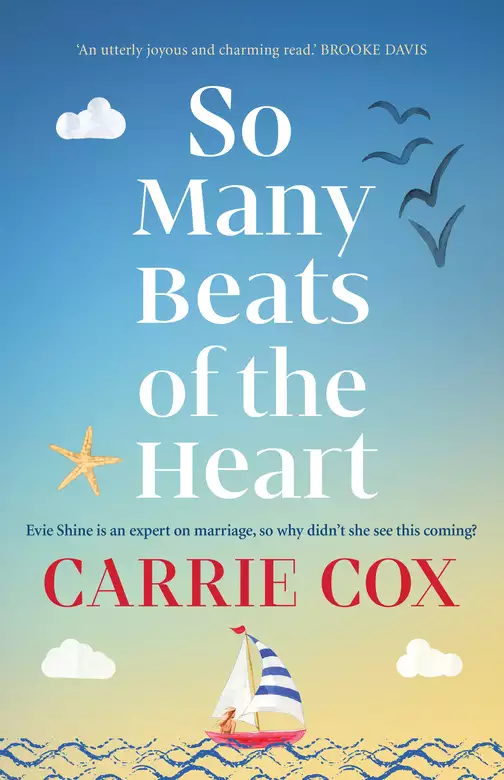
"Utterly joyous and charming." BROOKE DAVIS ‘Abundant wit, a keen instinct for the perfect detail and a whole lot of heart.' – Nick Earls ‘I adored Evie Shine and this warm, funny novel, filled with nuggets of wisdom about that most fascinating of landscapes: other people's relationships.' – Kerri Sackville Evie Shine is adrift. After two decades of marriage, her husband has left her. Possibly for another woman. He isn't saying. That Evie has spent her career dissecting relationships and mending broken hearts doesn't help at all – it just makes everything worse. How did she not see this coming? And what's she meant to do now? Her own worst client, Evie ignores all useful advice and chooses platitudes, wine and hangovers over the prospect of moving on. But soon she realises that the beauty of having the rug ripped from under you is getting to see exactly what's underneath. So Many Beats of the Heart is about how the crushing weight of time can take its toll on long-term relationships. It's about love lost, friendships found, losing your bearings and finding a way back to shore.
Release date:
March 29, 2022
Publisher:
Affirm Press
Print pages:
304
* BingeBooks earns revenue from qualifying purchases as an Amazon Associate as well as from other retail partners.
It’s cauliflower that finally undoes Evie Shine. A bed of rough nubs in aisle eleven. Something about its nothingness. A quick silent kick to the chest.
She can’t be winded, Evie thinks, and yet the air has shot right out of her and can’t get back in. Her hands twist the trolley bar. Does she even need cauliflower today? Does anyone?
There are tears splashing softly onto Evie’s hands. How long would cauliflower simply sit in the dark vegetable drawer of her fridge before exhibiting signs of oversight? Try to swallow. Try to breathe.
She hadn’t known her water table was rising. Maybe cauliflower is exactly what she needs. Just a hardy vegetable and a few fresh ideas. Some better shoes. Swifter changing of blown lightbulbs. Deeper lines in the sand. Simple things. Come on, breathe.
It used to be that almost everything Evie needed, everything two children and two adults need over the course of two decades, could be found in a supermarket. There she’d made the weekly choices, tiny and vital, that dictated the rhythm of their lives. The factory floor of a family. Now it’s all passive-aggressive vegetables and decisions of minimal consequence.
Hand on her pounding chest, Evie at last feels a slip of air find its way back in.
‘You okay?’
Evie looks up to see a woman at the head of her trolley. She’s young and concerned, dressed as though she’ll be going directly from here to a half-marathon.
‘Do you need anything?’ the woman asks her.
Evie puts a hand to her cheek now, feels its wetness and does her best to smile. ‘It’s the onions,’ she says, pointing loosely at the cauliflower. ‘Every time.’
‘Okay,’ the woman says uncertainly. ‘Um …’
They both glance at the rows of vegetables for answers, for a way out.
Keep. Breathing.
‘Really, I’m fine,’ Evie says now, one hand waving the entire store away, the other wiping the water from her eyes. She makes a better attempt to smile at the kind woman. Sees that her Lycra top says Run like no one’s watching.
What?
‘All good now,’ Evie says, loosening her grip on the trolley. ‘Sorry about that.’
And she hears herself say it this time. Sorry. A fellow tutor at the university had recently remarked that Evie was forever apologising. She’d thought about this for a day or so and waited to catch herself doing it. It was one thing to throw around empty apologies in daily life but another to do so within a school of psychology. Among the cloistered halls of smug dot-joiners.
She knows there are many reasons people become excessive apologisers. Social anxiety. Hardwired trauma. Insecurity. Seldom are those who apologise the people who really need to. Rarely is forgiveness the goal. But now that she’s doing it, punctuating her sentences with ‘sorry’ instead of commas apparently, none of those explanations fly. It’s reductive behaviour, and she has no idea how long it will continue.
Evie has become, she realises, here by the stupid cauliflower, the sort of client she’d never enjoyed treating. The case study she now hates teaching: blindsided spouse stuck in a loop of self-pity, anger and leaky moments in the supermarket. A patch-up job at best. Ugh.
It’s not that good therapy can’t do much for a trampled heart, at least in terms of holding it like a broken bird in two hands while time maybe, hopefully, does its thing. But if the trampler isn’t part of the process, then it’s all just guesswork and brushstrokes. History rewritten for an audience of one.
It should make it easier that Evie’s read all the textbooks relevant to her situation, every ironic one, but of course it doesn’t. Knowledge can be its own punishment. Insight makes for clean cuts that bleed for hours. You don’t want reason and clarity when waking up each day feels like a panicked diver’s ascent. You want bad advice and platitudes. Cheap wine and hangovers. Plotless movies set in Tuscany. A welcome loss of appetite.
You definitely don’t want moments like this in the supermarket. This is awful. Evie’s legs are trembling just when she has to push this two-hundred-ish-dollar trolley of vague meal possibilities and forgettable decisions towards the checkouts.
Just get out of here.
She’s not one to abandon a task, no matter how uncertain it’s become. She always sees things through, often for no good reason. But Evie also feels an uneasy sense of pointlessness about today and what lies beyond it. She steals a deep breath, parks her trolley behind the potatoes and walks out of the store as though struck by the possibility she’s left the oven on.
As though everything isn’t already burning down.
2
After enough time you stop reading the pithy magnets on your fridge door. You stop seeing them at all. But today the oldest and grimiest of magnets on Evie’s fridge pulls her up short: No matter where you go, there you are.
She can’t remember who first said that – Confucius? Seinfeld? – or even how she got the magnet in the first place, but somehow it’s survived every house move (four), every fridge upgrade (three) and every marriage implosion (one) since.
And it stops her mid-thought now as she checks with fresh hope whether there’s anything dinner-worthy on hand in the wake of her aborted shopping mission. Anything to cover herself and a carnivorous teenager. It strikes her that this prescient magnet might have known all along how the Shine family would go down: broken and adrift on the wrong side of the country. It knew Evie would end up stranded in an alien city of her husband’s choosing, unable to decide whether to stay or go, knowing only that any relocation would be like shuffling a steaming pile from one corner of a room to another.
She looks anew at the other magnets, mostly given by friends from a previous life: We are all broken – that’s how the light gets in, Turn your wounds into wisdom and a dozen or so homages to wine and chocolate and soulmates (mostly wine).
God. Evie leans back on her kitchen bench and wonders how many lives have been ruined by taking far too literally the advice on fridge magnets.
‘What’s for dinner?’
Angus Shine moves into the doorway of the kitchen like a dalmatian through a cat-flap. His ranginess is almost theatrical, though far from deliberate. It often pains Evie to see the quiet shame her son has about his own physicality. No matter what people say about Angus’s six-foot-four frame – and it’s always remarked upon – he hears only the white noise of undue attention.
‘How about takeaway?’ Evie says, waving off the fridge like an old debt. ‘Pizza?’ Again.
Angus shrugs in the affirmative. ‘Vegetarian with ham,’ he says.
Evie’s long stopped questioning the peculiarity of this order. ‘How was school today?’ she says, knowing the question will be longer than the answer.
‘Okay,’ her son emits, retreating at pace. ‘Boring. I’ll keep an ear out for the pizza.’
Angus is in his final year of school. There’s no plan beyond this, because plans stopped meaning anything a year ago. Now he’s marking time, mostly in his bedroom, and fronting up for meals.
Evie believes he’s a good kid and by that she figures he has a kind heart. The weight of unrequested existence elicits from him a quiet acquiescence. He will never be a boat-rocker, unlike his sister. He’s never once raised the issue of Hamish’s absence with Evie; he’s never asked a question or made a protest. Whatever anger and confusion he may feel about his father has no precedent and so cannot be shaped. He seems the least affected out of any of them, seems okay, better than he was, which Evie knows to be a false positive in most cases. Tectonic plates may well be shifting deep within.
She sees a pile of envelopes on the kitchen counter that Angus must have retrieved from the mailbox. A bill from her new skin doctor, a Mater Prize Home lottery brochure addressed to the previous owners, and a Private and Confidential letter for the house two doors down the street. Because Evie doesn’t want to open the bill yet, she decides instead to deliver the neighbour’s mail.
The street she now lives on, the address hand-picked by her husband via an excitable online search one evening just over two years ago, an evening she now looks back on as one might the feverish booking of a flight for a loved one that ultimately plummets, is typical of Sunshine Coast aspiration. A mixture of young families, blended experiments and seniors not yet going down for the count. In between are people like Evie – caught by circumstance in a place they don’t know but can’t quite see beyond, perhaps for the glare.
She goes to put the letter in the cream rendered mailbox of number 68 and is intercepted by a girl, maybe sixteen or seventeen, coming up the footpath towards the same house.
‘Hi,’ she says, lifting the letter out of Evie’s hands. ‘I can take that. Thanks.’
‘It came to the wrong address, sorry,’ Evie says. Again with the sorry. ‘It’s the third one.’
‘Right,’ the girl says.
‘But I don’t mind dropping them off – it’s fine.’
The girl has hair everywhere, wild and pointy like talons, the colour of Pilbara dust. Her face is sunken by furiously smudged brown eyes. ‘Thank you,’ she says and gestures at the house. ‘He doesn’t come out to the mailbox much.’
‘Probably afraid of all the bills like me,’ Evie says and smiles, then frowns, then half smiles. Can’t decide the right expression. She heads back in the direction of her house, wondering why she’s always felt the need to please ambivalent strangers.
In the fading light Evie looks again at this street they’ve landed in, a mix of new money and dubious money. High-walled mini compounds alongside porous beach shacks. She knows none of her neighbours and suspects she won’t, even though she knew most of the regular faces in her previous habitat. Jill the dog-walker, sad widow Sylvia, Ken the needy conversationalist. And the parents of her children’s friends from primary school – those relationships had, apart from one or three, withered from weekly barbecue catch-ups to apologetic summaries in the grocery aisle.
Life hadn’t seemed to be winding up in Perth until Hamish announced his golden opportunity: a three-year contract (unheard of in academia these days) as a professorial fellow in politics at Sunshine Coast University. And everything had looked different from that moment, as though viewed from forty thousand feet up – the depth of their friendships, the value of their home, the trajectory of their careers.
We would be mad – mad, Hamish had insisted, to pass this up. And Evie had quickly, so very quickly, come to agree. The money, the timing, the vague reminder of a feeling called thrill.
She looks back now on her agreeability as one might regret falling in with the wrong crowd at high school. There just weren’t enough obstacles in the way. She’d trampled over red flags. Moved too quickly.
Of course she’d worried about the kids, but, as Hamish pointed out, Sera was just finishing year twelve and her grades would get her into a university on any side of the country. And Angus would be fine, Hamish insisted. Hadn’t Evie wanted a change for him? Something to ignite his kindling.
The longer Evie took to find opposing arguments, and she didn’t, not really, the more rapidly the moving plan progressed. Her own job, as a relationships counsellor at a reputable not-for-profit centre in Cottesloe, had never felt worthy of throwing up as a counter-argument. As much as she felt she was making progress with most of her clients, she knew – and Hamish often reminded her – that their problems were largely universal and her expertise transferable.
What neither of them raised, for many reasons along the spectrum between doubt and fear, was how their own relationship factored into this decision to uproot their midlife. Somehow the conversation didn’t happen, either because it wasn’t necessary or because it was so necessary as to be impossible.
It had, for a short time anyway, been nice to see Hamish so enthusiastic about the prospect of change. Of making something happen. Evie hadn’t been tempted to look too squarely at the possibility that Hamish, like so many men she’d counselled over the years, might be trying to run away from his family by taking them with him.
3
Caron and Glen
There came a point in couples counselling, usually during the third or fourth appointment when the set pieces had all been played and the stakes were now abundantly clear, when Evie could see who was lying. Either to themselves or to their partner. Always to Evie.
Perhaps ‘lying’ isn’t fair. It was more the case that one person’s agenda suddenly came into clear focus, no longer hidden behind apparent confusion and hurt. It had been there all along: the trick card secreted at the bottom of the deck. It became evident, at least to Evie, just who was captaining this boat and where it would beach.
Caron was clearly a very capable woman, someone who could quickly size up any environment and insert herself at its core. She didn’t just win promotions; she expected them. Knew they were coming. She had surpassed Glen’s early notions of her capacity and quietly resented him for underestimating her.
But they’d been an attentive couple, neither one wanting to replicate the errors of their parents, both trying to fill childhood voids. They had produced two children, two boys, now in their final years of high school, one easy, one difficult. They couldn’t agree on who was the easy one.
Minutes into their first session with Evie, Caron had begun to cry. She consistently wept the minute each session began, six in total, before declaring there was no point continuing at all. It was because of all of the things, she said, all of them. It was her exhaustion, his ambivalence, her long hours, his long hours, the relentless march of it all, on and on and on into too-familiar territory. It was, Caron said, the meaningless conversations that felt like scraping mould off cheese. It was libidos that no longer signalled themselves. It was old resentment (the sheer engorgement of early motherhood) and new resentments too: his lack of fresh ideas, his acceptance of this … whatever this was. This place in the supposed middle of their lives that felt very much like the end, at least to Caron.
That Glen couldn’t see it, that she alone was left to identify the decomposing body of their marriage – this was what had upset Caron the most. This was what had brought her to Evie’s small office in Cottesloe one rainy August.
Caron needed to make Glen see how bad things had got, she said, or else they’d never be able to fix any of it. But that, Evie had begun to feel, wasn’t the truth.
It wasn’t Caron’s desire to fix her marriage, not anymore. Caron had done the building inspection some time ago, had deemed the structure unworthy. Her gaze was now elsewhere – quite possibly an exit affair, Evie had suspected – and she wanted out. But it’s not easy to call time on a well-established marriage without a bomb, especially if you’re a woman.
In the absence of exposed infidelity, abuse, financial ruin, chronic illness or insurmountable grief, first-time marriages in middle age can’t easily be detonated. They’re like murder trials without a smoking gun, entirely reliant on the weight of circumstantial evidence. One needed to mount a substantial case.
Because really, Evie often thought in spite of herself and in spite of her job, what was any married couple of a certain duration expecting at this point? She had heard it too many times: years and years of listening to couples collapsing in upon themselves, looking for answers, for validation, for a way out. So often the qualities they first saw in each other had become the focus of their respective disappointments. This was both cruel, Evie knew, and partly inevitable. Sometimes fixable if that was the shared goal – if therapy wasn’t simply an expensive ruse to please the jury.
She used to be more hopeful, of course. She used to be better at this. Once Evie had been painstakingly methodical about helping couples identify the hurts they were projecting on each other – most often the scars of childhood rearing up like fully grown vipers. She had been proudly successful in helping them at least reach a point of mutual understanding (the highest form of love, she would tell them) and to recalibrate their expectations about sex and romance post kids, career and calamity. Her talent, she knew, or at least assumed, helped insulate her own marriage.
But Evie had begun to see that most people simply come to counselling too late. And that at least one party is telling lies.
She would see Caron again, about six months after their last session. She spotted her at a weekend market throng, her head thrown back in joy at the taste of a tangerine. She was with a man, not Glen, and Evie had watched them both from behind a rack of clothes. All tanned limbs and sun hats. Side smiles and reinvention.
Evie had wondered what Glen was doing right now. She’d hoped he was okay.
4
There was a window after Hamish left through which Evie could have quietly crawled back, back to what came before, but somehow didn’t. There was a clear return route to her former life, the setting of it anyway, so recently abandoned that Evie imagines the fairy lights she’d strung up in branches for their leaving party are still flickering their tiny shards of joy. No one would have questioned it. She’d have returned an object of pity, but that would have been the worst of it. Like the dolt who throws in their job to travel around the world for a year, only to return a month later, sheepish and broke. It happens. Nothing to see here.
But Evie hadn’t moved – hadn’t even teetered like the last bowling pin. She is caught somehow. Drawn to disorientation. Stuck in Bono’s moment. Sometimes she recognises the signs of emotional inertia wrought by trauma – the resistance to courting any more unwelcome change. Stay still. Just wait.
But it’s more than that. More than not knowing what picture Hamish has apparently drawn for them.
In the last three years of her life in Perth, Evie witnessed a steady degradation of the partnerships in her friendship circle. One by one, as though each had somehow infected the next, her friends’ marriages ended. There were spectacular combustions and predictable dissolutions. There were third parties, no parties. There were tacky divorce parties. There were exceptions.
An ethnographer might have reported a quiet pandemic of pain in the city’s suburbs. A steady fracturing of street-front houses into nondescript little units at the rear of battle-axe blocks. Kids biting skin off thumbs. The packing and unpacking of sports bags. Teachers wanting quiet words. Bottle-shop boom times.
They might have noted the few commonalities – the certain vintage of most partnerships, kids not quite finished high school (but close enough), the absence of the sort of economic or societal pressures that might excite a documentary maker. Problems of privilege.
These were the marriages that had already made it through the early chicanes. Made it out of the dark forest of weariness, the tedium of toddlerhood, the contest for careers, the tandem tilts at joy and temptation. Evie had counselled many couples over the years who’d never made it this far, who’d tripped at much earlier hurdles, but these are not the cases she now looks back on in unbidden moments, the ones landing on her windscreen like bright yellow flyers. Now she remembers the couples who almost made it . . .
We hope you are enjoying the book so far. To continue reading...

 Please log in to recommend or discuss...
