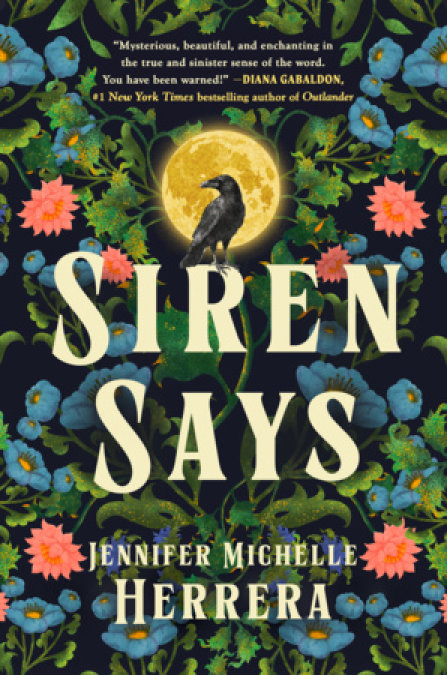
“Mysterious, beautiful, and enchanting in the true and sinister sense of the word. You have been warned!” —Diana Gabaldon, #1 New York Times bestselling author of Outlander
A lush, spellbinding tale about a tenacious young woman who must harness her family’s dangerous magic to put a stop to the sacrifices they’ve been making for more than a century
Twenty-five-year-old Raven Wynn knows that the ancient plant magic running through her veins brings nothing but destruction. It doomed her Welsh ancestors. It killed her mother. It’s the reason she’s now bound by a painful curse—one that will destroy her if she can’t find a way to break its hold.
When her estranged Aunt Delilah bursts into her life promising a cure, Raven seizes the chance. However, her freedom comes at a steep price: Once her magic is fully unleashed, she is more powerful—and more dangerous—than anyone thought possible.
Desperate to tame powers she never wanted, Raven makes a pact with Delilah: In exchange for learning to control her magic, Raven will capture one of the spirits that roam Delilah’s hometown on May’s Eve so that it may grant Delilah’s secret wish. With the help of an enigmatic new friend, Cherry, as well as an infuriatingly handsome stoneworker, Idris, Raven learns that her task is even more perilous than she imagined—one false move and the spirits could trap her soul—forever.
A sumptuous escape into a world of Celtic spirits and botanical magic, Siren Says is a bewitching story of the unbreakable bonds between women, the interplay between goodness and power, and the capacity of love to mend our very souls.
Release date:
August 18, 2026
Publisher:
G.P. Putnam's Sons
Print pages:
368
* BingeBooks earns revenue from qualifying purchases as an Amazon Associate as well as from other retail partners.
CAUTION: This email originated from outside of Penguin Random House. Please be extra cautious when opening file attachments or clicking on links.
CHAPTER ONE
Magic is Nature's gift to Wynn women. But Nature has an agenda all its own.
-The Wynns' Llyfr Cyfrin, entry by Violet Wynn
I had, of course, known that my mother was a witch, even though she'd always referred to herself as a Siren.
I'd known it from the way she ignited the fireplace with dittany powder instead of using a match. I'd known it from the way she'd forage for the exact type of pine needle to make her remedy tea-the one that never failed to cure me. I'd known it from her headaches, which could last for days or sometimes longer, when her visions took hold of her and the person inside went somewhere else. If I'd ever harbored any doubts about what my mother really was, all of those were put to rest on the day that she died.
That day, I'd woken to the sound of crows. My corner of Eighty-Sixth Street, which was normally soundscaped by honking horns and the beep beep beep of delivery vans parking, had suddenly thrummed with staccato cries, like tiny dogs barking.
When, with a pounding heart, I got out of bed and looked out my window, there they were. Dozens of glossy crows. They were scattered in the alleyway, sitting on top of trash cans, resting on windowsills, perched atop the fire escape. It was as though someone had decorated for Halloween, but during the wrong season.
It was an omen I didn't understand.
Now, thirteen years after her death, the crows had returned to my bedroom window. This time I understood what they meant.
This time, I would heed their warning. I wouldn't make the same mistake twice.
If trouble was coming for me, then I was going to be prepared. Even if it meant braving a freak snowstorm to do it.
For nearly three hours, I’d been wading through the slush. A sane person would have rescheduled. But this appointment with the bonesetter was too precious to risk.
Unfortunately, because of the storm, the subway had been running on modified service. So, I'd had to take the D train to Thirty-Sixth Street in Brooklyn and walk the hundred or so blocks from there. It was a brutal trek, full of stinging winds and drifts so high that snow filled my boots. Yet, despite the bitter cold, I forced myself to focus on the beauty.
This was a thing my mother had taught me before she died-a way to survive the harshness of a reality that might steal your joy if you let it. She'd taught me that, no matter how bad things were, there was always something to appreciate.
Now, with a frigid intake of breath, I did just that.
I noticed how the streets, which were usually full of dust and grime, were covered in cool drifts of white glitter. The grungy sidewalks and chipped window ledges were powdered in snow. Even the harsh glare of headlights had softened into something golden.
Yes, it was freezing. But the cold could be lovely, if you tried hard enough.
Up ahead, I spotted a green street sign that told me Ocean Parkway was finally becoming Surf Avenue. Minutes later, the heart of Coney Island came into full view.
The Ferris wheel and the Cyclone roller coaster formed ice sculptures in the sky. The Parachute Jump, which hadn't operated since the 1960s, stood beside them, iconic in the way that all big things become iconic when they're too much of a hassle to move.
As the ocean churned, kicking up vapors so thick that the air became foggy, I passed painted brick storefronts and shop doors that were vaguely familiar to me, even with their rolled-up metal gates closed.
I'd come to Coney Island many times over the years with my stepbrother, Ash. When I was thirteen years old, I'd even left him alone at a game booth-if only for twenty minutes-while I went searching for answers on my own.
I remember feeling so hopeful, so naughty that day as I'd perched him-all of six years old-at a booth and ran off to the other side of the park, promising I'd be back before he ran out of tickets.
Of course, I didn't have enough money for what I wanted. My only job-babysitting Ash-didn't pay. Yet I still came up with something. At the psychic's table, I uncrumpled a handful of dollar bills. I begged for a favor with my meager cash.
"One card," the psychic said, biting down on her charity before I mistook it for something kind.
"One card," I repeated, the tickle of an emotion building in my throat.
She shuffled the tarot deck. Her eyes flat, she said, "What's your question?"
"How do I heal the wound my mother gave me?"
The shuffling stopped. The woman's gaze shifted. Her mask of detachment, for a moment, unstitched.
I knew how I must have looked to her. I was wearing the clothes that my stepfather, Striker, had ordered for me, which were too pastel for my skin tone and too prim for my personality. Yet my long black hair betrayed me. It curtained my face, making my eyes into pits that, under the shadows, must have looked skeletal. More than once that year, I'd caught my own reflection and thought, Who is that wretched thing?
For a long moment, the psychic held my eyes. I thought she was going to ask how my mother had hurt me. I might have even tried to tell her about my mother's magic and how, when she'd used it against me, it had ended her life-as well as mine, in all the ways that counted.
But the psychic didn't ask me anything. Instead, she merely looked away. Her rings clanged together as she shuffled the tarot cards again. Her gaze went hazy. Her forehead crinkled. Then she flipped over a single card.
It punched a hole in my chest.
Even before she told me the card's meaning, it was obvious from the open-jawed skeleton what this was.
The psychic didn't want to say it. So I did it for her.
"Death."
Her face bloomed red. Embarrassed, or perhaps just wanting to be relieved of the sudden responsibility of me, the psychic called over a friend from another booth. Soon she was drawing a tarot card, too.
The picture was different, but the meaning was the same.
Again, death.
So a third psychic was called and the same situation repeated itself until all three of them stood at wit's end but also impressed at their own convergence. They rattled off explanations about death meaning transformation and rebirth, but mostly, they were trying not to scare me.
Yet they needn't have bothered. I was a child, but still I understood the situation for what it really was. My mother, even in death, was holding steadfast to her secrets.
As the great Violet Wynn was now making abundantly clear, no amount of divination was going to pry them out of her.
The day my mother died, Striker, my stepfather, had gone to work. He was a cardiothoracic surgeon, and he had an aortic valve replacement to perform. My stepbrother, Ash, had been sent away to his grandmother’s house in order to make these last moments with me and my mother private.
Shafts of light bled onto my mom's white blanket as I curled up on the bed beside her, her thin body radiating heat. I flipped through a large leather book so I didn't have to look at her. It was my mother's Llyfr Cyfrin, her Welsh book of secrets. But it was written in a coded language that she'd never taught me to read. Now, I realized, she never would.
For days, my mother had been ingesting a cocktail of magical herbs and powders in an effort to extend her life. As far as I could tell, the only thing they were doing was making her visions worse. With her eyes squeezed tight, she'd talk about the ysbrydion-the evil spirits-and how they were coming for us. Beads of sweat collected at her temples as she said things that didn't make any sense: She's not strong enough. She's not ready. Then, in a voice that could have broken glass, She can't!
My mother's body writhed as she lost herself in these visions, as she fell deeper into the abyss that magic had opened up for her, as magic slowly destroyed the final traces of who she'd once been.
At last, when her breath was so thin that it seemed about to shatter, her eyes burst open. They'd gone totally black, her irises not visible at all. In a voice that didn't sound like hers she said, "Bring me my belt."
I knew which one she meant. She meant the one with the heavy leather buckle and the packs on each side like saddlebags. It held her plant powders and vials of fragrant oils. She'd promised she'd teach me how to use them when my magic came in.
Yet instead of doing as she asked, I hesitated. Magic had completely clouded her eyes. She wasn't herself. Surely, I shouldn't follow her instructions.
Still, she was my mother, and she was dying, and she wanted this so much.
Reluctantly, I handed her the belt.
"I have to do this," she said, her voice like a creaky hinge. "While we still can. When it's over, I'll explain everything."
She didn't give me the opportunity to ask questions, and I didn't have the wherewithal to try. With a low, aspirated voice, she chanted words I didn't understand. Powders floated into the air in swirls of colored dust. The scents of herbs and flowers filled the room, making the place feel potpourried and already dead.
Then a pain like none I'd ever felt ripped through me.
I looked up at her in disbelief, in betrayal, at the same moment as my body released its scream.
I was on the floor, whimpering, convulsing from the shock of it. Yet she just kept going, kept chanting with those black, magic-filled eyes, hurting me in a way I hadn't even thought was possible.
All because magic had taken over her will and had turned her into someone else.
When it was over, my mother fell back onto the bed. She mumbled words I couldn't understand-perhaps an explanation or an apology or something that would help all of this make sense. But moments later, her body stilled. The light fell from her eyes. Then it was over.
She was over.
She'd used magic on me, and it had killed her.
My tears fell one after the other then, like raindrops borne from clouds too heavy to hold them. I cried as my back burned. I ignored the pain for as long as I could. When at last I could no longer take it, I touched my fingertips to my shoulder blade.
Instead of skin, I felt something hard, like a carapace.
Something had grown on my body. Even in my haze of grief, I understood that my mother's magic had put something on me, something that was hurting me, even now.
In the coming months, I would learn-through countless doctors and specialists and tests run-that the wound that lived on my back now was very dangerous. One day, if I didn't continue with my curettage and electrodesiccation treatments-excruciating as they were-it'd grow and grow until it strangled me. Until I was dead.
All because of my mother.
Because of magic.
Snow formed a crust around my collar as my steps crunched along the path. Wind whooshed in front of me, making the snowflakes into bits of confetti, glorious as they caught the lampposts’ hazy light. Minutes passed, and I saw it: a narrow path ahead, exactly as the bonesetter’s assistant had described it.
I smiled into the swirl of snow. It was 6:51 p.m I'd make it on time.
The assistant had made a big deal about not being late for my appointment. The bonesetter was superstitious in the way that a lot of the old mystics were. They heeded signs portended by broken china and read patterns in spilled coffee. They were always searching for ways that the universe was warning them or, on the flipside, directing them to a higher calling.
As I turned onto the path to the bonesetter's house, a whirl of wind ripped up from Jamaica Bay. Only this time, it wasn't a gentle dusting of snow, but a spray of sleet so strong that it made me stumble.
A metal awning creaked in front of me. It moaned as it swung down, crashing into the boardwalk and skittering at my feet.
Cold air pumped into my chest. I touched a hand to my heart as I caught my breath.
I considered turning back. Surely almost getting killed by an awning was a very bad sign.
But then I thought of the crows again, of the gentle tap on my windowsill. Of how the last time they'd done that, my mother had used magic on me and died. I wasn't about to ignore their warning again.
I'd come too far.
I shook off the chill and stepped around the awning. Yet as soon as I did, I caught sight of something strange. Tucked into an improbable space between bent metal and a mound of snow sat a small plant. It was audaciously green amongst all that gray.
The leaves were rounded and leathery and deep-lobed. There was a tiny bud at the end of the short stem. Although it hadn't yet bloomed, I could see what it was, what it might become.
This was a winter rose.
The name is a misnomer as it isn't actually a rose. The technical name is Helleborus niger. It comes from the Greek bora, meaning "food" and helein, meaning "destroys." It's food that destroys you.
Poison.
Yet I'd never thought of winter roses that way, not as dangerous but as something to be admired. Winter roses are some of Nature's heartiest plants. They can survive frost and wind. They can withstand scorching heat and rain and drought. They're natural wonders. Yet for all of their strength, they aren't indestructible.
I knelt, examining the winter rose's drooping head and its tattered leaves. Then, removing my ice-studded glove, I reached out and touched it.
Botanists will say not to do this. They will say that touching a plant triggers a chemical reaction that tells the plant she's under attack. The plant will then use precious resources to make herself bitter and less digestible. To touch a plant is to divert the resources she needs to survive in order to fight against an invader who's not really a risk.
I knew this was true of plants generally. But I also knew it didn't work that way for me. It never had. Even though my mother was wrong and I never did get any magic, I perceived the world differently than most people.
We hope you are enjoying the book so far. To continue reading...

 Please log in to recommend or discuss...
