I take out the invitation again, its creamy thick card with embossed lettering somehow more impressive than the first-class plane ticket to the Bahamas. There are a few minutes before my taxi arrives for the airport, so I sit on the velvet armchair by the window and study everything once more.
Dear Annabel, it reads. I hope this invitation comes as a pleasant surprise. I am getting married in the summer next year, and would love it if you could be a bridesmaid. I have organised the hen party to take place on a completely private island in the Bahamas, and you don’t need to spend a penny. Further details will follow about the wedding when you all arrive! Please write back to me to let me know you can make it. Full instructions are underneath and I have included your plane tickets. Love, Poppy Greer
Poppy Greer, of all people. The invitation was a surprise, that was for sure. I haven’t seen her in almost ten years, haven’t even spoken to her. Not since the end of our A levels. Nor was she my favourite person. It’s safe to say the four of us—that is, me, Chloe, Esther, and Tanya—didn’t like Poppy that much and teased her for it. Harmless teasing, nothing serious. But still, it’s a shock that she’s invited us, let alone asked us to be her bridesmaids.
“I’m not going to turn down a free first-class flight and stay on a private island,” Chloe said, when we all discovered we’d had the same letter. “Especially if it’s all four of us.”
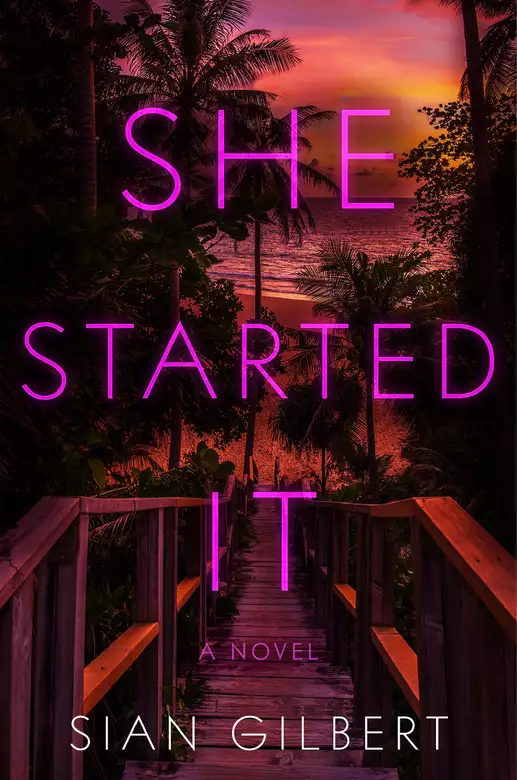
There’s a brochure in the envelope with the invitation and plane tickets. The island is called Deadman’s Bay, an ominous first impression but easily forgotten at the sight of the clear ocean water. There’s a small wooden whitewashed pier that peeks out into the waves, showcasing a strip of the faraway mainland and the blue skies above. Inside the brochure, there are a couple of photographs of the island itself. Through lush thick greenery is a tended lawn; palm trees are dotted about like streetlamps, some curving and others rod-straight, bound together by hammocks, and a fire pit sits in the middle surrounded by deck chairs. In the background there’s a glimpse of the white beach, sun loungers and a small red-and-white-striped open gazebo. The beachfront home, the biggest accommodation ahead of four tiny huts at the rear of the island, is hidden behind four large palm trees that fight for space, a small single-storey white building with pink windows and a pink front door.Next to it, almost out of sight, a decking area complete with barbecue.
It wasn’t hard to say yes. I didn’t even have to change any of my plans; I had none, and I don’t work. Andrew, my husband, didn’t have a problem with me being away for four days either.
The other three all have jobs. Esther Driscoll is an investment banker at a top firm and had to beg, borrow, and steal to get the time off. She’s much more serious than the rest of us. Even when out of work she’s constantly on her phone, responding to emails. It’s a far cry from the wild spirit she was at school and university, always the last to leave a party. But I know her mother got her the interview for her current job and she feels under a lot of pressure to perform, although she’d never admit that to us.
The last one to leave a party these days is Tanya Evesham, but that’s because she’s the one who organises them. She’s an events planner, from arranging celebrity features to high-class birthday parties. When she firststarted, she used to invite us along to whatever bash she’d put together that night, guaranteeing us free cocktails and the ability to rub shoulders with the social elite. There’s a certain charm to Tanya. She can capture a room’s attention and thrives on it, always leaving people wanting more. Tanya’s events were the social occasions everyone put on their calendar.
Until they suddenly weren’t, a few months ago. Tanya stopped inviting us to parties, and we stopped hearing about them, though that hasn’t stopped her throwing them and she seems busier than ever. She and her boyfriend, Harry—a professional bodyguard to a politician—bought a place last year on the outskirts of London and she’s been busy redecorating, so the three of us have barely seen her, nor has she invited us for a housewarming.
For Chloe, this trip counts as work. She’s the most delighted of us all. Chloe Devine (real name Chloe Smith, a hopelessly ordinary surname she never could have done well with, she tells us) is an Instagram sensation: just fifty thousand followers away from one million. Inundated with various sponsorship deals she advertises in different posts, Chloe loves nothing more than an opportunity to flaunt her wealth to her followers. But a first-class flight to a private island is a whole new level, and she’s bought seven different bikinis for the occasion. Something as simple as a photo of her sipping coffee in a café gets hundreds of thousands of likes.
If I’d known all it took to get rich and famous was a nose job, I’d have done it before her. But I’m not jealous. Chloe is still single, despite the numerous relationships she’s had. If you can call them relationships.
I’m happily married. I’m the lucky one.
As if he’s read my mind, Andrew comes into the living room and finds me curled up by the window, slotting everything safely back into the envelope and then my Prada handbag. Chloe isn’t the only one who has nice designer gear.
“Have you seen my keys?” Andrew asks, picking up the sofa cushions and flinging them back down. “I swear you always move them.”
I sigh. Andrew loses his keys every single time he is about to go out, and every single time it’s my fault. “Have you checked your coat pocket?”
“My coat pocket?” he echoes, as if I’ve gone mad. “Why on earth would it—” The rest of his sentence disappears along with him through the door, and I hear a jangle of keys. He comes back in with a frown on his face. “Did you put them in here? I could have sworn I took them out after work yesterday.”
“Why would I move your keys?” I try to laugh and make light of it, but Andrew’s expression darkens.
“You’re always moving my things.” He stands in front of the fireplace, adjusting his tie in the mirror that hangs above.
“Have you got something on at work today?”
He startles at my voice, but the tie is finally fixed into place. “Nothing in particular. Why do you ask?”
“You just seem very preoccupied with your tie today. And you’ve shaved.”
This makes him sigh. “Honestly, Annabel, don’t you have anything better to do than observe my morning routine?”
“Well, it’s my trip today,” I say, because he doesn’t seem to be mentioning it. I wasn’t expecting him to drop me to the airport, that would be ridiculous. But I had expected perhaps an early wake-up, breakfast together, some morning sex to say goodbye. Instead, Andrew pressed the snooze button and I had avocado on toast on my own in the kitchen. “I’ll be gone for four nights.”
“Right, your hen party,” he says. “What time do you leave?”
“Any minute,” I say, checking my phone. “The taxi should be arriving soon.”
“You look like you’re all ready to go.” He nods at the suitcase next to me, then checks his watch. “I can’t be late, babe.”
“No problem.” Because it’s not a problem. He has to work, he’s the one who earns the money around here, though he can be quite stingy with it, rarely allowing me to go shopping as much as I would like. But I have my ways around that. I stand and walk over to him. “I’ll miss you.”
“You’ll be having too much fun,” he replies, removing himself from the embrace I wrapped him in.
I fasten a smile on my face. “I love you. Hey, give me a kiss goodbye.”
He laughs. “I’ll be seeing you in a few days.”
I’m about to plant a kiss on his lips before he can protest any further when my phone rings, the sudden noise breaking any romantic moment we might have had. Thinking it’s the taxi, I hurry to answer it without even checking the caller.
“Hello?” As I put the phone to my ear, Andrew gives my shoulder a squeeze and heads out. The front door shuts behind him before the person on the other end is even able to respond.
“Annabel, darling, is that you? I can’t believe you’ve actually answered one of my calls. You’re normally so busy.”
My mother.
I groan inwardly. Perhaps it’s not too late—I can just hang up now and pretend there was a signal issue.
“Mum,” I say, deciding to get it over with.
“Well, how are you, for God’s sake? It’s been months since I last heard from you.”
To say I have a fractured relationship with my mother would be putting it delicately. There was no dramatic fallout, no deep dark secret for why I moved to the other side of Bristol and never came back. It’s natural, really, that after university I would want to reinvent myself a bit. I became a better person, not someone content with working in a shop like Mum. The tiny two-bedroom house on the edge of Hartcliffe where I grew up is where she’s always been, even after Dad left long ago. When I met Andrew, and he introduced me to his own parents—his father an ex-MP and his mother a dermatologist, living in their five-storey Georgian mansion in the centre of Clifton—it felt natural to break away from Mum.
Andrew’s only met her the once, at the wedding, when I had to invite her. I spent the whole day in a state of constant panic that she would say something ignorant, repeatedly talking over her and laughing immediately whenever she tried to crack a joke so the attention would come off her. She had tried, she really had, but her too-tight dress from Next and the potted plant wedding present couldn’t compete with Andrew’s family’s sophistication. Not when Andrew’s mother arrived in a Givenchy dress with Chantilly lace and gifted us not only a diamond decanter and glasses “so there was something for you to unwrap” but also a seven-night stay in a five-star spa resort in Iceland. Their taste is just more elevated. I was relieved when Mum left, and Andrew hasn’t asked to see her since, so I assume the feeling is mutual. She’s better off in Hartcliffe and we’re better off here, in a Georgian house identical to the one Andrew’s parents live in a couple of streets away.
“I’m actually about to go on holiday,” I say, hoping the taxi will pull up at any moment and give me an excuse to get off the phone. “I’m going to a hen party.”
“Who’s getting married?” Mum asks, always straight to the point. I wonder when the last time she went on holiday was. We certainly never went when I was a child, because I was always jealous hearing about everyone else’s fantastic summers.
“That’s the funny thing.” For a second I’m not sure whether to tell her, but what harm can it do? “It’s Poppy Greer’s wedding.”
“Poppy Greer?” Mum says, sounding surprised. “Poppy Greer from your school?”
“Yeah, that Poppy,” I say. “It’s a bit strange, isn’t it? But she invited us to join her on a private island in the Bahamas.We couldn’t exactly say no to that.”
There’s a sigh on the other end of the line. “That would be hard to refuse, I agree. You’ve seen her recently, then?”
“Uh—no,” I admit, realising that sounds odd. “She sent the plane tickets with the invitation. But we’ve seen her on Instagram, posting about her wedding. She followed us all a few months back.”
“Who’s this ‘we’?”
“Me, Chloe, Esther, and Tanya.” Why does it sound weird now that I’m explaining it to her? Mum always has this way of twisting things to seem worse than they are. “We’re all going to be her bridesmaids.”
“But I thought . . .” Her voice trails away.
“What?”
“Never mind, I must have been mistaken.” She clears her throat. Her tone lightens. “Well, this will be an opportunity for the four of you to make it up to Poppy, after everything. I hope you’re thinking of that and not just a free holiday. How lovely that she’s getting married.”
This again. Whenever there’s a chance to have a dig at me, she’s straight in there with a shovel.
“We don’t need to make anything up to her,” I say. “That was all ten years ago. And it was silly teenage stuff, nothing serious. I’m going through more problems right now than she ever did!”
“The problem with you, Annabel, is you’ve always felt like the past doesn’t matter because it’s over. You don’t think about how actions always have consequences. You’re too focused on yourself and not focused enough on other people.”
It’s the same old message. As if I don’t have enough going on.
Maybe she senses me drawing away, because she continues without waiting for a response.
“I mean it. Take this opportunity to make it up to Poppy for the past. You’ll regret it if you don’t. Perhaps that’s what she’s intending with this trip, a chance to clear the air.” She sighs again, a deep exhalation. “I do worry about you, love.But not because your social schedule is packed, or Andrew is too busy at work. I worry that you’re not living up to your potential. What happened to those degrees of yours? First in our family to go to university and you haven’t even used them.”
The taxi finally, mercifully, pulls up on our drive, and I can see the driver getting out, calling my phone. I give him a wave in the window and start gathering everything together.
“I have to go now, Mum, the taxi driver is here.”
“Think about what I said. I miss you. It would be nice to see you more often than at Christmas. Maybe after your holiday you could come and see me for a few days?”
“Maybe,” I say. “Bye now.”
“Bye, darling. I love you. Have a great hen party.”
She waits for me to hang up. She does it every time. I’m not sure why, when she has the last word. But I end the call and shove my phone in my handbag, doing one final check of everything before heading out the door.
It’s nothing I haven’t heard from her before, this insistence that I have to do something with my education. It’s also not like I haven’t thought about it. I chose to do Psychology because, at the time, I was passionate about understanding the human mind, and I still am today. When Andrew isn’t around, I’m often at his computer researching different studies I find interesting. It’s a side of me I don’t show anyone, not since Mum used to sit on the end of my bed and listen to me waffle on about my revision for my A levels.
But there’s no reason to use my degrees now. Yes, degrees, plural. I did a master’s degree in Psychology too, specialising in the biological side. There’s something so fascinating about the way several psychological disorders can be seen through scans and tests, physical proof of the genuine impact they can have. I’m not one for Freudian psychology—discussing feelings and connecting them to past trauma seems a load of rubbish to me.
The taxi driver helps me with my bags as I knew he would after I flashed him my brightest smile, and he even opens the car door. I know he’s after a big tip because he’s seen the size of our house, but it still makes me proud, knowing he’s gone to that extra effort.
As he pulls out of the drive, I take a last look back at our home. It’s in Andrew’s name, and it’s his money that paid for it, but I still call it “our.” From the outside it reminds me of my childhood dentistry, which had converted a huge Georgian house to suit its needs. The inside had been hollowed out, each room turned cold and clinical, white-washed with awful linoleum floors.
I check my phone, but Andrew hasn’t sent me a goodbye message even though he’s never off his mobile, a constant presence near his right hand whether he’s watching television or in the shower.
To take my mind off Andrew, I open the envelope with the tickets and brochure inside again, leafing through the pictures of the island once more.
I don’t feel guilty about the past. Mum hasn’t got to me. There’s nothing to make up for with Poppy, and this invitation proves it. We’re going to have a brilliant time and forget about the real world we’ve left behind.
If Poppy’s still harbouring any grudges she wouldn’t have invited us.
I can just relax now.
This is going to be fantastic.
We hope you are enjoying the book so far. To continue reading...
Copyright © 2026 All Rights Reserved

 Please log in to recommend or discuss...
