
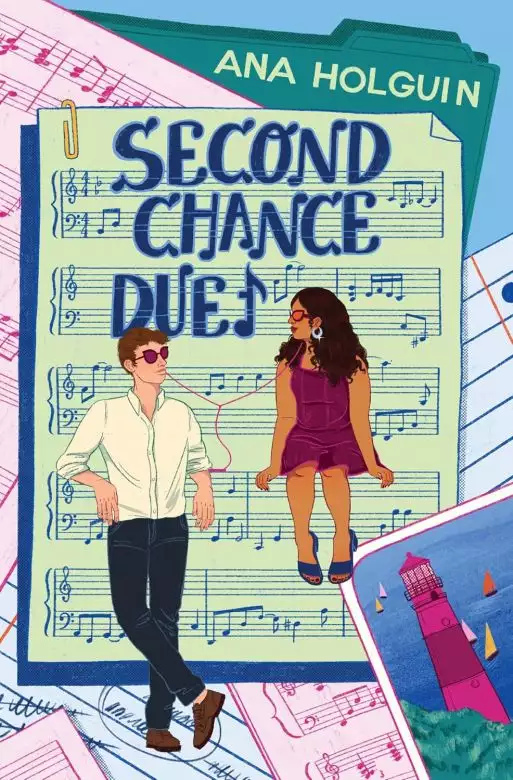
Second Chance Duet
Available in:
- eBook
- Paperback
- Audiobook
- Book info
- Sample
- Media
- Author updates
- Lists
Synopsis
Not Another Love Song meets You Between the Lines in this swoony, slow burn romance about a struggling composer whose big break comes at a cost—working side-by-side with her college nemesis.
Release date: March 10, 2026
Publisher: Grand Central Publishing
Print pages: 368
* BingeBooks earns revenue from qualifying purchases as an Amazon Associate as well as from other retail partners.
Reader buzz
 Please log in to recommend or discuss...
Author updates
Close
Second Chance Duet
Ana Holguin
MY LIFE HAS always been loud.
Car horns, the group of tourists talking behind me in a language I don’t understand, Vanessa Carlton’s “A Thousand Miles” booming from some guy’s open-top convertible—it’s happening now on the corner of Forty-Second and Tenth, but it’s all the same to me. My childhood home was like this up in the Heights—fewer honking cars, but roughly the same amount of people talking—and so was my dorm at Juilliard. The sounds thrum through my veins. I love it.
I do not, however, love being late. I glance down at the phone clutched in my hand: It’s 8:38 p.m., which means I will be, at best, fifteen minutes late for dinner with my old college friend Rebecca. It had been ambitious of me to say yes to her invitation, knowing I had a late-afternoon recording session booked for another round of yogurt advertisements. At least this jingle would be streaming on all major platforms; even if I wasn’t personally inspired by yogurt, this exposure would go national.
Before the crosswalk signal changes, I type out a quick text.
Celia
So sorry, running a few min late!
She responds right away with a picture of a martini in a low-lit restaurant accompanied by a smiling emoji. Okay, she’s fine.
For a moment, I feel a twinge of panic when I remember this morning: a notice stuffed into my mailbox from my property-management company, stating their intent to raise all rents in the building by 10 percent starting in the New Year. That letter alone had almost been enough to derail my entire day, but then an email came in from one of my clients, letting me know they were “going in a different direction” for their next commercial, so they wouldn’t need me next month after all. I can read between the lines just fine; this was another job lost to AI music, if you can even call that garbage music.
Problem is, they’re not the first clients I’ve lost to that AI bullshit. They won’t be the last, either. Anything to save a buck, right?
More than anything, I wanted to wallow in my tiny apartment today, the first and only place I’ve ever been able to call just mine in my entire New York life. After years of living with roommates of all varieties, it was only a couple of years ago I found a place I could afford on my own. Month by month, I’ve scraped by on my modest ad contracts, with just a tiny savings safety net to catch me should I stumble.
But I had a studio session booked and a corporate giant counting on me to deliver, so I had no choice but to shove those initial worries aside and get my ass to work. Now that I’m done for the day? Now, I can worry—about the fact that there is no way I’ll be able to afford my apartment in just a few months, about a corporate world that dehumanizes the lifetime of work I’ve put into being a professional musician and composer every time they generate some soulless thirty-second blob of sounds, about every little extra cost that won’t go into my savings account should I have to move. Costs like this dinner with an old friend, which I probably should have canceled.
The last of the cars whizz through the yellow light just as it turns red and the crosswalk switches over to the Walk signal. It’s too late to cancel now, so a combination of curiosity and anxiety spurs my legs faster than normal until I’m very nearly running down the sidewalk. My mind’s preoccupation with my personal financial and career doom fizzles with each pound of my sneakers on the cement. Despite this new life trajectory, I’m looking forward to seeing an old friend.
It’s been years since I last spoke to Rebecca in person; the last time I remember seeing her was at her Goodbye New York party (which she threw for herself, naturally). Ever since, she’s been out in LA, hustling hard toward her dreams of being a music supervisor on the biggest of movies. To my knowledge, she’s been widely successful—her Instagram and IMDB pages are proof of that. We’ve remained friendly over the years, swapping DMs and comments on social media. There’ve even been a few catch-up email threads started and later abandoned as we both got busy.
By the time I pull open the door to the cozy Hell’s Kitchen restaurant, I’m sweating. I spot Rebecca immediately; despite the aesthetic changes she’s made in the last few years, her sharp expression and jet-black hair haven’t changed. For a second, I hover near the door, watching as she sips her martini while typing one-handed on her phone. Nostalgia rolls over me in a wave.
God, are we really in our thirties now? Where the hell did the time go?
Before the hostess can approach me, I weave through the tightly packed tables to where Rebecca is seated along the far wall. She looks up at my approach, her diamond nose stud twinkling in the candlelight, and her red-painted lips pull into a wide smile.
With some difficulty, she manages to scoot back from the table and meet me halfway for a hug. “Celia! Girl, it is so good to see you!”
“You too, Rebecca,” I reply, the scent of her sandalwood perfume enveloping me in its own kind of embrace.
She steps back from our hug and holds me at arm’s length. Shamelessly, she gives me a thorough once-over; I can feel her gaze slide over my outfit, taking in all the changes that have occurred in me over the last… “God, how long has it been?” I ask out loud. “Like, four years?”
“It’d be five years this December,” she replies. “You look good, girl. Love that you’re still wearing the hoops.”
She releases me. On instinct, I reach for the gold hoop earrings I’ve worn since the day I got them for my high school graduation present. Occasionally, I’ll swap them out for something nicer when the event calls for it, but Rebecca is right—these earrings are my signature. Always have been, always will be.
We both take a seat at the table and I grab one of the laminated menus to glance over. “Sorry I’m late. Recording ran over today. Had some trouble getting the mixing right.”
“All good,” she says with a wave of her hand. “Honestly, I’m just happy to be back in the city. Every time I come back, I remember how much I miss it here.”
“Yeah? How’s LA treating you?”
Her answer is suspended on her lips when our server appears. I opt to follow her lead and order whatever it is she’s drinking. When he leaves us, Rebecca settles back into her chair, flips her long hair behind her shoulders, and lets out a gusty breath. “It’s good. Ruthless, but good. Everything they say about it is true.”
“So it really is a plastic, life-sucking cesspool?” I ask with a wink.
Normally, I wouldn’t be so brash with an old friend I hadn’t seen in years, but Rebecca is a part of my fondest memories from college. Like me (and everyone else), she’d entered Juilliard determined to prove herself. But where Rebecca differed from our peers was in her forwardness; so many of the elites that made up our musical circles spoke in riddles and passive-aggressive undertones designed to make you second-guess yourself. That was a truth I had a hard time learning as an outsider, but Rebecca? She went toward everything headfirst, with brutal honesty and sheer determination as her best weapons, forsaking the pampered, private school upbringing she’d experienced.
At my Tinseltown insult, she laughs. It’s still the same loud, boisterous honk that I remember. “Yes. As you can imagine, I fit in quite well there.”
“Give yourself some credit. You give as much as you can take.” I narrow my eyes to take a closer at her face, searching for any sign of said plastic, but there’s none that I can see. She looks just like the eighteen-year-old girl who hooked her arm in mine one summer evening and declared we were friends. “You look great, by the way.”
She smiles deviously. “Good. The best work is the kind you can’t see.”
“Wow, I sure have missed your honesty,” I say with a laugh.
For the first time all day, I’m not thinking about my rent increase, my lost jobs, none of that. I’m just politely thanking the server as he drops off my martini, relishing the immediate burn of gin and vermouth on my tongue when I take a sip, and listening as Rebecca orders a few small plates to share. When our server disappears again, she shakes her head and rolls her eyes. “Sorry,” she says. “I shouldn’t have ordered for the table without checking with you. Did you develop any food allergies in the last however many years?”
“No. Don’t worry. I’m glad to see some things haven’t changed.”
“Yeah, I’m still a bossy bitch, aren’t I?” she asks, mostly to herself. Her sharp expression softens slightly as she considers this; in the romantic, muted light of this restaurant, she looks wise beyond her years.
“You say that like it’s a bad thing. You know I’ve always loved that about you.”
My compliment brings her wandering eyes back to our table. She hits me with a shrewd look, her light eyes rimmed with kohl that lends itself well to her new, slightly edgy look. “I have to be this way now with the egos I deal with every day. But enough about me. How are you? What are you up to these days?”
I blow out a sigh strong enough to make the candle flame dance in the middle of the table. “Oh, I’m good. Still trucking along.”
“Are you still composing? You said you came from the recording studio today, yeah?” she asks, her tone filled with genuine interest.
At this, my heart twists. The barest truth is that yes, I’m still composing—except it’s not at all the work I’d planned to do. While jingles for advertising campaigns technically count as composing, they aren’t the grand scores I’d envisioned writing as a doe-eyed baby musician in the hallowed halls of one of the world’s finest music schools. Worse still, I’ve been doing this for years—spinning my wheels while dredging up creativity for banal platitudes about yogurt and power tools. The only respite I get comes from writing music for aspiring talent. That’s all I have to sustain the part of me that yearns to create something really meaningful.
Despite a decent roster of advertising clients and the writing credits I’ve managed to accumulate, no one in film wants me. I couldn’t even get a callback for assistant or mentorship opportunities—not since the first one ended thanks to budget cuts, a tale as old as time in the arts. My professors’ recommendations helped initially, but they only got me so far. Years of rejection have jaded me. I’ve since stopped reaching out.
But I owe Rebecca honesty. That’s what bound us together as friends in undergrad; during Ear Training I, our friendship went to the next level when I whispered that she was flat rather than humiliate her in front of the class. Ever since, we’ve had each other’s backs.
“Yes and no,” I finally reply, not even bothering to hide the resignation in my tone. “I compose for ads, but that’s about it.”
Her well-manicured brows furrow as she takes a sip of her drink. “But I heard Lady Osborn’s last album. You did drums for that, didn’t you?”
Right, the jazz artist I’d collaborated with last year. I’d written the percussion book and performed it for Lady Osborn’s latest release. “Yeah, I do some of that here and there. It’s corporate America that pays the bills, though.”
Rebecca eyes me shrewdly again, her gaze raking over me in that almost judgmental way. It’s almost as if she can hear what I didn’t say—that the advertising clients are no longer enough to pay said bills, at least the ones that aren’t dropping me for their stupid computer music. My skin prickles with awareness while my stomach does a funny little swoop; it’s nerve-racking enough, outwardly admitting my professional standstill while my classmate soars through her chosen field (thanks, in part, to the connections of her entertainment-lawyer dad). If she’d wanted to, Rebecca would have made a fine composer, but that’s not what called to her. With her eye for detail and her combined passion for both music and images, she’d always known she wanted to be a supervisor and editor.
And here she is, kicking ass at it.
“Well, I have to say, this is good news for me,” she says after a long beat. “As nice as it is to see you, I came here with an agenda.”
There it is, hovering just out of reach—the reason my friend from all those years ago texted me out of the blue.
“Oh?” I ask as I try (and fail) to contain my obvious interest.
But our conversation stalls as the first round of food arrives: a dish of oysters, accompanied by plates and wedges of lemons in ceramic ramekins. Both of us grab a shell, Rebecca reaching forward to clink them together, before she says, “Bottoms up!”
When we’re both done with our first, she leans forward to place her hands on the table. This simple change of her body language heightens the tension that’s got my heartstrings pulled tight. “So anyway,” she starts, “this is both a personal and professional dinner. I’m working on a big project now—something really cool—and our composer just dropped out.”
My eyebrows raise in response. “I’m listening.”
“It’s Chris Ross’s first foray into TV. I worked with him last year on that space movie. He’s doing a series for Limelight’s streaming studio called Lineage. It’s this intense drama about a rich family and the spouses that married into it.” She pauses to finish her drink. “Everything was good to go until Gustav Schneider had to drop out due to health issues. We’re already shooting, so we’re kind of fucked.”
My pulse ratchets up at these names. Ross is among the top directors in Hollywood; his movies are produced by the biggest studios, his career littered with awards and accolades. As for Schneider, there is no bigger name in film scoring. Well, perhaps one—but I prefer not to think about him much after dealing with his son at Juilliard.
I can barely find my voice when I ask, “Is Schneider okay? What are you trying to say, Rebecca?”
“Yes, yes, Schneider will be fine. He just needs to take some time off. What I’m saying is that I talked Ross into taking a chance on a more junior composer. We kind of don’t have a choice, considering how tight our timeline is. He agreed, but on one condition—he needs two composers, if he’s going to take someone green.”
“Oh.”
It’s all I can manage. Suddenly my denim-colored chambray shirt feels too heavy, the material too hot for this cramped restaurant. I’m aware of every single part of my body—from the ends of my curly hair to my toes pressing against the tips of my Nikes. This is the closest I’ve ever gotten to my dream. My real dream, of telling a story with music that doesn’t exist to sell something to someone. It could be the start of the career I’d always envisioned for myself—and possibly the solution to my recent financial woes.
After years of rejection, I’m scared to believe it’s real.
“Why me?” I find myself asking.
“Why not you?” Rebecca scoffs. “You were the best composer in our class—no, don’t even argue with me on that. You approached it with this, like, almost psychotic gleam in your eyes. You are good, Celia. Plus, you’ll get me in the editing process. I’m pretty damn good at my job.”
It’s funny, the feeling that comes over you when you realize: This is it. This is the moment I’ve been waiting for. All the rejections, all the unanswered calls and emails, all the shitty jobs I’ve had to take just to keep going—this is where they led me. Right here, to a small table for two in Hell’s Kitchen, sitting across from a woman I’ve known since we were little more than girls. It’s a warmth that spreads over me, settling somewhere low in my stomach.
“Yeah. Okay.” As reality starts to sink in, I nod. “You said Ross needs two. Who’s the other composer?” In an uncharacteristic move, Rebecca bites her bottom lip. The red lipstick she’s wearing doesn’t smear when she licks her lips, clearly uncertain. This is enough to bring my nerves back. “Spit it out, Rebecca.”
“It’s Oliver Barlowe.”
And just like that, my mood plummets.
Rebecca notices. She leans farther forward, her entire chest pressed into the table. “Listen, Celia. I know you two were weird in undergrad, but he’s not as insufferable as he used to be. I’ve run into him a few times over the years. We’ve kept in touch. He’s still the same guy, but he’s different now. He’s less…”
“Horrible?” I offer. “Pretentious?”
“I was going to say ‘stuffy,’ but that works, too.”
“Why would he even do this? Can’t he use Daddy’s name to propel his career forward?”
That I even have to ask this question grates on my nerves. As the son of Robert Barlowe—the living legend who has been scoring films for decades—Oliver no doubt has his pick of jobs. His dad has been collecting awards like they were trinkets while maintaining a hold on Hollywood’s most prominent film directors since we were toddlers. Of course, Oliver’s nepo-baby status wasn’t enough to make me hate him when we first met as teenagers all those years ago. He did that on his own, with his personality.
My blood boils at the thought of working with him.
“Believe it or not, he doesn’t,” Rebecca says. The earnest look in her eyes irritates me. “Oliver ran away to London about the same time I went to LA. He’s mostly been writing commissioned pieces—things for the ballet, modern dance, shit like that. He did a couple of indie films in the last few years, but that’s not enough. Ross needs to know he’s got a safety net with a duo, even if one of them comes from a legacy. He hates when there’s behind-the-scenes drama, which is ironic considering the types of stories he tells, but it’s true. He doesn’t have time to hand hold or coddle anyone. If anything jeopardizes his production, he puts an end to that shit right away.”
Taking a second oyster from the dish, I buy myself some time as I knock it back without any lemon. This is quite the predicament; to be offered the chance to work with someone like Chris Ross, who has the experience to guide a massive project like this, is remarkable. Without a doubt, this is a career-making opportunity. One that could change the course of my life forever.
Rebecca is handing me the chance to make my lifelong dreams come true, but Oliver Barlowe is attached. Does that make it a nightmare, then?
I shake my head to clear my thoughts. “When do you need a decision by?” I ask. Taking on a project like this would require a complete immersion; there would be no time for anything else. A full season of music can be anywhere from four to eight hours of completed composition; the amount of time it would take to craft, score, and polish that much music is nearly unfathomable. I would have to eat, sleep, and breathe this score for the next few months.
Which means that I would have to eat, sleep, and breathe alongside Oliver, too.
Rebecca lets loose a breath. “Tomorrow. I looked at your portfolio on your website. It’s good. Good enough that it will convince the decision-makers that you can handle the workload. Chris will want to meet with you to make sure you’re not, like, a weirdo or a liability, but the job is as good as yours, Celia.”
The look in her eyes—pleading, prodding, hopeful—says what we both don’t bother to speak aloud: that she needs me to do this. That she’s putting her own reputation on the line to recruit Oliver and me. That this is the opportunity of a lifetime. It’s the big break that everyone dreams about and so few get.
“I’ll let you know by tomorrow afternoon.”
Even when the words leave my lips, I already know what my answer will be. Because even though Oliver Barlowe and I have a complicated history at best, there is no man in this world that will keep me from my dreams. I’ve worked too hard for too long. I can’t walk away simply because I don’t like someone. I’ve done my time in the trenches, writing catchy tunes to accompany such riveting products as the latest cat food. Not only that, but I literally can’t afford to say no—not with a rent increase hanging over my head and no new ad job lined up.
Film scoring—really, any production work in movies and TV—used to be a certified boys’ club. But now Rebecca has a key, and she’s invited me in.
FROM: Celia García
TO: Ann Martin
DATE: Thursday, August 13 at 11:14 PM
SUBJECT: Job opportunity?
Hola Ann,
It’s been a while! How’s the family? Are you summering in Rhode Island again this year?
I might have a gig coming up in film. An old friend of mine from Juilliard tapped me for it. I still have to decide if I want to do it, meet with the producers, etc. Before I commit, I wanted to see if you had any interest for my composition work lately? Don’t want to cross any wires or anything!
Cheers,
Celia
FROM: Ann Martin
TO: Celia García
DATE: Thursday, August 13 at 11:39 PM
SUBJECT: RE: Job opportunity?
Hello Celia!
So nice to hear from you. Everyone is good here, we’re spending our days in the sun here in Newport. How is life in the city?
In terms of interest in your work, things are quiet. We’re seeing an overall decrease in composition/score work across the board here at the agency (with the obvious caveats). I still believe in your talent and skill just as much as I did when I signed you seven years ago! This career is all about persistence and tenacity. If you have anything new to add to your portfolio, please send it my way. I’d love to send it around and put some feelers out there on your behalf.
All this to say, if you have interest from your college connections—GO FOR IT!
Best,
Ann
I STARE AT THE email from my agent for longer than necessary. My phone screen starts to darken, but I tap it to keep it from going to sleep. Reading her response over and over again only solidifies the fears that started curdling in my stomach as soon as Rebecca and I hugged goodbye on the sidewalk with a promise that I’d be in touch tomorrow.
If I’m honest with myself, my email to Ann was my last-ditch effort to find a way forward in this career in a way that doesn’t involve Oliver Barlowe. But now it’s clear there is no other way. To keep at my passion, at the one thing I know how to do, I have to take this job. Turning it down would be putting the final nail in the coffin of my forever dream.
Even though I’m lying on my bed, my stomach drops. I toss my phone on the opposite pillow, let out a heavy sigh, then pull myself to sit. I force myself to take a drink of water from the bottle on my desk. I should not have had a third martini.
Now that my decision is made, even if only with myself, a whole new set of fears takes root somewhere in my gut. I stare at my humble home studio shoved against the wall next to the bed while my pulse pounds in my ears. So far, I’ve made do with what I could afford (and had space for); this primarily consists of a powerful computer with the software needed to orchestrate, a full keyboard plugged into said computer, and a handful of sound mixers, most of which I acquired secondhand from friends. Thankfully, every job I’ve taken has granted me access to professional recording studios to create the final product. But to compose a full score on my home setup? It would be impossible.
When was the last time I wrote for a full orchestra? Oh, right—two years ago, when I was hired for a luxury perfume commercial. But that was for a reduced group. No more than twenty-five musicians.
When was the last time I wrote music for dialogue? Well, if you counted ad jingles… all the time.
When was the last time I touched an instrument other than a keyboard or drums? God, it’s been years.
When was the last time I even played the drums, my first love and the reason for my entire existence in the musical world? It’s been at least a month, when I sat down at my father’s club and pounded away on the house drum set.
That in itself is a problem—as a New Yorker, space and privacy are limited in the best of times. Outside of my parents’ compound in Washington Heights, I’ve never lived in a place where having a drum set wouldn’t get me promptly kicked out of the building. Although, if I don’t take this job with the show, I might have no choice but to leave this building anyway.
I start to pace. Every creak of the hardwood floors underneath my bare feet is an echo of my own heartbeat as I wonder if I even have the talent to pull this off. Even through the fog of three strong drinks, the reality of my situation becomes clearer with each step.
I am so unprepared for this.
But then again, Oliver is involved. Could we pull it off? Could we work together after the last time we saw each other and all the years since?
There’s only one way to find out.
Within minutes of opening my eyes the next morning, I text Rebecca that I’m in.
She responds right away, the chime of the notification cutting through the rare moment of quiet, if you can call it that. My upstairs neighbor is already vacuuming, and my downstairs neighbor is watching Good Morning America on full blast. Still in bed with the muffled ambient noise of other people’s lives as the soundtrack, I rub the sleep out of my eyes and stare at her text.
Rebecca
Hell yeah! The crew gets into NY Monday to prep for the next leg of the shoot. I’ll set up a meeting with Chris asap. Monday? Can you come to the Limelight offices?
I don’t need to look at my calendar to know I’m wide open.
Celia
Tell me the time and address and I’ll be there
A thought occurs to me then, just as the response bubbles ripple on my phone screen. If I’m going to meet the great Chris Ross and convince him that . . .
Car horns, the group of tourists talking behind me in a language I don’t understand, Vanessa Carlton’s “A Thousand Miles” booming from some guy’s open-top convertible—it’s happening now on the corner of Forty-Second and Tenth, but it’s all the same to me. My childhood home was like this up in the Heights—fewer honking cars, but roughly the same amount of people talking—and so was my dorm at Juilliard. The sounds thrum through my veins. I love it.
I do not, however, love being late. I glance down at the phone clutched in my hand: It’s 8:38 p.m., which means I will be, at best, fifteen minutes late for dinner with my old college friend Rebecca. It had been ambitious of me to say yes to her invitation, knowing I had a late-afternoon recording session booked for another round of yogurt advertisements. At least this jingle would be streaming on all major platforms; even if I wasn’t personally inspired by yogurt, this exposure would go national.
Before the crosswalk signal changes, I type out a quick text.
Celia
So sorry, running a few min late!
She responds right away with a picture of a martini in a low-lit restaurant accompanied by a smiling emoji. Okay, she’s fine.
For a moment, I feel a twinge of panic when I remember this morning: a notice stuffed into my mailbox from my property-management company, stating their intent to raise all rents in the building by 10 percent starting in the New Year. That letter alone had almost been enough to derail my entire day, but then an email came in from one of my clients, letting me know they were “going in a different direction” for their next commercial, so they wouldn’t need me next month after all. I can read between the lines just fine; this was another job lost to AI music, if you can even call that garbage music.
Problem is, they’re not the first clients I’ve lost to that AI bullshit. They won’t be the last, either. Anything to save a buck, right?
More than anything, I wanted to wallow in my tiny apartment today, the first and only place I’ve ever been able to call just mine in my entire New York life. After years of living with roommates of all varieties, it was only a couple of years ago I found a place I could afford on my own. Month by month, I’ve scraped by on my modest ad contracts, with just a tiny savings safety net to catch me should I stumble.
But I had a studio session booked and a corporate giant counting on me to deliver, so I had no choice but to shove those initial worries aside and get my ass to work. Now that I’m done for the day? Now, I can worry—about the fact that there is no way I’ll be able to afford my apartment in just a few months, about a corporate world that dehumanizes the lifetime of work I’ve put into being a professional musician and composer every time they generate some soulless thirty-second blob of sounds, about every little extra cost that won’t go into my savings account should I have to move. Costs like this dinner with an old friend, which I probably should have canceled.
The last of the cars whizz through the yellow light just as it turns red and the crosswalk switches over to the Walk signal. It’s too late to cancel now, so a combination of curiosity and anxiety spurs my legs faster than normal until I’m very nearly running down the sidewalk. My mind’s preoccupation with my personal financial and career doom fizzles with each pound of my sneakers on the cement. Despite this new life trajectory, I’m looking forward to seeing an old friend.
It’s been years since I last spoke to Rebecca in person; the last time I remember seeing her was at her Goodbye New York party (which she threw for herself, naturally). Ever since, she’s been out in LA, hustling hard toward her dreams of being a music supervisor on the biggest of movies. To my knowledge, she’s been widely successful—her Instagram and IMDB pages are proof of that. We’ve remained friendly over the years, swapping DMs and comments on social media. There’ve even been a few catch-up email threads started and later abandoned as we both got busy.
By the time I pull open the door to the cozy Hell’s Kitchen restaurant, I’m sweating. I spot Rebecca immediately; despite the aesthetic changes she’s made in the last few years, her sharp expression and jet-black hair haven’t changed. For a second, I hover near the door, watching as she sips her martini while typing one-handed on her phone. Nostalgia rolls over me in a wave.
God, are we really in our thirties now? Where the hell did the time go?
Before the hostess can approach me, I weave through the tightly packed tables to where Rebecca is seated along the far wall. She looks up at my approach, her diamond nose stud twinkling in the candlelight, and her red-painted lips pull into a wide smile.
With some difficulty, she manages to scoot back from the table and meet me halfway for a hug. “Celia! Girl, it is so good to see you!”
“You too, Rebecca,” I reply, the scent of her sandalwood perfume enveloping me in its own kind of embrace.
She steps back from our hug and holds me at arm’s length. Shamelessly, she gives me a thorough once-over; I can feel her gaze slide over my outfit, taking in all the changes that have occurred in me over the last… “God, how long has it been?” I ask out loud. “Like, four years?”
“It’d be five years this December,” she replies. “You look good, girl. Love that you’re still wearing the hoops.”
She releases me. On instinct, I reach for the gold hoop earrings I’ve worn since the day I got them for my high school graduation present. Occasionally, I’ll swap them out for something nicer when the event calls for it, but Rebecca is right—these earrings are my signature. Always have been, always will be.
We both take a seat at the table and I grab one of the laminated menus to glance over. “Sorry I’m late. Recording ran over today. Had some trouble getting the mixing right.”
“All good,” she says with a wave of her hand. “Honestly, I’m just happy to be back in the city. Every time I come back, I remember how much I miss it here.”
“Yeah? How’s LA treating you?”
Her answer is suspended on her lips when our server appears. I opt to follow her lead and order whatever it is she’s drinking. When he leaves us, Rebecca settles back into her chair, flips her long hair behind her shoulders, and lets out a gusty breath. “It’s good. Ruthless, but good. Everything they say about it is true.”
“So it really is a plastic, life-sucking cesspool?” I ask with a wink.
Normally, I wouldn’t be so brash with an old friend I hadn’t seen in years, but Rebecca is a part of my fondest memories from college. Like me (and everyone else), she’d entered Juilliard determined to prove herself. But where Rebecca differed from our peers was in her forwardness; so many of the elites that made up our musical circles spoke in riddles and passive-aggressive undertones designed to make you second-guess yourself. That was a truth I had a hard time learning as an outsider, but Rebecca? She went toward everything headfirst, with brutal honesty and sheer determination as her best weapons, forsaking the pampered, private school upbringing she’d experienced.
At my Tinseltown insult, she laughs. It’s still the same loud, boisterous honk that I remember. “Yes. As you can imagine, I fit in quite well there.”
“Give yourself some credit. You give as much as you can take.” I narrow my eyes to take a closer at her face, searching for any sign of said plastic, but there’s none that I can see. She looks just like the eighteen-year-old girl who hooked her arm in mine one summer evening and declared we were friends. “You look great, by the way.”
She smiles deviously. “Good. The best work is the kind you can’t see.”
“Wow, I sure have missed your honesty,” I say with a laugh.
For the first time all day, I’m not thinking about my rent increase, my lost jobs, none of that. I’m just politely thanking the server as he drops off my martini, relishing the immediate burn of gin and vermouth on my tongue when I take a sip, and listening as Rebecca orders a few small plates to share. When our server disappears again, she shakes her head and rolls her eyes. “Sorry,” she says. “I shouldn’t have ordered for the table without checking with you. Did you develop any food allergies in the last however many years?”
“No. Don’t worry. I’m glad to see some things haven’t changed.”
“Yeah, I’m still a bossy bitch, aren’t I?” she asks, mostly to herself. Her sharp expression softens slightly as she considers this; in the romantic, muted light of this restaurant, she looks wise beyond her years.
“You say that like it’s a bad thing. You know I’ve always loved that about you.”
My compliment brings her wandering eyes back to our table. She hits me with a shrewd look, her light eyes rimmed with kohl that lends itself well to her new, slightly edgy look. “I have to be this way now with the egos I deal with every day. But enough about me. How are you? What are you up to these days?”
I blow out a sigh strong enough to make the candle flame dance in the middle of the table. “Oh, I’m good. Still trucking along.”
“Are you still composing? You said you came from the recording studio today, yeah?” she asks, her tone filled with genuine interest.
At this, my heart twists. The barest truth is that yes, I’m still composing—except it’s not at all the work I’d planned to do. While jingles for advertising campaigns technically count as composing, they aren’t the grand scores I’d envisioned writing as a doe-eyed baby musician in the hallowed halls of one of the world’s finest music schools. Worse still, I’ve been doing this for years—spinning my wheels while dredging up creativity for banal platitudes about yogurt and power tools. The only respite I get comes from writing music for aspiring talent. That’s all I have to sustain the part of me that yearns to create something really meaningful.
Despite a decent roster of advertising clients and the writing credits I’ve managed to accumulate, no one in film wants me. I couldn’t even get a callback for assistant or mentorship opportunities—not since the first one ended thanks to budget cuts, a tale as old as time in the arts. My professors’ recommendations helped initially, but they only got me so far. Years of rejection have jaded me. I’ve since stopped reaching out.
But I owe Rebecca honesty. That’s what bound us together as friends in undergrad; during Ear Training I, our friendship went to the next level when I whispered that she was flat rather than humiliate her in front of the class. Ever since, we’ve had each other’s backs.
“Yes and no,” I finally reply, not even bothering to hide the resignation in my tone. “I compose for ads, but that’s about it.”
Her well-manicured brows furrow as she takes a sip of her drink. “But I heard Lady Osborn’s last album. You did drums for that, didn’t you?”
Right, the jazz artist I’d collaborated with last year. I’d written the percussion book and performed it for Lady Osborn’s latest release. “Yeah, I do some of that here and there. It’s corporate America that pays the bills, though.”
Rebecca eyes me shrewdly again, her gaze raking over me in that almost judgmental way. It’s almost as if she can hear what I didn’t say—that the advertising clients are no longer enough to pay said bills, at least the ones that aren’t dropping me for their stupid computer music. My skin prickles with awareness while my stomach does a funny little swoop; it’s nerve-racking enough, outwardly admitting my professional standstill while my classmate soars through her chosen field (thanks, in part, to the connections of her entertainment-lawyer dad). If she’d wanted to, Rebecca would have made a fine composer, but that’s not what called to her. With her eye for detail and her combined passion for both music and images, she’d always known she wanted to be a supervisor and editor.
And here she is, kicking ass at it.
“Well, I have to say, this is good news for me,” she says after a long beat. “As nice as it is to see you, I came here with an agenda.”
There it is, hovering just out of reach—the reason my friend from all those years ago texted me out of the blue.
“Oh?” I ask as I try (and fail) to contain my obvious interest.
But our conversation stalls as the first round of food arrives: a dish of oysters, accompanied by plates and wedges of lemons in ceramic ramekins. Both of us grab a shell, Rebecca reaching forward to clink them together, before she says, “Bottoms up!”
When we’re both done with our first, she leans forward to place her hands on the table. This simple change of her body language heightens the tension that’s got my heartstrings pulled tight. “So anyway,” she starts, “this is both a personal and professional dinner. I’m working on a big project now—something really cool—and our composer just dropped out.”
My eyebrows raise in response. “I’m listening.”
“It’s Chris Ross’s first foray into TV. I worked with him last year on that space movie. He’s doing a series for Limelight’s streaming studio called Lineage. It’s this intense drama about a rich family and the spouses that married into it.” She pauses to finish her drink. “Everything was good to go until Gustav Schneider had to drop out due to health issues. We’re already shooting, so we’re kind of fucked.”
My pulse ratchets up at these names. Ross is among the top directors in Hollywood; his movies are produced by the biggest studios, his career littered with awards and accolades. As for Schneider, there is no bigger name in film scoring. Well, perhaps one—but I prefer not to think about him much after dealing with his son at Juilliard.
I can barely find my voice when I ask, “Is Schneider okay? What are you trying to say, Rebecca?”
“Yes, yes, Schneider will be fine. He just needs to take some time off. What I’m saying is that I talked Ross into taking a chance on a more junior composer. We kind of don’t have a choice, considering how tight our timeline is. He agreed, but on one condition—he needs two composers, if he’s going to take someone green.”
“Oh.”
It’s all I can manage. Suddenly my denim-colored chambray shirt feels too heavy, the material too hot for this cramped restaurant. I’m aware of every single part of my body—from the ends of my curly hair to my toes pressing against the tips of my Nikes. This is the closest I’ve ever gotten to my dream. My real dream, of telling a story with music that doesn’t exist to sell something to someone. It could be the start of the career I’d always envisioned for myself—and possibly the solution to my recent financial woes.
After years of rejection, I’m scared to believe it’s real.
“Why me?” I find myself asking.
“Why not you?” Rebecca scoffs. “You were the best composer in our class—no, don’t even argue with me on that. You approached it with this, like, almost psychotic gleam in your eyes. You are good, Celia. Plus, you’ll get me in the editing process. I’m pretty damn good at my job.”
It’s funny, the feeling that comes over you when you realize: This is it. This is the moment I’ve been waiting for. All the rejections, all the unanswered calls and emails, all the shitty jobs I’ve had to take just to keep going—this is where they led me. Right here, to a small table for two in Hell’s Kitchen, sitting across from a woman I’ve known since we were little more than girls. It’s a warmth that spreads over me, settling somewhere low in my stomach.
“Yeah. Okay.” As reality starts to sink in, I nod. “You said Ross needs two. Who’s the other composer?” In an uncharacteristic move, Rebecca bites her bottom lip. The red lipstick she’s wearing doesn’t smear when she licks her lips, clearly uncertain. This is enough to bring my nerves back. “Spit it out, Rebecca.”
“It’s Oliver Barlowe.”
And just like that, my mood plummets.
Rebecca notices. She leans farther forward, her entire chest pressed into the table. “Listen, Celia. I know you two were weird in undergrad, but he’s not as insufferable as he used to be. I’ve run into him a few times over the years. We’ve kept in touch. He’s still the same guy, but he’s different now. He’s less…”
“Horrible?” I offer. “Pretentious?”
“I was going to say ‘stuffy,’ but that works, too.”
“Why would he even do this? Can’t he use Daddy’s name to propel his career forward?”
That I even have to ask this question grates on my nerves. As the son of Robert Barlowe—the living legend who has been scoring films for decades—Oliver no doubt has his pick of jobs. His dad has been collecting awards like they were trinkets while maintaining a hold on Hollywood’s most prominent film directors since we were toddlers. Of course, Oliver’s nepo-baby status wasn’t enough to make me hate him when we first met as teenagers all those years ago. He did that on his own, with his personality.
My blood boils at the thought of working with him.
“Believe it or not, he doesn’t,” Rebecca says. The earnest look in her eyes irritates me. “Oliver ran away to London about the same time I went to LA. He’s mostly been writing commissioned pieces—things for the ballet, modern dance, shit like that. He did a couple of indie films in the last few years, but that’s not enough. Ross needs to know he’s got a safety net with a duo, even if one of them comes from a legacy. He hates when there’s behind-the-scenes drama, which is ironic considering the types of stories he tells, but it’s true. He doesn’t have time to hand hold or coddle anyone. If anything jeopardizes his production, he puts an end to that shit right away.”
Taking a second oyster from the dish, I buy myself some time as I knock it back without any lemon. This is quite the predicament; to be offered the chance to work with someone like Chris Ross, who has the experience to guide a massive project like this, is remarkable. Without a doubt, this is a career-making opportunity. One that could change the course of my life forever.
Rebecca is handing me the chance to make my lifelong dreams come true, but Oliver Barlowe is attached. Does that make it a nightmare, then?
I shake my head to clear my thoughts. “When do you need a decision by?” I ask. Taking on a project like this would require a complete immersion; there would be no time for anything else. A full season of music can be anywhere from four to eight hours of completed composition; the amount of time it would take to craft, score, and polish that much music is nearly unfathomable. I would have to eat, sleep, and breathe this score for the next few months.
Which means that I would have to eat, sleep, and breathe alongside Oliver, too.
Rebecca lets loose a breath. “Tomorrow. I looked at your portfolio on your website. It’s good. Good enough that it will convince the decision-makers that you can handle the workload. Chris will want to meet with you to make sure you’re not, like, a weirdo or a liability, but the job is as good as yours, Celia.”
The look in her eyes—pleading, prodding, hopeful—says what we both don’t bother to speak aloud: that she needs me to do this. That she’s putting her own reputation on the line to recruit Oliver and me. That this is the opportunity of a lifetime. It’s the big break that everyone dreams about and so few get.
“I’ll let you know by tomorrow afternoon.”
Even when the words leave my lips, I already know what my answer will be. Because even though Oliver Barlowe and I have a complicated history at best, there is no man in this world that will keep me from my dreams. I’ve worked too hard for too long. I can’t walk away simply because I don’t like someone. I’ve done my time in the trenches, writing catchy tunes to accompany such riveting products as the latest cat food. Not only that, but I literally can’t afford to say no—not with a rent increase hanging over my head and no new ad job lined up.
Film scoring—really, any production work in movies and TV—used to be a certified boys’ club. But now Rebecca has a key, and she’s invited me in.
FROM: Celia García
TO: Ann Martin
DATE: Thursday, August 13 at 11:14 PM
SUBJECT: Job opportunity?
Hola Ann,
It’s been a while! How’s the family? Are you summering in Rhode Island again this year?
I might have a gig coming up in film. An old friend of mine from Juilliard tapped me for it. I still have to decide if I want to do it, meet with the producers, etc. Before I commit, I wanted to see if you had any interest for my composition work lately? Don’t want to cross any wires or anything!
Cheers,
Celia
FROM: Ann Martin
TO: Celia García
DATE: Thursday, August 13 at 11:39 PM
SUBJECT: RE: Job opportunity?
Hello Celia!
So nice to hear from you. Everyone is good here, we’re spending our days in the sun here in Newport. How is life in the city?
In terms of interest in your work, things are quiet. We’re seeing an overall decrease in composition/score work across the board here at the agency (with the obvious caveats). I still believe in your talent and skill just as much as I did when I signed you seven years ago! This career is all about persistence and tenacity. If you have anything new to add to your portfolio, please send it my way. I’d love to send it around and put some feelers out there on your behalf.
All this to say, if you have interest from your college connections—GO FOR IT!
Best,
Ann
I STARE AT THE email from my agent for longer than necessary. My phone screen starts to darken, but I tap it to keep it from going to sleep. Reading her response over and over again only solidifies the fears that started curdling in my stomach as soon as Rebecca and I hugged goodbye on the sidewalk with a promise that I’d be in touch tomorrow.
If I’m honest with myself, my email to Ann was my last-ditch effort to find a way forward in this career in a way that doesn’t involve Oliver Barlowe. But now it’s clear there is no other way. To keep at my passion, at the one thing I know how to do, I have to take this job. Turning it down would be putting the final nail in the coffin of my forever dream.
Even though I’m lying on my bed, my stomach drops. I toss my phone on the opposite pillow, let out a heavy sigh, then pull myself to sit. I force myself to take a drink of water from the bottle on my desk. I should not have had a third martini.
Now that my decision is made, even if only with myself, a whole new set of fears takes root somewhere in my gut. I stare at my humble home studio shoved against the wall next to the bed while my pulse pounds in my ears. So far, I’ve made do with what I could afford (and had space for); this primarily consists of a powerful computer with the software needed to orchestrate, a full keyboard plugged into said computer, and a handful of sound mixers, most of which I acquired secondhand from friends. Thankfully, every job I’ve taken has granted me access to professional recording studios to create the final product. But to compose a full score on my home setup? It would be impossible.
When was the last time I wrote for a full orchestra? Oh, right—two years ago, when I was hired for a luxury perfume commercial. But that was for a reduced group. No more than twenty-five musicians.
When was the last time I wrote music for dialogue? Well, if you counted ad jingles… all the time.
When was the last time I touched an instrument other than a keyboard or drums? God, it’s been years.
When was the last time I even played the drums, my first love and the reason for my entire existence in the musical world? It’s been at least a month, when I sat down at my father’s club and pounded away on the house drum set.
That in itself is a problem—as a New Yorker, space and privacy are limited in the best of times. Outside of my parents’ compound in Washington Heights, I’ve never lived in a place where having a drum set wouldn’t get me promptly kicked out of the building. Although, if I don’t take this job with the show, I might have no choice but to leave this building anyway.
I start to pace. Every creak of the hardwood floors underneath my bare feet is an echo of my own heartbeat as I wonder if I even have the talent to pull this off. Even through the fog of three strong drinks, the reality of my situation becomes clearer with each step.
I am so unprepared for this.
But then again, Oliver is involved. Could we pull it off? Could we work together after the last time we saw each other and all the years since?
There’s only one way to find out.
Within minutes of opening my eyes the next morning, I text Rebecca that I’m in.
She responds right away, the chime of the notification cutting through the rare moment of quiet, if you can call it that. My upstairs neighbor is already vacuuming, and my downstairs neighbor is watching Good Morning America on full blast. Still in bed with the muffled ambient noise of other people’s lives as the soundtrack, I rub the sleep out of my eyes and stare at her text.
Rebecca
Hell yeah! The crew gets into NY Monday to prep for the next leg of the shoot. I’ll set up a meeting with Chris asap. Monday? Can you come to the Limelight offices?
I don’t need to look at my calendar to know I’m wide open.
Celia
Tell me the time and address and I’ll be there
A thought occurs to me then, just as the response bubbles ripple on my phone screen. If I’m going to meet the great Chris Ross and convince him that . . .
We hope you are enjoying the book so far. To continue reading...
Copyright © 2026 All Rights Reserved
