
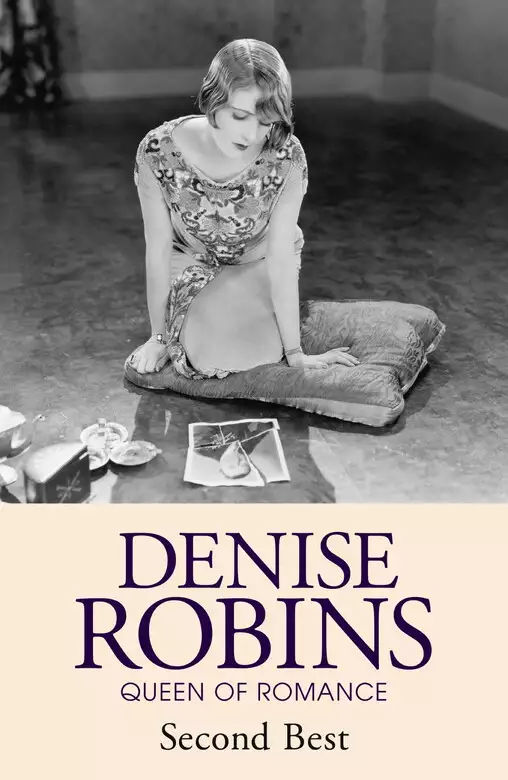
Second Best
- eBook
- Paperback
- Hardcover
- Book info
- Sample
- Media
- Author updates
- Lists
Synopsis
When Barry Elderton comes back from Ceylon to marry Virginia Brame, it is to find her the wife of the wealthy Sir Ian Kingleigh. So Barry turns to Virginia's cousin Joan for consolation. But she, loving Barry as much as he loved Virginia, knows that for him she is only 'second best'. Can she ever be first in his affections? A captivating love story from the 100-million-copy bestselling Queen of Romance, first published in 1931, and available now for the first time in eBook.
Release date: August 14, 2014
Publisher: Hodder & Stoughton
Print pages: 192
* BingeBooks earns revenue from qualifying purchases as an Amazon Associate as well as from other retail partners.
Reader buzz
 Please log in to recommend or discuss...
Author updates
Second Best
Denise Robins
This was a very fashionable wedding. There had been paragraphs in the leading papers for the last fortnight about the bride and her future husband. She was one of the most popular figures in young Society at the moment. Virginia Brame, only daughter of the late Sir William Brame of Wanderton Towers, Bucks, and of Lady Brame of 10, Greyes Street, Belgrave Square. She was marrying Sir Ian Kingleigh, Bart., also a popular figure in Society because he had a great deal of money and although he was not very young he was still handsome and had retired from the Diplomatic Service with a distinguished record.
The mass of humanity lined up outside the church craned their necks and stared expectantly at the church door. It was not too warm this morning. A real April day. Fitful sunshine, showers of rain, and a cool wind. But the weather behaved well and staged the affair charmingly. Just as the bridal pair appeared in the open, the sun broke through the clouds and poured what would seem a benediction upon them. Women in the crowd cheered hysterically.
The Press fought for precedence. Cameras clicked as the bride came down the steps and walked with light footsteps under the awning towards the big Rolls limousine which had pulled up at the entrance. One hand rested on the arm of the man who had been made her husband a few minutes ago; the other held a beautiful bouquet of Spanish irises—palest yellow with delicate fronds of green trailing fern. She was a golden bride. Gold lamé dress shimmering to the tips of golden shoes. Gold train held by a little golden page-boy. Golden, gauzy veil through which one could see smooth dark waves of hair. A cluster of orange-blossom over both ears. Virginia Brame, now Lady Kingleigh, was more than ordinarily beautiful. Hers was a face which had been photographed and published in Society papers continually since she “came out”. An oval, “madonna” face, large chestnut-brown eyes fringed with thick, black lashes, and a creamy skin. Virginia was always pale. Even now, in the midst of all this excitement, she was without colour save for her mouth, which was, as always, touched with lipstick of a bright, pillar-box red. The curved lips, so vivid a hue in the pale face, trembled very slightly as she reached the car.
Sir Ian Kingleigh took Virginia’s hand and squeezed it hard. His silk hat was set a little rakishly to one side of an iron-grey head. He was much more nervous than his bride, in spite of his six foot two and squared shoulders.
“Hurry up into the car, darling. Let’s try and miss the damned confetti.”
But they didn’t miss it. A shower from both sides deluged the bride and bridegroom. “Good luck, dear!” shouted an old woman in a shawl, and sprinkled Virginia with rice.
The faintest colour came into her cheeks now. She looked a little disdainful. She stepped into the Rolls, shaking the confetti from her veil. Her husband took his place beside her. The door slammed after them. The big car moved almost noiselessly away from the church. The sun, having done its duty, retired behind a bank of cloud and the morning was sad and cold and grey again.
Ian Kingleigh, who had been much more interested in his career as a diplomat than in women, until he reached the age of forty-five and met Virginia Brame, looked at the exquisite figure beside him with something approaching awe in his eyes. He had never thought to marry. Incidentally, he had always felt some contempt for middle-aged men who marry very young women. But who knows what one is going to do until one is faced with this problem or that? When Ian Kingleigh fell in love with Virginia, he fell badly. It did not seem to matter in the least that she was nearly twenty years younger than himself.
The only thing that did matter was making her care for him and having her for his wife. This morning saw the achievement of ambition. Fulfilment of the most ardent longing he had ever experienced. Virginia had married him. She was his wife. His, until death parted them.
“Well, my dearest …” he said. “I’m glad that’s over.”
Virginia smiled at him. Hers was a very slow, seductive kind of smile which parted her lips and narrowed her brown eyes until they were laughing slits. The sort of smile calculated to go to any man’s head. Kingleigh crushed her fingers in a grip that hurt.
“Virginia,” he said. “My dear, I love you very much. I’ll do everything that I can to make you happy.”
“I know you will, Ian,” she said.
She touched his cheek with two white fingers which had nails like glittering rubies. He kissed the palm of that hand which was redolent of the scent which she used and with which he was now so delightfully familiar.
“Frightful effort, a wedding—isn’t it?” he said, and laughed in a shy way—the typical Englishman, embarrassed by intense emotion.
Virginia looked through the windows of the car at the moody April sky. They were nearing Belgrave Square and the little Georgian house wherein she had lived for the last ten years alone with her mother. A house never empty of friends and acquaintances. She and her mother were noted for their hospitality. They had always entertained freely, gone everywhere, and “done” everything.
But the girl who was now Lady Kingleigh stared out of the window of her husband’s Rolls and thought, not of the charming house or her popularity amongst her friends, but of the bills—the horrible pile of bills which had been accumulating rapidly day after day for the last few months—a sea of debts in which she and her mother had been swimming. Both of them by nature extravagant, heading for the rocks of bankruptcy and unable to fight against the tide. Sir William, with his restraining influence as husband and father, was dead. Unfortunately, he had not tied up what money he left. Now most of it was gone. The house in Greyes Street was heavily mortgaged; cash had been borrowed and raised and scraped up from all sources. The ocean of debts had swelled to an alarming size. A crash had been in sight. Financial and social ruin stared mother and daughter in the face.
And then—Ian Kingleigh fell in love with Virginia. Marriage to Ian meant not only a title; a lovely country house in Sussex; a villa in Rome and a flat in Town; but the money necessary to keep up such acquisitions.
A month ago, when Virginia’s engagement to Sir Ian was publicly announced, the stormy sea of debts remained, but had calmed down considerably. Lady Brame and her daughter found themselves able to sail gracefully into harbour. Creditors were content to wait. They knew bills would be settled once Miss Brame became Lady Kingleigh. The relief on both sides was considerable.
Now there was no need to worry. The golden bride in the Rolls Royce possessed a distinguished husband and an income of £10,000 a year which was her marriage settlement. Generous, but not too much for Virginia, who could spend money like water.
What a good thing that Ian had come along just at the crucial moment. And how lucky that he was such a dear; she might have been a victim to an old, horrible man. Ian wasn’t young, yet fifty-five was not old and he was still good looking. A little stodgy, perhaps a little boring. But she liked him. Respected him. He would be heart-broken if he thought she had married him to save the financial situation. But why need he ever know? And she was giving him something in return. Herself. Her lovely, carefully tended body; her wit; her charm. She had all three. He couldn’t complain.
“My wife. D’you love me?” said Kingleigh huskily, against her ear.
“Of course,” said Virginia.
And then she shivered a little.
“You’re cold, my darling,” he said. “Your lovely dress isn’t very warm. Put on your coat.”
She shivered, not with cold, but with nerves. Her nerves were in an awful state. She knew it. She hadn’t been eating or sleeping well. The last three weeks had been a hectic rush—over to Paris and back—from shop to shop—from modiste to milliner. Buying her trousseau. All in such a hurry because Ian was so much in love. He hated long engagements and wanted an immediate marriage. Her mother had encouraged it—terrified of finding herself flung once more on to that harassing, ghastly sea of liabilities which she could not meet.
“I’m tired out,” Virginia told herself. “I shall feel better now. We shall be on our way to Italy tomorrow. I can forget all the worry.”
But there was one thing which she could not forget—she knew it was futile to delude herself. She saw herself sitting in front of the fire in her bedroom last night, tearing up old photographs and letters. There had been one photograph and one bundle of letters which she had been slow to destroy. She had felt that it meant the destruction of something fine and real and decent in herself. She was a particularly cool, level-headed girl, who despised emotions and trod on her own ruthlessly. She rarely shed a tear over anything or anybody. But last night she had cried. Cried over those letters before she put them in the fire; over that photograph which was the enlarged snapshot of a young man with a gay, charming face, sitting on the steps of a bungalow out East. It was signed: “Yours, Barry.”
The letters had all been signed “Barry,” and one or two special ones just “Your lover.”
He was the only man for whom she had ever really cared. Last summer when he was back on leave from Ceylon he had asked her to become engaged to him. She had said she couldn’t make up her mind. He had no money. At least, from hers and her mother’s point of view, no money. Not enough. But she gave him hope. He was extraordinarily attractive and he roused something in her which no other man had ever roused. Real passion—if not real love. Love of the selfless, sacrificial order, Virginia did not know. She was, perhaps, incapable of it. In her fashion she had loved Barry Elderton.
She sent him back with hope—and for the last twelve months she had written to him often and he had written to her every mail. He was faithful and he had never loved any woman except Virginia. For four years he had loved her. She had been eighteen and just out of school when they first met at Wanderton Towers in Buckinghamshire.
He fell in love with the eighteen-year-old Virginia from the hour that they played tennis together as partners on the first day of their meeting. It was a devotion from which he had never swerved during the four years that followed.
Virginia had known all the way along that Barry was the one and only man for her. That knowledge was confirmed every time he came back from the East and she saw him. She met so many men during those four years that he was in Ceylon. Men who fell in love with her. Men whom she could like and admire. But there was never anybody quite like Barry; Barry who was such a vital, enthusiastic young man with an immense amount of energy and personality. Barry, so good to look at with his athletic body, hard and disciplined; his brown eager face. He was tireless and nobody ever got tired of him. He was amusing; a little dry and satirical without being too much of a cynic. And what Virginia had liked most about him was his reserve. He always had that power of reticence which kept his ardours, both bodily and mental, in check. Never on any occasion had Virginia known Barry to let his feelings run away with him. And as she herself, up to a point, was built like that, she appreciated that part of his make-up. He was deeply and steadfastly in love with her, but he did not bore her with his love. He kept it in restraint. It was only once, on the last day of his last holiday, he laid aside the usual gay banter and chaff, and told her that he wanted her to be his wife.
The companionable days at Wanderton were over then. Virginia had grown up considerably, and the lovely, spoiled girl was still lovely and still being spoiled, but up in Town, sharing responsibilities and financial difficulties with her mother. Barry knew about them. He had worried over her. He could not marry her until he had a better position. He was hoping to become manager of the tea estate up in Nurwaraylia at the end of the year. He asked her to join him in Ceylon as his wife when that position was secured.
Virginia had wanted to marry Barry. He could have held her affections always, and she knew it. But the question of money remained an insoluble difficulty. She was not born to be the wife of a struggling tea-planter, and she knew it. He must have known it in his heart. But he was in love and he wanted her, so he had tried not to think too much about the money. He was not altogether without prospects. It was an accepted fact that Barry would inherit his uncle’s money, and that, by now, was no mean sum.
Virginia knew perfectly well, however, that it is a poor game to wait for a dead man’s shoes. John Elderton was sixty-four, but a perfectly healthy old man. It might be another ten years before Barry came into the money. She had hesitated to give him a definite answer. And he had said:
“You’re still very young, sweetheart, so don’t worry about an engagement if you’d rather not, until I come home again.”
He had taken her in his arms as a lover for the first time. When she surrendered to his kiss she had almost let her emotions run away with her and told him to take her then and there, and marry her. His lips and arms had been extraordinarily thrilling and satisfying to her. But the practical side of her nature won in the end and she sent him back to Ceylon without a definite promise. But Barry took it firmly for granted that she did care for him and that they would fix things up when he came back from Nurwaraylia as manager of the Jungwood Estate.
All these things, these memories of Barry, came back to Virginia vividly as she sat in the Rolls beside the man she had married this April morning. Came to torment and reproach her. She had been a coward. She knew it. She had been afraid of poverty—not only for herself, but for her fond and foolish mother, whom she sincerely loved. She had taken the easiest way out and “married money”. But there was a horrible little ache in her heart for Barry. She would never see him again. Would she be able to bear it? She had been so treacherous to all those lovely hours and days they had spent together. And so much of a coward, indeed, that she had even shirked writing the plain truth to him. Somebody else—anybody else—must tell him that she had married Ian Kingleigh. She couldn’t, or rather, wouldn’t. She avoided the painful things in life. It would be so painful to write and tell Barry that after his four years of adoring her and hoping to marry her she had failed him and gone beyond his reach. It would hurt her. She didn’t wish to be hurt any more than was necessary. So, when she had started the affair with Ian and let it develop, she had just stopped writing to Barry. That was all. She received several letters from him telling her that she was a lazy little brute not to write to him; chaffing her, scolding her. But never once had he seemed to doubt that things were all right. He was confident of her. Such confidence, such loyalty on his part, frightened Virginia. Heaped coals of fire on her head. She allowed Ian to hustle her into an immediate marriage because she was half afraid of throwing away the big chance he was offering, and of cabling to Barry to come home and take her back to Ceylon.
There had come one letter from Barry—a month ago—less confident—a little anxious. But she had left it unanswered, like the rest. And after that, silence. No more letters from Ceylon. She wondered if the news had leaked out and if he had just dropped her like a stone. It made her miserable. She had behaved badly. She ought never to have given Barry so much-encouragement. But she had been so fond of him, in her fashion. And if it hadn’t been for the money—she would have married him.
She didn’t like the idea of losing him altogether. They had been friends so long. There had been quite unforgettable moments during his last leave. She would miss him sorely. His devotion. His friendship. His gay, amusing personality.
What a horrible thing money was. The need of it. The lack of it!
Virginia stared out of the window of the Rolls a little blindly. She saw, not the Georgian house in Greyes Street outside which a crowd waited to see the bride, but the brown laughing face of Barry. And she supposed when, if ever, she saw him again—he would not smile at her. He would have nothing but contempt for her. Unless his love carried him even through his disappointment. Unless he understood how difficult things had been for her.
“I’d better stop thinking about Barry,” she told herself. “It’s Ian I ought to be thinking about.”
“Here we are, darling,” said the grave voice of the man at her side.
With a feeling almost of pride, Virginia pulled herself together and spoke to her husband.
“I could do with a cocktail, couldn’t you, Ian?”
She spoke flippantly. She felt the need to be flippant—to drown that feeling of panic in her heart.
He helped her out of the car. She was glad a sudden gust of wind blew the golden veil across her eyes, because they were full of tears.
WHILE the bride changed into her travelling dress, the guests poured to and from the drawing-room and dining-room. Everybody seemed to be holding a glass of champagne and a foie-gras sandwich or a piece of the immense glittering wedding cake which Virginia had cut just before she vanished. Everybody seemed to be screaming in order to make their voices heard.
Sir Ian stood in the centre of a circle of admiring bridesmaids—tall, willowy golden girls with big picture hats and bouquets of yellow Spanish irises. Lady Brame fluttered from one group of guests to another, performing her duties as hostess in her inimitable fashion. A petite woman, Millicent Brame, with a carefully preserved figure and face; pink cheeks and snow-white hair which gave her a fragile, porcelain appearance, and eyes that were still fine—that same warm chestnut-brown which she had bequeathed to Virginia.
She was always a gay, chatty, vivacious little woman. Nobody—not even Millicent Brame’s intimate friends—ever knew the weigh. . .
We hope you are enjoying the book so far. To continue reading...
