“Buckle up, readers! Ashton Lattimore’s gripping Prohibition-era tale of two lady rumrunners who risk everything to rescue their families and their futures is a twisting, turning, thrill ride of a book.”—Marie Bostwick, New York Times bestselling author of The Book Club for Troublesome Women
“A beautifully written, quintessential tale of family secrets, set against the backdrop of prohibition and the rich history of a Black community on Martha’s Vineyard.”—Crystal Smith Paul, author of Did You Hear About Kitty Karr?
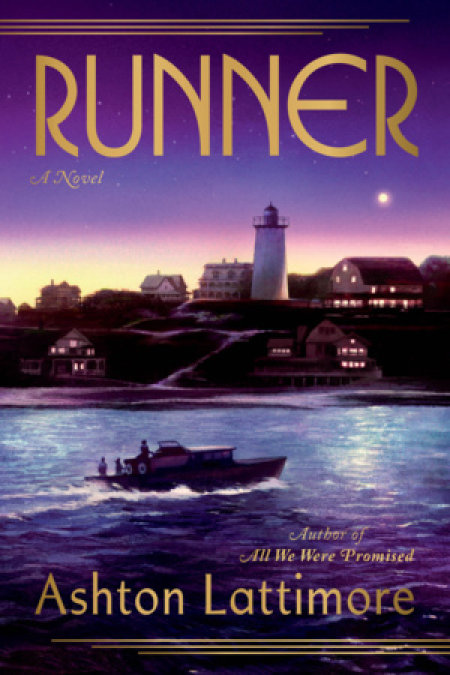
Martha’s Vineyard, 1923. The sea was the gift that kept on giving to Lena Jameson’s father, Earl, a fisherman turned successful rumrunner who built up a small fortune smuggling liquor from offshore ships to thirsty customers back on the island. But when Earl and his entire crew are lost in a mysterious shipwreck that some whisper was no accident, his loved ones are left reeling and penniless—and Lena, who’d been on the cusp of a college career in Boston, sees her future slipping away.
Desperate to save her family as well as her own hopes of escaping their small town, Lena decides to take over Earl’s rum-running business. For a crew, she ropes in Walter, her roguish big brother who leans too hard on the bottle; Sam, her steadfast local boyfriend who wants to keep her tethered to shore; and Dee, a glamorous young woman from Boston who is summering in the Vineyard and offers Lena a glimpse of the future that she still wants for herself—and who’s keeping her own explosive secret.
The foursome embarks on a journey from the quaint, colorful streets of Oak Bluffs through gangland Boston to the jazz-filled clubs of Harlem during its Renaissance, all in search of quick money—and the truth about the shipwreck. But as buried secrets rise to the surface and the temptations of the glittering underworld pull Lena in deeper, everything she’s fought to protect soon hangs in the balance: her heart, her family, and her place in a world that’s quick to condemn women who dare to want more.
Release date:
July 28, 2026
Publisher:
Ballantine Books
Print pages:
384
* BingeBooks earns revenue from qualifying purchases as an Amazon Associate as well as from other retail partners.
The house had space enough to hide things. Whether that was the cottage’s finest quality or its most scandalous flaw was a question for another season. But with the late spring sunlight peeking into every crevice, lighting up the shadowy corners, Lena Jameson had only one question: Where had her father hidden the hooch?
Earl should’ve been back from his rum run before dawn, but the parlor’s grandfather clock had just chimed out half past eleven and he was nowhere to be found. His lateness thwarted Lena’s carefully laid scheme to meet him at the door with a plateful of fresh-baked cinnamon buns to bait the hook for all her asks and aspirations. And with the day slipping away, she had places to be. So in Earl’s absence, she decided to settle for his liquor.
Every few weeks, all over the house, in the strangest of places, Lena would find bottles: a jug of Caribbean rum in the linen closet at the bottom of a basket of towels, some port wine under the floorboards in an upstairs bedroom, or a slim case of conveniently sized vodka flasks slid behind the wicker couch on the front porch. Her father’s stash was as far flung as it was lightly concealed, and the hiding spots moved, but only for Lena’s amusement. Earl didn’t mean to keep the liquor from her, now she was grown—he was just playing an old game. When she was young, it had been seashells with intricate grooves and ancient-looking insides, or bite-size pieces of vanilla saltwater taffy stashed around the house, always with the promise that Lena could keep whatever she found. Now, his bootlegging operation was the worst-kept secret in Oak Bluffs, and though he never involved Lena in the business, he didn’t begrudge her a drink—she was twenty-three years old, after all. She knew the ill-gotten liquor was around, the thrill was in discovering it—small thrill though it was. It was the most she could hope for in the sweet, stifling beach town she called home.
But the summer of 1923 would be Lena’s last in Oak Bluffs, so help her, or she’d lose her mind. There, her every spare moment was spoken for, and between frying up fish and seasoned potatoes at her family’s nearly deserted restaurant and helping her mother keep house and look after all the siblings, she’d had more than her fill of days tending to everyone else’s needs. On that breezy, clear morning in late May, the key to her escape was tucked into the pocket of her loose-fitting peach-toned day dress, but it’d do her no good until she got her hands on the means to use it.
As she crept through the rooms of the lavender-shingled Highlands Victorian her family had moved into last year, peering behind every couch and chair, rifling through each cabinet in search of drinks worthy of a sunset beach party, Lena shook her head—the house really was too big. With three floors, seven bedrooms, and a wraparound porch, it was an airy behemoth boasting much more space than the family could ever use, and there’d been no good reason for the move beyond puffing up her father’s considerable pride in being able to buy the place. Scanning the living room, Lena’s eye landed on the bench in front of the polished mahogany baby grand piano the twins used for their lessons. She rushed over and pulled the bench toward her, and as it scraped across the floor, she heard something heavy roll inside, and then a telltale clink—thick-blown glass hitting glass, with liquid goodness sloshing around inside. She opened the bench, shoved aside the sheet music, and grinned as she uncovered two pristine bottles of single-malt whiskey. Not a second later, she heard her mother huff.
“A little early for that, isn’t it?” Sarah Jameson stood in the doorway looking prim, her graying black hair pulled up and away from her deep brown face and piled loosely onto a bouffant. Lena sat back on her heels. Anytime her father was out of earshot, her mother would start in grumbling. Bad enough everyone knew Earl had swept them into this colossal new house on the tide of his bootlegging profits, she’d say. Did he have to leave contraband everywhere as a constant reminder on top of it? As Lena lifted the bottles out of the bench, Sarah frowned.
“Your father oughta be ashamed of himself, letting you dip into all this nonsense. And for what?” she asked. “Maybe a dry party would do you all some good—Prohibition’s not going anywhere, you know, so you might as well go on and get used to it.”
She wasn’t wrong. Three years into Prohibition, people had sized up the constraints of the new world, and had made their adjustments. Some, like Sarah, gave up liquor just as the good Lord, the 18th Amendment, and Mr. Andrew Volstead intended. For the less virtuous, like Lena, there were workarounds—hidden flasks of hooch from years past, bootleg bottles rolling in along the shore, or freshly distilled liquor from the folks who took the new laws as a chance to get creative. And then there were men like Earl. Men who heard “crime” but saw only cash, and had the gumption to change their ships’ courses; fisherman or bootlegger, the goods all came from the same sea.
“No need to get used to anything, Mama—I’ve got what I need,” Lena said. “Besides, you always say it’s not mannerly to show up to a party empty-handed.”
Sarah sucked her teeth, but a small smile played at the corners of her mouth. “Ha! I wish you took half as much heed to everything else I tell you,” she said. “Why don’t you cook something instead, put in a little effort for the guests?”
“Since you mention it, I’m headed to the Clam Shack right now to whip something up,” Lena said. “See? I take a little from Daddy, and a little from you.”
Sarah smiled and nodded her head, seemingly satisfied. “What’s the excuse for a party this time?”
It’d be a going-away party, if Lena got her way. In her pocket, a slim envelope from Boston University held a letter of acceptance, and all her hopes with it. She’d hardly expected to get in, especially as old as she was. But by some miracle she’d made the cut. More than that, the family finally had enough money to send her, and with the twins getting older, she wouldn’t be needed so much at home. The timing was ideal, and—to Lena’s mind—overdue.
Three years into a decade that seemed to promise nothing but novelty, so far Lena had missed the boat. Change had bubbled up all over the country after the war, and everyone else in her family had snatched some of the newness for themselves: a profitable—and prohibited—new gig for Earl and her big brother, Walter, and a grand new house to please Mama and delight Nettie and Louis, her decade-younger matched set of twin siblings. Lena should’ve had the world at her feet—the 19th Amendment claimed a young woman like her could be anything she wanted, or at least choose the governing men who’d tell her what she could be. But in her hometown, she walked a thin line between being sheltered and being burdened—the same family that covered and protected her bore down heavy on her freedom, and even the love of a good man sometimes felt like just another link in the chain holding her at bay. She’d missed her chance to get off this island once before, and she refused to let it pass her by again. Instead of haunting the same seven square miles as every laundress, fisherman, domestic, carpenter, hotel bellhop, and cook she’d known all her life, come autumn, she’d find new streets to walk, new things to learn, new men to eye, and new girlfriends to take on the world alongside her. At least that was how she planned to lay it all out to Sarah, once she’d recruited her father to her cause. For now, Lena grabbed for an easy cover.
“Just celebrating the last quiet before the summer rush starts on Memorial Day,” she answered. “Might as well enjoy the island while it’s still ours.” By the next week, there’d be a sea of extra folks crowding the ice cream shops down on Circuit Avenue and staking out spots on the beaches; some were new, and others familiar, but every one of them seasonal, coming down from Boston or up from New York.
What must it be like for them, living in an actual city all the time? Instead of a dollhouse destination like Oak Bluffs that roused to life only when people showed up to play from June to August, then fell silent and still through the dull off-seasons. “Maybe come summer’s end, one of the vacationers will pack me up in their suitcase and carry me off to the real world,” said Lena under her breath as she strode out of the living room.
“There’s plenty of ‘real’ right here, Lena Pearl—don’t you be in such a hurry to borrow trouble,” said Sarah. Her family ties on the island stretched back more than two hundred years, and she’d never had much use for the world beyond its shores. But Lena didn’t share her mother’s sense of settled peace. She kissed Sarah on the cheek and breezed out the front door, contraband in hand.
We hope you are enjoying the book so far. To continue reading...

 Please log in to recommend or discuss...
