
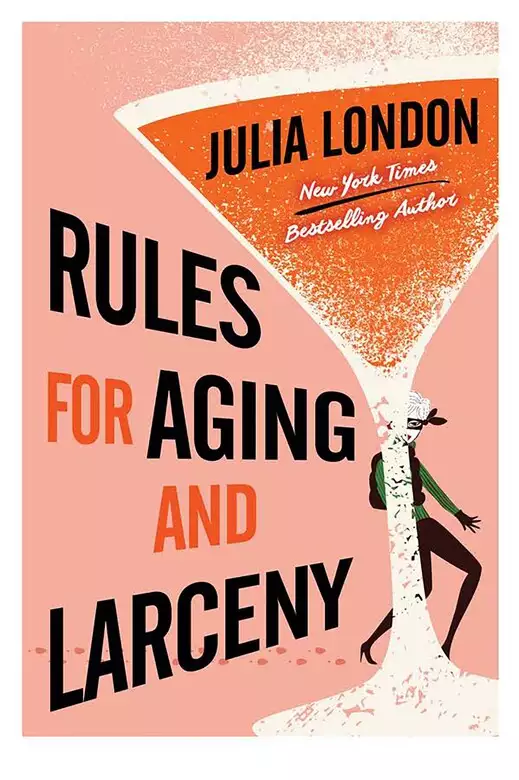
Rules for Aging and Larceny
- eBook
- Paperback
- Audiobook
- Book info
- Sample
- Media
- Author updates
- Lists
Synopsis
Ocean's Eleven meets the Golden Girls when an all-female group of chaotic, elderly thieves come out of retirement for one last heist against a young Crypto-loving DudeBro-type... while trying to repair their fractured friendship along the way.
For fans of Deanna Raybourn's Killers of a Certain Age and Mad Mabel by Sally Hepworth.
Frances Deluca has always been a force of nature. Active and agile into her 70s, she can handle anything—except perhaps the stretch of empty days looming ahead. Widowed, with a grown son living far away and her own mortality suddenly in view, Frances longs to feel busy again. What she really wants is the familiar rush of a well-crafted plan coming together. It’s been a while, decades in fact—since Frances and her friends pulled off a heist . . .
Frances, Joan, Edie, and Irene were a girl gang before such things even existed, joining forces in their 20s for a one-time job that revealed a remarkable affinity for crime. They developed a code of honor, taking only from those who deserved it—until misunderstandings and pride drove them apart.
Now, one by one, Frances manages to convince her old friends to put aside their grudges and reunite. And where better for a reunion tour than Las Vegas? Their target: Rocco Vitali, a mobster’s grandson who’s developed a high-tech shakedown. Rocco is a Crypto-loving scam artist, and Edie’s beloved granddaughter just lost everything to him, including her self-respect. But the women intend to take it all back—with interest.
Risks will be taken. Fractured relationships will be mended. And four badass seniors will discover how formidable a whole lot of experience can be . . .
Release date: June 30, 2026
Publisher: Kensington Books
Print pages: 352
* BingeBooks earns revenue from qualifying purchases as an Amazon Associate as well as from other retail partners.
Reader buzz
 Please log in to recommend or discuss...
Author updates
Rules for Aging and Larceny
Julia London
When she’d picked up pickleball this year, she’d fallen in love with it. She’d played a lot of tennis in her youth and considered herself a natural. She was at the club every afternoon to play as much as she was allowed and then to relive her matches in the bar with whomever would listen. Which turned out to be hardly anyone. And she couldn’t really count the bartender, because, as he reminded her, he was a captive audience.
But the day Sue Landis, the club director, walked into the bar wearing her polka-dot tennis dress, new sneakers, and a jaunty scarf around her neck, Frances knew there was trouble. She’d heard rumblings that some members were dissatisfied with her style of play.
Frances swiveled around on her stool and planted her elbows on the bar behind her as Sue approached. “Did Teresa Clark send you? She really hates losing.”
“Isn’t that ironic, coming from you,” Sue said, eyes narrowed accusingly. She gripped her ever-present clipboard to her chest. “I warned you, Fran. You’re too aggressive on the court.”
“You mean I win too much.” She’d beaten Sue quite handily only that morning. She liked to move her opponents around and make them sweat. Given her opponents’ advanced years, that appeared to be a sore spot for a lot of them. Particularly New Boobs Sue—she considered time on court to be more social than active and always showed up with a full face of makeup, her hair done, earrings dangling, bracelet charming, and designer togs that showcased her recently repositioned rack. Loser.
“It’s not just that you always win, Fran. It’s that you’re so cutthroat about it. We’ve had complaints that you hit too hard. You struck Rob Martinez in his hernia!”
“How was I supposed to know he had a hernia? And anyway, it’s basically a plastic wiffle ball,” Frances complained. Although she had put a little English on the shot into Rob’s groin. “Maybe if Rob allowed Inez to play and stopped covering her half of the court, he could have saved himself. If you think about it, he dove in front of my shot, so he’s at least as much to blame.”
Sue tilted her coiffed head to one side. “Seriously?”
Frances threw up her hands in defeat. “What can I say? I’m competitive. And correct me if I’m wrong, but there was a time in this country when the competitive spirit was how things got done.”
“Frances? It’s not tennis. It’s not a sport. It’s just a game. Our decision is final—you’ve been put on suspension for the championships.”
Frances had huffed and she’d puffed, but privately, she was not surprised. It wasn’t the first time she’d been kicked out of a club. She stood to go. “Thank you. I had a lovely time dominating the Pecan Springs Pickleball Club like a boss.”
“Have you thought about golf?” Sue suggested as Frances picked up her purse and sashayed for the door. “Since you like hitting the ball so hard.”
“I like everything hard, Sue!” Frances called over her shoulder.
She was too athletic to play in a baby league anyway. She’d learned the importance of tip-top physical fitness in her twenties, and she’d been a badass then. She’d kept up with her training all these years, because one never knew when one might fall, and one didn’t want to break a hip. But she’d never thought to join a club—that had been her friend Marjorie’s idea.
After her beloved husband Nick died three years ago, Frances realized that she’d been so busy for so long that she’d never had to look for things to do. She didn’t know how to look for things to do. She’d had a career, she’d been a wife and mother, and then a caretaker to her terminally ill husband. For well into her late sixties, she’d watched Nick waste away, his body so gaunt that in the end she could hardly recognize her once robust husband. As heartbreakingly difficult as it was, she hadn’t minded any of it. She’d been so grateful to be in good health and of pretty good mind so that she could be there for the love of her life. And she was, every moment. In the middle of the night when he couldn’t sleep. In the mornings when he was sick. In the evenings when he was in pain.
But when he was gone, and her son moved farther away, and her old dog died, and her tasks became fewer, and the days began to creep by, Frances realized there wasn’t a whole lot to occupy her. She was not prepared for this stage of her life. This long, empty, boring, tedious stretch of the rest of her life. But she wasn’t ready to give up, either. She felt so … undone.
With too much time on her hands, her imagination tended to run wild. She’d been having a bit of trouble with headaches and dizziness, sleeplessness, and some fatigue. She assumed these were all precursors to something terrible that would take her down. Every time she opened a Google search bar and began to type What would cause headaches and—it practically shouted CANCER at her before she could finish her question.
She did not have cancer. She was fit (just ask New Boobs Sue), she had a good appetite (too good—her favorite jeans were a smidge tight), and too much time on her hands. When she was busy, she didn’t have time to imagine symptoms. The only thing wrong with her was her.
On the phone during their weekly catch-up, Marjorie agreed she was her own worst enemy. She said Frances was fine, healthy as a horse. “You’re dehydrated, Fran. At your age, you need to watch that.” She further explained that Frances was simply approaching this stage of her life all wrong. “You’ve got to stop falling down Google rabbit holes. What you need to do is join a club or find a hobby. Don’t you like knitting?”
“I like running and cocktails, not necessarily in that order, and you know that, Marge. I haven’t knit a single stitch in my life.”
“Everyone eventually retires from running. You should try and knit. You never know, you may love it. And you should come and visit,” Marjorie continued. “What you need is community. Friends your own age. Come see what it’s like in senior living.”
Marjorie was seventy-eight, four years older than Frances. They’d been the best of friends since Fran and Nick had moved next door to Marjorie and Paul a million years ago. Paul was an oil executive, and Marjorie was an entertainer. There were parties and brunches and charity galas, all hosted by the inimitable Marjorie Cohen. When Paul died last year, she moved to the Silver Oak Towers (worry-free luxury resort retirement living!) with a speed that defied explanation. Paul died on a Thursday, was buried on a Monday, and Marjorie was packing up their beautiful old home the following Friday.
Marjorie had always given sound advice, even when Frances didn’t want it. So, she joined the pickleball club. When she reported being unceremoniously dumped from said club, Marjorie said, “I was afraid of that. You can be an ass sometimes.”
“I beg your pardon.”
“I guess you don’t remember upsetting everyone with your talk of smackdowns in the neighborhood bunco group,” Marjorie said. “All right, so clubs aren’t your thing,” she blithely continued. “How about travel? Go travel. You’ll meet people and make friends.”
Frances did like to travel, so she signed up for a tour to Machu Picchu. The tour group was made up of twenty-five people, mostly senior couples, one large family, and her, the solo grandma. She tried to make friends, and while everyone was perfectly polite to her, no one invited her into their circle. She was glaringly cliqueless. But she was a beast on the hike up, passing most in her tour group with a hearty “You’ve got this!” and “Age is just a number!” She reached the top of Machu Picchu with her fists raised overhead, victorious.
And no one she cared about was there to see it.
She asked someone from the tour group to take her photo. When she returned home, she slapped it onto the fridge with a magnet, next to a picture of her son, Aaron, and his family. A few days later, she took her photo down. She didn’t like the reminder that she was alone.
“It’s hard to make friends, Frances,” Marjorie informed her when Frances reported in. “That’s why people our age move into senior living. Come and visit. Just don’t, you know, challenge anyone to a duel or anything.”
Frances considered herself far too young to need senior living, but then again, maybe she could use some of that community. “Honestly, Marge. I’m not going to challenge anyone, especially not to something as old school as a duel,” Frances sniffed. “But okay, I’ll come visit.”
The first thing she’d noticed upon entering the luxury retirement resort was the blast of square dance music into the foyer. She turned right, as Marjorie had instructed, and passed a large gymlike room. Inside, residents were dressed in square dance clothing, the women with colorful skirts and petticoats that could only be described as hideous, the men in jeans and bolo ties. On stage, a man held on to his walker with one hand and the mic with his other, calling out the squares.
“Well, hello there!” chirped a voice behind her.
Frances turned to see a young woman with bouncy blond hair dressed in a sparkly pink dance skirt. Her name tag announced she was GLORIA. “Visiting someone?”
One might have thought that was the point of the visitor tag affixed to Frances’s shirt. “My friend.”
“Wonderful! We highly encourage social interactions for our residents. Studies show it’s vital to senior mental health and may help ward off dementia. Is your friend dancing today?”
Frances almost gasped with alarm. If Marjorie had set her up, she would strangle her. The last time she’d do-si-doed was in the fifth grade. Her partner, Bobby Brick, refused to touch her hand. It was amazingly difficult to square-dance without touching hands. “I’m sure not. She would have mentioned it.”
“I’m surprised she’s not! It’s one of our most popular activities.”
Well, that was sobering. Frances looked around for the elevator.
“Who is your friend?”
“Marjorie Cohen.”
“Oh, Marge! She’s one of our favorites around here. You can get a five percent rental discount for the first year with a referral from a current resident. You look like you’d fit right in! If you’d like to stop by and see what else we have to offer, my office is right there, next to the koi pond. We have one of the best catalogs of activities for a facility of this size.”
Forget the activities, Frances looked like she “fit right in” exactly how? she would like to know. And then again, she would not like to know.
“It’s just there,” Gloria said, pointing to her office.
“Yes, I see,” Frances said. “Could you point me to the elevator, please?”
Gloria swung around so fast that her square dance skirt helicoptered into Frances’s leg. “Right past the barber shop. We have a full range of spa services, too. I can show you.”
“Thanks,” Frances said, and headed for the elevator before Gloria could shove a rental agreement at her.
Marjorie’s apartment was easy enough to find, as the resident names were printed in big block letters on the wall outside their door. She had a pleasant little single-bedroom apartment with a view of a parking garage. She’d decorated her rooms in suburban kitsch—lots of LIVE LAUGH LOVE–type signs around. She said the living here was great and offered Frances a martini.
“It’s only two o’clock,” Frances pointed out.
“And? Happy hour is at three-thirty, dinner at five. We’re pregaming, that’s all. You would love it here, Fran. There are so many things to do! Bingo and a bridge club and a singles dance every Friday night. But you won’t be single here for long, Franny girl,” she said, wagging her eyebrows.
Frances inwardly shuddered. She was not a bingo person, and she most definitely was not into the singles scene. Until this moment, she didn’t know that a singles scene existed in her age range.
“I’m so glad you’ve come to visit,” Marjorie said as she cut a slice of the coffee cake she’d made fresh this morning to go with the two olive martinis she’d whipped up. “I have news. Look at this.” She waved her fingers in Frances’s face.
Frances reached into her bag for her glasses, put them on, and leaned forward. “It’s a ring.” A plain, thin gold band.
“Not just any ring. A forever ring.”
“What’s that?”
Marjorie stopped waving her fingers in Frances’s face. “Essentially, a promise ring.”
“A promise ring? Like when we were kids?”
“Yep. Dan Stefano lives across the hall, and we’ve been dating.”
Frances didn’t know why she should be so surprised, but she’d built her life around Nick Deluca and their son, and the thought of casually dating after his death had never entered her mind. No one could top Nick. And Paul had only been dead a year. “You’re … How?”
Marjorie giggled like a girl. “Well, he was dating Ellen Hurkle when I first moved in, but her Alzheimer’s got bad, so her kids sent her off to memory care. I would go around to see her in the afternoons, and he was usually there, and we sort of hit it off.”
Putting aside that Marjorie and Dan had allowed something to develop while poor Ellen Hurkle lost her mind, what was Marjorie doing? “You’re getting married?” Frances exclaimed.
“No! But we’re going to be together forever. Marriage is too complicated at this age. You know, the kids have opinions, and they worry he’s after my money.”
“Is he?”
“Of course not.” Marjorie airily waved her hand. “Never mind that. We don’t need to get married, that’s the point, but we are promised to each other forever. Cheers.”
Frances did not lift her glass. “You told me you were worried about getting an STD from a toilet seat here. You said senior living was the Hotbed of Herpes.”
“Dan doesn’t have an STD. Not that it’s any of your business.” She thrust her glass forward.
Marjorie was right. Frances realized she didn’t want to know a single thing about Marjorie’s sex life. “Forever, huh?” she asked, and clinked glasses. “So, what are we talking, a year? How old is this guy?”
“Frances! That’s not very nice,” Marjorie scolded her. “But they do tend to drop like flies here. At our lunch table, two have died in the last month. Just like that, one two.” She snapped her fingers. “Anyway, why aren’t you dating? Nick has been gone for three years. You have a lot of life left, girl. And you look great. Nice and thin. I love your silvery bob.”
Frances put a hand to her hair. She was trying something new. New clothes, new hairstyle—searching for the thing that would suddenly make her life interesting. “Nick ruined me for other men. What I need is a fulfilling hobby and I’m not having any luck finding one.”
“Hmm.” Marjorie frowned as she thought about it. “What was your job again?”
Planning big heists. Stealing priceless artifacts and art and money. Deceiving people. More generally, thievery and swindling. Thieves and swindlers didn’t square-dance as a rule. “Accounting,” she said, choosing a profession out of thin air.
“Oh,” Marjorie said, clearly disappointed. “I don’t think I ever knew that, did I? Well, I can’t think of any hobbies that involve accounting.”
Neither could Frances. And after the visit, she couldn’t think of moving into Silver Oak Towers to square-dance and be pressured to date, for God’s sake. She was not like Marjorie; she couldn’t be satisfied with bingo and a new beau.
So, what was next for a world-class thief?
Granted, she hadn’t been a world-class thief in a long while, but she had been once upon a time. She missed that old life. She missed the days when she, Edie, Joan, and Irene were a girl gang before girl gangs were cool. They’d started out in their twenties to avenge a wrong and, as it happened, discovered they were good at vengeance. Frankly, they’d been surprised by just how good. And it was fun. So, they’d carried on, figuring out how to take from men who needed to be taught a lesson. Because they weren’t thieves just for the sake of stealing; they had standards. Most of the time, anyway.
Frances missed the adrenaline, she missed the danger and excitement, she missed the camaraderie, the travel, the attention that came with being young and pretty. She missed the satisfaction of being underestimated because they were women and then blowing the doors to a good heist wide open with their cunning. Even those times they didn’t really know what they were doing. It just went to prove that working together, women can accomplish anything.
She would love to feel that rush again, that joy when the puzzle pieces of a good plan fell into place.
Alas, the gang hadn’t been together in more than forty years, not since Edie had betrayed them all. And now, it felt as if too much time had passed. It wasn’t like she could call them up and suggest they do a heist to see if they still had it. And then make Edie promise not to betray them this time and, moreover, trust her. Even if she could call them together for a last heist, they were as old as she was. They probably had families and full lives and weren’t very limber anymore. Hell, she’d bet Joan was still using a flip phone.
She had to face the fact that the days of thrilling adventure were behind her, and the next best thing had been pickleball. Now that was behind her, too.
Trying to sort out her life on top of a two-martini cake lunch was exhausting. But on the way home from Marjorie’s, Frances had to stop at the grocery store. They were having a sale on plums and prunes, and anyone over the age of seventy knew it was wise to keep high-fiber fruit on hand. This was something else she’d begun to do—wander the grocery store aisles, reading labels. In the middle of the afternoon. It was frightening that, one, she was adopting such a senior citizen habit, and two, the preservatives they put in food these days.
An instrumental version of John Denver’s “Rocky Mountain High” was wafting out of the store’s sound system as she grabbed a cart and went in. She wandered into the produce section, humming along. She remembered this very song was playing the time she and Edie scammed a convenience store clerk by tipping over some water bottle pallets and putting Edie under—
Wait.
An idea burst into Frances’s brain, freezing her so suddenly that a young man behind nearly collided with her, muttering under his breath as he swept around her with his handheld basket. Why hadn’t she thought of this before? She and Edie had scammed the guy behind the counter because he was a prick and because they could. It had been a spur-of-the-moment thing that had netted them a nice little payday in the end. Frances could still do spur-of-the-moment. She was perfectly capable of pulling a scam on her own. Sure, she missed the girls, and it was obviously more fun when you had friends along for the ride. But she was missing more than her friends. She was missing the thrill of the heist like some people missed a drink.
She could stage a fall in this store and sue the bejeezus out of them. (Was her old fix-it lawyer, Sal Bernard, still alive? She’d check for an obituary later.) She raced through the logistics in her mind. It was too easy. So easy she could pull it off alone.
Wait. Was she really going to do this, or was this the martinis talking? She was rusty, and she didn’t have the girls to poke holes in her theory until all four of them were convinced the idea was fail-safe. But who would question an elderly woman falling in a grocery store? No one. Absolutely no one. You practically expected elderly women to fall in grocery stores. And if they did question it, she’d put it on social media, a little old lady done dirty by the big corporate grocery store. Her idea was foolproof.
Just like the good old days, she felt suddenly invigorated. Even a little giddy. She would be breaking the gang’s cardinal rule, because no one was on the receiving end of this lesson. And she recalled how harshly she and Edie had been chastised by Irene and Joan for that very thing when they’d pulled the scam at the convenience store. But Frances could justify this as a practice run and necessary to her mental health.
A practice run? She’d gone from keeping the thief side of her dormant for years to suddenly needing a practice run? For what, more scams? That was crazy! But then … why not? Just the idea was giving her the kick in the pants she’d been needing for months. What else was she going to do? Join another club? Square-dance? Date some old dude with a bottle of Viagra and get an STD?
She was doing this. Watch out, supermarkets. Franny is back in town.
She and her squeaky cart veered to the left, away from the produce and toward the aisles with sodas or vegetable oil or industrial-sized containers of lotion. She had to contain her enthusiasm for her con, making sure to walk slowly and carefully, so that anyone who might be asked later would remember seeing her dodder along.
The baking aisle with the oils was crowded with shoppers, so Frances moved on. She ruled out lotion as the bottles were too small and it would take quite a lot to make a convincing mess. She needed liquid and lots of it. She headed for the drink aisle, turning and wheeling her empty cart to the stock of two- and three-liter bottles of soda.
There was a woman with two small children in the aisle, so Frances dawdled by examining the brands. Glasses. She needed glasses to see what she was doing. She looked in her bag and couldn’t find them. She took several things out and still couldn’t find them. She patted down her pockets. No glasses. What the hell had she done with them? She glanced at the woman with the kids. She was heaving boxes of soda into her cart, but happened to look up at her, and Frances snapped her gaze away so quickly that the glasses she’d been looking for tumbled off the top of her head. “Of course,” she muttered, and bent down to pick them up.
With her glasses on, she picked up a three-liter bottle. Or rather, hoisted it, because it was heavy. It had a twist-off top. With a couple of good shakes, this puppy would spew like Mt. Vesuvius. She glanced over her shoulder; the woman with the kids was turning the corner of the aisle. Frances was alone. Go time.
She shook the bottle, then tried to twist off the cap. It didn’t budge. “You’ve got to be kidding me,” she muttered. She held the bottle under her arm and twisted again. Nothing doing. She’d noticed a bit of arthritis in her fingers, but this was ridiculous. Why was packaging so hard to get into these days? She clamped the bottle between her knees for leverage and twisted with all her might. The damn cap was not coming off, and if she’d been at home, she would have thrown it violently into the pantry to join the pickles, the salsa, and the honey, all in jars with immovable lids.
She ditched that bottle and grabbed another one. She shook it up, put the thing under her arm, grabbed hold of the cap, and twisted hard. This cap came off so easily that the soda exploded. She quickly lay it on its side on the floor and watched as the dark amber liquid spread across the linoleum. She considered how much of her body she needed to have in the spill to make it look authentic—she hated the thought of getting her nice athleisure wear wet and dirty—but the job called for it.
“Help!” she called faintly to no one. She began to position herself for a descent to the floor. “Help!” she said, a little louder.
“Ma’am, are you okay?”
Frances was so startled by the arrival of another person that she jerked around, and when she did, her foot slipped in the spill. She felt herself going down and grabbed on to her empty cart for purchase, but the cart came with her, crashing on top of her as she fell.
Her head whacked against the shelving before all of her hit the floor, shooting blazing rockets of pain through her back and hips, her head and neck. “For fuck’s sake,” she managed to croak before the world turned blurry and faded away.
It was the smell that got to Frances. That sickly, antiseptic scent like someone had spilled a bottle of Lysol. Between that and the torturous headache, she thought she was going to vomit. She opened her eyes and tried to focus so she wouldn’t.
She was in a hospital, goddammit. If there was one thing Frances could not abide, it was hospitals. Not for an appointment, not for a consult, not to visit anyone—and yet, here she was. She’d had to get stitches where her head hit the shelving, and she’d just been brought up from getting a CT scan. She’d tried to convince the emergency room doctor that wasn’t necessary, but no one listened to her. They’d advised her to remain calm and then shouted, “Is there anyone we can call for you?” like they thought she was dumb and deaf.
She was so stupid to have tried that con. She wanted to kick herself, slap her own face. Rule number one of girl gang: Do not go into a con unprepared or alone. If this had been the old days, Irene would have bought big bottles of soda and made them practice opening them and would have timed their efforts. And if this had been the old days, Edie would have clocked her for being so careless, and she would have deserved it.
This was exactly the sort of thing that happened when a person got bored and drank martinis at two in the afternoon.
“Hello, hon, how are you feeling?”
Frances turned her head to the right and winced with the pain that electrocuted her right behind the eyes. A slender young man in purple scrubs, with sparkly blue nail polish that matched his blue hair, was adjusting something on her IV. “Not as shiny as you, that’s for sure. And my head is killing me. And I think I might be sick.”
“I’ll bet. You took a nasty fall. I’m Jorge, your nurse. If you need to vomit, do it in here.” He handed her a blue paper balloon-looking thing.
Her whole body ached. She was almost afraid to move. “Did they find anything broken? A hip? A shoulder?”
“Nope. Your bones are apparently made of concrete. And they didn’t shave as much of your hair as I would have guessed.”
What? Her hand immediately went to the back of her head and the bald patch there, covered by a bandage that seemed to take up most of the real estate on her head. This day was getting worse and worse.
He picked up her wrist and put two fingers to her pulse, his eyes on his watch. “Is there anyone I can call for you besides Marjorie?”
Frances yanked her gaze to him and immediately regretted it, as white-hot spasms of pain shot through her. “You called Marjorie Cohen?”
“No, but Marjorie Cohen called you. I answered.” He let go of her wrist and smiled. “I can’t have you in here all alone.”
“Yes, you can. It was just a dumb fall. Now that I’m awake or alert or whatever, I’ll just get dressed and go. Where are my clothes?”
“Are you going to go before or after you vomit?” he asked. “Your clothes are in the wardrobe, hon. But you can’t go until the doctor discharges you. She’s going to be up to talk to you about your noggin.”
“Franny!” Marjorie suddenly appeared, sailing into Frances’s hospital ro. . .
We hope you are enjoying the book so far. To continue reading...
